Streamline Infrastructure with IaC Management Software Solutions
March 12, 2026|9:13 AM
Unlock Your Digital Potential
Whether it’s IT operations, cloud migration, or AI-driven innovation – let’s explore how we can support your success.
Home /
Work /
Blogs /
Streamline Infrastructure with IaC Management Software Solutions
Navigating the World of IaC Management Software
In today’s rapidly evolving digital landscape, managing complex IT infrastructure efficiently is paramount for businesses of all sizes. The traditional manual approach to provisioning and managing infrastructure is no longer sustainable, leading to inconsistencies, errors, and significant delays. This is where iac management software emerges as a transformative solution, enabling organizations to treat their infrastructure like code.
This comprehensive guide will demystify iac management software, exploring its core principles, benefits, and practical implementation strategies. We will delve into how these powerful tools streamline operations, enhance reliability, and accelerate development cycles, providing a clear pathway for adoption. Understanding and mastering iac management software is crucial for any organization aiming for operational excellence and agility.
Understanding IaC Fundamentals
Before diving into the specifics of iac management software, it is essential to grasp the foundational concepts of Infrastructure as Code (IaC). IaC represents a paradigm shift in how infrastructure is managed, moving from manual processes to automated, script-based definitions. This approach brings software development best practices directly to infrastructure operations.
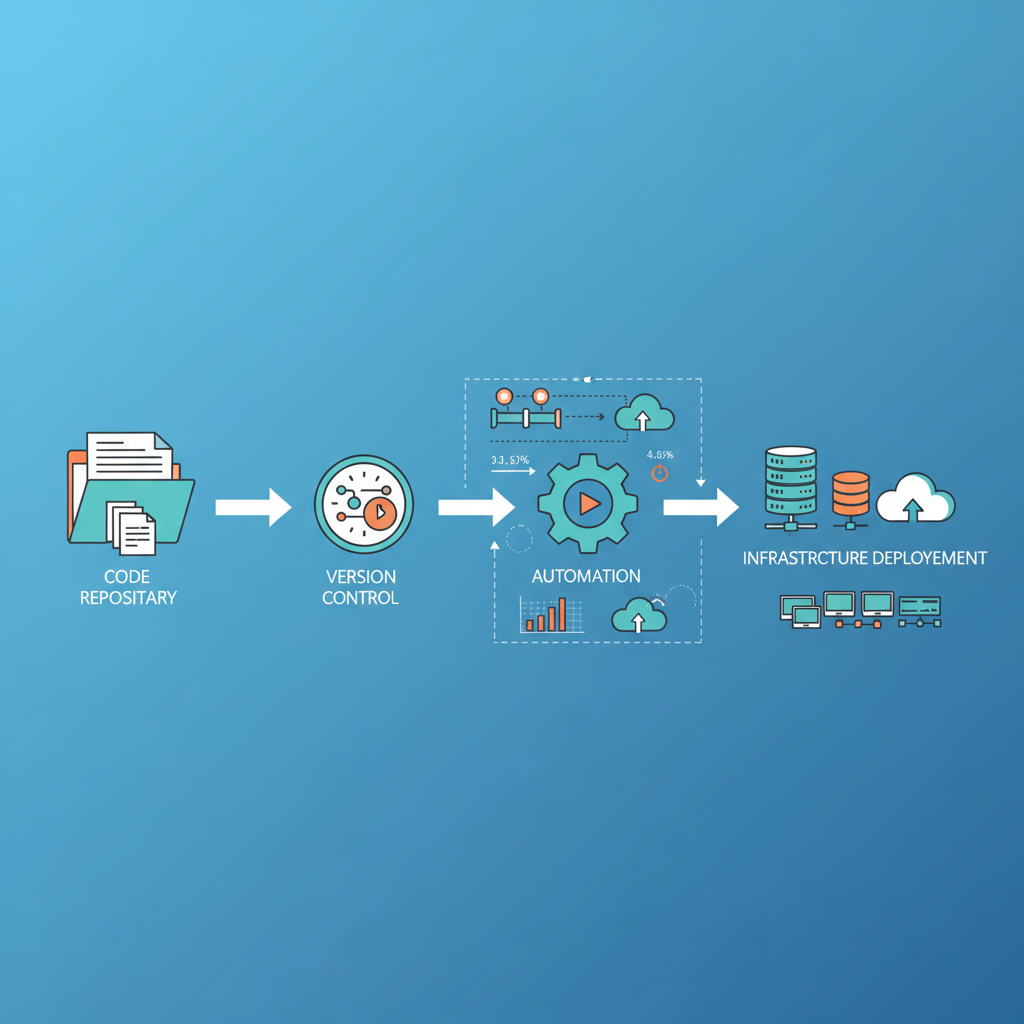
A diagram showing the workflow of Infrastructure as Code, illustrating code repository, version control, automation, and infrastructure deployment.
The core idea is to define and manage infrastructure resources—such as virtual machines, networks, databases, and load balancers—using machine-readable definition files. These files are then used by various IaC automation platforms to provision and configure the desired state automatically. This drastically reduces human error and ensures consistency across environments.
What is Infrastructure as Code?
Infrastructure as Code refers to the process of managing and provisioning computing infrastructure through machine-readable definition files, rather than physical hardware configuration or interactive configuration tools. It treats infrastructure components as software artifacts, allowing them to be versioned, tested, and deployed in an automated manner. This practice is fundamental to modern DevOps methodologies.
This approach leverages declarative infrastructure software, where you define the desired state of your infrastructure, and the IaC tool ensures that state is achieved. Contrast this with imperative approaches, which specify the exact steps to reach a configuration. IaC ensures that environments are identical and reproducible, promoting greater stability and reliability.
Why Use IaC?
Adopting Infrastructure as Code offers a multitude of compelling benefits that directly impact operational efficiency and business agility. It standardizes infrastructure deployments, making them predictable and repeatable. This consistency is vital for maintaining stable development, testing, and production environments.
Firstly, IaC significantly reduces manual effort and the potential for human error. Automation handles the intricate details of provisioning, freeing up valuable time for engineers to focus on more strategic tasks. Secondly, it improves speed and efficiency in deployment, allowing infrastructure to be spun up or down rapidly to meet changing demands. Finally, it enhances security and compliance by ensuring that all infrastructure adheres to predefined policies and configurations, which is critical for robust DevOps infrastructure software.
Key Features of iac management software
Modern iac management software encompasses a range of features designed to facilitate the full lifecycle of infrastructure provisioning and management. These tools are far more than simple scripting engines; they provide robust frameworks for defining, deploying, and maintaining complex infrastructure landscapes. Evaluating these features is crucial when selecting the right solution for your organization.
A comprehensive IaC tools suite often includes capabilities for everything from initial setup to ongoing configuration drift detection. They integrate seamlessly into existing CI/CD pipelines, making them an indispensable part of a modern software delivery ecosystem. Understanding these features helps in maximizing the return on investment from your chosen platform.
Configuration Management
Configuration management is a cornerstone feature of any effective iac management software. It allows organizations to define, track, and manage the configuration of their systems and applications across various environments. This ensures consistency and prevents configuration drift, where systems slowly diverge from their intended state.
Tools in this category, often referred to as configuration management software, automate the process of setting up operating systems, installing software packages, configuring services, and managing users. They maintain a desired state and automatically apply changes to bring systems back into compliance. This capability is essential for large-scale infrastructure as code applications.
Automation and Orchestration
Beyond simple configuration, iac management software excels at automation and orchestration. Automation refers to the ability to execute repetitive tasks without manual intervention, such as provisioning a new server. Orchestration, on the other hand, involves coordinating multiple automated tasks across various infrastructure components to achieve a larger objective, like deploying a multi-tier application.
These IaC automation platforms can provision entire environments, from networking and storage to compute and application layers, with a single command. The advanced IaC orchestration software ensures that components are provisioned in the correct order, dependencies are met, and the entire system functions cohesively. This drastically speeds up deployment times and reduces complexity.
Version Control Integration
Deep integration with version control systems (VCS) like Git is a non-negotiable feature for iac management software. Treating infrastructure definitions as code means they benefit from the same versioning, collaboration, and review processes as application code. This provides a complete history of all changes, who made them, and when.
Version control enables teams to collaborate effectively on infrastructure definitions, review changes before they are applied, and easily revert to previous stable states if issues arise. This auditability and rollback capability is critical for maintaining stable and secure environments. It fosters a culture of transparency and accountability within DevOps infrastructure software practices.
Compliance and Security
Security and compliance are paramount considerations in any infrastructure deployment, and iac management software plays a crucial role in upholding these standards. By defining infrastructure in code, security policies and compliance requirements can be baked directly into the provisioning process. This ensures that every deployed resource adheres to organizational standards from day one.
These platforms can enforce security best practices, such as network segmentation, access control rules, and encryption settings, automatically. They can also detect deviations from approved configurations, flagging potential security vulnerabilities or compliance breaches. This proactive approach significantly strengthens an organization’s overall security posture and simplifies audits, especially important for cloud automation software.
✓ Free consultation ✓ No commitment required ✓ Trusted by experts
Choosing the Right iac management software
Selecting the appropriate iac management software is a critical decision that impacts an organization’s long-term operational efficiency and agility. With a diverse array of tools available, each with its strengths and weaknesses, a careful evaluation process is essential. The “best” tool is often subjective, depending on your specific needs, existing technology stack, and team expertise.
Consider your current infrastructure, future growth plans, and the skill set of your engineering teams. A thorough assessment upfront can prevent significant challenges down the line. It is also wise to evaluate community support and the vendor’s commitment to continuous development, ensuring the tool remains relevant and supported.
Vendor Ecosystem and Support
The robustness of a tool’s vendor ecosystem and the quality of its support are vital considerations. Some iac management software tools are open-source with strong community backing, while others are commercial products with dedicated vendor support. Evaluate the availability of plugins, integrations with other tools, and marketplace offerings that extend functionality.
Consider the vendor’s reputation, their release cadence, and their commitment to ongoing development and security patches. A vibrant ecosystem ensures access to a wealth of resources, pre-built modules, and solutions to common challenges. Strong vendor support can be invaluable, particularly for critical enterprise deployments.
Scalability and Performance
The chosen iac management software must be able to scale alongside your organization’s growth and infrastructure complexity. Assess its ability to manage hundreds or thousands of resources across multiple cloud providers or on-premises environments without performance degradation. A tool that struggles with scale can quickly become a bottleneck.
Evaluate how quickly the software can provision and de-provision resources, and its efficiency in applying configuration changes. Performance is key to maintaining agile development cycles and responding rapidly to business demands. Look for proven benchmarks and case studies showcasing its capabilities under load.
Learning Curve and Team Expertise
The learning curve associated with a new iac management software is a significant factor, especially for teams transitioning from manual processes. Consider your team’s existing skill set and their familiarity with programming languages or declarative syntaxes. Some tools are more approachable for beginners, while others require specialized knowledge.
A tool that aligns with your team’s current expertise can accelerate adoption and minimize the initial overhead. Conversely, choosing a complex tool without adequate training can lead to frustration and hinder implementation. Invest in training and certification to ensure your team can fully leverage the chosen platform’s capabilities.
Implementing iac management software: A Step-by-Step Guide
Implementing iac management software involves a structured approach, transforming how your organization manages its infrastructure. This process requires planning, execution, and continuous refinement to achieve optimal results. Following these steps will help ensure a smooth transition and successful adoption of IaC practices.
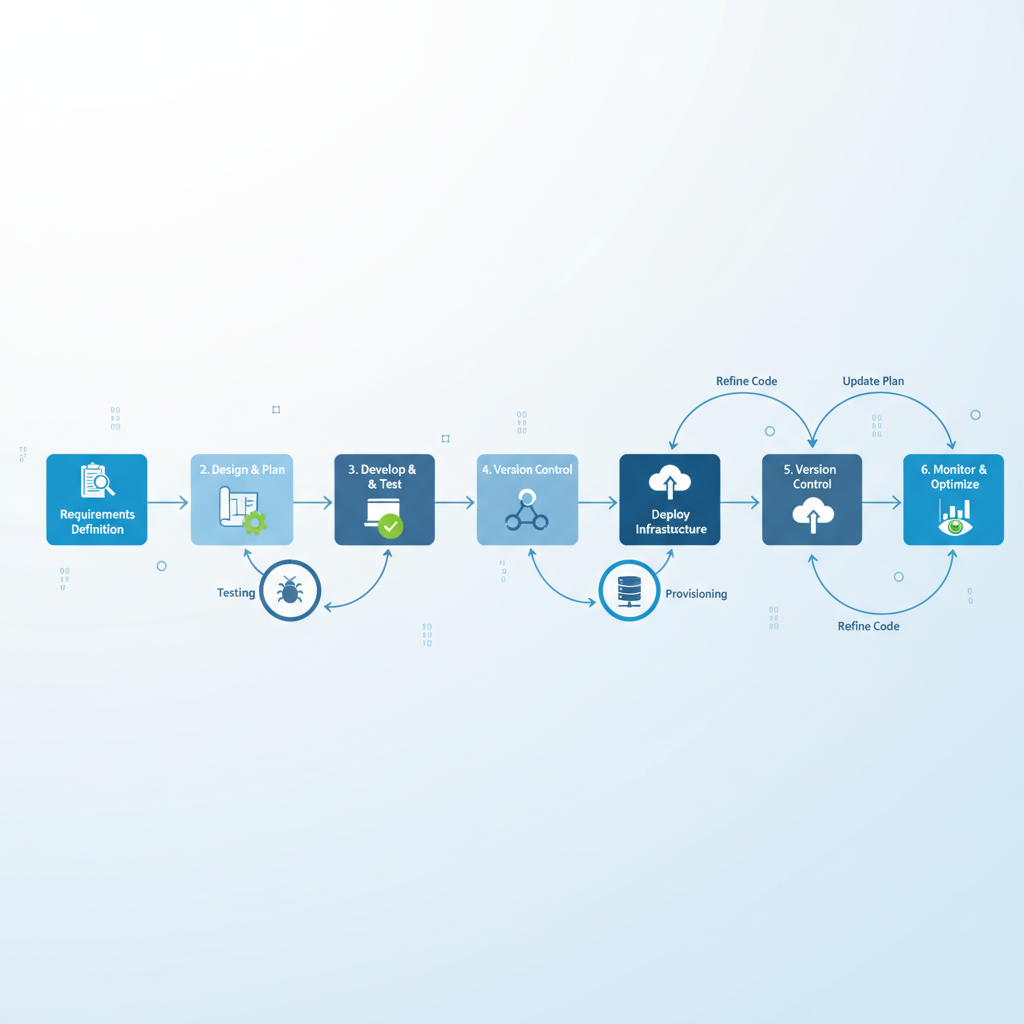
A flowchart illustrating the 6 steps of implementing IaC, from requirements definition to deployment and monitoring, with feedback loops.
Each step builds upon the previous one, creating a robust and automated infrastructure management pipeline. Remember that IaC is an ongoing journey, not a one-time project, so continuous improvement is key. This framework provides a solid foundation for integrating powerful infrastructure as code applications into your operations.
Step 1: Define Your Infrastructure Requirements
Before writing any code, clearly define your infrastructure requirements. This includes specifying the types of resources needed (e.g., VMs, databases, networks), their configurations, and their interdependencies. Documenting these requirements provides a blueprint for your IaC efforts.
Consider current state, desired state, and any compliance or security mandates. Clearly document all resource specifications and interdependencies to guide your IaC development. This initial planning phase is crucial for avoiding costly rework later in the process.
Step 2: Select Your Preferred IaC Tool
Based on your defined requirements, team expertise, and evaluation of vendor ecosystems, choose the iac management software that best fits your needs. Popular choices include Terraform for provisioning, Ansible for configuration management, and Pulumi for general-purpose programming language-based IaC.
Each IaC tools suite has its unique strengths and paradigms. For instance, Terraform is excellent for multi-cloud provisioning with its declarative infrastructure software approach, while Ansible shines in host configuration. Select a tool that aligns with your specific infrastructure landscape and team’s programming preferences.
Step 3: Develop Your IaC Templates
Begin writing your infrastructure code using the chosen tool’s syntax. This involves creating templates or definition files that declaratively describe your desired infrastructure state. Start with smaller, manageable components and progressively build more complex configurations.
Break down your infrastructure into logical modules for better organization and reusability. For example, create separate modules for network configuration, compute instances, and database services. This modular approach simplifies development and maintenance of your IaC automation platforms.
Step 4: Implement Version Control
Integrate your IaC templates with a robust version control system like Git. This is crucial for collaborative development, change tracking, and ensuring the auditability of your infrastructure changes. Every modification to your infrastructure code should be committed and reviewed.
Create feature branches for new infrastructure changes, conduct peer reviews, and merge changes into a main branch only after thorough validation. Ensure every change to your infrastructure definition goes through a proper version control workflow. This practice is fundamental for reliable DevOps infrastructure software.
Step 5: Test and Validate Your Infrastructure
Thoroughly test your IaC templates before deploying them to production. This can involve linting your code, performing syntax checks, and using integration tests to verify that the provisioned infrastructure behaves as expected. Automated testing is a hallmark of mature IaC practices.
Utilize tools that can simulate deployments or run tests against temporary, isolated environments. This helps catch errors early and prevents misconfigurations from reaching live systems. Implement a robust testing strategy to validate your infrastructure code at every stage.
Step 6: Deploy and Monitor
Once your IaC templates are tested and validated, deploy your infrastructure using your iac management software. Integrate the deployment process into your CI/CD pipeline for automated, continuous delivery. After deployment, establish comprehensive monitoring to track the health and performance of your infrastructure.
Use monitoring tools to detect configuration drift and ensure your deployed infrastructure remains consistent with your IaC definitions. Set up alerts for any anomalies or deviations. This continuous feedback loop is essential for maintaining a stable and optimized environment, particularly for cloud automation software.
Best Practices for Effective IaC Management
Implementing iac management software is just the beginning. To truly harness its power and ensure long-term success, organizations must adhere to a set of best practices. These practices promote maintainability, security, scalability, and collaboration, turning your IaC investment into a strategic advantage.
Adopting these guidelines helps prevent common pitfalls and fosters a culture of infrastructure excellence. They are designed to maximize the benefits of treating your infrastructure as a programmable asset. Consistency and discipline in applying these practices are key to sustainable IaC operations.
Modularize Your Code
Break down your infrastructure code into small, reusable modules. Instead of a single monolithic template, create modules for common infrastructure patterns, such as a “web server module” or a “database module.” This enhances reusability, reduces redundancy, and simplifies maintenance.
Modularization also makes it easier to test individual components and reduces the blast radius of changes. When a change is needed, you update one module rather than modifying multiple, potentially disparate configurations. This is a core principle for scalable infrastructure as code applications.
Prioritize Security
Security should be embedded into your IaC practices from the outset. Define security policies directly within your infrastructure code, such as network access controls, encryption settings, and identity and access management (IAM) roles. Automate security compliance checks as part of your CI/CD pipeline.
Regularly review your IaC templates for potential security vulnerabilities and ensure that sensitive information is managed securely, perhaps using secret management tools. Always build security into your IaC definitions rather than treating it as an afterthought.
Integrate your iac management software deployments into a robust CI/CD pipeline. This ensures that every change to your infrastructure code undergoes automated testing, review, and deployment. CI/CD pipelines automate the entire lifecycle, from code commit to infrastructure provisioning.
This automation accelerates delivery, improves reliability, and provides faster feedback loops. It allows teams to deploy infrastructure changes frequently and with confidence. A well-implemented CI/CD pipeline is the backbone of efficient IaC automation platforms.
Document Everything
Comprehensive documentation for your IaC templates, modules, and deployment processes is invaluable. Document the purpose of each module, input variables, output values, and any assumptions or dependencies. Good documentation helps new team members get up to speed quickly and ensures institutional knowledge is retained.
Keep your documentation updated as your infrastructure code evolves. Clear documentation enhances collaboration, reduces ambiguity, and simplifies troubleshooting efforts. It is a critical component for the long-term maintainability of your IaC tools suite.
Challenges and Solutions in IaC Management
While iac management software offers immense benefits, organizations may encounter several challenges during its adoption and ongoing management. Understanding these common hurdles and knowing how to address them is essential for a successful IaC journey. Proactive planning and continuous adaptation are key to overcoming these obstacles.
These challenges often stem from a combination of technical complexities, organizational inertia, and the inherent learning curve associated with new technologies. Addressing them systematically ensures that the promise of IaC is fully realized.
One common challenge is managing configuration drift, where manual changes or out-of-band updates cause deployed infrastructure to diverge from its IaC definition. The solution involves implementing strict policies against manual changes, automating detection of drift, and regularly reconciling infrastructure with its code. Tools for configuration management software can often highlight these discrepancies.
Another hurdle is the initial learning curve for teams transitioning from manual operations to code-driven infrastructure. Providing comprehensive training, starting with simpler projects, and fostering a culture of experimentation and knowledge sharing can mitigate this. Investing in professional development for your team to master IaC orchestration software is critical.
Frequently Asked Questions
What is the primary benefit of using iac management software?
The primary benefit of using iac management software is the ability to manage and provision infrastructure through code, leading to increased consistency, repeatability, and automation. This significantly reduces manual errors, speeds up deployment times, and ensures environments are identical, which is crucial for modern development practices.
How does iac management software enhance security?
IaC management software enhances security by allowing security policies and compliance requirements to be embedded directly into infrastructure definitions. This ensures that every deployed resource adheres to predefined security standards automatically. It helps enforce access controls, network segmentation, and encryption settings, providing a consistent and auditable security posture.
Is iac management software only for cloud environments?
No, iac management software is not exclusively for cloud environments. While it is widely used for cloud automation software with providers like AWS, Azure, and Google Cloud, it can also be used to manage on-premises infrastructure. Many tools support hybrid environments, allowing you to manage virtual machines, networks, and other resources within your own data centers using the same code-driven principles.
What’s the difference between declarative and imperative IaC?
Declarative IaC describes the desired end-state of the infrastructure, and the tool figures out how to get there. For example, “ensure there are three web servers.” Imperative IaC, conversely, specifies the exact steps to achieve that state, such as “create server A, then install software B, then start service C.” Most modern iac management software, like Terraform, uses a declarative approach.
Can different IaC tools work together?
Yes, different IaC tools can often work together to form a comprehensive IaC tools suite. For example, you might use Terraform (a declarative infrastructure software) for provisioning cloud resources and then use Ansible (a configuration management software) to configure the operating systems and applications running on those provisioned resources. This allows organizations to leverage the strengths of various tools for different aspects of their infrastructure lifecycle.
✓ Free consultation ✓ No commitment required ✓ Trusted by experts
Conclusion
The adoption of iac management software is no longer a luxury but a necessity for organizations striving for agility, reliability, and security in their IT operations. By treating infrastructure as code, businesses can automate complex processes, eliminate manual errors, and maintain consistent environments across their development, testing, and production landscapes. This transformative approach empowers teams to deploy infrastructure with unprecedented speed and confidence.
Embracing iac management software is a strategic investment that pays dividends in operational efficiency, reduced costs, and enhanced competitive advantage. As you embark on or continue your IaC journey, remember the principles of modularization, security, continuous integration, and thorough documentation. Master these practices, and you will unlock the full potential of your infrastructure as a programmable, adaptable asset, ready to meet the demands of tomorrow’s digital world.
Johan Carlsson is a cloud architecture specialist and frequent speaker focused on scalable workloads, AI/ML, and IoT innovation. At Opsio, he helps organizations harness cutting-edge technology, automation, and purpose-built services to drive efficiency and achieve sustainable growth. Johan is known for enabling enterprises to gain a competitive advantage by transforming complex technical challenges into powerful, future-ready cloud solutions.