Mastering IaC Management: Essential Best Practices for Your Infrastructure
March 12, 2026|9:23 AM
Unlock Your Digital Potential
Whether it’s IT operations, cloud migration, or AI-driven innovation – let’s explore how we can support your success.
Home /
Work /
Blogs /
Mastering IaC Management: Essential Best Practices for Your Infrastructure
Navigating iac management best practices: How to Implement – 2026 Guide
Infrastructure as Code (IaC) has become an indispensable methodology for modern IT operations, transforming how infrastructure is provisioned and managed. By representing infrastructure configurations in code, organizations achieve speed, consistency, and scalability previously unattainable. Adopting robust iac management best practices is crucial for harnessing these benefits fully and avoiding common pitfalls.
This comprehensive guide delves into the essential strategies and principles for effective IaC implementation. We will explore key areas from foundational concepts to advanced techniques, ensuring your infrastructure management is resilient and agile for 2026 and beyond. Mastering these practices allows teams to maintain control, enhance security, and drive innovation across their cloud environments.
Understanding the Core Principles of IaC
IaC fundamentally shifts infrastructure provisioning from manual processes to automated, code-driven workflows. This approach treats infrastructure components like servers, databases, and networks as software artifacts. These artifacts are defined in declarative configuration files, enabling consistent and repeatable deployments.
The goal is to eliminate configuration drift and ensure environments are identical across development, staging, and production. This consistency dramatically reduces errors and speeds up the entire software development lifecycle. Embracing these core principles is the first step towards establishing effective IaC strategies within your organization.
Why IaC is Essential for Modern Infrastructure
IaC brings numerous advantages, making it a cornerstone of modern DevOps practices. It enables rapid provisioning, allowing new environments to be spun up in minutes rather than hours or days. This speed is critical for agile development and responding quickly to business needs.
Furthermore, IaC improves reliability by standardizing configurations and reducing human error. Each deployment is consistent, ensuring predictability and minimizing unexpected issues. This consistency is vital for maintaining uptime and delivering stable services.
Key Benefits of Implementing IaC
Automation: Automates repetitive tasks, freeing up valuable engineering time.
Speed: Accelerates infrastructure provisioning and deployment cycles.
Scalability: Easily scales infrastructure up or down based on demand.
Cost Efficiency: Optimizes resource utilization and reduces operational overhead.
Version Control: Tracks all changes, enabling rollbacks and auditing.
Key Pillars of Effective IaC Strategies
Implementing IaC requires a strategic approach that encompasses several critical pillars. These foundational elements ensure that your IaC efforts are not just functional but also efficient, secure, and maintainable. Focusing on these pillars will lay the groundwork for strong iac management best practices.
Building a solid framework involves thoughtful planning around how code is written, stored, and deployed. This holistic view prevents isolated solutions and promotes a unified infrastructure management strategy. It also sets the stage for continuous improvement and adaptation.
Embracing Version Control for IaC
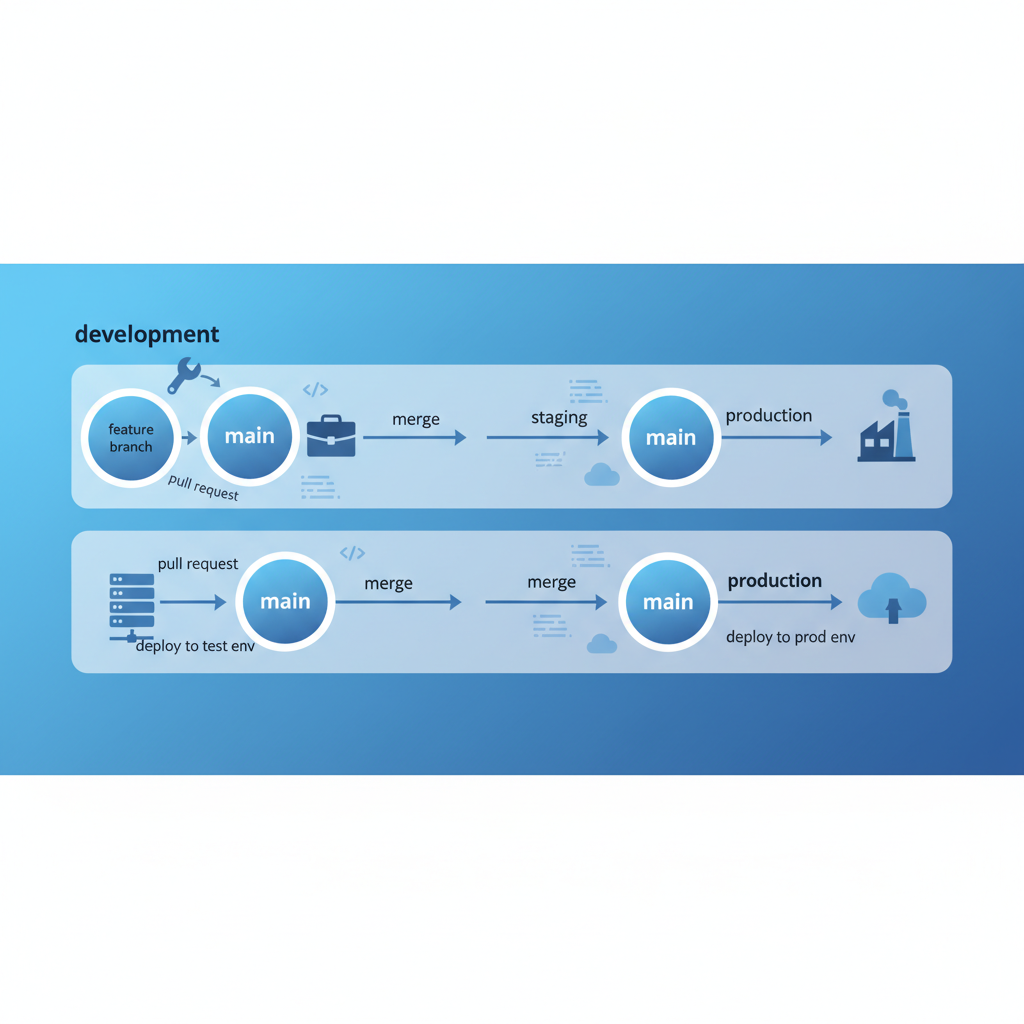
Version control is arguably the most crucial aspect of iac management best practices. Just like application code, all IaC configurations must reside in a version control system (VCS) like Git. This enables tracking every change, who made it, and when.
Version control provides a complete history of your infrastructure’s evolution, offering invaluable audit trails and the ability to roll back to previous stable states if issues arise. It is the backbone for collaboration in IaC teams, allowing multiple engineers to work on infrastructure definitions concurrently without conflicts. Implementing a robust branching strategy is also essential for managing changes effectively.
A diagram showing a Git workflow for IaC, with branches for development, staging, and production, and arrows indicating merges and pull requests.
Adopting Modular IaC Design
Modular IaC design is fundamental for creating scalable and maintainable infrastructure codebases. This approach involves breaking down large infrastructure definitions into smaller, reusable components or modules. Each module should encapsulate a specific piece of infrastructure, such as a VPC, a database instance, or a load balancer.
This modularity promotes reusability, reducing duplication and making the codebase cleaner. It also simplifies testing and troubleshooting, as changes to one module have limited impact on others. Organizations employing modular IaC design benefit from increased efficiency and reduced complexity in their infrastructure deployments.
Implementing Declarative Configuration Management
Declarative configuration management focuses on describing the desired state of the infrastructure, rather than the steps to get there. Tools like Terraform, AWS CloudFormation, or Azure Resource Manager exemplify this approach. You define “what” you want, and the IaC tool figures out “how” to achieve it.
This contrasts with imperative approaches, which specify a sequence of commands. Declarative IaC is inherently more idempotent, meaning applying the configuration multiple times will yield the same result without unintended side effects. This consistency is a cornerstone of reliable iac management best practices.
✓ Free consultation ✓ No commitment required ✓ Trusted by experts
Implementing Robust IaC Governance Models
Establishing clear governance models is vital to ensure consistency, security, and compliance across your IaC environments. Without proper governance, even the best technical practices can lead to unmanaged sprawl and vulnerabilities. Strong IaC governance models define the rules and processes for managing infrastructure code and deployments.
These models provide guardrails for development teams, ensuring adherence to organizational standards. They also facilitate audits and compliance checks, which are increasingly important in regulated industries. Effective governance underpins all other iac management best practices.
Defining Roles and Responsibilities
Clear role definition is paramount in an IaC environment. Specify who is responsible for writing, reviewing, approving, and deploying IaC code. This prevents confusion and ensures accountability throughout the infrastructure lifecycle.
For instance, infrastructure engineers might be responsible for core module development, while application teams extend these modules for their specific needs. A separation of duties, especially for deployment approvals, adds an extra layer of security and control. Establishing these boundaries strengthens your overall governance framework.
Establishing Code Review Processes
Mandatory code reviews for all IaC changes are a non-negotiable best practice. Just like application code, infrastructure code can contain bugs or security vulnerabilities. Peer review helps catch these issues before they manifest in production.
Code reviews also serve as a knowledge-sharing mechanism, improving the overall quality and understanding of the IaC codebase across the team. They enforce coding standards and ensure that all changes align with defined architectural patterns and security policies. This collaborative process is key to maintaining high IaC code quality.
Implementing Policy as Code
Policy as Code involves defining compliance and security policies in a machine-readable format. These policies can then be automatically enforced during IaC deployments. Tools like OPA (Open Policy Agent) or Cloud Custodian allow you to codify rules like “all S3 buckets must be encrypted” or “no public IPs on EC2 instances.”
This approach shifts policy enforcement left, catching non-compliant configurations early in the development cycle. It provides a consistent, automated way to ensure adherence to regulatory requirements and internal security standards. Policy as Code is a powerful component of modern IaC governance models.
Ensuring Security and Quality in IaC
Security and quality are two sides of the same coin when it comes to IaC. A secure infrastructure is a high-quality infrastructure, and vice-versa. Integrating security checks and quality assurance into every stage of your IaC pipeline is critical for protecting your environments.
Neglecting either aspect can lead to significant vulnerabilities, operational disruptions, and compliance failures. Therefore, IaC security best practices and IaC code quality standards must be meticulously applied throughout the development and deployment process. This proactive approach saves time and resources in the long run.
IaC Security Best Practices
Security must be baked into your IaC from the very beginning. This includes implementing the principle of least privilege, ensuring that all deployed resources have only the necessary permissions. Regularly audit IAM policies and resource configurations to prevent over-provisioning.
Sensitive information, such as API keys and database credentials, should never be hardcoded into IaC files. Instead, use secure secrets management services like AWS Secrets Manager, Azure Key Vault, or HashiCorp Vault. These services protect sensitive data and prevent its exposure in version control systems.
Regularly scan your IaC code for security vulnerabilities and misconfigurations using specialized tools. Tools like Checkov, Kics, and Terrascan can identify potential issues before deployment. These automated checks are essential for maintaining a strong security posture.
Maintaining High IaC Code Quality
High IaC code quality ensures maintainability, readability, and reliability. This includes adhering to consistent naming conventions, commenting code effectively, and structuring files logically. Clear and concise code is easier to understand, debug, and update by various team members.
Automated linting and formatting tools are invaluable for enforcing coding standards. Tools like `terraform fmt` for Terraform or `cfn-lint` for CloudFormation help ensure consistency across the codebase. Investing in these practices improves the long-term viability of your IaC efforts.
Secure Credential Management
Managing credentials securely is paramount in IaC. Avoid embedding plain-text secrets directly within your IaC repositories. This poses a severe security risk, as anyone with access to the repository could compromise your systems.
Instead, integrate with dedicated secrets management solutions. These tools encrypt and manage sensitive data, allowing your IaC pipeline to retrieve credentials securely at runtime. This practice significantly reduces the attack surface and helps achieve compliance.
Testing, Deployment, and Maintenance
The lifecycle of IaC extends beyond initial coding to rigorous testing, controlled deployment, and ongoing maintenance. Each phase is critical for ensuring the reliability and stability of your infrastructure. Establishing robust processes for these stages is central to iac management best practices.
Without a well-defined pipeline, even perfectly crafted IaC can lead to unpredictable outcomes in production. A systematic approach ensures that changes are validated, deployed safely, and monitored effectively. This continuous cycle supports high-quality infrastructure operations.
Testing IaC Configurations
Testing IaC configurations is just as important as testing application code. This involves validating that your infrastructure code correctly provisions resources and that those resources behave as expected. Unit tests, integration tests, and end-to-end tests should be part of your IaC testing strategy.
Tools like Terratest (for Terraform) or serverspec allow you to write tests that verify the state of deployed resources. These tests can confirm that ports are open, services are running, and security groups are configured correctly. Automated testing reduces the risk of deploying faulty infrastructure.
Implementing CI/CD for IaC
A Continuous Integration/Continuous Delivery (CI/CD) pipeline is essential for automating the IaC deployment process. Every code commit should trigger a pipeline that lints, validates, tests, and potentially deploys the infrastructure. This automation reduces manual errors and speeds up deployments.
The CI/CD pipeline enforces your governance models, running checks for security, compliance, and code quality before deployment. It ensures that only validated and approved infrastructure changes make it to production. This disciplined approach is a cornerstone of effective IaC strategies.
Monitoring and Alerting for IaC Drift
Once infrastructure is deployed using IaC, continuous monitoring is crucial to detect configuration drift. Drift occurs when manual changes are applied to infrastructure outside of the IaC process, leading to inconsistencies. Tools can compare the actual state of your infrastructure with its desired state defined in code.
Setting up alerts for detected drift allows operations teams to quickly identify and remediate unauthorized changes. Regular drift detection and remediation are vital for maintaining the integrity and consistency promised by IaC. This proactive monitoring is a key element of ongoing iac management best practices.
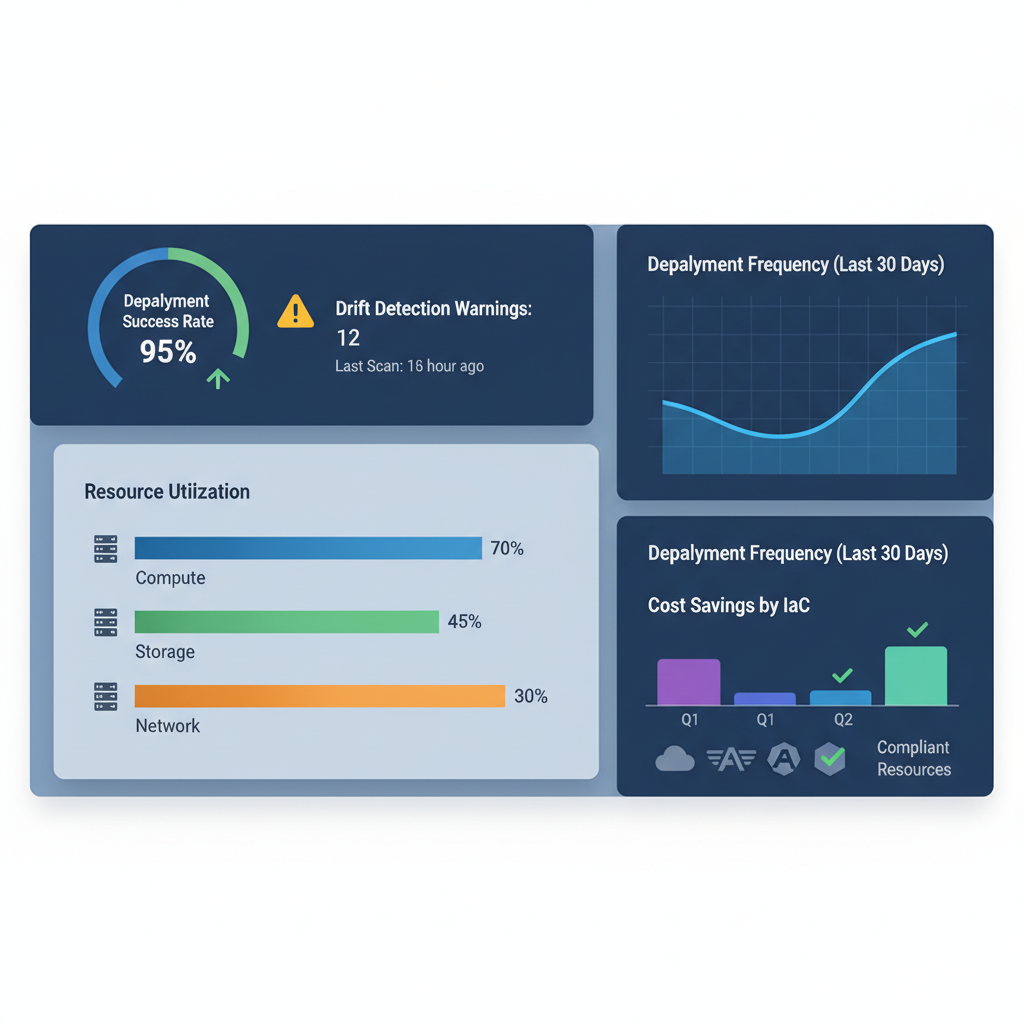
A dashboard showing various IaC metrics, including deployment success rates, drift detection warnings, and resource utilization graphs.
Advanced iac management best practices for 2026
As IaC matures, organizations are looking beyond basic implementation to more sophisticated techniques. These advanced practices further enhance automation, security, and operational efficiency. Staying ahead with these strategies will be crucial in 2026.
Embracing these cutting-edge approaches ensures your IaC capabilities evolve with technological advancements. This continuous improvement mindset helps in adapting to new challenges and optimizing existing workflows. It’s about building a future-proof infrastructure management system.
GitOps for Infrastructure Management
GitOps extends the principles of IaC by using Git as the single source of truth for both applications and infrastructure. All changes, desired states, and operational procedures are declared in Git. An automated operator then continuously observes the actual state of the infrastructure and attempts to reconcile it with the desired state in Git.
This approach provides a powerful auditable trail, simplifies rollbacks, and enhances collaboration in IaC teams. GitOps promotes a fully declarative, version-controlled, and automated approach to infrastructure delivery. It’s an increasingly popular advanced practice for highly dynamic environments.
Cost Optimization with IaC
IaC can be a powerful tool for cost optimization. By accurately defining resource requirements, you can prevent over-provisioning and ensure resources are scaled appropriately. Implementing policies via IaC to automatically de-provision unused resources or schedule shutdowns for non-production environments can lead to significant savings.
Furthermore, IaC facilitates the use of spot instances or reserved instances where appropriate, helping to reduce cloud spend. Integrating cost management tools into your IaC pipeline allows for proactive cost analysis before deployment. This proactive approach aligns infrastructure spend with business value.
Disaster Recovery and Business Continuity with IaC
IaC profoundly simplifies disaster recovery (DR) and business continuity planning. By having your entire infrastructure defined in code, you can quickly rebuild environments in a different region or even with a different cloud provider. This capability drastically reduces Recovery Time Objectives (RTO).
Automating the deployment of DR environments through IaC ensures they are always consistent with your production setup. Regular testing of these IaC-driven DR scenarios verifies their effectiveness and builds confidence in your resilience strategy. IaC transforms DR from a complex manual process into a repeatable, automated one.
Frequently Asked Questions
What is the primary benefit of iac management best practices?
The primary benefit of iac management best practices is achieving consistent, reliable, and scalable infrastructure deployments through automation. It minimizes manual errors, speeds up provisioning, and enables rapid iteration of infrastructure changes, aligning IT operations with agile development methodologies.
How does version control improve IaC management?
Version control, typically using Git, allows teams to track every change made to infrastructure code, including who made it and when. This provides an audit trail, enables easy rollbacks to previous stable states, and facilitates collaboration in IaC teams by managing concurrent changes efficiently and safely.
What are some common IaC security best practices?
Key IaC security best practices include implementing the principle of least privilege, using secure secrets management tools instead of hardcoding credentials, and regularly scanning IaC code for vulnerabilities and misconfigurations. Policy as Code also helps enforce security rules automatically before deployment.
Why is modular IaC design important?
Modular IaC design breaks down infrastructure definitions into smaller, reusable components, promoting reusability and reducing duplication. It simplifies maintenance, makes testing easier, and enhances collaboration by allowing different teams to manage their specific infrastructure modules more effectively.
What role does CI/CD play in IaC management?
CI/CD pipelines automate the process of validating, testing, and deploying IaC changes, significantly reducing human error and speeding up deployments. They enforce code quality, security policies, and compliance checks, ensuring only thoroughly vetted and approved infrastructure configurations reach production environments.
How can organizations ensure IaC code quality?
Organizations ensure IaC code quality by establishing clear coding standards, implementing mandatory code reviews, and using automated linting and formatting tools. These practices lead to readable, maintainable, and reliable infrastructure code that adheres to architectural guidelines and best practices.
✓ Free consultation ✓ No commitment required ✓ Trusted by experts
Conclusion
Implementing iac management best practices is no longer an option but a necessity for organizations striving for agility, reliability, and security in their cloud environments. By embracing version control, modular design, robust governance, and continuous testing, you lay a solid foundation for your infrastructure. These practices ensure consistent deployments and scalable operations.
As we look towards 2026, advanced techniques like GitOps and proactive cost optimization will further refine your IaC capabilities. Continuously adopting these proven strategies empowers your teams to manage infrastructure with unprecedented efficiency and confidence. Start integrating these best practices today to transform your infrastructure management.
Jacob Stålbro is a seasoned digitalization and transformation leader with over 20 years of experience, specializing in AI-driven innovation. As Head of Innovation and Co-Founder at Opsio, he drives the development of advanced AI, ML, and IoT solutions. Jacob is a sought-after speaker and webinar host known for translating emerging technologies into real business value and future-ready strategies.