Mastering DevOps IaC Management for Efficient Infrastructure
March 12, 2026|9:15 AM
Unlock Your Digital Potential
Whether it’s IT operations, cloud migration, or AI-driven innovation – let’s explore how we can support your success.
Home /
Work /
Blogs /
Mastering DevOps IaC Management for Efficient Infrastructure
Understanding DevOps IaC Management: A Comprehensive Guide
DevOps has revolutionized how organizations develop and deliver software, emphasizing collaboration, automation, and continuous delivery. A cornerstone of this transformation is Infrastructure as Code (IaC), a practice that manages and provisions infrastructure through code rather than manual processes. Effective devops iac management is critical for harnessing the full power of IaC, ensuring your infrastructure is consistent, scalable, and resilient.
This guide will delve into the intricacies of devops iac management, providing a clear roadmap for implementation and optimization. We will explore key principles, essential tools, best practices, and common challenges. By the end, you will understand how to leverage IaC to streamline your DevOps pipeline and achieve superior operational efficiency.
What is Infrastructure as Code (IaC) in DevOps?
Infrastructure as Code (IaC) treats infrastructure provisioning and management like software development. Instead of clicking through dashboards or manually configuring servers, you write declarative or imperative code. This code defines the desired state of your infrastructure components, such as virtual machines, networks, databases, and load balancers.
The IaC approach ensures that your infrastructure is version-controlled, testable, and repeatable. It integrates seamlessly into the broader DevOps methodology, supporting continuous integration and continuous delivery (CI/CD) practices. This shift allows teams to provision and manage resources much faster and with greater consistency.
Why IaC is Essential for DevOps
IaC offers profound benefits that align perfectly with DevOps goals. It eliminates configuration drift, a common issue where environments diverge over time due to manual changes. With IaC, every environment, from development to production, can be identical, reducing “it works on my machine” problems.
Moreover, IaC in DevOps pipeline significantly speeds up the provisioning process. New environments can be spun up in minutes, accelerating development cycles and enabling rapid experimentation. This automation enhances reliability and reduces human error, making infrastructure operations far more predictable.
Benefits of Effective DevOps IaC Management
Implementing robust devops iac management provides numerous advantages for any organization. It leads to improved collaboration between development and operations teams, as infrastructure definitions are shared and versioned. This transparency fosters a unified approach to infrastructure.
Effective management also enhances security and compliance. By defining infrastructure policies in code, you can consistently enforce security configurations and audit changes easily. This makes it simpler to meet regulatory requirements and maintain a secure operational posture.
Core Principles of DevOps IaC Management
Successful devops iac management relies on adhering to several foundational principles. These principles guide the development, deployment, and maintenance of your infrastructure code. Embracing them ensures your IaC implementation is robust, scalable, and easy to manage.
Understanding these core tenets will help you build a resilient and efficient infrastructure. They form the backbone of any effective DevOps infrastructure automation strategy.
Version Control for Infrastructure
Every piece of infrastructure code must reside in a version control system (VCS), such as Git. This is perhaps the most fundamental principle of IaC. Version control allows teams to track all changes, revert to previous states if necessary, and collaborate effectively.
It provides a complete audit trail for your infrastructure, making it easy to understand who changed what and when. Integrating IaC with your existing VCS ensures that infrastructure changes follow the same rigor as application code changes. This is vital for maintaining stability and control.
Modularity and Reusability
Your IaC should be designed with modularity in mind. Break down your infrastructure into smaller, reusable components or modules. For example, a module might define a virtual network, a database instance, or a specific application tier. This promotes reusability across different projects and environments.
Modularity reduces duplication of effort and ensures consistency. When you update a module, all instances that use it benefit from the change. This approach significantly simplifies the management of complex infrastructures and makes your code base more maintainable.
Immutability of Infrastructure
Immutable infrastructure means that once a server or component is deployed, it is never modified. If a change is needed, a new component is provisioned with the updated configuration, and the old one is decommissioned. This contrasts with mutable infrastructure, where servers are patched or updated in place.
Immutability eliminates configuration drift and ensures consistency across environments. It simplifies rollbacks and makes deployments more predictable. This principle is a cornerstone for continuous infrastructure delivery, as it supports frequent and reliable updates.
Testing IaC
Just like application code, your infrastructure code must be thoroughly tested. This includes unit tests for individual modules, integration tests for how components interact, and end-to-end tests for complete environment deployments. Testing helps catch errors early in the CI/CD pipeline.
Automated testing frameworks can validate syntax, check for common misconfigurations, and ensure the deployed infrastructure meets desired specifications. Comprehensive testing is crucial for maintaining the reliability and security of your infrastructure as it evolves.
Documentation
Clear and concise documentation for your IaC is indispensable. This includes comments within the code itself, as well as external documentation detailing the purpose, usage, and dependencies of your infrastructure modules. Good documentation facilitates onboarding new team members and ensures long-term maintainability.
It also helps in troubleshooting and auditing, providing a quick reference for understanding the infrastructure’s design and behavior. Well-documented IaC contributes significantly to the overall maintainability and transparency of your DevOps processes.
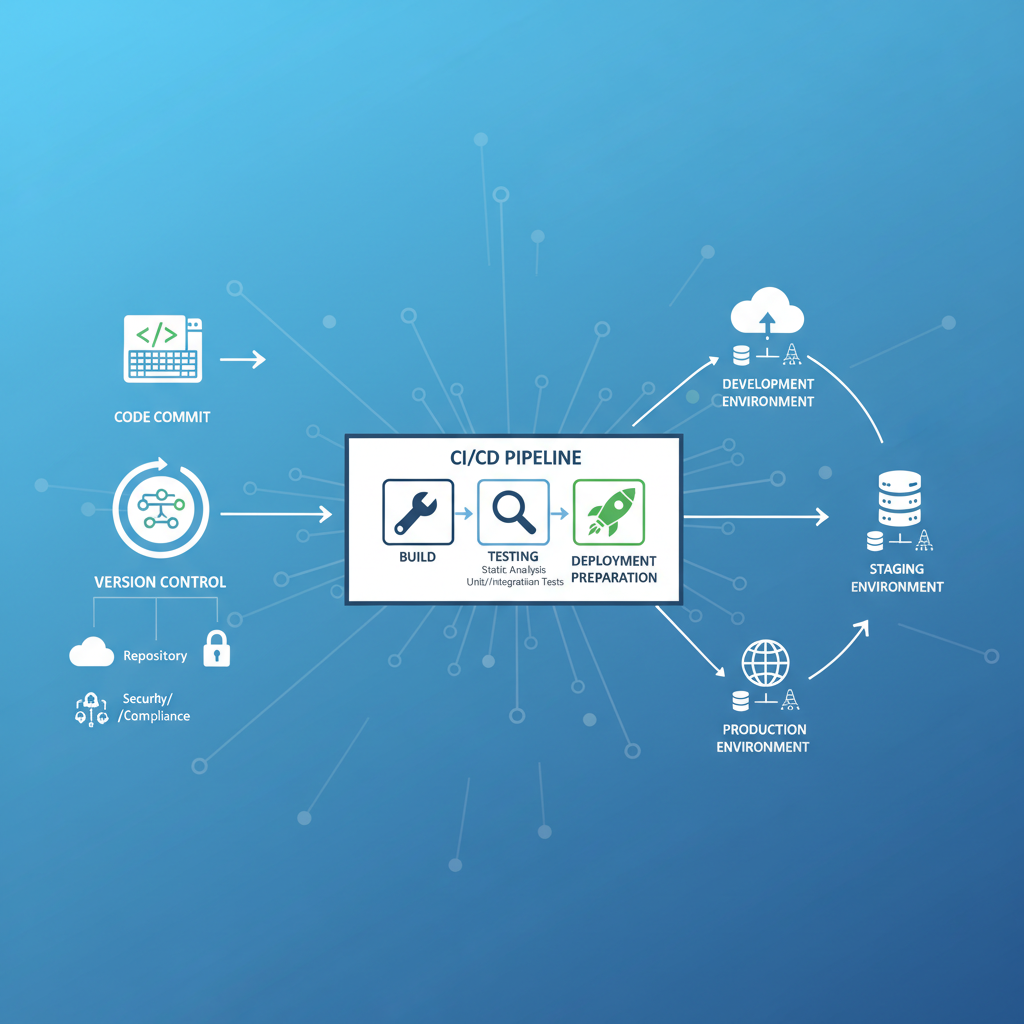
A diagram illustrating the IaC workflow within a DevOps pipeline, showing stages like code commit, version control, CI/CD, testing, and deployment to various environments.
✓ Free consultation ✓ No commitment required ✓ Trusted by experts
Choosing the Right IaC Tools
The market offers a wide array of tools for devops iac management, each with its strengths and use cases. Selecting the appropriate tools for your organization is a critical step in establishing an effective IaC strategy. These tools facilitate everything from configuration management to cloud resource provisioning.
The right DevOps toolchain IaC can significantly enhance automation and collaboration. Consider your existing infrastructure, team expertise, and specific requirements when making your selections.
Configuration Management Tools
These tools manage the configuration of servers and software on existing machines. They are generally imperative, meaning you define the steps to achieve a desired state.
Popular examples include:
Ansible: Agentless, uses SSH, and leverages YAML for playbooks, making it relatively easy to learn and deploy. It excels at orchestration and configuration.
Chef: Requires an agent on managed nodes and uses Ruby for writing cookbooks and recipes. It offers powerful capabilities for complex configurations.
Puppet: Also agent-based, uses its own declarative language, Puppet DSL, to define infrastructure. It’s known for strong reporting and compliance features.
Orchestration and Provisioning Tools
These tools are primarily declarative, focusing on defining the desired end state of your infrastructure resources in the cloud or on-premises. They provision the underlying infrastructure itself.
Key tools in this category are:
Terraform: An open-source tool that supports multiple cloud providers (AWS, Azure, GCP) and on-premises infrastructure. It uses HashiCorp Configuration Language (HCL) and is widely adopted for its flexibility and extensibility.
AWS CloudFormation: AWS’s native IaC service for provisioning and managing AWS resources. It uses JSON or YAML templates. It’s tightly integrated within the AWS ecosystem.
Azure Resource Manager (ARM) Templates: Azure’s native IaC solution for deploying and managing Azure resources. These templates are JSON files.
Container Orchestration
While not strictly IaC for underlying infrastructure, container orchestration tools are crucial for managing containerized applications defined by code. They extend the IaC principle to application deployment.
Kubernetes: The industry standard for orchestrating containerized workloads, enabling declarative deployment and scaling of applications.
Docker Swarm: Docker’s native clustering and orchestration solution for Docker containers.
CI/CD Tools
CI/CD tools integrate your IaC code with the rest of your development pipeline. They automate the testing, building, and deployment of infrastructure changes.
Jenkins: A highly flexible and extensible open-source automation server.
GitLab CI/CD: Built directly into GitLab, offering a seamless experience for code and pipeline management.
Azure DevOps: A comprehensive suite of DevOps services, including CI/CD pipelines.
Implementing IaC in Your DevOps Pipeline
Integrating IaC into your existing DevOps pipeline is a strategic move that enhances efficiency and reliability. This section outlines the practical steps involved in setting up and leveraging IaC within your continuous integration and continuous delivery (CI/CD) processes. Automating operations with IaC becomes a reality through these defined steps.
By following these guidelines, you can build a robust CI/CD with IaC, ensuring that your infrastructure evolves as smoothly as your application code. This continuous infrastructure delivery approach is key to modern DevOps.
Step 1: Setting Up Your Version Control System
The first step is to establish a dedicated repository for your IaC code in a version control system like Git. All infrastructure definitions, configurations, and scripts should be stored here. Treat your infrastructure code with the same reverence as application code, including branching strategies, pull requests, and code reviews.
This ensures traceability, collaboration, and the ability to revert changes if necessary. A well-organized repository is the foundation for effective devops iac management.
Step 2: Developing IaC Code
Begin by defining your infrastructure resources using your chosen IaC tool’s language (e.g., HCL for Terraform, YAML for Ansible). Start small, perhaps by provisioning a single virtual machine or a network segment. Gradually expand to more complex components.
Focus on creating modular and reusable components from the outset. Use descriptive names for resources and variables to enhance readability. Adhere to coding standards and best practices for your chosen IaC language.
Step 3: Integrating IaC with CI/CD
Integrate your IaC repository with your CI/CD tool. Whenever a change is pushed to the main branch, the CI/CD pipeline should automatically trigger. The pipeline typically involves several stages for your IaC.
Linting and Static Analysis: Tools can check your IaC for syntax errors, best practice violations, and potential security issues before deployment. This stage ensures code quality and adherence to standards.
Plan/Dry Run: For tools like Terraform, a “plan” step generates an execution plan that shows exactly what changes will be made to your infrastructure. This is crucial for review and approval.
Testing: Run automated tests against your IaC, including unit tests for modules and integration tests against temporary environments.
Deployment: After successful planning and testing, the IaC is applied to deploy or update your infrastructure. This stage can be manual or fully automated, depending on your organization’s risk tolerance.
Step 4: Deployment Strategies
When deploying IaC, consider different strategies to minimize risk and ensure availability.
Blue/Green Deployments: Maintain two identical environments (blue and green). Deploy changes to the inactive environment, test it thoroughly, then switch traffic. This allows for instant rollback.
Canary Deployments: Gradually roll out changes to a small subset of users or servers. Monitor performance and errors, then proceed with a full rollout if stable.
Rolling Updates: Update servers in a phased manner, taking a few offline at a time, updating them, and bringing them back online.
Step 5: Automating Operations with IaC
IaC extends beyond initial provisioning; it also automates ongoing operational tasks. This includes scaling resources up or down, applying security patches, and configuring monitoring agents. By defining these operations in code, you ensure consistency and reduce manual effort.
For example, a sudden traffic spike might automatically trigger an IaC script to provision additional web servers. This level of automation significantly improves responsiveness and operational efficiency.
Step 6: Continuous Infrastructure Delivery
The ultimate goal of IaC in DevOps is continuous infrastructure delivery. This means infrastructure changes can be deployed frequently and reliably, often multiple times a day. This agility enables rapid iteration and quick responses to business needs.
By fully embracing CI/CD with IaC, you create a robust system where infrastructure can evolve hand-in-hand with application development. This dynamic capability is a hallmark of truly optimized devops iac management.
Best Practices for DevOps IaC Management
Adopting best practices is paramount for maximizing the benefits of devops iac management. These guidelines help ensure your IaC is secure, maintainable, and performs optimally within your DevOps environment. By adhering to these principles, you can streamline DevOps with IaC and achieve greater operational excellence.
These practices foster collaboration, reduce errors, and enhance the overall reliability of your infrastructure deployments. They are essential for any team aiming for high-quality, automated infrastructure.
Small, Atomic Changes
Commit small, independent changes to your IaC repository frequently. Each change should address a single, well-defined objective. This makes code reviews easier, reduces the risk of introducing bugs, and simplifies debugging if issues arise.
Large, monolithic changes are difficult to track and can introduce multiple points of failure. Breaking down changes into atomic units is a fundamental DevOps best practices IaC principle.
Drift Detection and Remediation
Configuration drift occurs when the actual state of your infrastructure diverges from its defined state in IaC. Implement mechanisms to detect this drift regularly. Tools can compare the deployed infrastructure against your IaC definitions.
Once drift is detected, automate its remediation by reapplying the IaC configuration. This ensures your infrastructure always matches its desired state, maintaining consistency and preventing unexpected behavior.
Security Considerations
Security must be integrated into every aspect of your devops iac management.
Least Privilege: Grant only the necessary permissions to IaC tools and users.
Secret Management: Never hardcode sensitive information (API keys, passwords) in your IaC. Use dedicated secret management solutions like HashiCorp Vault, AWS Secrets Manager, or Azure Key Vault.
Security Scanning: Incorporate security scanning tools into your CI/CD pipeline to identify vulnerabilities in your IaC templates and configurations.
Network Segmentation: Design your infrastructure with proper network segmentation defined in IaC to limit potential attack surfaces.
Collaboration and Team Workflows
Establish clear collaboration workflows for your IaC. This typically involves using pull requests (PRs) for all changes. Every PR should be reviewed by at least one other team member before merging. This promotes knowledge sharing and catches potential issues early.
Automated checks and tests should be mandatory for every PR. Foster a culture where everyone feels ownership of the infrastructure code, encouraging continuous improvement and shared responsibility.
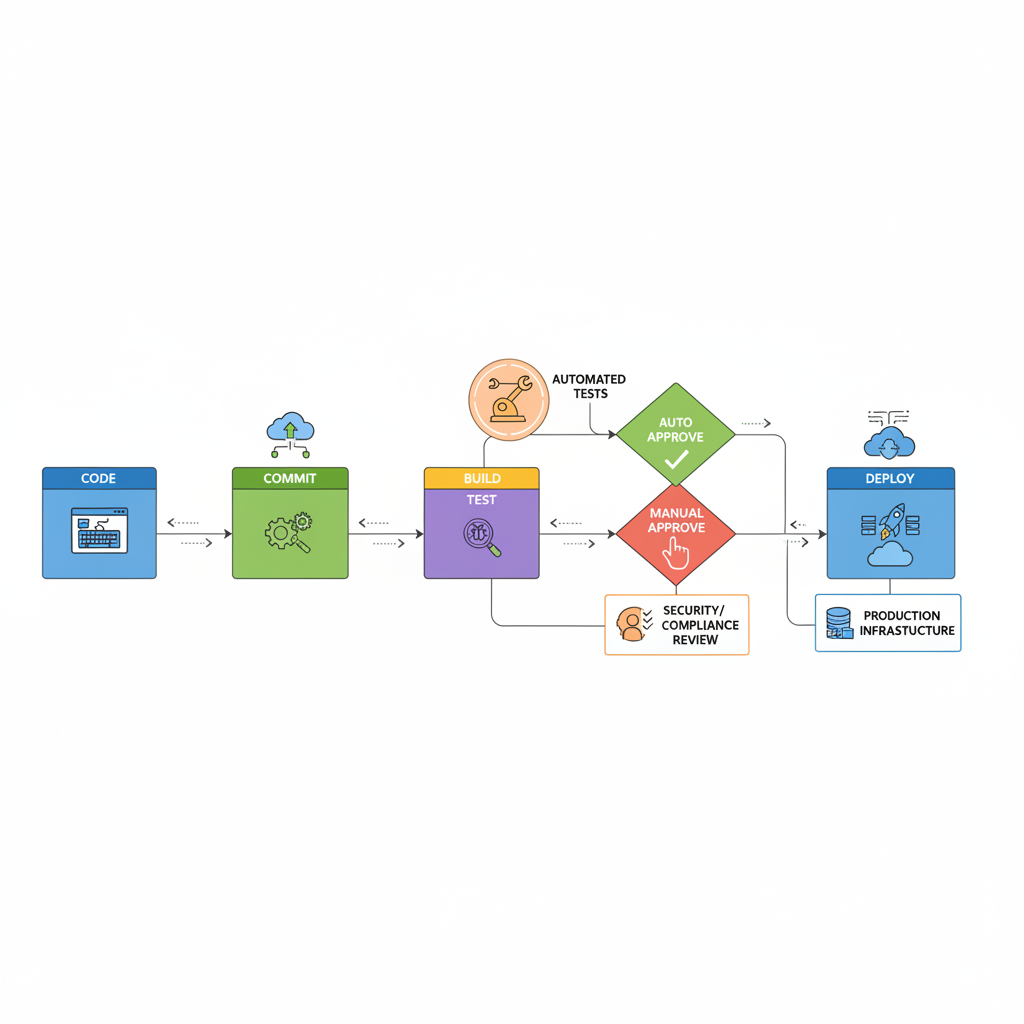
A flowchart showing a typical IaC CI/CD pipeline with stages like code, commit, build, test, approve, and deploy, indicating automated and manual gate points.
Monitoring and Logging
Implement comprehensive monitoring and logging for your infrastructure managed by IaC. Monitor the health and performance of your deployed resources. Log all changes and events related to IaC deployments.
This data is crucial for troubleshooting, performance analysis, and security auditing. Integrate monitoring alerts with your communication channels to ensure rapid response to any anomalies or failures.
Streamlining DevOps with IaC
IaC acts as a powerful accelerator for streamlining DevOps processes. By automating infrastructure provisioning and management, it frees up valuable time for developers and operations teams. This allows them to focus on innovation and higher-value tasks, rather than repetitive manual configurations.
The consistency and repeatability provided by IaC reduce operational overhead and improve time-to-market for new features and applications. This truly optimizes the entire software delivery lifecycle.
Challenges and Solutions in IaC Management
While devops iac management offers immense benefits, teams often encounter specific challenges during implementation and maintenance. Understanding these hurdles and their solutions is crucial for a smooth and effective IaC journey. Addressing these proactively helps to fully realize the potential of DevOps infrastructure automation.
These challenges often relate to complexity, security, and integration, but practical solutions exist for each.
Managing State Files
Many IaC tools, like Terraform, maintain a state file that maps real-world infrastructure resources to your configuration. Managing this state file correctly is critical, especially in team environments.
Challenge: State file corruption or conflicts can lead to incorrect resource management or data loss.
Solution: Store state files in a remote, shared, and versioned backend (e.g., AWS S3, Azure Blob Storage) with locking mechanisms. This prevents multiple users from modifying the state simultaneously and ensures consistency.
Handling Secrets
Secrets (API keys, database credentials, sensitive configuration) are integral to infrastructure but pose a significant security risk if not managed properly.
Challenge: Storing secrets directly in IaC code or version control is a major security vulnerability.
Solution: Utilize dedicated secret management systems (e.g., HashiCorp Vault, AWS Secrets Manager, Azure Key Vault). Your IaC should reference secrets from these systems at deployment time, never embed them directly.
Scaling IaC
As infrastructure grows in complexity and size, managing IaC can become challenging.
Challenge: A single, monolithic IaC codebase can become unwieldy, slow to execute, and difficult to manage for large infrastructures.
Solution: Adopt a modular and hierarchical structure for your IaC. Break down infrastructure into logical units (e.g., by service, environment, or team). Use workspaces or environments to manage different deployments from the same code.
Ensuring Compliance
Meeting regulatory and internal compliance standards is a non-negotiable requirement for many organizations.
Challenge: Manually auditing infrastructure for compliance is time-consuming and prone to errors, and IaC changes might inadvertently introduce non-compliance.
Solution: Define compliance policies as code using policy-as-code tools (e.g., Open Policy Agent, AWS Config Rules, Azure Policy). Integrate these tools into your CI/CD pipeline to automatically enforce and audit compliance before and after deployment.
Frequently Asked Questions
This section addresses common questions about devops iac management, offering quick answers to clarify key concepts and practices. These FAQs provide further insights into optimizing your infrastructure automation journey.
What is the primary goal of devops iac management?
The primary goal of devops iac management is to define, provision, and manage infrastructure resources through code. This aims to achieve consistency, automation, scalability, and repeatability across all environments. It fundamentally treats infrastructure as a software artifact.
How does IaC improve consistency in a DevOps environment?
IaC improves consistency by using a single, version-controlled source of truth for infrastructure definitions. This eliminates manual configuration errors and ensures that all environments, from development to production, are identical. It prevents configuration drift and ensures predictable deployments.
What is the difference between imperative and declarative IaC?
Imperative IaC (e.g., Ansible) defines *how* to achieve a desired state through a sequence of commands. Declarative IaC (e.g., Terraform, CloudFormation) defines *what* the desired end state of the infrastructure should be, and the tool figures out how to get there. Declarative IaC is generally preferred for its simplicity and idempotency.
Can IaC be used for existing infrastructure?
Yes, IaC can certainly be applied to existing infrastructure through a process called “importing” or “reverse engineering.” Tools often provide mechanisms to import existing resources into an IaC state file. This allows you to bring existing environments under IaC management.
What are the benefits of integrating IaC with CI/CD?
Integrating IaC with CI/CD automates the testing, validation, and deployment of infrastructure changes. It ensures that every infrastructure change goes through a standardized, repeatable process, reducing manual errors and accelerating delivery. This continuous integration and continuous delivery with IaC is a core tenet of modern DevOps.
How does IaC contribute to cost optimization?
IaC contributes to cost optimization by enabling efficient resource provisioning and de-provisioning. It helps prevent over-provisioning and ensures resources are only active when needed. Furthermore, the automation reduces operational overhead, saving on labor costs associated with manual infrastructure management.
✓ Free consultation ✓ No commitment required ✓ Trusted by experts
Conclusion
Effective devops iac management is not just a best practice; it is a fundamental requirement for modern software delivery. By embracing IaC, organizations can achieve unprecedented levels of automation, consistency, and scalability in their infrastructure. The journey involves careful planning, tool selection, adherence to core principles, and continuous iteration.
From version-controlling every configuration to implementing robust CI/CD pipelines and addressing common challenges, the path to mastering IaC is transformative. By streamlining DevOps with IaC, teams can build more resilient systems, accelerate innovation, and deliver value faster than ever before. This comprehensive guide provides the blueprint for that success.
Johan Carlsson is a cloud architecture specialist and frequent speaker focused on scalable workloads, AI/ML, and IoT innovation. At Opsio, he helps organizations harness cutting-edge technology, automation, and purpose-built services to drive efficiency and achieve sustainable growth. Johan is known for enabling enterprises to gain a competitive advantage by transforming complex technical challenges into powerful, future-ready cloud solutions.