Master Cloud IaC Management for Seamless Infrastructure Deployment
March 12, 2026|9:18 AM
Unlock Your Digital Potential
Whether it’s IT operations, cloud migration, or AI-driven innovation – let’s explore how we can support your success.
Home /
Work /
Blogs /
Master Cloud IaC Management for Seamless Infrastructure Deployment
Navigating the Future with Cloud IaC Management: Your How-To Guide
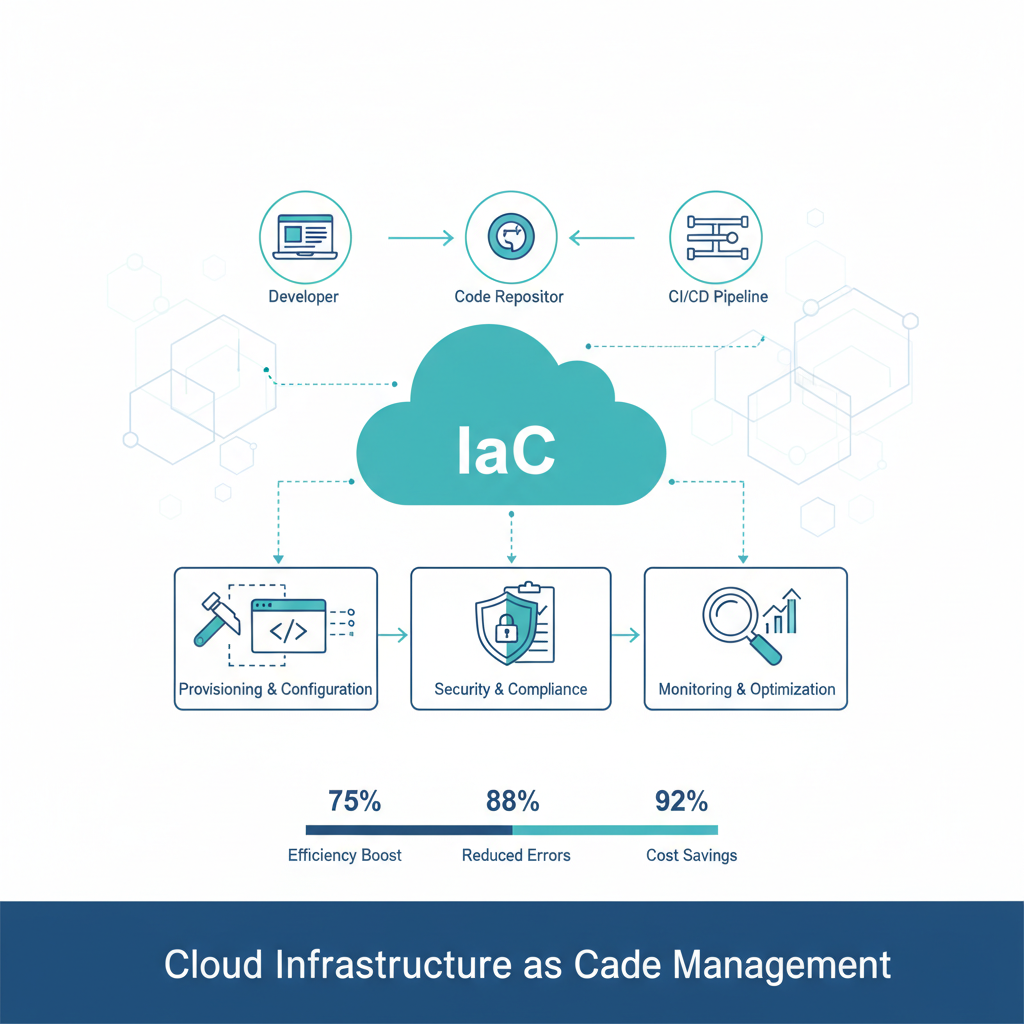
The digital landscape in 2026 demands efficiency, consistency, and scalability from cloud infrastructure. This is precisely where cloud IaC management becomes indispensable. Infrastructure as Code (IaC) allows organizations to manage and provision their computing infrastructure using machine-readable definition files, rather than physical hardware configuration or interactive configuration tools.
Adopting robust cloud iac management practices is no longer an option but a necessity for businesses aiming for agility and reliability. This comprehensive guide will walk you through the core concepts, tools, implementation steps, and best practices for mastering cloud IaC management. You will gain valuable insights into effectively automating your cloud environments.
Understanding Cloud IaC Management Fundamentals
Infrastructure as Code (IaC) is a pivotal methodology that treats infrastructure configuration files the same way developers treat application code. It enables the management of cloud resources with code, bringing numerous benefits to modern cloud operations. This approach ensures environments are consistently provisioned and easily replicable.
Cloud IaC management extends these principles specifically to cloud environments, leveraging the elasticity and API-driven nature of platforms like AWS, Azure, and Google Cloud. It provides a standardized and repeatable way to deploy, update, and manage cloud infrastructure at scale. This fundamental shift from manual configuration to automated, script-based deployments is transformative.
What is Infrastructure as Code (IaC)?
IaC automates the provisioning of infrastructure by using code or configuration files. Instead of manually setting up servers, databases, or networks, you write scripts that define the desired state of your infrastructure. These scripts can then be executed to create or modify resources.
This method replaces traditional manual processes, which are often prone to human error and inconsistency. IaC for cloud infrastructure ensures that environments are identical across development, testing, and production stages. This consistency drastically reduces deployment failures and speeds up the development lifecycle.
Why is Cloud IaC Management Essential in 2026?
In 2026, the complexity of cloud environments continues to grow alongside the demand for rapid deployments. Manual provisioning simply cannot keep pace with these evolving requirements. Cloud iac management provides the necessary framework for maintaining control and agility.
It addresses critical challenges such as configuration drift, where environments diverge over time, leading to unpredictable behavior. Furthermore, it supports the burgeoning need for multi-cloud IaC strategies, allowing organizations to manage infrastructure across different providers seamlessly. This unified approach reduces operational overhead and enhances strategic flexibility.
Benefits of Adopting Cloud IaC Management
Implementing cloud IaC management brings a wealth of advantages to any organization. These benefits directly contribute to improved operational efficiency, reduced costs, and enhanced security postures. Understanding these advantages highlights why IaC is a cornerstone of modern cloud architecture.
Key benefits include:
Consistency and Repeatability: IaC eliminates manual errors by ensuring every environment is provisioned identically from the same code. This consistency is vital for reliable operations.
Speed and Agility: Deploying infrastructure becomes significantly faster, enabling rapid iteration and quicker time-to-market for applications. Cloud automation with IaC accelerates the entire development pipeline.
Cost Efficiency: By automating provisioning and de-provisioning, resources are only active when needed, reducing unnecessary expenditure. It helps optimize cloud infrastructure provisioning costs.
Version Control: Infrastructure definitions can be stored in version control systems like Git, allowing for change tracking, collaboration, and easy rollbacks. This provides a clear audit trail.
Reduced Risk: Automated deployments are less error-prone than manual processes, leading to more stable and secure environments. It minimizes the risk associated with human intervention.
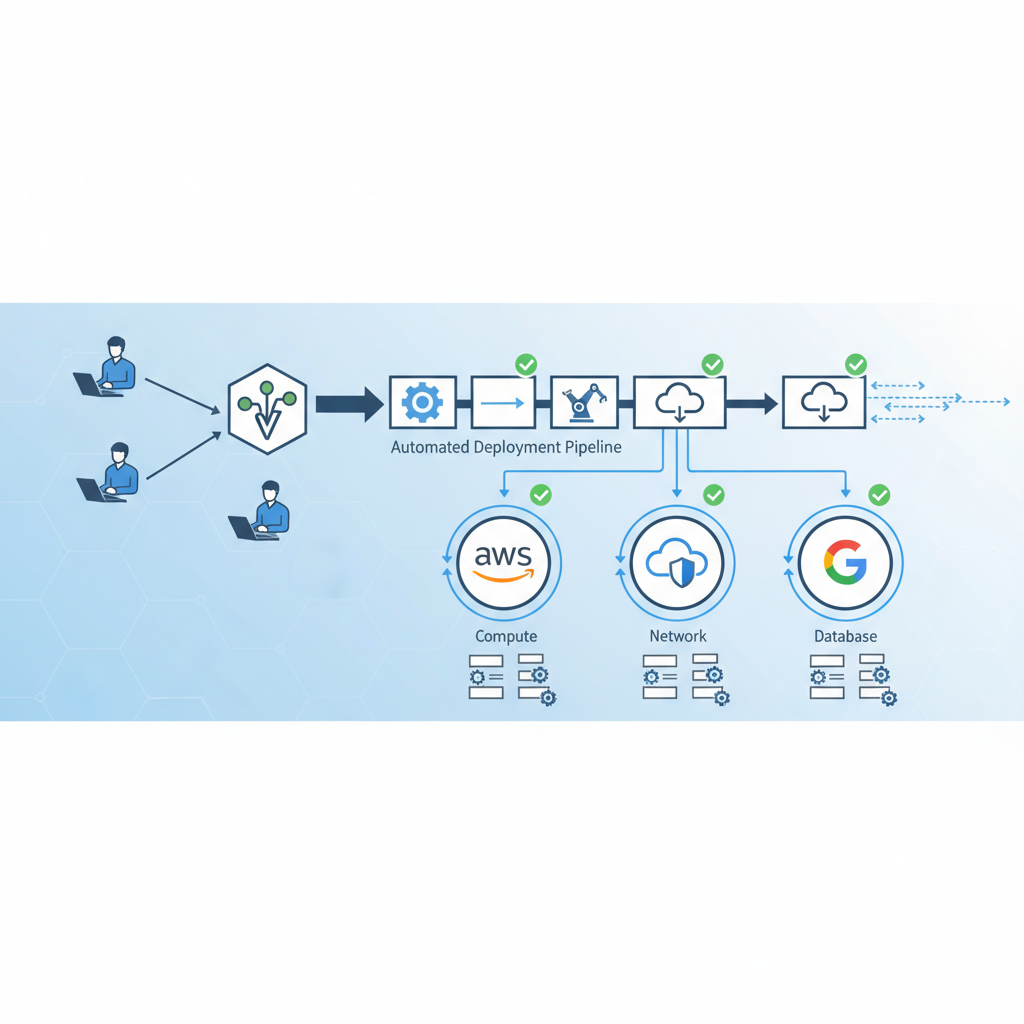
A diagram illustrating the workflow of Infrastructure as Code, showing developers committing code to a version control system, which then triggers an automated deployment pipeline to provision and configure cloud resources across different cloud providers.
Core Principles of Cloud IaC
Effective cloud iac management relies on a few fundamental principles that guide its implementation and ongoing use. Adhering to these principles ensures that your IaC strategy is robust, maintainable, and scalable. These are the bedrock of reliable cloud automation.
Understanding these foundational concepts is crucial for anyone looking to leverage IaC for cloud infrastructure. They inform tool selection, design patterns, and operational practices. Let’s delve into each of them.
Idempotence
Idempotence is a critical concept in IaC, meaning that applying the same IaC configuration multiple times will always result in the same desired state, without causing unintended side effects. For example, if your code specifies that a virtual machine should exist, running the code multiple times will only create it once and then ensure it remains in that state.
This principle simplifies operations, as you don’t need to worry about the current state of your infrastructure before applying a configuration. You can run your IaC scripts knowing they will safely bring the environment to the defined state. This makes updates and rollbacks far more reliable.
Version Control
Storing your IaC configurations in a version control system (VCS) like Git is non-negotiable. Version control provides a historical record of all changes, who made them, and why. It facilitates collaboration among team members.
This allows for seamless tracking of infrastructure changes, easy rollback to previous stable states, and code reviews before deployment. It ensures that managing cloud resources with code is as disciplined as managing application code. Without it, IaC quickly becomes chaotic and unmanageable.
Modularity
Modularity involves breaking down your infrastructure definitions into smaller, reusable components. Instead of one monolithic script, you create modules for common patterns, such as a web server setup or a database cluster. These modules can then be composed to build larger environments.
This approach enhances readability, reduces duplication, and improves maintainability of your IaC code. It encourages reuse, which is especially beneficial in complex or multi-cloud IaC environments. Modularity also makes it easier to onboard new team members.
Declarative vs. Imperative Approaches
IaC tools generally fall into two categories: declarative or imperative. Understanding the distinction is vital for choosing the right tool for your specific needs. Both have their place in cloud automation with IaC.
Declarative IaC: You define the desired end state of your infrastructure, and the IaC tool figures out how to get there. Examples include Terraform and AWS CloudFormation. This approach focuses on what should be, rather than how to do it. It offers simplicity and reduces the need for detailed step-by-step instructions.
Imperative IaC: You define the specific steps or commands to execute to reach the desired state. Examples include Ansible, Chef, and Puppet. This approach focuses on how to achieve the state. It offers fine-grained control but can be more complex to manage as infrastructure grows.
Key Tools for Cloud IaC Management
The market offers a rich ecosystem of tools designed to facilitate cloud iac management. Each tool has its strengths, ideal use cases, and specific syntax. Choosing the right tool often depends on your cloud provider strategy, team expertise, and specific requirements.
Understanding the landscape of these tools is crucial for any organization looking to implement IaC for cloud infrastructure effectively. They are the engines that drive cloud automation with IaC. Let’s explore some of the most prominent ones.
Terraform
HashiCorp Terraform is a widely adopted open-source IaC tool that allows you to define and provision cloud and on-premise resources using a declarative configuration language (HashiCorp Configuration Language or HCL). Its popularity stems from its provider-agnostic nature.
Terraform supports a vast array of cloud providers, including AWS, Azure, Google Cloud, and many others, making it an excellent choice for multi-cloud IaC strategies. It creates an execution plan describing what it will do before actually making any changes, offering a transparent and predictable provisioning process. This helps manage cloud resources with code across diverse environments.
CloudFormation (AWS IaC Management)
AWS CloudFormation is Amazon’s native IaC service for provisioning and managing AWS resources. It allows you to model your entire AWS infrastructure in text files (JSON or YAML) known as templates. CloudFormation then provisions and configures those resources in an orderly and predictable fashion.
CloudFormation is deeply integrated with the AWS ecosystem, offering fine-grained control over AWS services. It’s an excellent choice for organizations heavily invested in AWS IaC management, providing features like stack sets for multi-account, multi-region deployments. This makes it a powerful tool for cloud infrastructure provisioning within AWS.
Azure Resource Manager (Azure IaC Management)
Azure Resource Manager (ARM) is Microsoft Azure’s native deployment and management service. It provides a management layer that enables you to create, update, and delete resources in your Azure subscription. ARM templates (JSON files) define the infrastructure and configuration for your Azure solutions.
Similar to CloudFormation for AWS, ARM templates are the preferred method for Azure IaC management. They allow you to deploy entire solutions repeatedly and reliably. ARM templates integrate seamlessly with Azure DevOps and other Azure services, streamlining cloud automation with IaC within the Azure ecosystem.
Google Cloud Deployment Manager (Google Cloud IaC)
Google Cloud Deployment Manager is the native IaC tool for Google Cloud Platform. It allows you to specify all the resources needed for your application in a declarative format (YAML or Python templates). It then provisions and manages those resources on Google Cloud.
Deployment Manager enables users to create and manage complex Google Cloud infrastructure consistently. It integrates well with other Google Cloud services and is the go-to solution for organizations focused on Google Cloud IaC. It streamlines cloud infrastructure provisioning for GCP environments.
Ansible, Puppet, Chef (Configuration Management)
While Terraform, CloudFormation, and ARM templates focus on infrastructure provisioning, tools like Ansible, Puppet, and Chef primarily handle configuration management. They define the state of software and services within servers. Ansible, in particular, is often used for cloud automation with IaC due to its agentless nature.
These tools can complement infrastructure provisioning tools by configuring applications, installing packages, and managing services on the provisioned VMs. For instance, you might use Terraform to provision a VM and then Ansible to configure the web server on it. This integrated approach ensures complete managing cloud resources with code.
✓ Free consultation ✓ No commitment required ✓ Trusted by experts
Implementing Cloud IaC Management: A Step-by-Step Guide
Successfully implementing cloud iac management involves a structured approach, from defining requirements to continuous deployment. This section provides a practical, step-by-step guide to help you establish robust IaC practices within your organization. Each step is designed to build upon the last, ensuring a cohesive strategy.
Following these steps will enable you to effectively harness IaC for cloud infrastructure, leading to more reliable and automated environments. This process will guide you through managing cloud resources with code efficiently.
Step 1: Define Your Cloud Infrastructure Requirements
Before writing any code, clearly articulate what infrastructure you need. This includes virtual machines, networks, databases, storage, load balancers, security groups, and any specific configurations. Document these requirements thoroughly.
Consider factors like desired region, instance types, networking topology, and security policies. A clear understanding of your target architecture is foundational for effective cloud infrastructure provisioning. This initial planning phase prevents costly rework later on.
Step 2: Choose Your IaC Tool
Based on your cloud providers (single-cloud vs. multi-cloud IaC), team expertise, and specific requirements (declarative vs. imperative), select the most appropriate IaC tool. Terraform is often preferred for multi-cloud scenarios, while native tools like CloudFormation or ARM are excellent for single-provider environments.
Consider the learning curve, community support, and existing integrations. The right tool aligns with your long-term cloud strategy and organizational capabilities. This decision significantly impacts your cloud automation with IaC capabilities.
Step 3: Develop Your IaC Code
Write your infrastructure definitions using the chosen IaC tool’s syntax (e.g., HCL for Terraform, JSON/YAML for CloudFormation/ARM). Start with small, manageable modules for common resource types. Focus on creating reusable components.
Ensure your code is clear, well-commented, and follows best practices for the chosen language. This phase is where you begin managing cloud resources with code, transforming architectural designs into executable scripts. Break down complex infrastructure into logical blocks.
Step 4: Version Control and Collaboration
Store all your IaC code in a version control system like Git. Create a structured repository with clear folders for different environments (dev, staging, prod) or services. Implement branching strategies, pull requests, and code reviews.
This ensures all changes are tracked, reviewed, and approved before deployment, fostering collaboration and preventing unauthorized modifications. Version control is crucial for maintaining the integrity of your cloud iac management system. It provides an essential audit trail for every change.
Step 5: Testing Your IaC Deployments
Testing is as vital for IaC as it is for application code. Implement various testing strategies:
Syntax Validation: Tools often provide commands to validate the syntax of your configuration files.
Static Analysis: Use linters to enforce coding standards and identify potential issues.
Unit Testing: Test individual modules in isolation.
Integration Testing: Deploy a small, isolated environment to ensure different infrastructure components work together as expected.
End-to-End Testing: Validate the entire application stack after infrastructure provisioning.
Thorough testing ensures reliability and catches errors before they impact production environments. It validates the effectiveness of your cloud automation with IaC efforts.
Step 6: Deploying and Monitoring
Integrate your IaC workflows into a Continuous Integration/Continuous Delivery (CI/CD) pipeline. This automates the process of validating, deploying, and updating your infrastructure. Tools like Jenkins, GitLab CI/CD, GitHub Actions, or Azure DevOps can orchestrate these pipelines.
After deployment, monitor your infrastructure using cloud-native monitoring tools (e.g., AWS CloudWatch, Azure Monitor, Google Cloud Monitoring). Set up alerts for any deviations from the expected state. Continuous monitoring is crucial for detecting and addressing issues proactively.
Step 7: Managing Multi-Cloud Environments
For organizations adopting a multi-cloud strategy, multi-cloud IaC becomes paramount. Tools like Terraform excel in this area by providing a unified language to manage resources across different providers. Develop abstract modules that can be reused across AWS, Azure, and Google Cloud IaC.
Establish consistent naming conventions and tagging strategies across all cloud platforms. This helps in managing cloud resources with code effectively, even with varied underlying infrastructure. A coherent strategy minimizes complexity and maximizes efficiency in a multi-cloud setup.
Professional visual illustration related to cloud iac management
Best Practices for Effective Cloud IaC Management
Adopting cloud iac management is a journey, and adhering to best practices ensures its long-term success and maintainability. These practices are designed to maximize efficiency, enhance security, and promote collaboration within your team. They build upon the core principles and steps outlined earlier.
By integrating these best practices, your organization can fully realize the transformative power of IaC for cloud infrastructure. They are essential for turning theoretical knowledge into practical, robust solutions.
Modular Design
Always design your IaC code with modularity in mind. Break down your infrastructure into small, reusable components or modules. For instance, create a module for a standard VPC network configuration, another for a database instance, and so on.
This approach reduces complexity, promotes code reuse, and makes your configurations easier to test and maintain. It is particularly valuable for complex architectures and multi-cloud IaC environments. Modularity helps ensure consistency across different projects.
Security First
Integrate security considerations into every stage of your IaC lifecycle. Implement the principle of least privilege in your IaC configurations, granting only the necessary permissions to resources. Use secrets management tools (e.g., HashiCorp Vault, AWS Secrets Manager) for sensitive data.
Regularly audit your IaC code for security vulnerabilities. Tools like static analysis can help identify misconfigurations that could expose your infrastructure. A security-first approach is critical for protecting your cloud assets.
Cost Optimization
IaC can be a powerful tool for cost optimization. Define resource lifecycles within your code, automatically de-provisioning resources when they are no longer needed. Implement tagging strategies to track costs across different projects or teams.
Use smaller instance types when appropriate and leverage auto-scaling configurations defined in your IaC. By codifying cost-aware practices, you ensure that your cloud infrastructure provisioning remains efficient and cost-effective.
Embrace CI/CD pipelines for your IaC deployments. Automate testing, validation, and deployment processes. This ensures that every change to your infrastructure code is automatically checked for errors and consistency before being deployed.
A robust CI/CD pipeline accelerates deployments, reduces manual errors, and provides a reliable audit trail for all infrastructure changes. It is the cornerstone of effective cloud automation with IaC, ensuring rapid and safe iteration.
Documentation and Knowledge Sharing
Maintain clear and comprehensive documentation for your IaC code and deployment processes. Document architectural decisions, module usages, and specific configurations. This helps new team members quickly understand the infrastructure.
Regularly share knowledge and conduct code reviews within your team. Foster a culture where IaC best practices are consistently applied and improved upon. Good documentation and knowledge sharing are vital for the long-term sustainability of your cloud iac management efforts.
Challenges and Solutions in Cloud IaC Management
While cloud iac management offers immense benefits, it also presents its own set of challenges. Addressing these proactively is key to a successful implementation. Understanding potential pitfalls allows teams to prepare and implement effective mitigation strategies.
From managing complexity to handling state, these challenges are common but surmountable with the right approach. Let’s explore some of the typical hurdles and their respective solutions in managing cloud resources with code.
Complexity
As infrastructure grows, IaC codebases can become complex and difficult to manage. Multiple teams might be contributing, and interdependencies can become intricate. This complexity can slow down development and increase the risk of errors.
Solution: Embrace modularity and create clear, consistent directory structures. Use abstraction layers and follow strict naming conventions. Leverage IaC frameworks that support modularity and encourage code reuse. Regular refactoring and code reviews also help maintain clarity and reduce complexity in IaC for cloud infrastructure.
State Management
Many IaC tools, like Terraform, maintain a “state file” that maps real-world cloud resources to your configuration. Managing this state, especially in collaborative environments, can be challenging. Incorrect state files can lead to resource corruption or unexpected deletions.
Solution: Always store state files remotely in a shared, secure backend (e.g., AWS S3, Azure Blob Storage, Google Cloud Storage) with versioning enabled. Implement strong locking mechanisms to prevent concurrent modifications. Regularly back up your state files to ensure recovery in case of accidental loss or corruption.
Drift Detection
Configuration drift occurs when the actual state of your cloud infrastructure deviates from the state defined in your IaC code. This can happen due to manual changes, out-of-band updates, or errors. Drift leads to inconsistencies and potential operational issues.
Solution: Implement automated drift detection tools that regularly compare your live infrastructure with your IaC definitions. Use IaC tools in an idempotent manner, running them periodically to enforce the desired state. Establish strict policies preventing manual changes to IaC-managed resources.
Learning Curve
Adopting IaC requires developers and operations teams to learn new tools, syntax, and paradigms. This learning curve can initially slow down progress and require significant investment in training. The transition from manual processes can be substantial.
Solution: Provide comprehensive training and resources for your team. Start with small, manageable IaC projects to build confidence and expertise. Foster a culture of learning and knowledge sharing. Leverage existing documentation and community support for chosen IaC tools to accelerate the learning process for cloud automation with IaC.
Future Trends in Cloud IaC Management in 2026
The field of cloud iac management is continuously evolving, driven by advancements in cloud technologies and the increasing demand for automation. Looking ahead to 2026, several key trends are poised to reshape how we manage cloud infrastructure. These trends will further enhance the power and reach of IaC.
Staying abreast of these emerging trends is crucial for organizations aiming to maintain a competitive edge and optimize their cloud operations. They signify a continuous push towards more intelligent, secure, and integrated IaC solutions.
AI/ML Integration
Expect to see greater integration of Artificial Intelligence and Machine Learning into IaC tools. AI could automate the generation of IaC code based on natural language descriptions or existing infrastructure patterns. ML algorithms might optimize resource allocation or predict potential configuration issues before deployment.
This integration promises to make cloud infrastructure provisioning even smarter and more efficient, reducing the manual effort required for complex deployments. AI-driven insights will enhance drift detection and predictive maintenance.
Enhanced Security Automation
Security will remain a top priority, with a focus on embedding security practices more deeply into IaC workflows. Expect advanced static analysis tools capable of detecting sophisticated security vulnerabilities within IaC code automatically. Policy-as-Code solutions will become more prevalent, enforcing security compliance throughout the deployment pipeline.
Zero-trust principles will be more easily configurable and auditable through IaC. This will lead to more robust, self-healing security postures within cloud environments.
Greater Multi-Cloud Abstraction
As multi-cloud strategies become more common, there will be a push for even higher levels of abstraction in IaC. Tools will emerge that allow users to define infrastructure requirements at an even higher level, translating them into provider-specific IaC code automatically. This will simplify multi-cloud IaC.
This trend aims to further reduce the overhead of managing diverse cloud environments, making it easier to achieve true cloud portability and vendor independence. Unified control planes for managing cloud resources with code across disparate platforms will become more sophisticated.
Frequently Asked Questions
This section addresses some common questions regarding cloud iac management, providing concise answers to help clarify key concepts and best practices.
What is the primary goal of cloud iac management?
The primary goal of cloud iac management is to automate the provisioning and management of cloud infrastructure using code. This ensures consistency, repeatability, and efficiency across all environments, reducing manual errors and accelerating deployments. It aims to treat infrastructure like any other software component.
How does IaC for cloud infrastructure differ from traditional infrastructure management?
IaC for cloud infrastructure differs significantly from traditional methods by replacing manual configurations with code-based definitions. Traditional approaches often involve manual clicks, scripts, or proprietary tools, leading to inconsistencies and human error. IaC automates these processes, making them version-controlled, repeatable, and scalable.
What are the main advantages of using multi-cloud IaC?
The main advantages of using multi-cloud IaC include enhanced vendor independence, improved disaster recovery capabilities, and the ability to leverage best-of-breed services from different cloud providers. It allows organizations to manage diverse cloud resources with a unified approach, reducing operational complexity and increasing flexibility.
Is cloud automation with IaC only for large enterprises?
No, cloud automation with IaC is beneficial for organizations of all sizes, from small startups to large enterprises. While larger companies might have more complex needs, even small teams can gain significant advantages in terms of consistency, speed, and reduced manual effort by adopting IaC practices. It scales effectively across different operational scopes.
What is the role of version control in cloud iac management?
Version control plays a critical role in cloud iac management by providing a comprehensive history of all infrastructure changes. It enables collaboration among teams, facilitates easy rollbacks to previous stable states, and serves as an audit trail for compliance. Without version control, managing cloud resources with code would be highly chaotic and prone to error.
How can I ensure security in my cloud infrastructure provisioning with IaC?
To ensure security in cloud infrastructure provisioning with IaC, always follow the principle of least privilege, use secrets management solutions for sensitive data, and implement automated security scanning in your CI/CD pipelines. Regularly audit your IaC code for misconfigurations and integrate policy-as-code tools to enforce security standards automatically.
✓ Free consultation ✓ No commitment required ✓ Trusted by experts
Conclusion
Cloud IaC management is an indispensable practice for any organization navigating the complexities of modern cloud environments in 2026. By treating your infrastructure as code, you unlock unparalleled levels of consistency, automation, speed, and reliability. This fundamental shift from manual configuration to automated, version-controlled deployments is not just a best practice; it is a strategic imperative.
From understanding core principles like idempotence and modularity to selecting the right tools like Terraform, CloudFormation, or Azure Resource Manager, and following a structured implementation guide, mastering cloud iac management empowers your teams. Embracing best practices such as modular design, security-first approaches, and CI/CD pipelines will further solidify your cloud infrastructure. While challenges like complexity and state management exist, they are surmountable with the right strategies. By staying informed about future trends like AI/ML integration and enhanced multi-cloud abstraction, your organization can continue to evolve and thrive. Cloud IaC management is the key to building resilient, scalable, and efficient cloud operations for the future.
Johan Carlsson is a cloud architecture specialist and frequent speaker focused on scalable workloads, AI/ML, and IoT innovation. At Opsio, he helps organizations harness cutting-edge technology, automation, and purpose-built services to drive efficiency and achieve sustainable growth. Johan is known for enabling enterprises to gain a competitive advantage by transforming complex technical challenges into powerful, future-ready cloud solutions.