Discover Why Use IaC Management For Enhanced IT Operations
March 12, 2026|8:09 AM
Unlock Your Digital Potential
Whether it’s IT operations, cloud migration, or AI-driven innovation – let’s explore how we can support your success.
Home /
Work /
Blogs /
Discover Why Use IaC Management For Enhanced IT Operations
Understanding IaC Management
Infrastructure as Code (IaC) has revolutionized how organizations manage their IT infrastructure, moving from manual configurations to automated, script-driven deployments. The question of why use iac management? is increasingly central for businesses striving for agility, scalability, and reliability in their operations. Embracing IaC management transforms the entire lifecycle of infrastructure provisioning and configuration.
This comprehensive guide will explore the compelling reasons behind adopting IaC management. We will delve into its core principles, demonstrate its practical applications, and outline a clear path for implementation in 2026 and beyond. Understanding the value proposition of IaC management is crucial for any organization looking to modernize its IT landscape.
The Core Reasons: why use iac management?
The fundamental shift towards IaC management is driven by a desire for greater control, consistency, and speed in infrastructure provisioning. Traditional manual processes are prone to human error, leading to configuration drift and inconsistent environments across development, testing, and production. This inconsistency creates significant challenges and slows down deployment cycles.
By codifying infrastructure, organizations gain a single source of truth for their environments. This codified approach ensures that every deployment is identical, repeatable, and auditable, significantly reducing the risks associated with manual operations. It’s a paradigm shift that offers profound advantages in today’s fast-paced digital world.
One of the primary reasons for implementing IaC is its ability to accelerate deployment times dramatically. Automation removes the bottlenecks of manual approvals and configurations, allowing infrastructure to be provisioned in minutes rather than days or weeks. This speed is critical for rapid innovation and responding quickly to market demands.
IaC also fosters collaboration between development and operations teams, often referred to as DevOps. When infrastructure is treated like application code, it can be version-controlled, reviewed, and deployed using similar CI/CD pipelines. This integration enhances communication and streamlines the entire software delivery process, making it a compelling business case for IaC.
Key benefits of IaC adoption and Its Advantages
The benefits of IaC adoption extend far beyond simple automation, touching almost every aspect of IT operations and business strategy. Organizations experience significant improvements in efficiency, reliability, and security, justifying the investment in this transformative approach. Understanding these deep advantages of infrastructure as code is key to appreciating its power.
Enhanced Consistency and Reduced Configuration Drift
One of the most significant advantages of IaC is its ability to ensure consistency across all environments. Infrastructure defined in code means that every time an environment is provisioned, it will be identical to the last. This eliminates the “it works on my machine” problem, as development, staging, and production environments are consistently configured.
Configuration drift, where environments diverge over time due to manual changes, becomes a thing of the past. IaC tools continuously enforce the desired state, automatically rectifying any unauthorized or accidental modifications. This level of consistency is paramount for stable applications and predictable performance, highlighting the importance of IaC in modern IT.
Improved Efficiency and Faster Deployments
IaC management significantly boosts operational efficiency. Automated provisioning and configuration reduce the time and effort traditionally spent on manual setup tasks. This frees up valuable IT staff to focus on more strategic initiatives rather than repetitive, error-prone work.
The speed of deployment is also dramatically enhanced. With IaC, entire infrastructures can be spun up or down in minutes, supporting dynamic scaling needs and accelerating time-to-market for new applications and features. These efficiency gains with IaC translate directly into a more agile and responsive business, bolstering the reasons for implementing IaC.
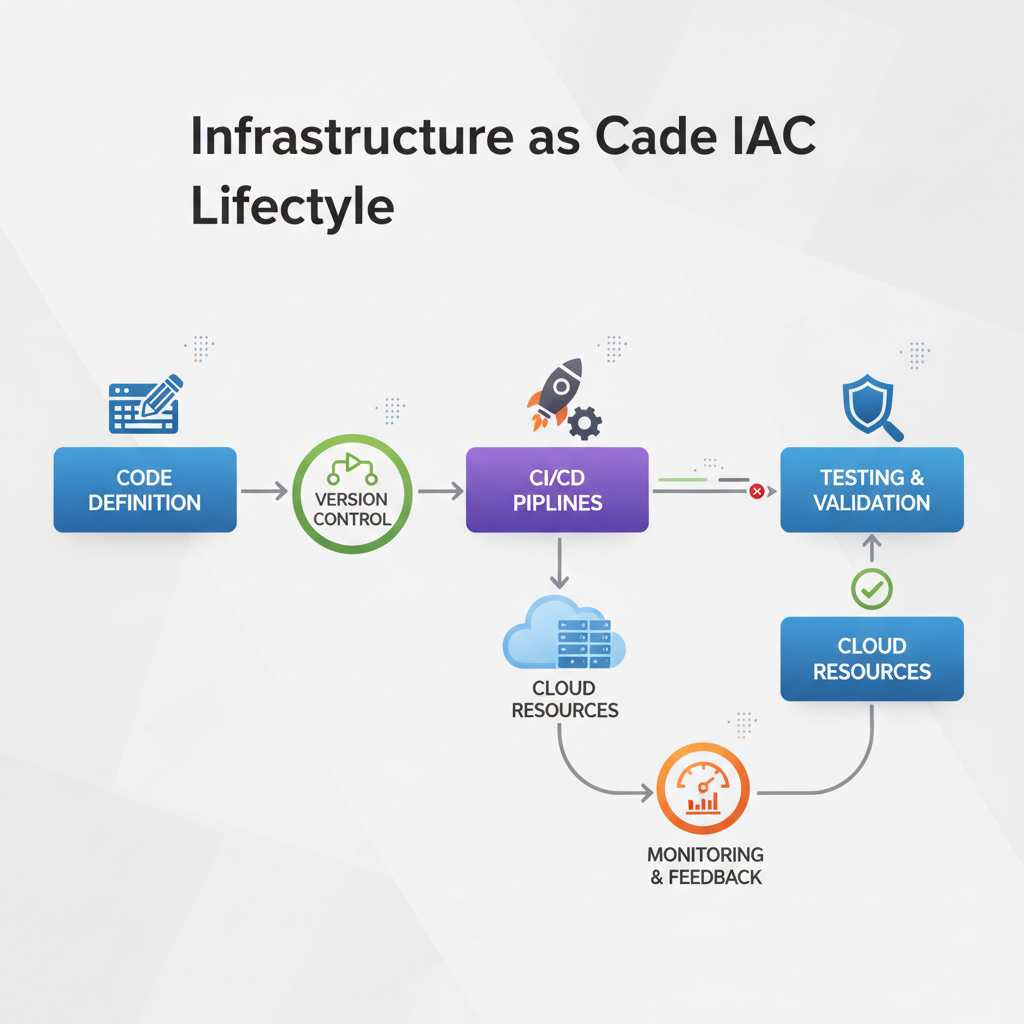
A flowchart illustrating the IaC lifecycle, showing steps from code definition to automated deployment and continuous monitoring, with icons representing version control, CI/CD pipelines, and cloud resources.
Greater Scalability and Cost Optimization
IaC makes scaling infrastructure much simpler and more predictable. Whether an organization needs to provision hundreds of servers for a peak load or tear down resources to optimize costs, IaC scripts can handle these operations automatically. This elasticity is crucial for cloud-native architectures and managing fluctuating demands.
By enabling automated provisioning and de-provisioning, IaC helps in optimizing cloud costs. Resources are only active when needed, minimizing wasted expenditure on idle infrastructure. This direct impact on the bottom line showcases the strong business case for IaC, making it an attractive proposition for financial efficiency.
Enhanced Security and Compliance
Security and compliance are inherently improved through IaC. Security policies, network configurations, and access controls can all be defined in code and subjected to version control and review processes. This ensures that security best practices are consistently applied across all infrastructure.
Automated enforcement helps prevent security misconfigurations, which are a common cause of breaches. Furthermore, IaC provides an auditable trail of all infrastructure changes, simplifying compliance reporting and demonstrating adherence to regulatory standards. This makes IaC an indispensable tool for robust security postures.
Better Collaboration and Version Control
Treating infrastructure as code enables it to be managed with the same principles as application code. This means using version control systems like Git to track changes, review pull requests, and roll back to previous states if necessary. Collaboration among teams, especially DevOps teams, is greatly enhanced.
Developers and operations engineers can work together on infrastructure definitions, fostering a shared understanding and reducing silos. This collaborative environment is a cornerstone of improving operations with IaC, leading to smoother deployments and faster issue resolution. The clear history of changes also makes debugging and troubleshooting significantly easier.
✓ Free consultation ✓ No commitment required ✓ Trusted by experts
Implementing IaC: A Step-by-Step Approach
Adopting IaC management requires a structured approach to ensure a smooth transition and maximize its benefits. It’s not just about tools; it’s about a fundamental shift in mindset and processes. This section provides a practical, step-by-step guide for organizations looking to harness the power of IaC.
Step 1: Define Your Strategy and Choose Your Tools
Before diving into code, clearly define your organization’s goals for IaC. Are you aiming for faster deployments, better consistency, cost savings, or a combination? Understanding your objectives will guide your tool selection and implementation strategy. Research different IaC tools available in the market.
Popular IaC tools include Terraform, Ansible, Puppet, Chef, and AWS CloudFormation. Each has its strengths, ideal use cases, and learning curves. For instance, Terraform is excellent for provisioning cloud resources across multiple providers, while Ansible is often preferred for configuration management. Choose the tool that best aligns with your existing technology stack and team expertise.
Step 2: Start Small with a Pilot Project
Do not attempt to convert all your infrastructure to IaC at once. Begin with a small, non-critical project or a new greenfield environment. This allows your team to gain experience with the chosen tools and processes without risking major production outages. A pilot project helps identify potential challenges early on.
This initial project should focus on automating a specific, well-understood piece of infrastructure, such as a simple web server or a new development environment. Document every step, challenge, and lesson learned during this phase. This valuable experience will inform your broader IaC adoption.
Step 3: Develop Your IaC Code and Repository Structure
Once tools are chosen and a pilot is underway, start writing your infrastructure code. Define your desired infrastructure state using the syntax of your chosen IaC tool. Organize your code logically within a version control system, typically Git. A well-structured repository is crucial for maintainability and collaboration.
Consider creating separate modules or templates for reusable components, such as standard virtual machine configurations or network setups. This modular approach promotes reusability, reduces redundancy, and makes your code easier to manage and update. Treat your IaC code with the same rigor as application code, including commenting and documentation.
Step 4: Implement Version Control and CI/CD Pipelines
Version control is foundational to IaC management. All infrastructure code must reside in a version control system, allowing teams to track changes, revert to previous versions, and collaborate effectively. Implement branching strategies and pull request workflows for reviewing and approving infrastructure changes.
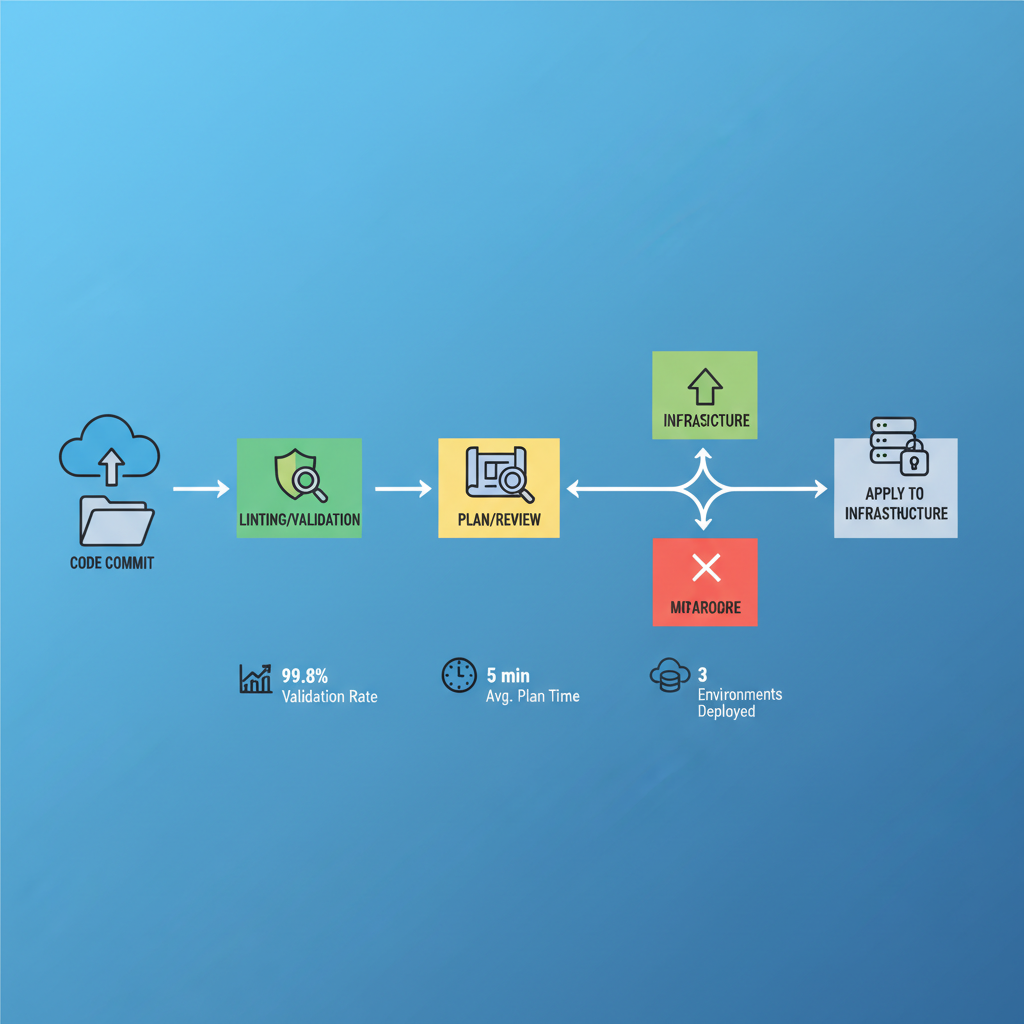
Integrate your IaC code into Continuous Integration/Continuous Deployment (CI/CD) pipelines. This automates the testing and deployment of your infrastructure changes, similar to how application code is deployed. A typical pipeline might involve linting, validation, plan generation, and then applying the changes to the target environment.
A diagram showing a CI/CD pipeline specifically for IaC, illustrating stages like “Code Commit,” “Linting/Validation,” “Plan/Review,” and “Apply to Infrastructure,” with arrows indicating flow.
Step 5: Test, Monitor, and Refine
Testing your IaC code is as critical as testing application code. Implement automated tests to validate your infrastructure configurations, ensuring they meet your requirements and security policies. Tools exist to test the syntax, logic, and even the deployed state of your infrastructure.
Once deployed, continuously monitor your infrastructure to ensure it remains in its desired state and performs as expected. Leverage monitoring tools to detect configuration drift or performance issues. Use this feedback to refine your IaC code and processes, ensuring continuous improvement.
Overcoming Challenges and Best Practices for IaC Management
While the advantages of infrastructure as code are compelling, organizations may encounter challenges during adoption. Being aware of these potential pitfalls and implementing best practices can smooth the transition and ensure long-term success with IaC management. Addressing these proactively reinforces the reasons for implementing IaC.
Addressing Cultural Resistance
One of the biggest hurdles is often cultural, not technical. Teams accustomed to manual processes may resist the change to automated, code-driven infrastructure. Education, training, and demonstrating the direct benefits of IaC are crucial for overcoming this resistance. Foster a culture of collaboration between development and operations.
Start with champions within the organization who are enthusiastic about IaC and can demonstrate its value. Provide ample training and support to empower all team members to embrace the new workflows. Highlighting the efficiency gains with IaC and how it improves operations can motivate adoption.
Managing State Files
Many IaC tools, like Terraform, maintain a state file that maps real-world infrastructure to your configuration. Managing this state file correctly is critical, especially in team environments. Incorrectly managed state files can lead to inconsistencies or even accidental infrastructure destruction.
Always store state files in a secure, remote backend that supports locking, such as AWS S3 with DynamoDB locking, Azure Blob Storage, or Google Cloud Storage. This prevents concurrent modifications and ensures consistency across team members, safeguarding your infrastructure.
Securing IaC Code and Credentials
Just as application code can expose vulnerabilities, so can IaC code. Sensitive information, such as API keys, database credentials, or access tokens, should never be hardcoded directly into your IaC scripts. Implement robust secrets management solutions.
Utilize secret management tools like HashiCorp Vault, AWS Secrets Manager, or Azure Key Vault to store and retrieve sensitive information securely at deployment time. Ensure your CI/CD pipelines are configured to access these secrets safely without exposing them in logs or version control.
Maintaining Idempotency
IaC tools are designed to be idempotent, meaning that applying the same configuration multiple times will result in the same desired state without unintended side effects. Ensure your IaC code adheres to this principle. Avoid scripts that produce different results on subsequent runs.
Thoroughly test your IaC configurations to confirm idempotency. This is crucial for consistent deployments and for safely making incremental changes to your infrastructure without introducing errors. Consistent outcomes are a key part of the importance of IaC.
Continuous Learning and Iteration
The landscape of cloud services and IaC tools is constantly evolving. Continuous learning is essential for keeping your IaC strategy effective and up-to-date. Encourage your teams to stay informed about new features, best practices, and security updates for their chosen tools.
Regularly review and refine your IaC code and processes. Conduct post-mortems on any deployment issues and incorporate lessons learned into your future IaC practices. This iterative approach ensures your IaC management evolves with your business needs, continuously improving operations with IaC.
The Future of Infrastructure Management: IaC in 2026
Looking ahead to 2026, the question of why use iac management? will likely be replaced by how to best optimize IaC management? As cloud adoption continues to grow, IaC will become an even more indispensable component of modern IT. We anticipate several key trends shaping the future of IaC.
Greater integration of AI and machine learning into IaC tools will likely emerge, offering smarter recommendations for infrastructure optimization and anomaly detection. We can expect more sophisticated policy-as-code enforcement, automating compliance and security checks at every stage of the infrastructure lifecycle. The value proposition of IaC management will continue to grow as it becomes more intelligent and proactive.
Furthermore, the rise of “platform engineering” will see organizations building internal developer platforms that heavily leverage IaC. These platforms will provide self-service capabilities for developers to provision and manage their infrastructure, further accelerating development cycles. This strategic shift underscores the increasing importance of IaC as a core enabler of business innovation.
Frequently Asked Questions About IaC Management
Here are some common questions about why use iac management? and its implications.
What is the primary benefit of IaC over manual provisioning?
The primary benefit of IaC over manual provisioning is the achievement of consistency and repeatability. Manual processes are prone to human error and configuration drift, leading to inconsistent environments. IaC ensures that infrastructure is provisioned identically every time, reducing errors and enhancing reliability.
Can IaC be used with on-premises infrastructure, or is it only for the cloud?
IaC can absolutely be used with on-premises infrastructure, not just the cloud. Tools like Ansible, Puppet, and Chef are widely used for managing physical and virtual servers in traditional data centers. Many IaC principles and tools are platform-agnostic, allowing for hybrid cloud and multi-cloud strategies.
What are the main challenges when adopting IaC?
The main challenges when adopting IaC often include cultural resistance from teams used to manual methods, the initial learning curve associated with new tools and coding practices, and properly managing state files and secrets. Overcoming these requires strong leadership, comprehensive training, and robust process definition.
How does IaC contribute to DevOps practices?
IaC is a foundational component of DevOps practices because it enables treating infrastructure like application code. This allows for version control, automated testing, and CI/CD pipelines for infrastructure, fostering collaboration between development and operations teams. It streamlines the entire software delivery lifecycle, making deployments faster and more reliable.
Is IaC expensive to implement?
The initial investment in IaC can involve training costs and time spent on learning new tools and refactoring existing infrastructure. However, the long-term benefits, such as reduced errors, faster deployments, improved scalability, and cost optimization through efficient resource utilization, typically lead to significant cost savings and a strong return on investment. The business case for IaC is often overwhelmingly positive when considering its long-term value.
✓ Free consultation ✓ No commitment required ✓ Trusted by experts
Conclusion: Embracing IaC for Future-Ready Infrastructure
The journey to understand why use iac management? reveals a compelling landscape of benefits that are essential for any organization seeking to thrive in the digital age. From ensuring consistency and reducing human error to accelerating deployments and optimizing costs, IaC management is more than just a technological trend; it’s a strategic imperative. The advantages of infrastructure as code are clear, driving improved operations with IaC and delivering significant efficiency gains.
By embracing IaC, organizations can build a resilient, scalable, and secure infrastructure that supports rapid innovation and business growth. The importance of IaC cannot be overstated as we move towards increasingly complex and dynamic IT environments. Investing in IaC management today will lay the foundation for a future-ready infrastructure, providing a competitive edge in 2026 and beyond.
Johan Carlsson is a cloud architecture specialist and frequent speaker focused on scalable workloads, AI/ML, and IoT innovation. At Opsio, he helps organizations harness cutting-edge technology, automation, and purpose-built services to drive efficiency and achieve sustainable growth. Johan is known for enabling enterprises to gain a competitive advantage by transforming complex technical challenges into powerful, future-ready cloud solutions.