Discover Top IaC Management Tools for Effortless Infrastructure
March 12, 2026|7:50 AM
Unlock Your Digital Potential
Whether it’s IT operations, cloud migration, or AI-driven innovation – let’s explore how we can support your success.
Home /
Work /
Blogs /
Discover Top IaC Management Tools for Effortless Infrastructure
Understanding the Power of top iac management tools
Infrastructure as Code (IaC) has revolutionized how organizations manage and provision their IT infrastructure. Moving beyond manual configurations, IaC treats infrastructure like software, enabling automation, consistency, and repeatability. This fundamental shift is critical for modern cloud environments and agile development practices.
Adopting top iac management tools allows teams to define their infrastructure in code, store it in version control, and deploy it reliably across various environments. This approach significantly reduces human error, speeds up deployment times, and ensures environments are identical from development to production. Choosing the right set of tools is paramount for operational efficiency and successful digital transformation initiatives.
What is Infrastructure as Code (IaC)?
Infrastructure as Code is a methodology that uses configuration files to define, provision, and manage infrastructure resources. Instead of manually configuring servers, networks, and databases, these resources are described in declarative or imperative code. This code is then executed by IaC tools to create and maintain the desired state of the infrastructure.
The core principle behind IaC is to automate infrastructure management processes, making them repeatable, consistent, and scalable. This leads to faster deployments and a more robust, error-resistant environment. IaC is foundational for DevOps and continuous delivery pipelines, streamlining the entire software development lifecycle.
Benefits of Adopting IaC
Implementing IaC brings numerous advantages to organizations of all sizes. These benefits extend from development efficiency to operational stability and cost control.
Here are some key benefits:
Consistency and Repeatability: IaC ensures that infrastructure deployments are identical across different environments (development, staging, production), eliminating configuration drift and “it works on my machine” problems.
Speed and Agidity: Automating infrastructure provisioning dramatically accelerates deployment cycles, allowing teams to respond faster to business needs and scale resources rapidly.
Reduced Human Error: Manual configurations are prone to mistakes. IaC eliminates these errors by standardizing processes and using tested code to provision resources.
Version Control and Documentation: Infrastructure definitions are stored in version control systems, providing a complete history of changes, easy rollbacks, and clear documentation. This enables better collaboration among teams.
Cost Efficiency: By automating provisioning and reducing manual effort, organizations can optimize resource utilization and lower operational costs associated with infrastructure management.
Key Features to Look for in top iac management tools
When evaluating leading IaC platforms, it is crucial to understand the essential features that contribute to their effectiveness. These features dictate a tool’s capabilities, ease of use, and suitability for specific organizational needs. A comprehensive IaC management system should offer robust functionality across several key areas.
Consider these critical aspects when exploring best infrastructure as code software:
Declarative vs. Imperative Approaches:
Declarative: Users define the desired state of the infrastructure, and the tool figures out how to achieve it. This simplifies configuration for complex systems.
Imperative: Users define the steps to provision the infrastructure in a specific order. This offers more granular control but can be more complex.
Idempotence: This feature ensures that applying the same configuration multiple times will always result in the same system state, without unintended side effects. It’s a cornerstone of reliable automation.
Cloud Agnostic vs. Cloud-Specific: Some tools are designed to work across multiple cloud providers and on-premises environments, while others are optimized for a single cloud ecosystem (e.g., AWS CloudFormation). Your infrastructure strategy will guide this choice.
State Management: Many IaC tools maintain a state file that tracks the current configuration of your infrastructure. This is vital for managing changes and ensuring consistency. Understanding how a tool manages and stores this state is important.
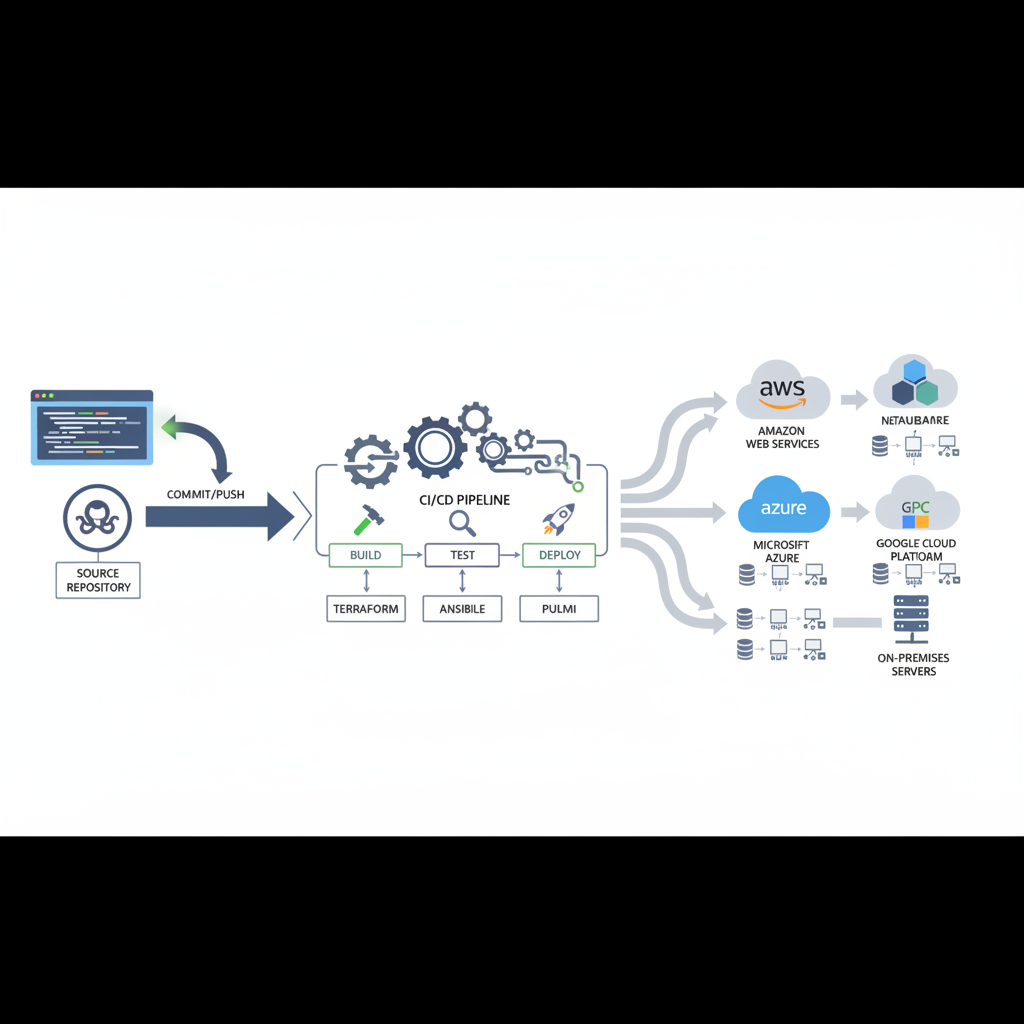
A complex diagram illustrating the flow of Infrastructure as Code, showing code being committed to a repository, CI/CD pipeline triggering IaC tools, and then provisioning resources on multiple cloud platforms and on-premises servers.
Module and Component Reusability: The ability to create reusable modules or components allows teams to define common infrastructure patterns once and reuse them across various projects. This promotes standardization and accelerates development.
Integration with CI/CD Pipelines: Seamless integration with continuous integration and continuous delivery pipelines is essential for automating the entire software release process. This ensures that infrastructure changes are tested and deployed alongside application code.
Security and Compliance: top iac management tools should offer features to enforce security policies and ensure compliance with regulatory standards. This includes secret management, access controls, and auditing capabilities.
Ecosystem and Community Support: A strong community and a rich ecosystem of plugins, modules, and integrations enhance a tool’s utility. Good documentation and active community forums are invaluable for troubleshooting and learning.
Scalability: The tool should be capable of managing infrastructure at scale, whether you are dealing with a few virtual machines or thousands of containers across multiple regions.
✓ Free consultation ✓ No commitment required ✓ Trusted by experts
Leading IaC Platforms and Tools
The market for popular IaC automation solutions is vibrant, featuring a range of highly rated IaC tools, each with its unique strengths and use cases. Understanding the distinctions between these industry-leading IaC frameworks is key to making an informed decision for your organization. This section provides an IaC tool comparison of some of the most prominent players.
Terraform
Terraform, developed by HashiCorp, is one of the most widely adopted and comprehensive IaC management systems. It uses a declarative configuration language called HashiCorp Configuration Language (HCL) to define infrastructure. Terraform is renowned for its cloud-agnostic nature, allowing users to manage resources across numerous cloud providers like AWS, Azure, Google Cloud, and even on-premises infrastructure.
Its core strength lies in its ability to provision resources across diverse environments from a single configuration. Terraform’s modularity and extensive provider ecosystem make it incredibly flexible. It maintains a state file to map real-world resources to your configuration, enabling efficient updates and preventing drift.
Ansible
Ansible, an open-source automation engine acquired by Red Hat (now IBM), is known for its simplicity and agentless architecture. It primarily uses YAML for its playbooks, making it highly readable and easy to learn. Ansible is excellent for configuration management, orchestrating multi-tier deployments, and performing ad-hoc task execution.
Unlike some other tools, Ansible connects to target machines via SSH (or WinRM for Windows), requiring no agents to be installed on the managed nodes. This reduces overhead and simplifies setup. While primarily focused on configuration, it can also provision resources effectively, especially in hybrid environments.
Puppet
Puppet is an open-source configuration management tool designed for system administrators. It uses its own declarative language (Puppet DSL) to define the desired state of infrastructure. Puppet operates on an agent/master architecture, where agents run on managed nodes and report back to a central master server.
Puppet is particularly strong in enforcing configuration policies across large fleets of servers, ensuring continuous compliance. Its strength lies in its ability to manage the lifecycle of an individual system, from initial provisioning to ongoing maintenance. It’s a mature tool with a robust ecosystem.
Chef
Similar to Puppet, Chef is another powerful configuration management tool that follows a declarative approach. It uses Ruby-based domain-specific languages (DSLs) to define “cookbooks” and “recipes” that describe infrastructure configurations. Chef also employs an agent/master model, with agents (“Chef clients”) running on managed nodes.
Chef is highly flexible and programmable, making it suitable for complex configuration scenarios and custom automation tasks. Its strength is in its ability to precisely define server configurations, applications, and services. Organizations with strong Ruby expertise often find Chef an attractive option.
AWS CloudFormation
AWS CloudFormation is a native IaC service provided by Amazon Web Services. It allows users to define AWS resources in JSON or YAML templates and provision them in an automated, repeatable fashion. CloudFormation is tightly integrated with the AWS ecosystem, offering deep control over AWS services.
While it is cloud-specific, its integration and control over AWS resources are unparalleled for AWS-centric organizations. CloudFormation supports change sets for previewing infrastructure modifications and stack sets for deploying common templates across multiple AWS accounts and regions.
Azure Resource Manager (ARM Templates)
Azure Resource Manager (ARM) templates are the native IaC solution for Microsoft Azure. These JSON-based templates define the infrastructure and configuration for Azure resources. ARM templates enable declarative deployment and management of Azure services.
They are deeply integrated with the Azure platform, offering fine-grained control over resource deployment, updates, and deletion. ARM templates support features like conditional deployments, loops, and parameterization, making them powerful for complex Azure environments.
Google Cloud Deployment Manager
Google Cloud Deployment Manager is the native IaC service for Google Cloud Platform. It allows you to specify all the resources needed for your application in a declarative configuration written in YAML. It then provisions and manages those resources in a repeatable manner.
Deployment Manager supports templating with Jinja2 or Python, providing flexibility for dynamic resource definitions. It’s ideal for organizations heavily invested in the Google Cloud ecosystem, offering seamless integration and management of GCP services.
Pulumi
Pulumi is a newer entrant among the top iac management tools, distinguishing itself by allowing developers to define infrastructure using general-purpose programming languages like Python, TypeScript, JavaScript, Go, and C#. This approach enables leveraging existing programming skills and tools for IaC.
Pulumi offers strong type-safety, testing capabilities, and integration with standard development workflows. It supports multiple cloud providers and Kubernetes, making it a versatile choice for modern cloud-native development teams who prefer code-centric infrastructure definitions.
How to Choose the Right IaC Tool for Your Needs
Choosing IaC tools is a critical decision that impacts your organization’s agility, scalability, and operational efficiency. There isn’t a one-size-fits-all solution; the best fit depends on your specific requirements, existing technology stack, and team expertise. Here’s a step-by-step guide to help you in your IaC tool comparison process.
1. Assess Your Current Environment and Future Goals:
Infrastructure Type: Are you primarily in a single cloud, multi-cloud, hybrid, or on-premises environment? Cloud-agnostic tools like Terraform or Pulumi are excellent for multi-cloud, while CloudFormation or ARM templates excel in their respective single-cloud ecosystems.
Existing Tools: Do you already use configuration management tools like Ansible or Chef for server management? Leveraging existing investments can simplify adoption.
Scalability Needs: How much infrastructure do you need to manage? Some tools are better suited for massive, dynamic environments than others.
2. Evaluate Your Team’s Expertise and Skillset:
Programming Language Preference: If your team has strong Python or Ruby skills, Ansible or Chef might be easier to adopt. If they are proficient in TypeScript/JavaScript, Pulumi could be a natural fit. For HCL, Terraform requires learning a new DSL, but it’s generally considered easy to pick up.
Learning Curve: Some tools have steeper learning curves than others. Consider the time and resources available for training your team. Agentless tools like Ansible often have a lower barrier to entry.
3. Define Your IaC Scope and Priorities:
Provisioning vs. Configuration: Are you primarily focused on provisioning new infrastructure (e.g., VMs, networks) or configuring existing servers (e.g., installing software, managing services)? Tools like Terraform excel at provisioning, while Ansible, Puppet, and Chef are stronger for configuration management. Many organizations use a combination.
Orchestration Needs: Do you need to orchestrate complex multi-step deployments across various resources? Look for tools with strong orchestration capabilities.
Security and Compliance: Prioritize tools that offer robust features for managing secrets, enforcing security policies, and providing audit trails.
4. Consider Ecosystem, Community, and Support:
Provider Support: Ensure the tool supports all the cloud providers and services you intend to use. Check the breadth and depth of official and community-contributed providers.
Community: An active community provides ample resources, forums, and shared modules. This can be invaluable for problem-solving and staying updated.
Vendor Support: For enterprise use, evaluate the availability and quality of commercial support offerings.
5. Conduct a Proof of Concept (PoC):
Hands-on Experience: Select 2-3 promising leading IaC platforms and conduct small-scale PoCs. This hands-on experience will provide invaluable insights into usability, performance, and team adoption.
Test Key Scenarios: Use the PoC to test your most critical IaC use cases, such as provisioning a new environment, making a significant change, or rolling back a deployment.
Feedback Collection: Gather feedback from your team members involved in the PoC. Their input is crucial for choosing IaC tools that align with daily workflows.
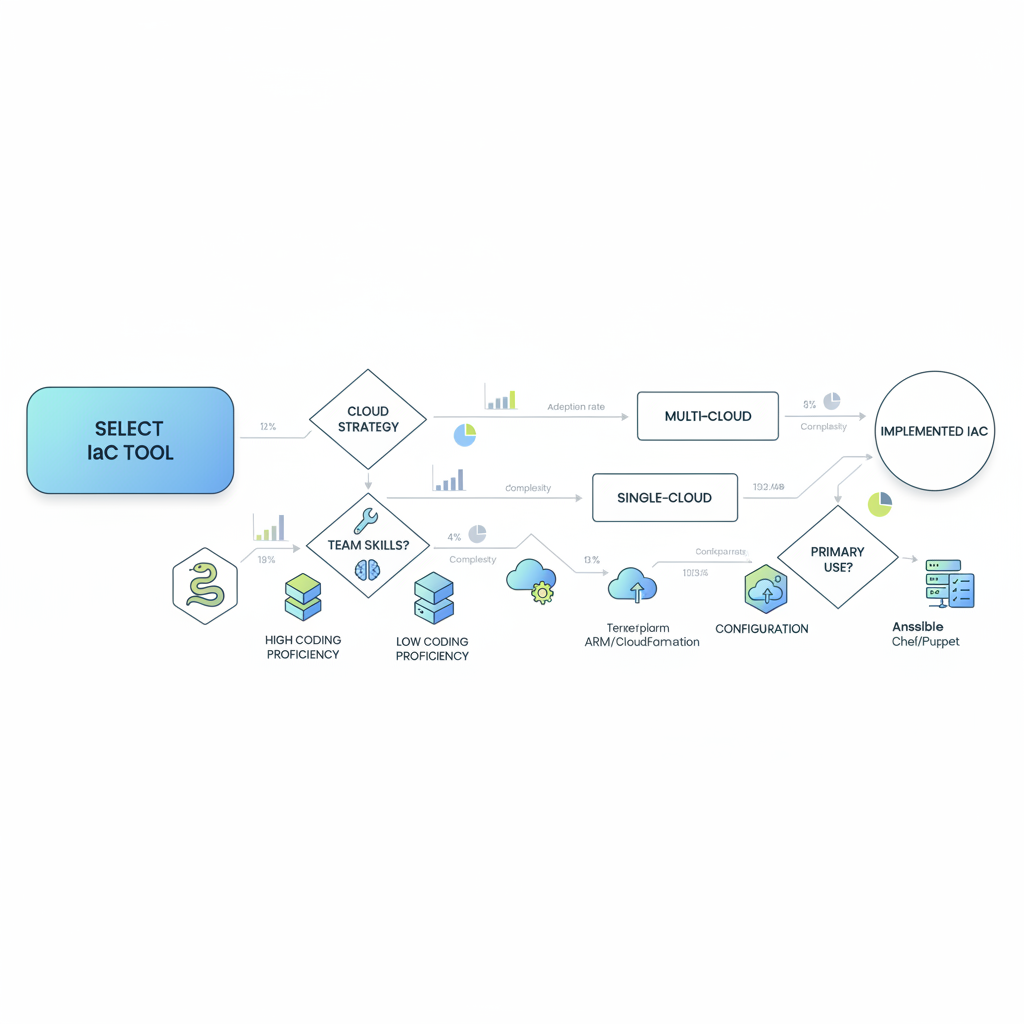
A flowchart illustrating the decision-making process for selecting an IaC tool, with branches for multi-cloud vs. single-cloud, team skill sets, and desired functionality (provisioning vs. configuration).
Implementing IaC: Best Practices
Once you have selected your top iac management tools, successful implementation hinges on adopting robust best practices. These principles ensure that your IaC journey is efficient, secure, and sustainable. Following these guidelines will maximize the benefits of best infrastructure as code software.
1. Treat Infrastructure as Code
Version Control Everything: Store all your IaC configurations in a version control system like Git. This provides a single source of truth, change history, and collaboration capabilities.
Code Review: Implement code reviews for all infrastructure changes, just as you would for application code. This catches errors early and promotes knowledge sharing.
2. Design for Idempotence and Modularity
Idempotent Configurations: Ensure your IaC scripts are idempotent. Running them multiple times should always result in the same desired state without unintended side effects.
Modular Design: Break down your infrastructure configurations into small, reusable modules. This promotes reusability, reduces complexity, and makes configurations easier to manage and test.
3. Implement Automated Testing
Unit and Integration Tests: Write tests for your IaC code to validate its correctness and ensure it achieves the desired state. This is crucial for preventing deployment issues.
Linting and Static Analysis: Use tools to lint and statically analyze your IaC code for syntax errors, best practice violations, and potential security issues.
4. Prioritize Security and Compliance
Least Privilege: Configure your IaC tools and roles with the principle of least privilege, granting only the necessary permissions to provision and manage resources.
Secrets Management: Never hardcode sensitive information like API keys or passwords in your IaC code. Use secure secrets management solutions integrated with your IaC tools.
Policy Enforcement: Implement policies to ensure that all deployed infrastructure adheres to organizational security and compliance standards.
5. Adopt Continuous Integration and Continuous Delivery (CI/CD)
Automate Deployment: Integrate your IaC workflows into your CI/CD pipelines. This automates testing, validation, and deployment of infrastructure changes, speeding up delivery.
Small, Frequent Changes: Encourage small, frequent changes to your IaC configurations. This reduces the risk associated with large deployments and makes troubleshooting easier.
Future Trends in IaC
The landscape of top iac management tools is continuously evolving, driven by advancements in cloud computing, DevOps practices, and artificial intelligence. Keeping an eye on emerging trends can help organizations future-proof their IaC strategies and continue to optimize their infrastructure management. These trends are shaping the next generation of popular IaC automation solutions.
One significant trend is the rise of GitOps. GitOps extends IaC by using Git as the single source of truth for both application and infrastructure declarations. All changes, approved through pull requests, are automatically applied to the environment, fostering a fully declarative and auditable operational model. This approach enhances security, consistency, and observability.
Another area of growth is the integration of Artificial Intelligence (AI) and Machine Learning (ML) into IaC. AI-powered tools could potentially analyze infrastructure usage patterns, predict resource needs, and even generate optimal IaC configurations. This could lead to more intelligent, self-optimizing infrastructure, reducing manual effort and improving efficiency.
Furthermore, there is a growing emphasis on policy as code and security as code. This involves embedding security and compliance policies directly into IaC definitions and automating their enforcement throughout the deployment lifecycle. This ensures that infrastructure is secure by design, shifting security left in the development process. The demand for highly rated IaC tools with robust governance features will only increase.
Frequently Asked Questions
Choosing the right top iac management tools can bring up many questions. Here are some of the most common inquiries regarding IaC and its implementation.
What is the main difference between declarative and imperative IaC?
The main difference lies in how you define your infrastructure. Declarative IaC, like Terraform or CloudFormation, describes the desired end state of your infrastructure, and the tool figures out the steps to get there. Imperative IaC, such as traditional shell scripts or some Ansible playbooks, specifies the exact sequence of commands to execute to achieve that state.
Can I use multiple top iac management tools together?
Yes, many organizations successfully use a combination of top iac management tools. For example, Terraform might be used for provisioning cloud resources (servers, databases, networks), while Ansible or Puppet could then be used for configuring software and services on those provisioned servers. This hybrid approach leverages the strengths of each tool.
Is IaC only for cloud environments?
No, IaC is not exclusive to cloud environments. While it’s highly prevalent in cloud computing due to its dynamic nature, IaC can also be effectively used for managing on-premises infrastructure, virtualized environments, and even bare-metal servers. Many leading IaC platforms offer providers or modules for various infrastructure types.
How does IaC contribute to DevOps?
IaC is a cornerstone of DevOps culture. It enables the automation, consistency, and repeatability necessary for continuous integration and continuous delivery (CI/CD) pipelines. By treating infrastructure like application code, IaC breaks down silos between development and operations teams, fostering collaboration and accelerating release cycles.
What are the biggest challenges when adopting IaC?
Common challenges include the initial learning curve for new tools and languages, integrating IaC into existing CI/CD pipelines, managing state files, ensuring security of IaC configurations, and shifting organizational culture towards an infrastructure-as-code mindset. Overcoming these requires careful planning and continuous learning.
✓ Free consultation ✓ No commitment required ✓ Trusted by experts
Conclusion
The adoption of top iac management tools is no longer a luxury but a necessity for organizations striving for agility, consistency, and efficiency in their infrastructure management. By treating infrastructure as code, businesses can automate complex deployments, reduce human error, and accelerate their path to market. The array of leading IaC platforms available today offers diverse capabilities to suit every need.
Careful consideration of your team’s expertise, infrastructure type, and specific goals is crucial for choosing IaC tools that will provide the most value. Embracing best practices in version control, modularity, and security will ensure a smooth and successful IaC journey. Continuously exploring future trends will keep your infrastructure robust and ready for tomorrow’s challenges.
Johan Carlsson is a cloud architecture specialist and frequent speaker focused on scalable workloads, AI/ML, and IoT innovation. At Opsio, he helps organizations harness cutting-edge technology, automation, and purpose-built services to drive efficiency and achieve sustainable growth. Johan is known for enabling enterprises to gain a competitive advantage by transforming complex technical challenges into powerful, future-ready cloud solutions.