Expert Terraform IaC Management for India: Boost Efficiency Today.
March 12, 2026|8:27 AM
Unlock Your Digital Potential
Whether it’s IT operations, cloud migration, or AI-driven innovation – let’s explore how we can support your success.
Home /
Work /
Blogs /
Expert Terraform IaC Management for India: Boost Efficiency Today.
Mastering Terraform IaC Management India: A Comprehensive Guide
Infrastructure as Code (IaC) has revolutionized the way organizations provision and manage their IT infrastructure. Among the various IaC tools available, Terraform stands out for its declarative language and cloud-agnostic capabilities. For businesses navigating the dynamic digital landscape of the subcontinent, effective terraform iac management india is becoming an essential pillar for scalable, efficient, and reliable operations.
This guide delves into the nuances of implementing and managing infrastructure using Terraform within the Indian context. We will explore its benefits, core concepts, best practices, and address specific challenges. Whether you are a DevOps engineer, a cloud architect, or an IT leader, understanding how to leverage Terraform effectively can significantly enhance your cloud infrastructure management India strategies.
Why Terraform for IaC Management in India?
The Indian technology ecosystem is experiencing rapid growth, with increasing adoption of cloud services across various sectors. This shift necessitates robust tools for automating infrastructure deployment and management. Terraform, by HashiCorp, offers a powerful solution for Terraform infrastructure automation India, bringing numerous advantages to the table.
Terraform allows teams to define their infrastructure in human-readable configuration files, version control it, and automate its deployment across multiple cloud providers. This approach significantly reduces manual errors, accelerates provisioning times, and ensures consistency. For companies in India seeking agility and efficiency, managing infrastructure with Terraform in India provides a competitive edge.
The demand for skilled IaC specialists India is on the rise, reflecting the growing understanding of Terraform’s value. From startups to large enterprises, the ability to rapidly provision and scale resources is crucial. Terraform’s declarative nature means you describe the desired state, and Terraform figures out how to achieve it, simplifying complex deployments.
Core Concepts of Terraform for IaC Management
Before diving into practical implementation, it is crucial to grasp Terraform’s fundamental concepts. These building blocks enable the effective definition and management of your infrastructure. Understanding these elements is key to successful terraform iac management india.
Terraform operates on a few core principles, including providers, resources, modules, and the state file. Each plays a vital role in how infrastructure is declared and maintained. Mastering these will empower you to build robust and scalable IaC solutions.
Providers and Resources
Terraform interacts with various cloud and on-premises platforms through “providers.” A provider is responsible for understanding API interactions and exposing resources. Examples include AWS, Azure, Google Cloud, Kubernetes, and many more.
Resources are the fundamental components of your infrastructure, defined by a provider. This could be a virtual machine, a network interface, a database, or a security group. You declare resources in your configuration files, specifying their desired attributes.
Modules for Reusability
Modules in Terraform are self-contained configurations that can be reused across different projects or within the same project. They encapsulate a set of resources and their configurations into a logical unit. This promotes consistency and reduces code duplication.
Developing custom modules or utilizing community-contributed ones is a cornerstone of efficient IaC. For organizations in India, creating standardized modules for common infrastructure patterns accelerates development and simplifies complex deployments. Modules are crucial for scaling Terraform IaC solutions India effectively.
Managing Terraform State
Terraform maintains a “state” file that maps real-world infrastructure to your configuration, keeps track of metadata, and improves performance. This state file is critical for Terraform to understand what infrastructure it is managing and how to make changes.
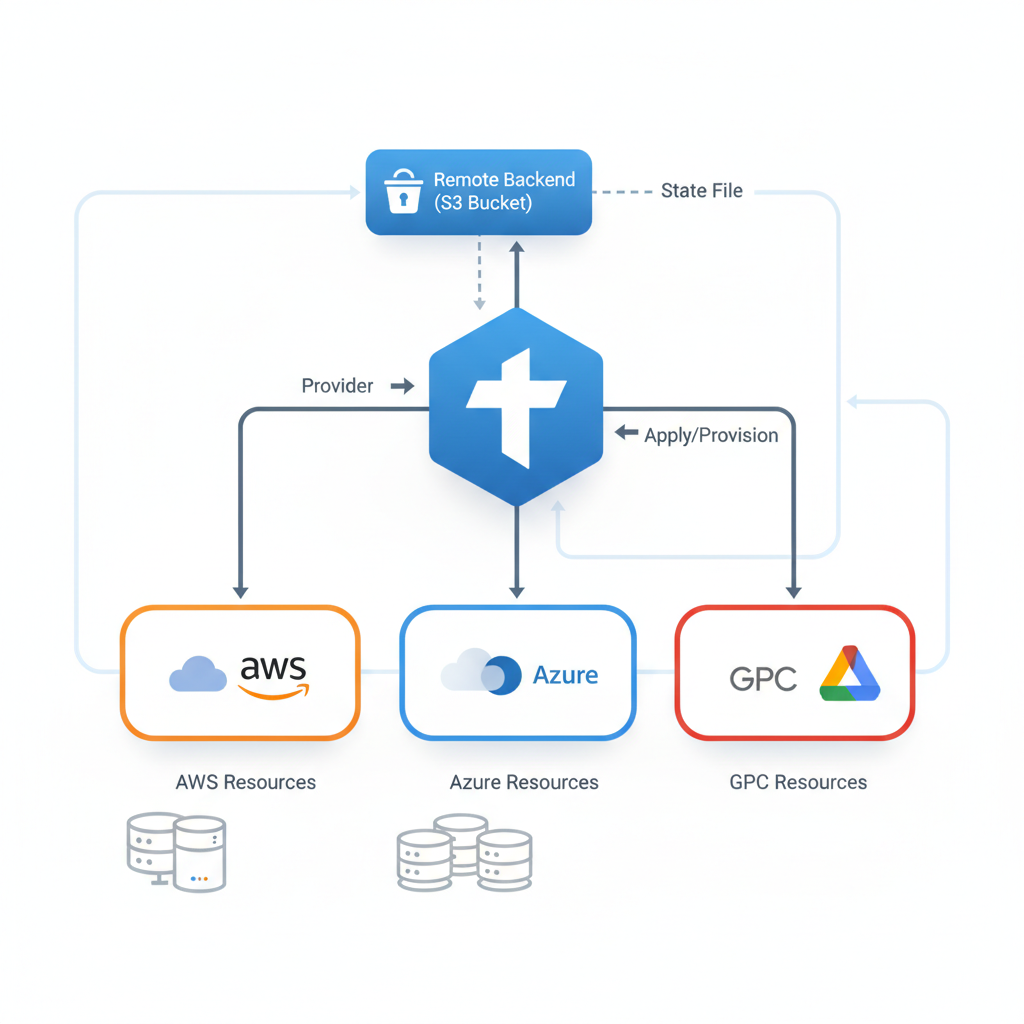
The state file contains sensitive information and is crucial for correct operation; thus, it must be stored securely and often remotely. Remote state backends like S3 (AWS), Azure Blob Storage, or Google Cloud Storage facilitate team collaboration and provide versioning and locking mechanisms. Securely managing this state is a primary concern for terraform iac management india.
A diagram showing Terraform interacting with multiple cloud providers (AWS, Azure, GCP) through separate providers, with a central Terraform state file stored securely in a remote backend like an S3 bucket, illustrating a multi-cloud IaC setup.
Setting Up Your Terraform Environment for India
To begin managing infrastructure with Terraform in India, you first need to set up your local development environment. This involves installing the Terraform CLI and configuring access to your chosen cloud provider(s). The process is straightforward and lays the groundwork for all subsequent IaC activities.
Ensuring your environment is correctly configured is essential for smooth operations. This setup applies whether you are deploying to public clouds or hybrid environments. A properly configured environment minimizes issues and streamlines your IaC workflow.
Installation Steps
Installing Terraform is a simple process. HashiCorp provides pre-compiled binaries for various operating systems. You can download the appropriate package from the official Terraform website.
Once downloaded, extract the executable to a directory that is included in your system’s PATH. This allows you to run Terraform commands from any directory in your terminal. Verify the installation by running `terraform –version`.
Cloud Provider Configuration
After installing Terraform, the next step is to configure access to your desired cloud provider. Each provider has specific authentication methods, typically involving API keys, access tokens, or IAM roles. For example, with AWS, you might configure your AWS credentials file or use environment variables.
For Azure, you would use `az login` to authenticate via Azure CLI, or configure service principal credentials. Google Cloud Platform typically uses application default credentials or service account keys. Proper configuration ensures Terraform has the necessary permissions to create, modify, and destroy resources in your cloud environment.
✓ Free consultation ✓ No commitment required ✓ Trusted by experts
Implementing IaC with Terraform in India: A Step-by-Step Guide
Implementing IaC with Terraform involves a systematic approach, from writing configuration files to applying changes. This section outlines the typical workflow for terraform iac management india, offering a practical guide to get you started. Following these steps will help you effectively manage your cloud resources.
The power of Terraform lies in its ability to predict and execute infrastructure changes safely and efficiently. Understanding this cycle is crucial for any successful IaC initiative. Let’s walk through the essential stages.
Step 1: Defining Your Infrastructure
The first step is to define your infrastructure using HashiCorp Configuration Language (HCL) in `.tf` files. These files declare the resources you want Terraform to manage. Start by creating a `main.tf` file in your project directory.
“`hcl provider “aws” { region = “ap-south-1” # Mumbai region }
resource “awsinstance” “example” { ami = “ami-0abcdef1234567890” # Replace with a valid AMI for ap-south-1 instancetype = “t2.micro” vpcsecuritygroupids = [awsvpc.main.defaultsecuritygroup_id] tags = { Name = “MyTerraformInstance” } } “`
This example defines an AWS VPC and an EC2 instance in the Mumbai region (`ap-south-1`). Remember to replace the AMI with a valid one for your chosen region. These declarative configurations form the basis of Terraform IaC solutions India.
Step 2: Initializing Your Working Directory
Once your configuration files are ready, navigate to your project directory in the terminal and run `terraform init`. This command initializes the working directory, downloading necessary provider plugins. It sets up the backend for state management and downloads any modules specified.
This step is crucial and must be performed before any other Terraform command. It ensures that Terraform has all the prerequisites to interact with your declared infrastructure. It prepares your local environment for seamless terraform iac management india.
Step 3: Planning and Applying Changes
After initialization, you can preview the changes Terraform plans to make by running `terraform plan`. This command generates an execution plan, showing you exactly what resources will be created, modified, or destroyed. Always review the plan carefully before proceeding.
To apply the changes and provision the infrastructure, execute `terraform apply`. Terraform will prompt you for confirmation before making any modifications to your cloud environment. Type `yes` to proceed. This is where Terraform executes the defined actions, bringing your infrastructure to life.
Step 4: Destroying Infrastructure
If you need to tear down the infrastructure managed by Terraform, you can use `terraform destroy`. This command will delete all resources defined in your configuration files. Use this command with extreme caution, as it permanently removes resources.
Terraform will present a plan of resources to be destroyed and ask for confirmation. Type `yes` to proceed. This capability is useful for testing environments or when decommissioning old infrastructure, ensuring a clean slate.
Best Practices for Terraform IaC Management India
Adopting best practices is crucial for successful and sustainable terraform iac management india. These practices enhance collaboration, security, and maintainability, especially in complex enterprise environments. Implementing them early in your IaC journey will pay dividends.
Effective IaC goes beyond just writing code; it encompasses workflow, team collaboration, and security considerations. These recommendations help organizations build resilient and scalable cloud infrastructure management India. They are vital for long-term success.
Version Control Integration
Treat your Terraform configuration files like any other source code. Store them in a version control system like Git. This allows for tracking changes, collaborating with team members, and rolling back to previous versions if needed.
Integrating Git with your IaC workflow enables GitOps principles, where infrastructure changes are managed through pull requests and code reviews. This ensures that all changes are reviewed before being applied, enhancing accountability and reducing errors. DevOps with Terraform India heavily relies on robust version control.
Module Development
Develop reusable and standardized modules for common infrastructure patterns. This not only reduces code duplication but also ensures consistency across your environments. Centralize these modules in a repository for easy access by all team members.
Well-designed modules make your configurations more readable, maintainable, and testable. They abstract complexity, allowing users to provision infrastructure without needing deep knowledge of every underlying resource. This is a key aspect of scalable Terraform IaC solutions India.
Security Considerations
Security must be paramount in your IaC practices. Never hardcode sensitive information like API keys or passwords directly into your Terraform configurations. Instead, use secure methods for secrets management, such as environment variables, AWS Secrets Manager, Azure Key Vault, or HashiCorp Vault.
Implement the principle of least privilege for the IAM roles or service accounts Terraform uses. Grant only the necessary permissions to create, modify, or destroy specific resources. Regularly audit your Terraform configurations for potential security vulnerabilities.
Collaboration and Team Workflow
For teams, using remote state is non-negotiable. It allows multiple team members to work on the same infrastructure without conflicting state files. State locking, a feature of remote backends, prevents simultaneous updates from corrupting the state.
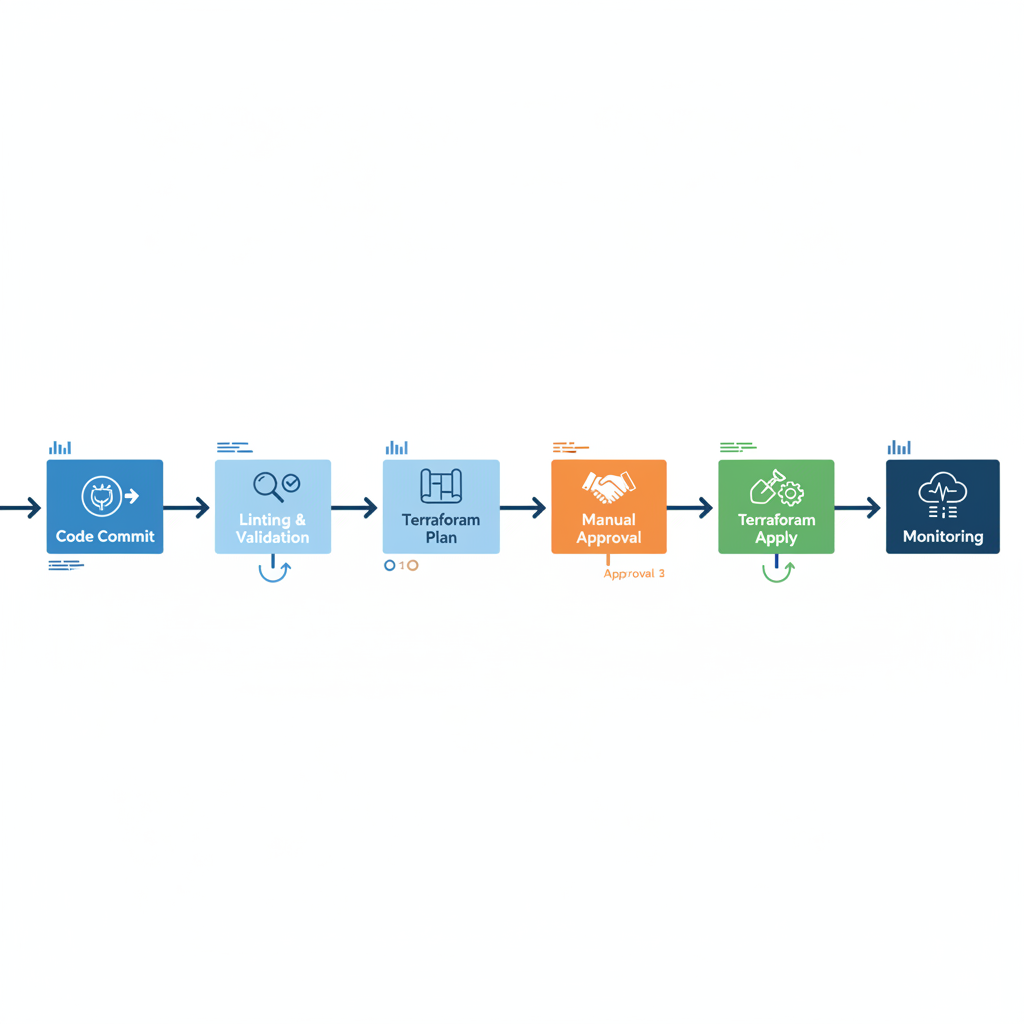
Consider implementing Terraform workspaces for managing multiple distinct environments (e.g., dev, staging, prod) within the same configuration. Integrate Terraform into your CI/CD pipelines for automated testing and deployment, fostering a robust DevOps with Terraform India culture. This ensures consistent and repeatable deployments.
A flowchart depicting a CI/CD pipeline for Terraform IaC, showing steps like “Code Commit,” “Linting & Validation,” “Terraform Plan,” “Manual Approval,” “Terraform Apply,” and “Monitoring,” illustrating an automated and collaborative infrastructure deployment process.
Challenges and Solutions for Terraform Adoption India
While Terraform offers immense benefits, organizations in India may encounter specific challenges during its adoption and implementation. Addressing these proactively can smooth the transition and ensure long-term success. Understanding these hurdles is critical for effective terraform iac management india.
Overcoming these obstacles often involves a combination of technical strategies, training, and cultural shifts within an organization. Strategic planning helps in successfully navigating the path to full IaC implementation.
Talent and Training
One significant challenge is the availability of skilled IaC specialists India. While the talent pool is growing, expertise in advanced Terraform features, module development, and enterprise-grade IaC patterns might still be concentrated. Organizations might struggle to find experienced personnel.
To address this, invest in training existing teams. Offer certifications, workshops, and opportunities for hands-on experience. Partner with Terraform consulting India firms to kickstart initiatives and mentor internal teams. Building internal capability is a sustainable solution for Terraform adoption India.
Organizational Buy-in
Securing organizational buy-in can be a hurdle, especially in traditional IT environments accustomed to manual infrastructure provisioning. Shifting to an IaC paradigm requires a cultural change, moving from ticket-based requests to code-driven deployments. Resistance to change is common.
Demonstrate the tangible benefits of Terraform through pilot projects. Highlight faster provisioning, reduced errors, cost savings, and improved auditability. Start small, showcase quick wins, and build momentum. Effective communication about the benefits of Terraform adoption India is key.
Tooling and Ecosystem Integration
Integrating Terraform with existing tooling, such as configuration management systems, monitoring solutions, or security scanning tools, can sometimes be complex. Ensuring seamless operation within the broader DevOps ecosystem requires careful planning.
Leverage Terraform’s extensibility and provider ecosystem. Many tools offer native Terraform providers or modules. For custom integrations, explore using external data sources or local-exec provisioners cautiously. Prioritize integration with core CI/CD platforms for streamlined operations. Terraform IaC solutions India often require careful ecosystem management.
The Future of Terraform IaC Management India
The landscape of cloud infrastructure management India is continuously evolving, and Terraform is poised to remain a central player. As more businesses migrate to the cloud and embrace multi-cloud strategies, the demand for robust, automated, and platform-agnostic IaC tools will only intensify.
The focus will increasingly shift towards higher-level abstractions, policy-as-code, and advanced GitOps workflows. Terraform’s consistent innovation, coupled with the growing community and ecosystem, ensures its continued relevance. The future of terraform iac management india is bright, characterized by greater automation, enhanced security, and more sophisticated infrastructure deployments.
Frequently Asked Questions
What is terraform iac management india?
Terraform IaC management India refers to the practice of defining, provisioning, and managing IT infrastructure in India using HashiCorp Terraform. It involves writing declarative configuration files to automate the deployment and lifecycle management of resources across various cloud providers or on-premises environments, ensuring consistency and efficiency in the Indian market.
Why is Terraform becoming popular for infrastructure automation in India?
Terraform is gaining popularity in India due to its ability to automate complex infrastructure deployments, its cloud-agnostic nature supporting major providers like AWS, Azure, and GCP, and its emphasis on collaborative, version-controlled workflows. This enables faster deployment cycles, reduces human error, and supports scalable operations crucial for India’s rapidly expanding digital economy.
How can organizations in India get started with Terraform IaC solutions?
Organizations in India can start by training their IT and DevOps teams on Terraform fundamentals, defining small pilot projects for non-critical infrastructure, and gradually expanding its use. Engaging with Terraform consulting India firms can provide expert guidance, accelerate adoption, and help establish best practices from the outset.
What are the key benefits of using Terraform for cloud infrastructure management India?
The key benefits include increased operational efficiency through automation, reduced manual errors, consistent infrastructure deployments across environments, cost optimization by managing resources effectively, and improved security posture through code reviews and policy enforcement. It also facilitates quicker innovation by rapidly provisioning necessary resources.
What kind of support is available for Terraform adoption India?
Support for Terraform adoption India includes a growing community of users and forums, online documentation and tutorials, official HashiCorp certifications, and a number of local Terraform consulting India partners. Many cloud providers also offer resources and integrations to support Terraform deployments within their ecosystems.
How does Terraform integrate with DevOps practices in India?
Terraform is a cornerstone of DevOps with Terraform India, integrating seamlessly into CI/CD pipelines. It enables developers and operations teams to collaborate using a single source of truth for infrastructure, automate testing and deployment of infrastructure changes, and implement GitOps workflows for managing infrastructure via version control. This fosters a culture of automation and rapid, reliable delivery.
✓ Free consultation ✓ No commitment required ✓ Trusted by experts
Conclusion
Terraform has emerged as an indispensable tool for modern infrastructure management, particularly for organizations in India striving for agility and efficiency. By embracing terraform iac management india, businesses can automate their cloud infrastructure, reduce operational overheads, and build scalable, resilient systems. The journey involves understanding its core concepts, adopting best practices, and strategically overcoming challenges related to talent and organizational change.
As the digital transformation accelerates across India, the demand for skilled IaC specialists India and robust Terraform IaC solutions India will continue to grow. Investing in Terraform adoption India is not just about technology; it’s about fostering a culture of automation, collaboration, and continuous improvement. By mastering Terraform, companies can unlock significant value, driving innovation and staying ahead in a competitive market.
Johan Carlsson is a cloud architecture specialist and frequent speaker focused on scalable workloads, AI/ML, and IoT innovation. At Opsio, he helps organizations harness cutting-edge technology, automation, and purpose-built services to drive efficiency and achieve sustainable growth. Johan is known for enabling enterprises to gain a competitive advantage by transforming complex technical challenges into powerful, future-ready cloud solutions.