Master IaC Management: Your Essential Guide Explained
March 12, 2026|8:21 AM
Unlock Your Digital Potential
Whether it’s IT operations, cloud migration, or AI-driven innovation – let’s explore how we can support your success.
Home /
Work /
Blogs /
Master IaC Management: Your Essential Guide Explained
Understanding Infrastructure as Code (IaC) Management
Infrastructure as Code (IaC) has revolutionized how organizations provision and manage their IT infrastructure. Instead of manual processes and configuration, IaC treats infrastructure configurations like software code. This fundamental shift brings numerous benefits, but it also necessitates a robust approach to management. This comprehensive iac management guide provides a detailed overview of the principles, best practices, and tools required for effective IaC management.
Understanding IaC management means recognizing that your infrastructure is now represented by human-readable configuration files. These files define everything from virtual machines and networks to databases and load balancers. Managing IaC therefore involves the entire lifecycle of these code files, from creation and versioning to deployment and maintenance.
This approach ensures consistency, repeatability, and agility across your infrastructure. It allows teams to build, deploy, and scale environments with speed and confidence. This guide serves as a comprehensive IaC resource, equipping you with the knowledge to succeed.
Why an iac management guide is Essential for Modern Infrastructure
In today’s fast-paced IT landscape, manual infrastructure provisioning is fraught with challenges. It often leads to inconsistencies, human errors, slow deployments, and significant operational overhead. Without a structured approach, scaling infrastructure becomes a bottleneck, hindering innovation and business growth.
An effective iac management guide addresses these critical issues head-on. It provides a blueprint for transforming chaotic infrastructure operations into a streamlined, automated process. By adopting IaC management, organizations can ensure their infrastructure is always in a desired state. This minimizes configuration drift and enhances system reliability.
Implementing a sound infrastructure as code implementation guide is crucial for several reasons. It drastically reduces the time required to provision new environments, allowing development teams to focus on delivering value. Moreover, it enhances security by embedding compliance rules directly into the code and provides an immutable audit trail for all infrastructure changes.
Key Principles and Best Practices for IaC Management
Effective IaC management is built upon a foundation of key principles and adherence to established best practices. These tenets ensure your IaC efforts are sustainable, secure, and scalable. Embracing these principles helps prevent common pitfalls and maximizes the benefits of your IaC investment.
One core principle is version control. All IaC configurations must be stored in a version control system like Git. This allows for tracking changes, collaborating effectively, and rolling back to previous states if necessary. It forms the backbone of any robust IaC best practices handbook.
Another vital principle is idempotency, meaning applying the same configuration multiple times yields the same result without unintended side effects. This ensures consistency and predictability in your deployments. Immutable infrastructure is also key, advocating for replacing existing infrastructure components rather than modifying them in place, enhancing reliability and simplifying rollbacks.
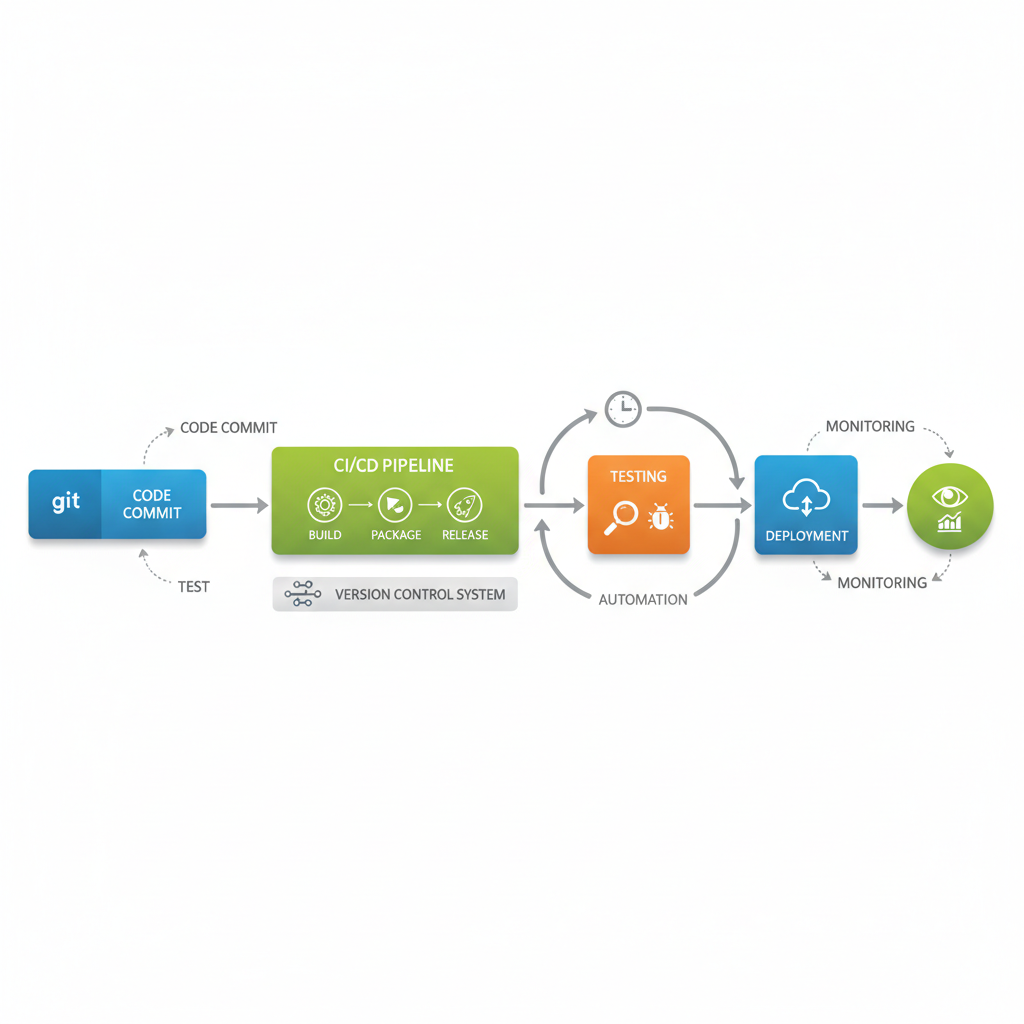
A flowchart showing the lifecycle of Infrastructure as Code management, starting from code commit, through CI/CD pipeline, testing, deployment, and monitoring, highlighting version control and automation.
Security should be embedded from the start within your IaC configurations. This includes managing secrets securely and adhering to the principle of least privilege. Regularly auditing IaC code for vulnerabilities is also a critical practice. Treat your infrastructure code with the same rigor as application code.
Modularity and reusability are essential for creating maintainable and scalable IaC. Break down complex infrastructure into smaller, reusable modules or components. This promotes consistency across projects and reduces the effort needed to provision new environments. It also simplifies troubleshooting and updates.
Testing your IaC configurations before deployment is non-negotiable. Just like application code, infrastructure code can have bugs or misconfigurations. Implementing automated tests helps catch errors early in the development cycle, preventing costly outages. Testing covers syntax validation, unit tests, and integration tests across different modules.
✓ Free consultation ✓ No commitment required ✓ Trusted by experts
A Step-by-Step iac management guide for Successful Implementation
Embarking on your IaC journey requires a structured approach. This step-by-step iac management guide will walk you through the essential phases, from initial planning to continuous operations. Following these steps will help ensure a smooth and successful infrastructure as code implementation guide.
Step 1: Define Your Strategy and Scope
Before writing any code, clearly articulate your goals for IaC. Identify which infrastructure components you want to manage with code first. Start small, perhaps with a non-critical environment, to gain experience. This initial planning phase is crucial for laying a solid foundation.
Consider your current environment, existing tools, and team capabilities. Document your desired end-state and how IaC will help achieve it. This will inform your tool selection and overall approach.
Step 2: Choose the Right IaC Tools
The market offers a variety of IaC tools, each with its strengths. Popular choices include Terraform for provisioning cloud resources, Ansible for configuration management, and cloud-native options like AWS CloudFormation or Azure Resource Manager. Your choice should align with your infrastructure, team skills, and project requirements.
Evaluate factors such as declarative versus imperative approaches, multi-cloud support, community backing, and integration capabilities with your existing CI/CD pipelines. Selecting the right tools is a foundational element of any IaC setup guide.
Step 3: Establish Version Control and Repository Structure
All your IaC code must reside in a version control system (VCS), predominantly Git. Create a clear repository structure that supports your modularity and team collaboration needs. This might involve separate repositories for different environments, applications, or infrastructure layers.
Implement branching strategies that facilitate safe development and deployment. Code reviews are essential to maintain quality and share knowledge among team members. This ensures every change is scrutinized before it impacts the infrastructure.
Step 4: Develop Your IaC Configurations
Start writing your infrastructure definitions using the chosen IaC tool. Begin with simple resources and gradually increase complexity. Focus on creating reusable modules that encapsulate specific infrastructure components, such as a VPC or a database cluster.
Ensure your code is well-documented and follows consistent coding standards. Parameterize your configurations to make them flexible and adaptable to different environments. This enhances the reusability and maintainability of your code.
Step 5: Implement Automated Testing
Integrate testing into your IaC development workflow. This includes static analysis for syntax and style, unit tests for individual modules, and integration tests to verify that different components work together as expected. Tools like Terratest for Terraform or Ansible Molecule can automate these processes.
Automated testing catches errors early, reduces manual effort, and increases confidence in your deployments. It is a critical component of a robust IaC deployment tutorial.
Step 6: Automate Your Deployment Pipeline (CI/CD)
Integrate your IaC code with a Continuous Integration/Continuous Delivery (CI/CD) pipeline. This pipeline will automatically test, validate, and deploy your infrastructure changes upon code commits. Popular CI/CD tools include Jenkins, GitLab CI/CD, GitHub Actions, or Azure DevOps.
The pipeline should include stages for linting, testing, planning infrastructure changes, and applying them. Automating this process significantly accelerates deployment times and minimizes human error. This is a core part of any step-by-step IaC management process.
Step 7: Monitor and Manage Drift
Once infrastructure is deployed, continuous monitoring is essential. Tools can help detect configuration drift, which occurs when the actual state of your infrastructure diverges from its defined state in your IaC code. Implement alerts for detected drift.
Establish processes to reconcile drift, either by automatically reverting unauthorized changes or updating your IaC code to reflect intentional modifications. Regular audits of your infrastructure against your IaC definitions are vital.
Tools and Technologies for Effective IaC Management
The landscape of IaC tools is diverse, offering solutions for various needs and environments. Selecting the right set of tools is crucial for effective iac management guide implementation. These tools empower teams to define, provision, and manage infrastructure programmatically.
Terraform, from HashiCorp, is a popular open-source tool for provisioning infrastructure across multiple cloud providers and on-premises environments. It uses a declarative language (HCL) to define resources and their relationships. Terraform is excellent for managing the lifecycle of your infrastructure.
Ansible, a Red Hat product, focuses more on configuration management and application deployment. It’s agentless and uses YAML for playbooks, making it easy to get started. Ansible excels at automating tasks on existing servers and provisioning software.
Cloud-native tools like AWS CloudFormation, Azure Resource Manager (ARM), and Google Cloud Deployment Manager offer deep integration with their respective cloud platforms. These tools allow you to define and manage resources using templates specific to that cloud environment. They are powerful for single-cloud strategies.
Puppet and Chef are older, more mature configuration management tools that require agents on managed nodes. They provide extensive capabilities for enforcing configuration policies and automating system administration tasks. These tools are often used in larger, more complex enterprise environments.
Integrating these IaC tools with CI/CD platforms is also critical. Solutions like Jenkins, GitLab CI/CD, GitHub Actions, and Azure DevOps pipelines provide the orchestration layer. They automate the entire IaC workflow, from code commit to infrastructure deployment. This ensures consistency and accelerates delivery.
Advanced Strategies for Mastering IaC Management
Beyond the foundational steps, adopting advanced strategies can significantly enhance your iac management guide practices. These approaches help you tackle complex scenarios, improve security, and build a more resilient infrastructure. Mastering IaC management involves continuous learning and adaptation.
Implementing GitOps principles is an advanced strategy gaining traction. GitOps uses Git repositories as the single source of truth for declarative infrastructure and applications. All changes to infrastructure are made through Git commits, which then trigger automated deployments. This enhances auditability, security, and operational consistency.
Policy as Code is another powerful concept. It involves defining security, compliance, and operational policies as code, which can then be automatically enforced across your IaC deployments. Tools like Open Policy Agent (OPA) or cloud-native policy services (e.g., AWS Config, Azure Policy) allow you to prevent non-compliant infrastructure from being provisioned. This is a key aspect of a comprehensive IaC resource.
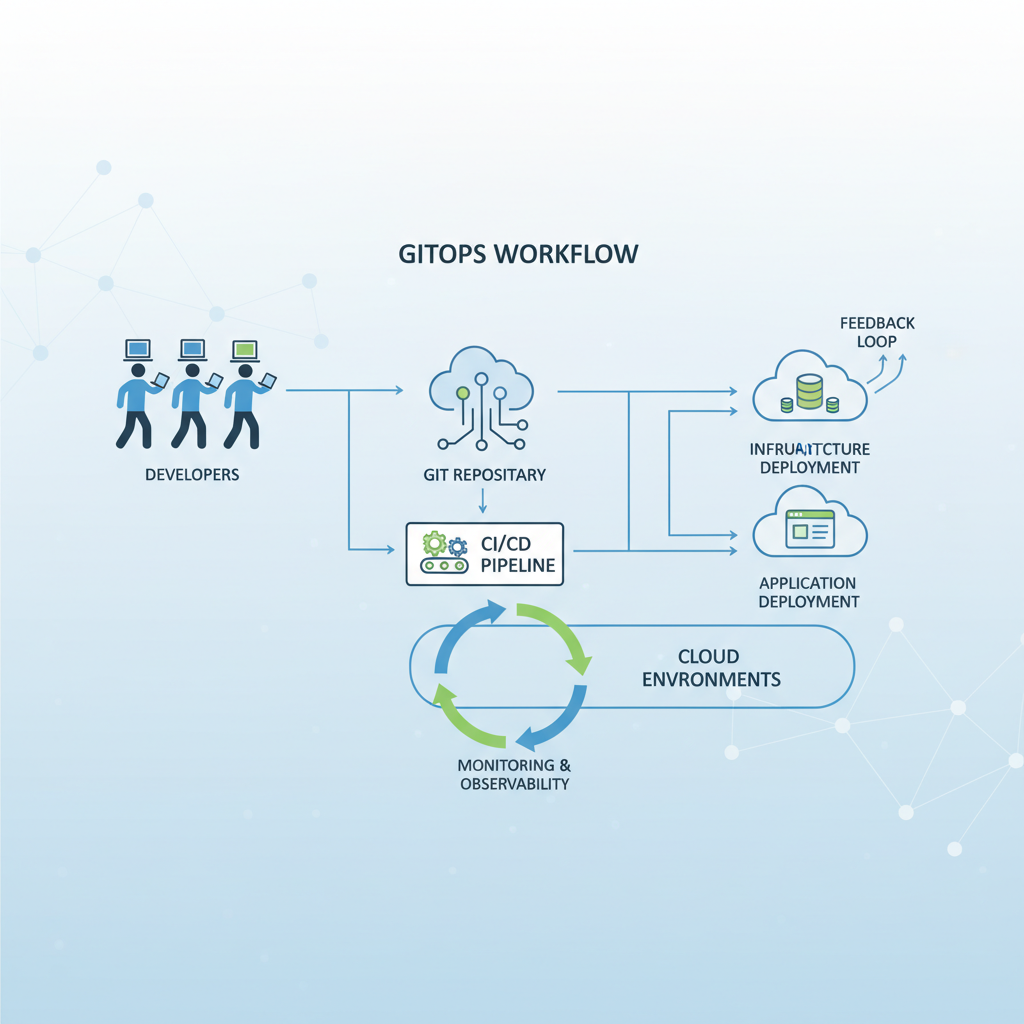
A diagram illustrating the concept of GitOps, showing developers committing code to a Git repository, which then triggers a CI/CD pipeline to deploy infrastructure and applications to cloud environments, with continuous feedback loops.
Drift detection and automated remediation are crucial for maintaining the desired state of your infrastructure. Tools can periodically scan your deployed infrastructure and compare it against your IaC definitions. If drift is detected, systems can alert administrators or even automatically revert the infrastructure to its defined state. This prevents unauthorized changes and ensures consistency.
Developing comprehensive IaC documentation is often overlooked but incredibly valuable. Document not only the “what” (the infrastructure definition) but also the “why” (design decisions and rationale). This helps new team members onboard faster and provides critical context during troubleshooting. Good documentation is part of an effective IaC best practices handbook.
Cross-functional collaboration and knowledge sharing are paramount. Encourage developers, operations teams, and security specialists to work together on IaC. Establish communities of practice where team members can share best practices, solve problems, and learn from each other. This fosters a culture of continuous improvement in your IaC practices.
Overcoming Common Challenges in IaC Management
While IaC offers immense benefits, organizations often encounter specific challenges during its implementation and ongoing management. Being aware of these hurdles and having strategies to overcome them is vital for a successful iac management guide.
One significant challenge is state management, particularly with tools like Terraform. Terraform maintains a state file that maps real-world resources to your configuration. Managing this state, especially in team environments, requires careful planning. Solutions involve using remote backends (e.g., S3, Azure Blob Storage) with locking mechanisms to prevent concurrent modifications.
Another common issue is secrets management. IaC configurations often need access to sensitive information like API keys, database credentials, or private certificates. Never hardcode secrets directly into your IaC files. Instead, integrate with dedicated secrets management services like HashiCorp Vault, AWS Secrets Manager, or Azure Key Vault.
Team collaboration can also be a hurdle, especially in large organizations. Different teams might have varying levels of IaC expertise or conflicting requirements. Establishing clear guidelines, promoting modularity, and using a consistent IaC best practices handbook can mitigate these issues. Regular training and knowledge transfer are also critical.
The initial learning curve for IaC tools and concepts can be steep for teams accustomed to manual operations. Provide ample training and allocate time for experimentation. Start with smaller, less critical projects to build confidence and expertise. Gradual adoption can make the transition smoother.
Integrating IaC with existing, legacy infrastructure can be complex. Not all components might be easily convertible to code, or their management might require hybrid approaches. Prioritize which parts of the infrastructure to bring under IaC management first, focusing on new deployments or rapidly changing environments. Gradual modernization is often the most practical path.
Frequently Asked Questions
What is Infrastructure as Code (IaC)?
Infrastructure as Code (IaC) is the practice of managing and provisioning computing infrastructure through machine-readable definition files, rather than physical hardware configuration or interactive configuration tools. It treats infrastructure definitions like application code, allowing for version control, automated testing, and continuous delivery. IaC aims to automate the setup and management of servers, networks, databases, and other infrastructure components.
Why is an iac management guide important?
An iac management guide is crucial because it provides a structured framework for implementing, maintaining, and scaling IaC practices. It helps ensure consistency, reduce errors, improve security, and accelerate infrastructure deployments. Without a proper guide, IaC efforts can become disorganized, leading to configuration drift, security vulnerabilities, and operational inefficiencies.
What are the main benefits of using IaC?
The primary benefits of using IaC include increased speed and efficiency in provisioning infrastructure, enhanced consistency and repeatability across environments, reduced human error, and improved scalability. IaC also provides better documentation through code, facilitates version control for infrastructure changes, and strengthens security by enabling policy enforcement as code. It streamlines the entire infrastructure lifecycle.
What are some popular tools for IaC management?
Several popular tools are used for IaC management, each with different strengths. Terraform is widely used for provisioning multi-cloud infrastructure, while Ansible is popular for configuration management and application deployment. Cloud-specific tools include AWS CloudFormation, Azure Resource Manager (ARM), and Google Cloud Deployment Manager. Puppet and Chef are also prominent for enterprise-level configuration management.
How does IaC contribute to DevOps?
IaC is a foundational component of DevOps methodologies. It enables the “Ops” side of DevOps to adopt software development practices, leading to faster, more reliable infrastructure provisioning and management. By automating infrastructure changes and integrating them into CI/CD pipelines, IaC bridges the gap between development and operations teams. This fosters greater collaboration and accelerates the overall software delivery lifecycle.
What are the key principles for effective IaC management?
Key principles for effective IaC management include using version control for all configurations, ensuring idempotency (repeated application yields the same result), and striving for immutable infrastructure (replacing rather than modifying components). Other important principles are security by design, modularity for reusability, comprehensive automated testing, and integrating with CI/CD pipelines. Adhering to these principles ensures robust and scalable IaC practices.
✓ Free consultation ✓ No commitment required ✓ Trusted by experts
Conclusion
Embracing an effective iac management guide is no longer optional for organizations striving for agility, reliability, and security in their infrastructure. From understanding the core concepts to implementing advanced strategies, this guide has provided a comprehensive roadmap for transforming your infrastructure operations. By treating infrastructure as code, adopting best practices, and leveraging the right tools, you can build resilient, scalable, and highly automated environments.
The journey to mastering IaC management is continuous, involving ongoing learning, adaptation, and improvement. Invest in your teams, establish robust processes, and commit to a culture of automation. The benefits—from accelerated deployments to enhanced security and reduced operational overhead—will undoubtedly yield significant returns for your organization.
Jacob Stålbro is a seasoned digitalization and transformation leader with over 20 years of experience, specializing in AI-driven innovation. As Head of Innovation and Co-Founder at Opsio, he drives the development of advanced AI, ML, and IoT solutions. Jacob is a sought-after speaker and webinar host known for translating emerging technologies into real business value and future-ready strategies.