Discover the Key Benefits of IaC Management for Your Business
March 12, 2026|8:13 AM
Unlock Your Digital Potential
Whether it’s IT operations, cloud migration, or AI-driven innovation – let’s explore how we can support your success.
Home /
Work /
Blogs /
Discover the Key Benefits of IaC Management for Your Business
Understanding Infrastructure as Code (IaC) Management
In the rapidly evolving landscape of IT infrastructure, managing servers, networks, and databases manually is no longer sustainable. This is where Infrastructure as Code (IaC) management emerges as a foundational practice for modern development and operations. It transforms the way organizations provision and manage their computing infrastructure.
IaC management involves defining and managing infrastructure resources using machine-readable definition files, rather than physical hardware configuration or interactive configuration tools. These files are treated like software code, allowing teams to version, test, and apply infrastructure changes systematically. Understanding the comprehensive benefits of iac management is crucial for any organization aiming for agility and reliability in 2026.
This guide delves into the core advantages and practical steps for leveraging IaC management effectively. We will explore how this methodology not only streamlines operations but also introduces a new level of control and predictability to infrastructure deployment. Embracing IaC management can significantly enhance an organization’s competitive edge.
The Transformative Power of IaC Efficiency
One of the most immediate and significant advantages of infrastructure as code is the unparalleled efficiency it introduces into infrastructure management. By automating repetitive tasks, IaC drastically reduces the time and effort required for provisioning and configuration. This automation frees up valuable engineering resources.
The implementation of IaC efficiency means that complex infrastructure setups can be deployed with a single command, eliminating the need for manual, click-by-click processes. This automation ensures that environments are consistently configured, which is a cornerstone of modern, high-performing IT operations. It minimizes the potential for human error inherent in manual tasks.
Streamlined Provisioning
IaC allows for the rapid provisioning of entire environments, from development to production. Instead of waiting hours or days for infrastructure to be set up, resources can be provisioned in minutes. This speed is critical for accelerating development cycles and responding quickly to business needs.
Templates define the desired state of the infrastructure, which can then be instantiated consistently across multiple environments. This approach simplifies the creation of new test environments or the scaling of existing ones. Teams can replicate complex setups effortlessly, ensuring parity across all stages.
Automated Configuration
Beyond provisioning, IaC also excels in automated configuration management. Tools like Ansible, Chef, and Puppet can ensure that servers and services are configured exactly as required. This prevents configuration drift, where environments gradually diverge over time due to manual changes.
Automated configuration ensures that every server adheres to defined standards and security policies. It dramatically reduces the time spent on troubleshooting configuration issues, allowing teams to focus on innovation. This level of automation is central to achieving true IaC efficiency.
Achieving Significant Cost Savings with IaC
Organizations are constantly looking for ways to optimize their spending, and IaC management offers substantial cost savings with IaC. This isn’t just about reducing labor costs, though that’s a major factor. It also encompasses more efficient resource utilization and minimized downtime.
By standardizing infrastructure deployments, organizations can avoid over-provisioning resources “just in case.” IaC enables precise resource allocation based on actual needs, leading to significant reductions in cloud computing expenses. This optimization directly impacts the bottom line.
Optimized Resource Utilization
IaC encourages the use of disposable infrastructure, where resources are spun up only when needed and terminated afterwards. This “pay-as-you-go” model is particularly beneficial in cloud environments, preventing resources from sitting idle and incurring unnecessary costs. Automated scaling policies, defined in code, can dynamically adjust resource capacity.
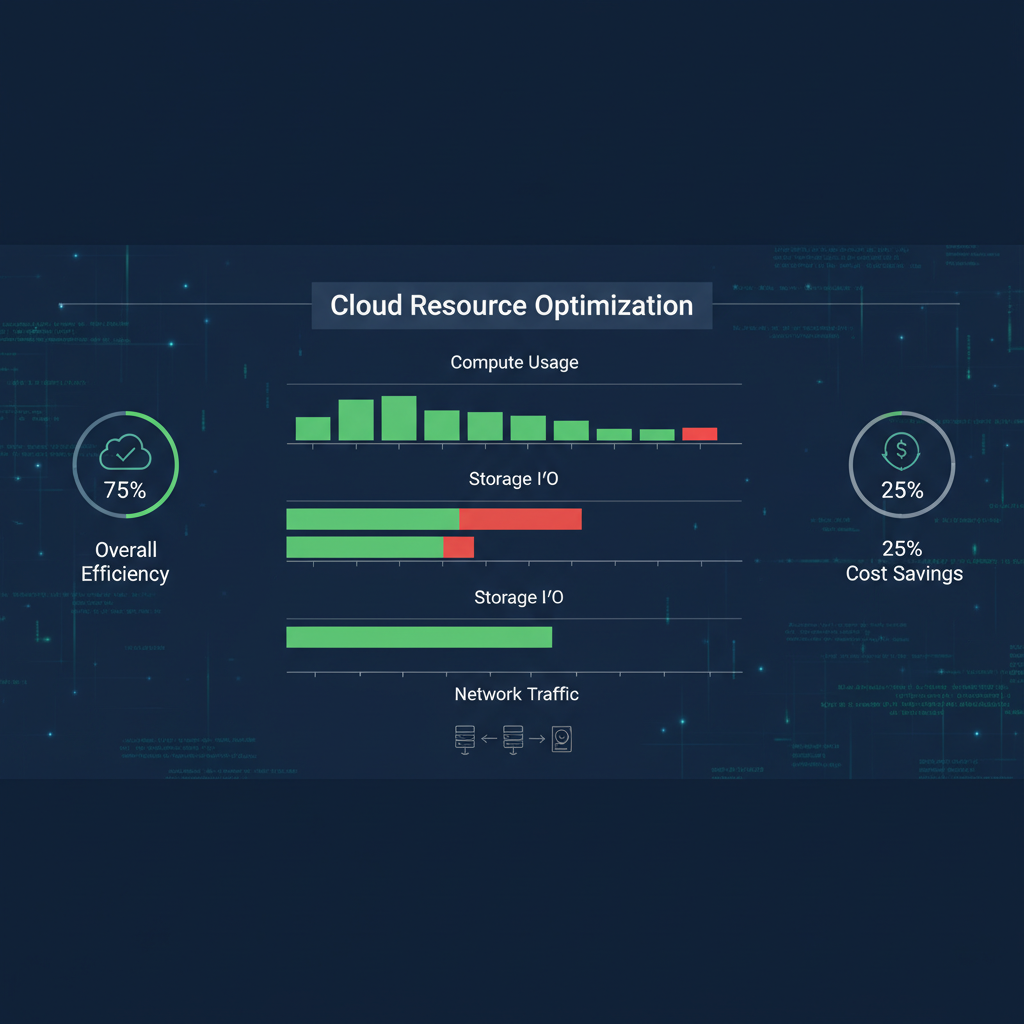
A dashboard showing cloud resource utilization graphs, with green bars indicating optimal use and red bars indicating idle or over-provisioned resources. A subtle overlay of code snippets can be seen in the background.
This level of control ensures that infrastructure perfectly matches demand, leading to maximum efficiency and minimal waste. Optimized resource utilization is a direct consequence of implementing robust IaC practices. It helps organizations right-size their infrastructure effectively.
Reduced Operational Overheads
The automation inherent in IaC significantly reduces the need for manual intervention by IT operations staff. Fewer hours are spent on routine provisioning, configuration, and maintenance tasks. This allows skilled engineers to focus on higher-value activities, such as innovation and strategic planning.
Furthermore, improved consistency and fewer errors translate into less time spent troubleshooting and resolving production issues. This reduction in downtime and incident response contributes to substantial cost savings with IaC over the long term. It transforms reactive operations into proactive engineering.
Driving Faster and More Reliable Deployments
The pace of software development demands rapid and consistent infrastructure provisioning. One of the standout benefits of iac management is its ability to facilitate faster deployments with IaC, ensuring that applications reach users more quickly and reliably. This agility is a competitive differentiator.
By integrating IaC into continuous integration and continuous delivery (CI/CD) pipelines, infrastructure changes can be deployed alongside application code. This seamless integration accelerates the entire release process, from development to production. It drastically reduces bottlenecks.
Accelerating Release Cycles
IaC turns infrastructure deployment into a repeatable, automated process that can be triggered programmatically. This means new features and bug fixes can be released much faster, allowing organizations to respond rapidly to market demands and customer feedback. Speed is paramount in today’s digital economy.
The ability to quickly provision identical test environments is particularly valuable for accelerating quality assurance. Developers can spin up personal environments for testing, then tear them down, all without manual intervention. This efficiency shortens the feedback loop dramatically.
Minimizing Deployment Risks
Manual deployments are inherently prone to human error, which can lead to outages and security vulnerabilities. IaC mitigates these risks by ensuring that every deployment is consistent and follows predefined specifications. The infrastructure is always deployed exactly as intended.
Moreover, IaC enables version control for infrastructure configurations, just like application code. This means every change is tracked, allowing for easy rollbacks to previous, stable states if an issue arises. This capability significantly enhances the reliability and safety of deployments, leading to fewer incidents.
✓ Free consultation ✓ No commitment required ✓ Trusted by experts
Ensuring Consistency and Reducing Errors
Inconsistent environments are a nightmare for developers and operations teams alike, often leading to “works on my machine” syndrome and difficult-to-diagnose bugs. A core advantage of IaC is the dramatically reduced errors in infrastructure and improved consistency with IaC across all environments. This consistency is foundational for reliable systems.
By defining infrastructure in code, every environment – development, staging, and production – can be built from the exact same blueprint. This eliminates configuration drift and ensures that what works in one environment will work in another. Predictability becomes the norm.
Eliminating Configuration Drift
Configuration drift occurs when manual changes are applied directly to servers, causing them to deviate from a desired standard. IaC tools actively manage infrastructure state, detecting and correcting any deviations. This ensures that all instances remain identical to their code-defined state.
This continuous enforcement of configuration prevents subtle differences that could lead to unexpected behavior or security gaps. Eliminating configuration drift is a key enabler of improved consistency with IaC, providing a stable foundation for applications. It makes troubleshooting much simpler.
Enhancing Reproducibility
The ability to reproduce environments on demand is a powerful aspect of IaC. Whether recreating a production issue in a test environment or setting up a new development workstation, IaC guarantees identical configurations every time. This reproducibility saves immense amounts of time and frustration.
It also facilitates disaster recovery planning, as entire infrastructure stacks can be rapidly rebuilt from code in the event of a catastrophic failure. Enhanced reproducibility is a non-negotiable requirement for high-availability systems and efficient development workflows. It builds confidence in the infrastructure.
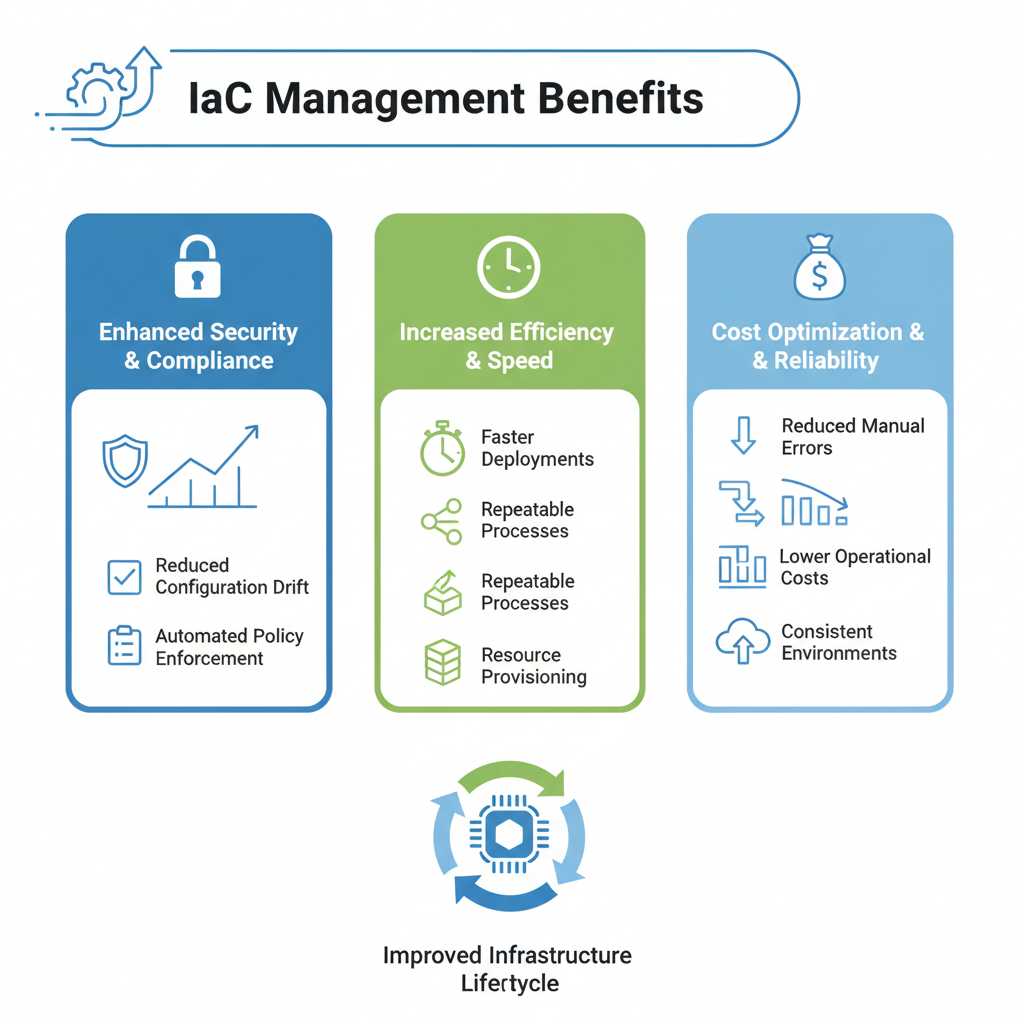
Professional visual illustration related to benefits of iac management
Unlocking Scalability and Flexibility
Modern applications often experience fluctuating demand, requiring infrastructure that can scale up and down effortlessly. Scalability through IaC is a major benefit, allowing organizations to dynamically adjust their resources to meet these changing needs without manual intervention. This flexibility is vital for cloud-native architectures.
IaC enables the rapid provisioning of additional resources when demand spikes, and conversely, the de-provisioning of resources when demand subsides. This elastic scalability ensures optimal performance while controlling costs. It supports dynamic workloads gracefully.
Dynamic Resource Scaling
With IaC, scaling rules and parameters can be defined directly in configuration files. These definitions can then be linked to monitoring systems that automatically trigger the creation or destruction of instances based on metrics like CPU utilization or network traffic. This automation is a cornerstone of cloud elasticity.
This dynamic scaling ensures that applications always have sufficient resources to perform optimally, even during peak loads. At the same time, it prevents over-provisioning during quiet periods, contributing to cost efficiency. Scalability through IaC is essential for applications with unpredictable traffic patterns.
Environment Portability
IaC promotes infrastructure portability, allowing organizations to deploy their applications across different cloud providers or even hybrid environments with greater ease. The underlying infrastructure definitions are abstract enough to be adapted to various platforms. This vendor independence is a significant strategic advantage.
This flexibility makes it easier to migrate workloads, experiment with new technologies, or implement multi-cloud strategies. It reduces vendor lock-in and provides organizations with greater choice and resilience. Environment portability is a key enabler of future-proofing infrastructure investments.
Bolstering Security and Compliance Posture
Security and compliance are paramount concerns for any organization, especially in 2026. One of the compelling benefits of iac management is its capability to deliver enhanced security with IaC, integrating security best practices directly into the infrastructure definition. This “security by design” approach is far more robust than traditional methods.
By treating infrastructure as code, security policies can be defined, version-controlled, and automatically enforced across all environments. This ensures consistent application of security standards and significantly reduces the attack surface. It provides a strong defensive posture.
Security by Design
With IaC, security configurations—such as firewall rules, network segmentation, and access controls—are embedded directly into the infrastructure templates. This means that security is baked in from the very beginning of the provisioning process, not bolted on as an afterthought. Every deployed resource adheres to predefined security policies.
Version control for security configurations allows teams to track every change, making it easier to audit and revert if a vulnerability is introduced. This proactive integration of security controls leads to enhanced security with IaC, providing a robust and consistent defense. It establishes a baseline of security.
Simplified Auditing and Compliance
Maintaining compliance with regulatory standards (e.g., GDPR, HIPAA, PCI DSS) is a complex and ongoing challenge. IaC simplifies this process by providing an auditable trail of all infrastructure changes. Every modification is recorded in version control, creating a clear history.
This programmatic control and clear audit log make it much easier to demonstrate compliance to auditors. Automated checks can verify that infrastructure configurations align with compliance requirements before deployment. Simplified auditing is a powerful benefit, reducing the burden of regulatory oversight.
Practical Steps for Adopting IaC Management in 2026
Adopting IaC management is a strategic move that requires careful planning and execution. This how-to section outlines key steps for organizations looking to fully unlock the benefits of iac management in 2026. Embracing these practices will ensure a smoother transition and maximize returns.
1. Start Small and Define Scope: Begin by identifying a small, non-critical project or a specific environment (like a development sandbox) to apply IaC. This allows your team to gain experience without disrupting critical systems. Define the specific resources you intend to manage with IaC, such as virtual machines, networks, or databases.
2. Choose the Right Tools: Select IaC tools that align with your existing technology stack and team’s expertise. Popular options include Terraform for infrastructure provisioning (agnostic across clouds), Ansible for configuration management, and cloud-native tools like AWS CloudFormation or Azure Resource Manager. Consider features like idempotency, state management, and community support.
3. Develop Standardized Templates: Create reusable, parameterized templates for common infrastructure components. These templates should encapsulate best practices for security, networking, and resource tagging. Standardization is crucial for achieving improved consistency with IaC and `reduced errors in infrastructure`.
4. Integrate with Version Control: Treat your IaC files like application code. Store them in a version control system like Git. This enables collaboration, change tracking, and rollbacks. Implement branching strategies and code review processes for infrastructure changes to maintain quality.
5. Implement CI/CD Pipelines: Integrate your IaC workflows into your existing CI/CD pipelines. This means that infrastructure changes are automatically tested and deployed as part of your software release process. Automated testing of IaC changes ensures that they are valid and won’t introduce regressions.
6. Establish Monitoring and Alerting: Monitor your IaC deployments and the state of your infrastructure closely. Set up alerts for any configuration drift or failed deployments. Tools can compare the actual state of your infrastructure against its desired state defined in code.
7. Train Your Team: Invest in training for your operations and development teams. IaC requires a shift in mindset, moving from manual tasks to code-driven automation. Foster a culture of collaboration between “Dev” and “Ops” to maximize the `advantages of infrastructure as code`.
8. Iterate and Refine: IaC adoption is an ongoing process. Continuously review and refine your IaC practices, templates, and tooling based on feedback and evolving requirements. Stay updated with new features and best practices in the IaC community.
Frequently Asked Questions about IaC Management
This section addresses common questions about the benefits of iac management, providing clarity for those considering or implementing this powerful approach.
What exactly is Infrastructure as Code (IaC)?
Infrastructure as Code (IaC) is a methodology that manages and provisions computer data centers through machine-readable definition files, rather than physical hardware configuration or interactive configuration tools. It treats infrastructure components (like virtual machines, networks, and databases) as code, allowing them to be versioned, tested, and deployed programmatically.
How does IaC contribute to cost savings?
IaC contributes to cost savings by enabling optimized resource utilization, reducing manual labor, and minimizing downtime. It allows for the precise provisioning of resources only when needed, reducing cloud costs associated with idle or over-provisioned infrastructure. Automation also lessens the operational overhead by freeing up engineering time.
Can IaC really improve security?
Yes, IaC significantly improves security by allowing security policies and configurations to be defined directly in code. This “security by design” approach ensures consistent application of security best practices across all environments. It creates an auditable trail of changes, making compliance easier and reducing the attack surface.
Is IaC only for large enterprises, or can small businesses benefit too?
IaC is beneficial for organizations of all sizes. While large enterprises gain immense advantages from managing complex infrastructures, small businesses can also leverage IaC to achieve `faster deployments with IaC`, `improved consistency with IaC`, and `cost savings with IaC` without needing a large operations team. It democratizes sophisticated infrastructure management.
What are the main challenges when adopting IaC?
Common challenges when adopting IaC include the initial learning curve for teams unfamiliar with coding infrastructure, choosing the right tools, managing state files, and integrating IaC into existing CI/CD pipelines. Overcoming these requires proper training, clear standards, and a phased implementation approach.
How does IaC help with scalability?
IaC facilitates scalability through automated and dynamic resource provisioning. By defining scaling rules in code, infrastructure can automatically expand or contract based on demand, ensuring optimal performance and cost efficiency. This `scalability through IaC` is crucial for applications with fluctuating workloads.
✓ Free consultation ✓ No commitment required ✓ Trusted by experts
Conclusion: Embracing the Future with IaC Management
The journey towards modern, resilient, and agile IT operations is inextricably linked with the widespread adoption of Infrastructure as Code management. The compelling benefits of iac management—ranging from dramatic cost savings with IaC and `IaC efficiency` to `enhanced security with IaC` and `faster deployments with IaC`—make it an indispensable practice for organizations in 2026 and beyond.
By embracing IaC, businesses can ensure `reduced errors in infrastructure` and `improved consistency with IaC` across their environments, leading to more reliable applications and happier customers. The `advantages of infrastructure as code` are not merely theoretical; they translate directly into tangible improvements in operational performance and business agility. As technology continues to evolve, IaC will remain a cornerstone of effective infrastructure management, empowering teams to build, deploy, and manage complex systems with unprecedented speed and confidence.
Jacob Stålbro is a seasoned digitalization and transformation leader with over 20 years of experience, specializing in AI-driven innovation. As Head of Innovation and Co-Founder at Opsio, he drives the development of advanced AI, ML, and IoT solutions. Jacob is a sought-after speaker and webinar host known for translating emerging technologies into real business value and future-ready strategies.