Master Your Cloud with Top iac Management Platforms Today
March 12, 2026|7:57 AM
Unlock Your Digital Potential
Whether it’s IT operations, cloud migration, or AI-driven innovation – let’s explore how we can support your success.
Home /
Work /
Blogs /
Master Your Cloud with Top iac Management Platforms Today
Understanding iac management platforms in 2026
In today’s fast-paced digital landscape, managing vast and complex cloud infrastructures efficiently is paramount for businesses. Infrastructure as Code (IaC) has revolutionized how organizations provision and manage their IT resources, shifting from manual processes to automated, script-driven deployments. However, as IaC adoption grows, so does the need for sophisticated tools to oversee these operations effectively.
This is where iac management platforms become indispensable. These advanced solutions provide a unified framework for controlling, orchestrating, and securing your IaC deployments across diverse environments. They are the backbone for maintaining consistency and compliance within modern infrastructure as code ecosystems.
What is Infrastructure as Code (IaC)?
Infrastructure as Code refers to the practice of managing and provisioning infrastructure through code, rather than through manual processes. This involves defining your network configurations, virtual machines, databases, and other infrastructure components in human-readable files. Tools like Terraform, Ansible, and CloudFormation enable this transformative approach.
By codifying infrastructure, organizations can achieve greater consistency, reproducibility, and version control. This significantly reduces human error and accelerates the deployment lifecycle. It allows infrastructure to be treated with the same rigor and practices as application code.
The Evolution and Necessity of iac management platforms
Initially, managing IaC involved disparate scripts and tools, leading to potential inconsistencies and a lack of centralized oversight. As organizations scaled their cloud adoption and IaC usage, the complexity of managing multiple IaC projects, teams, and environments became a significant challenge. This fragmented approach often resulted in configuration drift and security vulnerabilities.
The emergence of iac management platforms directly addresses these pain points. These platforms evolved to provide comprehensive control, offering features that go beyond basic IaC tools. They are designed to bring order and governance to complex IaC deployments, supporting devops IaC platforms by streamlining operations and ensuring adherence to best practices.
Why Your Organization Needs iac management platforms
Adopting iac management platforms is not merely a technical upgrade; it’s a strategic move that delivers profound benefits across an organization. These platforms are crucial for any enterprise committed to efficient, secure, and scalable cloud operations. They help solidify your control over cloud infrastructure platforms.
Streamlined Operations and Efficiency
One of the primary advantages of iac management platforms is their ability to streamline operational workflows. They automate repetitive tasks, reduce manual errors, and accelerate the deployment of infrastructure changes. This enhanced efficiency allows development and operations teams to focus on innovation rather than routine provisioning.
These platforms provide a single pane of glass for monitoring IaC states, tracking changes, and managing deployments. This consolidated view significantly reduces the time and effort required to maintain complex infrastructures. It is key for achieving unified IaC management across the organization.
Enhanced Security and Compliance
Security is a paramount concern in cloud environments, and IaC management platforms play a vital role in strengthening an organization’s security posture. They enable the consistent enforcement of security policies and compliance standards across all infrastructure deployments. This reduces the risk of misconfigurations that could lead to vulnerabilities.
With features like policy-as-code and automated auditing, these platforms can detect and remediate non-compliant resources swiftly. They provide a clear audit trail of all infrastructure changes, which is essential for regulatory compliance. This ensures centralized IaC control over critical security aspects.
Scalability and Reliability
As businesses grow, their infrastructure needs inevitably scale. iac management platforms are built to handle this expansion with grace, ensuring that infrastructure can be provisioned and managed consistently, regardless of scale. They promote reliability by standardizing configurations and reducing the likelihood of manual inconsistencies.
These platforms facilitate the rapid deployment of identical environments, from development to production. This reproducibility is crucial for maintaining high availability and disaster recovery capabilities. It ensures that your infrastructure is always reliable and ready to meet demand.
Key Features to Look for in iac management platforms
Choosing the right iac management platform requires a careful evaluation of its capabilities and how they align with your organizational needs. A robust platform will offer a suite of features designed to enhance control, security, and operational efficiency. Look for solutions that act as comprehensive enterprise IaC solutions.
Centralized Control and Visibility
A core feature of effective iac management platforms is their ability to provide centralized control over all IaC deployments. This includes a dashboard or interface that offers a holistic view of your infrastructure’s current state, deployment histories, and pending changes. This level of visibility is crucial for large, distributed teams.
Centralization allows for better oversight, preventing configuration drift and ensuring that all teams adhere to defined standards. It simplifies debugging and troubleshooting by providing a single source of truth for infrastructure definitions. This capability is foundational for effective IaC orchestration platforms.
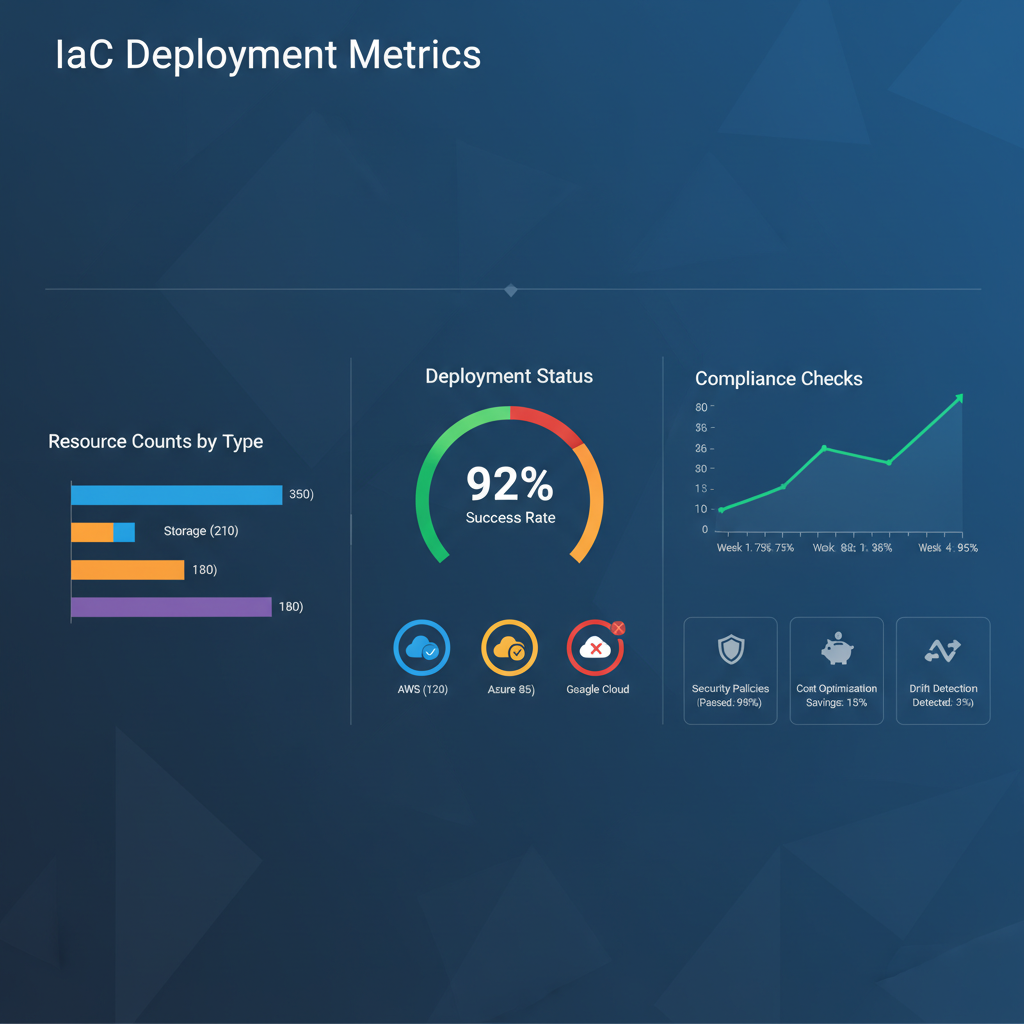
A dashboard showing various metrics and graphs related to IaC deployments, including deployment status, resource counts, and compliance checks across multiple cloud providers.
Version Control and Change Management
Just like application code, infrastructure code requires robust version control. iac management platforms integrate seamlessly with popular version control systems like Git. This allows teams to track every change, revert to previous versions, and collaborate effectively on infrastructure definitions.
Advanced change management features include approval workflows, peer review processes, and automated testing of IaC changes. These mechanisms ensure that only authorized and validated infrastructure changes are deployed, minimizing risks and maintaining stability. This is critical for maintaining an auditable history of your infrastructure.
Policy Enforcement and Governance
Implementing strong governance is a cornerstone of responsible infrastructure management. iac management platforms allow organizations to define and enforce policies as code, ensuring that all deployed resources comply with internal standards and external regulations. These policies can cover security, cost, resource tagging, and more.
Policy enforcement can prevent non-compliant resources from being provisioned or automatically remediate them if they are detected. This proactive approach significantly reduces security risks and helps maintain a compliant infrastructure footprint. It strengthens the overall governance framework for your cloud estate.
Integration Capabilities
No platform operates in a vacuum, and iac management platforms are most effective when they integrate seamlessly with your existing toolchain. This includes integration with cloud providers (AWS, Azure, GCP), CI/CD pipelines, security scanning tools, and monitoring systems. Strong integration capabilities enhance automation and streamline workflows.
Look for platforms that offer open APIs and a wide range of connectors to support your current and future technology stack. Effective integration transforms the platform into a true IaC delivery platform, facilitating end-to-end automation from code commit to infrastructure deployment. This ensures a cohesive and efficient DevOps environment.
✓ Free consultation ✓ No commitment required ✓ Trusted by experts
How to Choose the Right iac management platforms for Your Enterprise
Selecting the appropriate iac management platform is a significant decision that can impact your entire IT operations. A thorough evaluation process is essential to ensure the chosen platform meets your unique requirements and integrates well with your existing ecosystem. Consider the long-term implications for your cloud infrastructure platforms.
Assess Your Current Infrastructure and Needs
Before evaluating any platforms, clearly define your current infrastructure landscape, existing IaC tools, and specific pain points. Understand the scale of your operations, the complexity of your environments, and your compliance requirements. Document your team’s skill sets and preferences regarding IaC tools.
Consider your future growth plans and how a platform can support anticipated expansion. A comprehensive understanding of your internal needs will help you prioritize features and narrow down your options effectively. This foundational step ensures you select a platform that truly solves your problems.
Evaluate Vendor Offerings and Support
Research different iac management platforms available in the market, comparing their feature sets, pricing models, and architectural approaches. Look for vendors with a strong track record, robust documentation, and responsive customer support. Consider whether they offer managed services or require self-hosting.
Engage with vendors for demonstrations and proof-of-concept deployments to see how their platforms perform in your specific environment. Pay attention to community support and available training resources, as these can be invaluable during adoption and ongoing use. Seek out comprehensive enterprise IaC solutions that fit your budget and technical requirements.
Consider Scalability and Future-Proofing
The platform you choose should be capable of scaling with your organization’s growth, accommodating increasing numbers of resources, teams, and cloud providers. Ensure it supports multi-cloud or hybrid-cloud strategies if those are part of your long-term vision for infrastructure as code ecosystems.
Evaluate the platform’s roadmap and how well it aligns with emerging trends in cloud technology and IaC. A future-proof platform will continuously evolve, offering new features and integrations to keep your infrastructure management at the cutting edge. This foresight prevents the need for costly migrations down the line.
Implementing iac management platforms: A Step-by-Step Guide
Implementing iac management platforms effectively requires a structured approach. Following these steps will help ensure a smooth transition and maximize the benefits for your organization. This process focuses on integrating the platform into your existing devops IaC platforms.
Step 1: Define Your IaC Strategy
Begin by clearly outlining your organization’s IaC strategy. This includes standardizing on specific IaC languages (e.g., Terraform, CloudFormation), defining naming conventions, and establishing module structures. Identify which environments will be managed by IaC and set clear goals for automation and governance.
This strategic foundation will guide your platform selection and implementation process. A well-defined strategy ensures consistency and clarity across all IaC initiatives. It also helps in identifying the specific functionalities you will need from your chosen platform.
Step 2: Select Your Preferred Platform
Based on your needs assessment and vendor evaluations, choose the iac management platform that best fits your requirements. Consider factors like ease of integration, cost, features, and vendor support. Ensure the platform aligns with your long-term vision for unified IaC management.
This decision should ideally involve key stakeholders from development, operations, and security teams. A collaborative selection process ensures broader buy-in and smoother adoption across the organization. The chosen platform should seamlessly fit into your existing infrastructure as code ecosystems.
Step 3: Integrate with Existing Systems
Once selected, integrate the iac management platform with your existing version control systems (e.g., Git), CI/CD pipelines, and cloud providers. Configure API keys and access roles to ensure secure and efficient communication between the platform and your infrastructure.
This step is crucial for automating your IaC workflows. Thoroughly test all integrations to ensure data flows correctly and deployments can be triggered reliably. Seamless integration turns the platform into a true IaC orchestration platform, coordinating various tools.
Step 4: Develop and Test IaC Templates
Start developing your IaC templates and modules within the platform’s framework. Begin with simple resources and gradually move to more complex infrastructure configurations. Implement policy-as-code to enforce security and compliance standards from the outset.
Rigorous testing of your IaC templates is essential. Use automated testing frameworks to validate deployments, check for configuration drift, and ensure compliance. This iterative process refines your IaC code and builds confidence in your automated deployments.
Step 5: Implement Continuous Deployment and Monitoring
Establish continuous deployment pipelines that leverage your iac management platforms to automate infrastructure changes. Configure monitoring and alerting to track the health, performance, and compliance of your deployed infrastructure. This proactive approach ensures stability and rapid response to issues.
Regularly review and update your IaC templates and policies to adapt to evolving business needs and security threats. Continuous monitoring and feedback loops are vital for maintaining a robust and secure infrastructure. This ensures effective centralized IaC control and ongoing optimization.
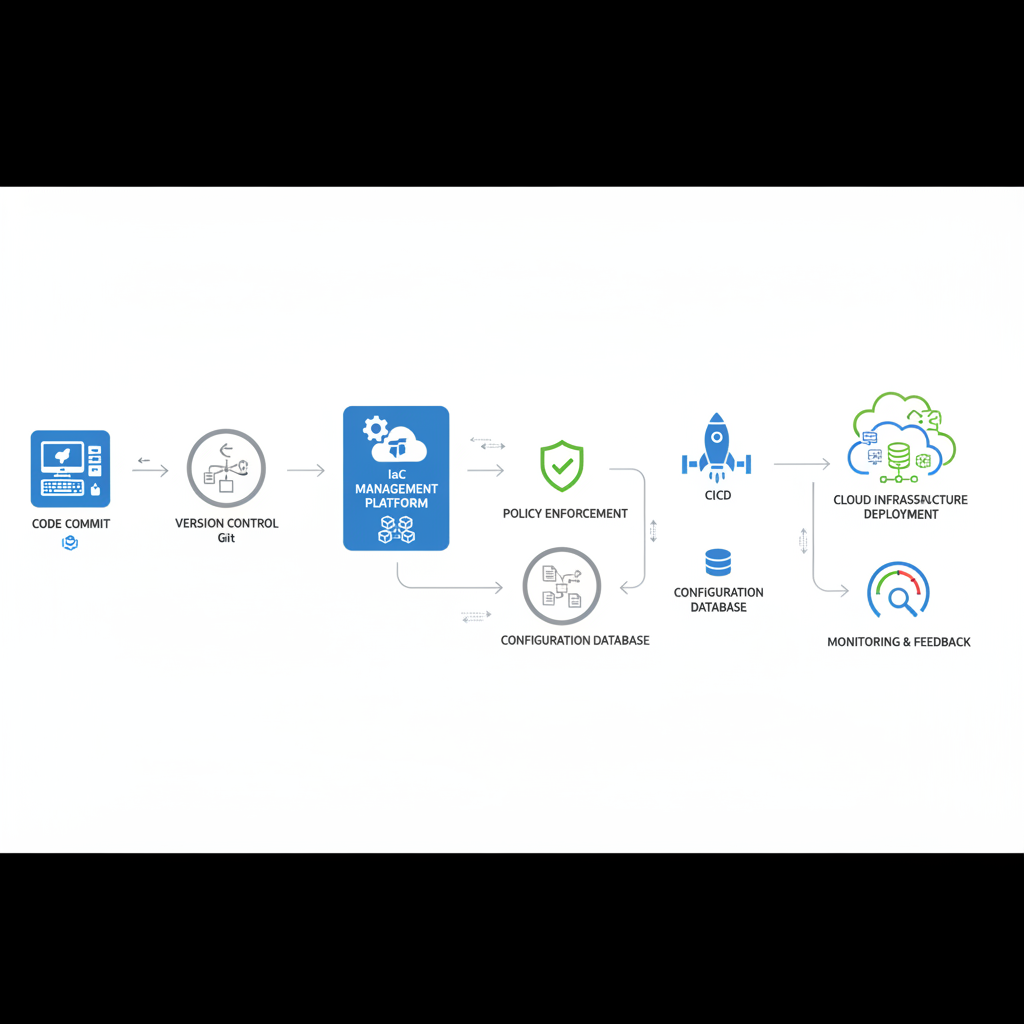
A flowchart depicting the IaC delivery pipeline, starting from code commit, through version control, IaC management platform, policy enforcement, CI/CD, and finally to cloud infrastructure deployment and monitoring.
Best Practices for Maximizing Your iac management platforms Investment
To fully leverage the capabilities of your iac management platforms, adopting certain best practices is crucial. These practices extend beyond mere technical implementation and involve organizational culture and ongoing processes.
Foster a Culture of Automation
Encourage all teams to embrace an automation-first mindset for infrastructure provisioning and management. Provide training and resources to help engineers become proficient with the chosen platform and IaC principles. A strong automation culture is key to realizing the full potential of your IaC delivery platforms.
Celebrate successes and share knowledge to foster continuous improvement and innovation. When automation becomes ingrained in your culture, manual errors decrease, and efficiency soars. This mindset shift is vital for effective enterprise IaC solutions.
Regular Auditing and Updates
Continuously audit your IaC configurations and the resources they manage for compliance and security vulnerabilities. Regularly update your iac management platforms and IaC tool versions to benefit from the latest features, security patches, and performance improvements. Staying current ensures optimal operation.
Scheduled reviews of your IaC policies and templates help adapt them to changing regulatory requirements and business needs. This proactive approach prevents technical debt and maintains a secure, efficient infrastructure. Consistent auditing reinforces centralized IaC control.
Leverage Collaboration Features
Many iac management platforms offer robust collaboration features, such as shared workspaces, peer review tools, and activity logs. Encourage teams to utilize these features to improve communication, knowledge sharing, and overall productivity. Collaborative development of IaC fosters better quality and shared ownership.
This collaborative environment helps democratize infrastructure management, allowing more team members to contribute while maintaining governance. Leveraging these features enhances the collective expertise within your infrastructure as code ecosystems.
The Future of iac management platforms: Trends and Innovations for 2026
The landscape of iac management platforms is continuously evolving, driven by advancements in cloud computing, artificial intelligence, and security. Looking ahead to 2026, several key trends are set to reshape how organizations manage their infrastructure as code.
AI/ML Driven Automation
Artificial intelligence and machine learning are increasingly being integrated into iac management platforms. These technologies can provide predictive insights into infrastructure performance, automatically detect and remediate configuration drift, and even suggest optimized IaC templates. This elevates the capabilities of IaC orchestration platforms.
AI-powered anomaly detection will further enhance security by identifying unusual patterns in infrastructure deployments. This shift towards intelligent automation will make infrastructure management even more proactive and efficient, reducing the need for manual intervention.
Enhanced Security Posture Management
As cyber threats become more sophisticated, iac management platforms will offer even more advanced security features. Expect deeper integration with cloud native security tools, real-time threat detection within IaC pipelines, and automated security policy generation based on compliance frameworks.
These platforms will provide a more comprehensive and dynamic approach to security posture management. They will ensure that security is not just an afterthought but an intrinsic part of the IaC lifecycle, enabling more robust and secure cloud infrastructure platforms.
Frequently Asked Questions
What are iac management platforms?
iac management platforms are advanced software solutions designed to provide centralized control, orchestration, and governance over Infrastructure as Code (IaC) deployments. They help organizations manage, secure, and scale their cloud infrastructure defined through code, offering features like version control, policy enforcement, and reporting.
How do iac management platforms differ from basic IaC tools?
Basic IaC tools like Terraform or CloudFormation primarily focus on provisioning and managing infrastructure through code. iac management platforms build upon these tools by adding layers of centralized control, security policies, collaboration features, and operational visibility across multiple IaC projects and teams, offering unified IaC management.
What benefits do iac management platforms offer for large enterprises?
For large enterprises, these platforms offer streamlined operations, enhanced security through consistent policy enforcement, and greater scalability and reliability across complex, distributed environments. They provide centralized IaC control, reduce human error, and accelerate infrastructure delivery at scale.
Can iac management platforms integrate with existing DevOps pipelines?
Absolutely. Modern iac management platforms are designed for seamless integration with existing DevOps pipelines, including CI/CD tools, version control systems (like Git), and cloud providers. This integration enables automated deployment workflows and continuous delivery of infrastructure changes as part of a complete devops IaC platforms strategy.
What are common challenges when adopting iac management platforms?
Common challenges include the initial learning curve for teams, integrating with a diverse existing toolchain, and establishing robust policy-as-code frameworks. Overcoming these requires a clear strategy, proper training, and a commitment to cultural change towards automation and governance.
How important is security in iac management platforms?
Security is critically important. iac management platforms embed security throughout the infrastructure lifecycle by enforcing policies, scanning for vulnerabilities in IaC templates, and providing audit trails. They help prevent misconfigurations and ensure compliance, significantly strengthening an organization’s overall security posture in their cloud infrastructure platforms.
✓ Free consultation ✓ No commitment required ✓ Trusted by experts
Conclusion: Empowering Your Infrastructure with iac management platforms
The adoption of iac management platforms is no longer a luxury but a necessity for organizations navigating the complexities of modern cloud infrastructure. These powerful platforms provide the control, security, and efficiency required to unlock the full potential of your Infrastructure as Code initiatives. By centralizing management, enforcing policies, and streamlining operations, they empower your teams to build, deploy, and manage robust, scalable, and secure cloud environments with unprecedented confidence.
Embracing iac management platforms means investing in a future where infrastructure is agile, resilient, and perfectly aligned with your business objectives. Start your journey today to transform your infrastructure as code ecosystems into a highly efficient and governed operational powerhouse for 2026 and beyond.
Johan Carlsson is a cloud architecture specialist and frequent speaker focused on scalable workloads, AI/ML, and IoT innovation. At Opsio, he helps organizations harness cutting-edge technology, automation, and purpose-built services to drive efficiency and achieve sustainable growth. Johan is known for enabling enterprises to gain a competitive advantage by transforming complex technical challenges into powerful, future-ready cloud solutions.