Streamline Operations with Expert Cloud Management Strategies
March 5, 2026|12:19 PM
Unlock Your Digital Potential
Whether it’s IT operations, cloud migration, or AI-driven innovation – let’s explore how we can support your success.
Home /
Work /
Blogs /
Streamline Operations with Expert Cloud Management Strategies
Understanding Cloud Management: Your Foundation for Success
In today’s fast-paced digital landscape, effective cloud management is no longer optional; it’s a critical imperative for organizations leveraging cloud computing. This comprehensive guide will equip you with the knowledge and strategies to master your cloud management practices, ensuring efficiency, security, and cost-effectiveness across your cloud infrastructure. By establishing robust frameworks, businesses can harness the full potential of their cloud investments.
Cloud management encompasses the administrative control over cloud services, resources, and applications. It involves a suite of tools, policies, and processes designed to oversee and optimize an organization’s cloud environment, whether public, private, or hybrid. Understanding these core principles is the first step toward achieving operational excellence.
Why Effective Cloud Management is Essential
The rapid adoption of cloud computing brings immense flexibility and scalability, but also introduces complexities that necessitate careful oversight. Without proper cloud management, organizations risk spiraling costs, security vulnerabilities, performance bottlenecks, and a lack of control over their digital assets. It’s about maintaining order in an inherently dynamic environment.
Strategic cloud management provides a clear roadmap for leveraging cloud resources efficiently. It helps businesses avoid common pitfalls associated with unmanaged cloud sprawl, such as orphaned resources or unoptimized configurations. Ultimately, it ensures that your cloud infrastructure supports your business objectives effectively and securely.
Key Pillars of Effective Cloud Management
Effective cloud management relies on several interconnected pillars, each crucial for maintaining a healthy and efficient cloud environment. Addressing these areas comprehensively allows organizations to derive maximum value from their cloud investments. Let’s delve into each foundational component.
Resource Management and Cloud Orchestration
Managing diverse cloud resources across various services and locations can be daunting. Resource management involves the allocation, monitoring, and optimization of virtual machines, storage, networks, and applications within the cloud. It ensures that resources are provisioned correctly and utilized efficiently.
Cloud orchestration takes resource management a step further by automating the coordination and arrangement of multiple cloud services and workloads. This automation is key to streamlining operations, reducing manual errors, and deploying applications consistently. It allows complex processes to run smoothly across your distributed cloud infrastructure.
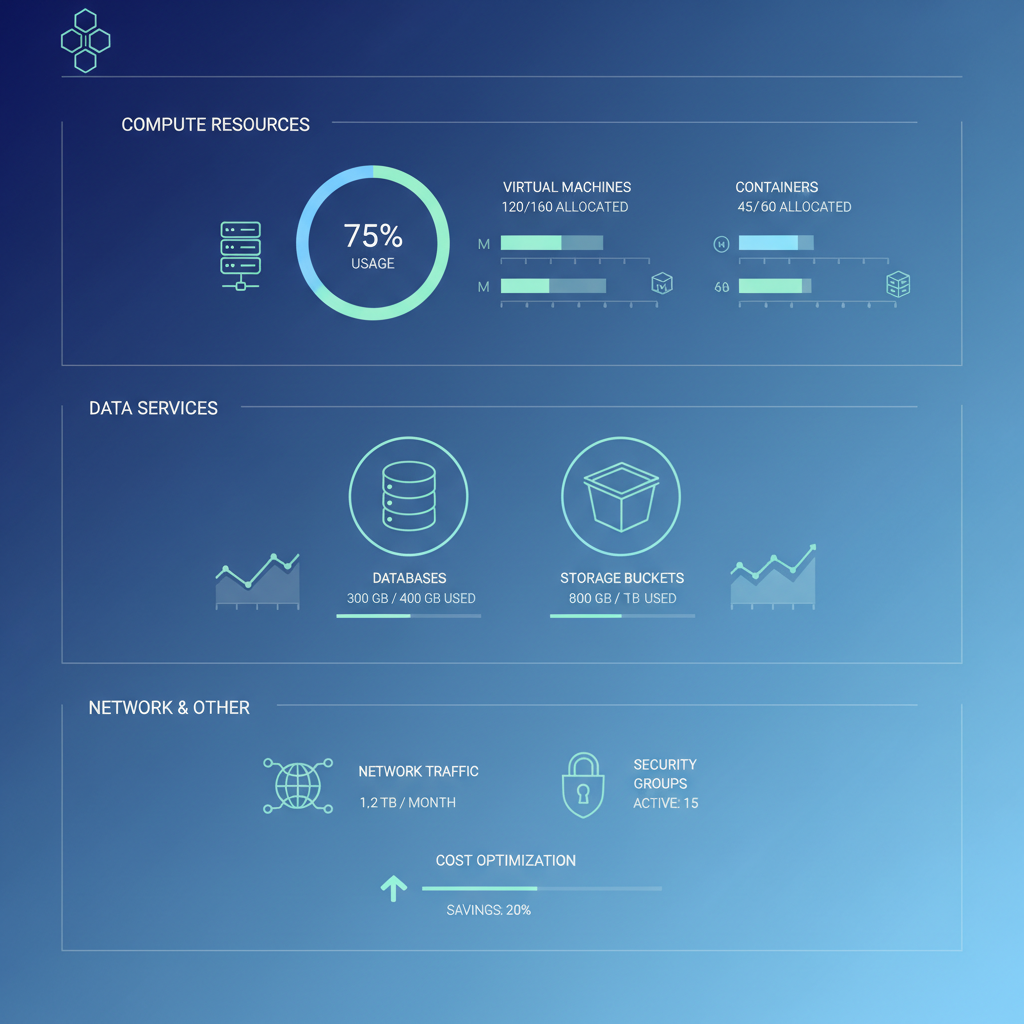
A dashboard showing various cloud resources like virtual machines, databases, and storage buckets, with metrics for usage and allocation, representing effective resource management.
Cloud Monitoring and Performance Management
Continuous cloud monitoring is vital for understanding the health and performance of your cloud environment. It involves collecting and analyzing data on resource utilization, application performance, and service availability. Proactive monitoring helps identify potential issues before they impact users.
Performance management goes beyond simply observing metrics; it involves actively optimizing the configuration and scaling of resources to meet demand. This ensures applications perform optimally, providing a seamless experience for end-users. Tools that provide real-time insights are indispensable for this pillar.
Cost Optimization
One of the biggest advantages, and potential pitfalls, of cloud computing is its pay-as-you-go model. Cost optimization focuses on minimizing cloud spend while maintaining desired performance and availability levels. This requires diligent tracking, analysis, and strategic adjustments.
Effective cost optimization involves identifying underutilized resources, right-sizing instances, leveraging reserved instances or spot instances, and deleting unused assets. Cloud governance policies play a crucial role in preventing unnecessary expenditures and ensuring financial accountability.
Security Management
Cloud security management is paramount in an era of increasing cyber threats. It encompasses protecting cloud-based data, applications, and infrastructure from unauthorized access, breaches, and other malicious activities. A robust security posture is non-negotiable for business continuity and trust.
This pillar includes implementing strong access controls, encryption, network security, regular vulnerability assessments, and compliance with industry standards. Proactive threat detection and rapid incident response are also critical components. Ensuring data integrity and privacy across all cloud services is fundamental.
Cloud Governance and Compliance
Cloud governance establishes the policies, procedures, and best practices that guide the use of cloud services within an organization. It provides a framework for decision-making, ensuring that cloud initiatives align with business objectives and regulatory requirements. Good governance fosters order and accountability.
Compliance involves adhering to external regulations (e.g., GDPR, HIPAA) and internal company policies. Effective cloud governance simplifies demonstrating compliance by providing auditable trails and enforcing necessary controls. This ensures legal and ethical operation across your cloud footprint.
MAXIMIZE YOUR CLOUDS
Maximize your cloud’s potential with expert management. Discover custom cloud solutions
✓ Free consultation ✓ No commitment required ✓ Trusted by experts
Implementing Your Cloud Management Strategy
Developing and implementing a robust cloud management strategy requires a structured approach. This isn’t a one-time task but an ongoing process of refinement and adaptation. Follow these steps to establish an effective framework.
1. Assess Your Current Cloud Footprint: Begin by gaining a comprehensive understanding of your existing cloud resources, applications, and their dependencies. Document what you have, where it lives, and how it’s being used. This initial assessment provides a baseline for future improvements.
2. Define Clear Objectives and Policies: Articulate specific goals for your cloud management efforts, such as reducing costs by 20% or improving security posture. Establish clear policies for resource provisioning, access control, tagging, and data retention. These policies form the bedrock of your cloud governance.
3. Implement Centralized Monitoring and Logging: Deploy robust cloud monitoring solutions that provide a unified view across your entire cloud environment. Centralize logs to facilitate easier troubleshooting, performance analysis, and security auditing. This provides the visibility needed for proactive management.
4. Establish Cost Control Mechanisms: Leverage cloud provider tools and third-party solutions for cost visibility and budgeting. Implement automated alerts for budget overruns and enforce tagging policies to attribute costs to specific teams or projects. Regularly review spend and identify optimization opportunities.
5. Strengthen Security Measures: Apply the principle of least privilege for all access controls. Implement multi-factor authentication, network segmentation, and encryption for data at rest and in transit. Conduct regular security audits and penetration testing to identify and remediate vulnerabilities.
6. Automate with Cloud Orchestration: Utilize Infrastructure as Code (IaC) tools to automate the provisioning and configuration of your cloud resources. Automate routine tasks, scaling operations, and deployment pipelines. This significantly improves efficiency and reduces human error.
7. Regularly Review and Optimize: Cloud environments are dynamic, so your management strategy must be too. Schedule regular reviews of your policies, performance metrics, and cost reports. Continuously seek opportunities for improvement and adapt your strategy as your business needs evolve.
Tools and Technologies for Cloud Management
A wide array of tools and technologies support effective cloud management, ranging from native cloud provider services to specialized third-party platforms. Choosing the right tools depends on your specific cloud setup, budget, and operational requirements.
Major cloud providers like AWS, Azure, and Google Cloud offer extensive native toolsets for managing their respective services. These include identity and access management (IAM), monitoring (CloudWatch, Azure Monitor, Google Cloud Monitoring), and cost management tools. They are often integrated and provide deep insights into their specific ecosystems.
Third-party Cloud Management Platforms (CMPs) offer a unified dashboard for managing multi-cloud or hybrid cloud environments. These platforms often provide advanced features for cost optimization, security posture management, and cloud orchestration across different providers. They can significantly simplify complex management tasks.
Infrastructure as Code (IaC) tools like Terraform and Ansible are critical for automating resource provisioning and configuration. They allow you to define your infrastructure in code, enabling version control, consistency, and repeatability. This greatly enhances cloud governance.
Challenges in Cloud Management and How to Overcome Them
Despite its benefits, cloud management presents several challenges that organizations must navigate. Understanding these hurdles is the first step toward developing resilient strategies. Proactive planning can transform potential obstacles into manageable tasks.
One significant challenge is cloud sprawl, where an organization accumulates numerous unmanaged cloud resources. This leads to increased costs, security risks, and operational inefficiencies. Overcome this by implementing strict cloud governance policies, automating resource lifecycle management, and regularly auditing your environment.
Another hurdle is cost unpredictability. The dynamic nature of cloud billing can make forecasting difficult, leading to unexpected expenses. Address this through continuous cost monitoring, setting budgets with alerts, and utilizing reserved instances or savings plans where appropriate. Comprehensive cost optimization strategies are key.
Security and compliance concerns are ever-present. The shared responsibility model means organizations must actively secure their data and applications in the cloud. Mitigate these risks by implementing strong identity and access management, employing encryption, conducting regular security assessments, and aligning with compliance frameworks.
Finally, the complexity of multi-cloud environments can be overwhelming. Managing resources across different providers often requires specialized skills and tools. Centralized cloud management platforms and a focus on cloud orchestration can simplify multi-cloud operations, providing a single pane of glass for management.
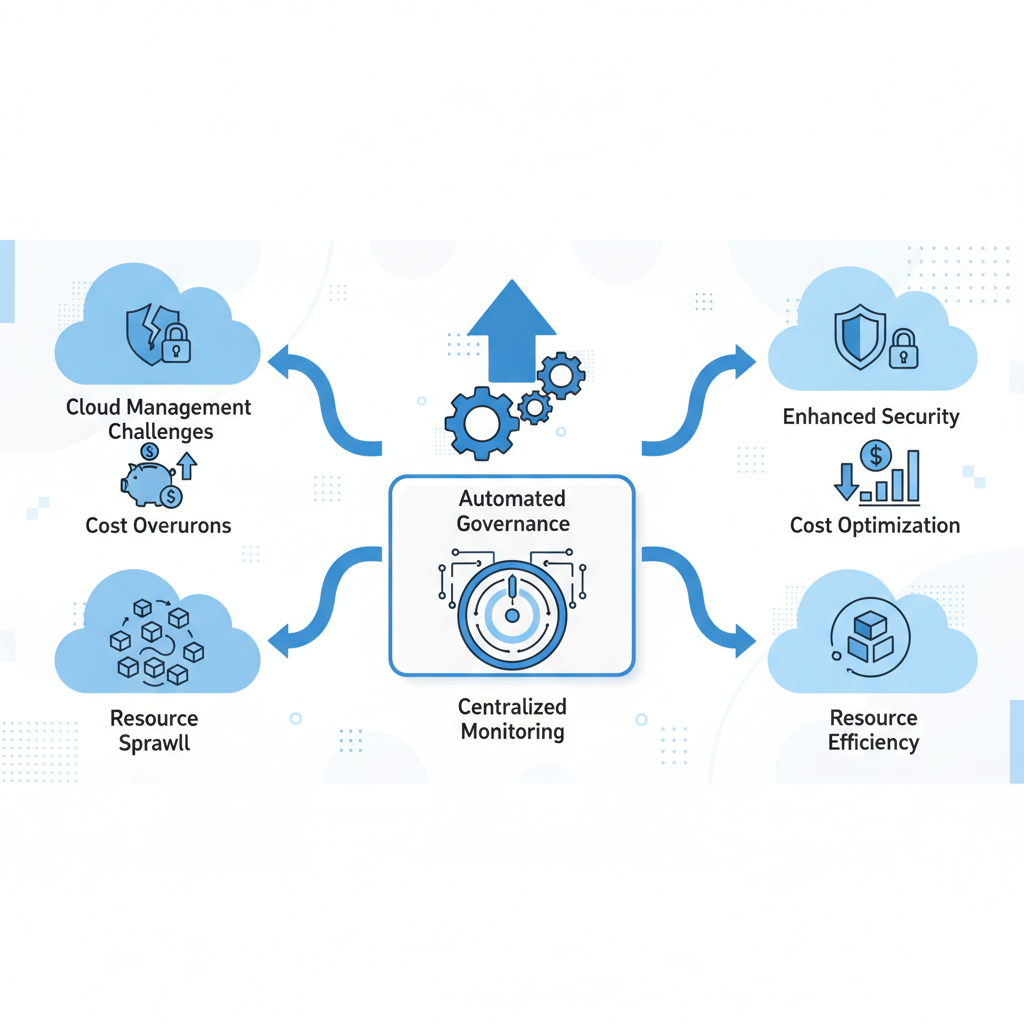
A conceptual diagram showing various cloud management challenges like security gaps, cost overruns, and resource sprawl, with arrows pointing towards solutions like automated governance and centralized monitoring.
Frequently Asked Questions
This section addresses common queries about cloud management, offering concise explanations to clarify key concepts. Understanding these fundamentals helps solidify your knowledge.
What is cloud management?
Cloud management refers to the comprehensive administration of cloud computing services, resources, and applications. It involves planning, organizing, coordinating, and controlling cloud environments to optimize performance, security, and cost. Its primary goal is to ensure that cloud infrastructure supports business objectives effectively.
Why is cloud governance important?
Cloud governance is crucial because it establishes the rules, policies, and processes that guide an organization’s use of cloud services. It ensures consistency, mitigates risks, maintains compliance with regulations, and optimizes resource utilization and costs. Without strong governance, cloud adoption can lead to uncontrolled sprawl and inefficiencies.
How does cloud orchestration differ from automation?
Cloud orchestration involves the automated arrangement, coordination, and management of complex cloud workloads, applications, and services across multiple systems. Automation, while similar, often refers to the execution of individual, repetitive tasks. Orchestration essentially automates the automation of multiple processes, creating cohesive workflows.
What are the main benefits of cost optimization in the cloud?
Cost optimization in the cloud helps businesses reduce unnecessary expenses, improve financial predictability, and maximize the return on their cloud investments. Key benefits include preventing budget overruns, identifying and eliminating wasted resources, and allowing funds to be redirected to innovation. It ensures you pay only for what you truly need and use.
What role does security management play in cloud environments?
Security management in cloud environments is critical for protecting data, applications, and infrastructure from cyber threats and unauthorized access. It involves implementing robust security controls, monitoring for vulnerabilities, ensuring compliance, and responding to incidents effectively. A strong security posture builds trust and protects sensitive information.
Can cloud management tools work across different cloud providers?
Yes, many cloud management platforms (CMPs) are designed to offer multi-cloud capabilities, allowing organizations to manage resources and services across various public and private cloud providers from a single interface. These tools help reduce complexity and provide a unified view of disparate cloud environments.
MAXIMIZE YOUR CLOUDS
Maximize your cloud’s potential with expert management. Discover custom cloud solutions
✓ Free consultation ✓ No commitment required ✓ Trusted by experts
Conclusion
Mastering cloud management is an ongoing journey that requires dedication, strategic planning, and continuous adaptation. By embracing the key pillars of resource management, cloud monitoring, cost optimization, security, and strong cloud governance, organizations can transform their cloud infrastructure from a mere utility into a powerful driver of innovation and business value. The principles outlined in this guide provide a robust foundation for building an efficient, secure, and future-proof cloud strategy.
As your organization continues to evolve in the digital landscape, so too must your approach to cloud management. Stay agile, leverage the right tools, and commit to continuous improvement. This proactive stance will ensure your cloud investments consistently deliver optimal performance and align with your strategic objectives, setting your business up for sustained success.