Navigating Replatforming Challenges and Solutions for Modern Systems
March 10, 2026|11:07 AM
Unlock Your Digital Potential
Whether it’s IT operations, cloud migration, or AI-driven innovation – let’s explore how we can support your success.
Home /
Work /
Blogs /
Navigating Replatforming Challenges and Solutions for Modern Systems
Understanding Replatforming: What It Entails
Replatforming refers to the process of migrating an existing software application or system from one platform or technology stack to another. This significant undertaking aims to improve performance, scalability, security, or cost-efficiency. It involves moving core functionalities, data, and integrations to a new foundation.
Organizations often consider replatforming when their current system becomes outdated, difficult to maintain, or can no longer meet evolving business demands. The decision to replatform is strategic, often driven by a need for modernization. It’s crucial to understand the full scope of replatforming challenges and solutions before embarking on such a project.
Replatforming can involve moving from an on-premise solution to a cloud-based platform, switching between different cloud providers, or adopting a new underlying technology. The ultimate goal is to enhance the overall user experience and operational efficiency. Successful replatforming can unlock new capabilities and competitive advantages.
Why Organizations Consider Replatforming
Several compelling reasons drive businesses to undertake replatforming initiatives. These motivations often revolve around addressing existing limitations and preparing for future growth. Understanding these drivers is the first step in formulating an effective replatforming strategy.
One primary driver is the desire for enhanced scalability. Legacy systems may struggle to handle increasing user loads or data volumes, hindering business expansion. A new platform can provide the necessary infrastructure to support growth without performance degradation.
Another significant factor is the need for improved security. Older platforms might lack modern security features, making them vulnerable to cyber threats. Replatforming to a more secure environment protects sensitive data and maintains customer trust.
Cost optimization also plays a crucial role in the decision-making process. Maintaining outdated systems can be expensive due to specialized skill requirements and high operational overheads. Moving to a more efficient platform, especially a SaaS replatforming strategy, can significantly reduce long-term costs.
Common Replatforming Challenges and Solutions
Embarking on a replatforming journey is rarely straightforward; it comes with its share of hurdles. Identifying these common replatforming challenges and solutions early is vital for effective project planning and risk mitigation. Anticipating potential pitfalls allows teams to prepare robust strategies to overcome them.
Understanding these obstacles helps organizations proactively develop strategies to mitigate risks. This section explores key replatforming pain points solutions and provides practical insights into how to tackle them head-on. Many of these challenges require careful planning and execution.
Technical Complexities: Data Migration and Integration
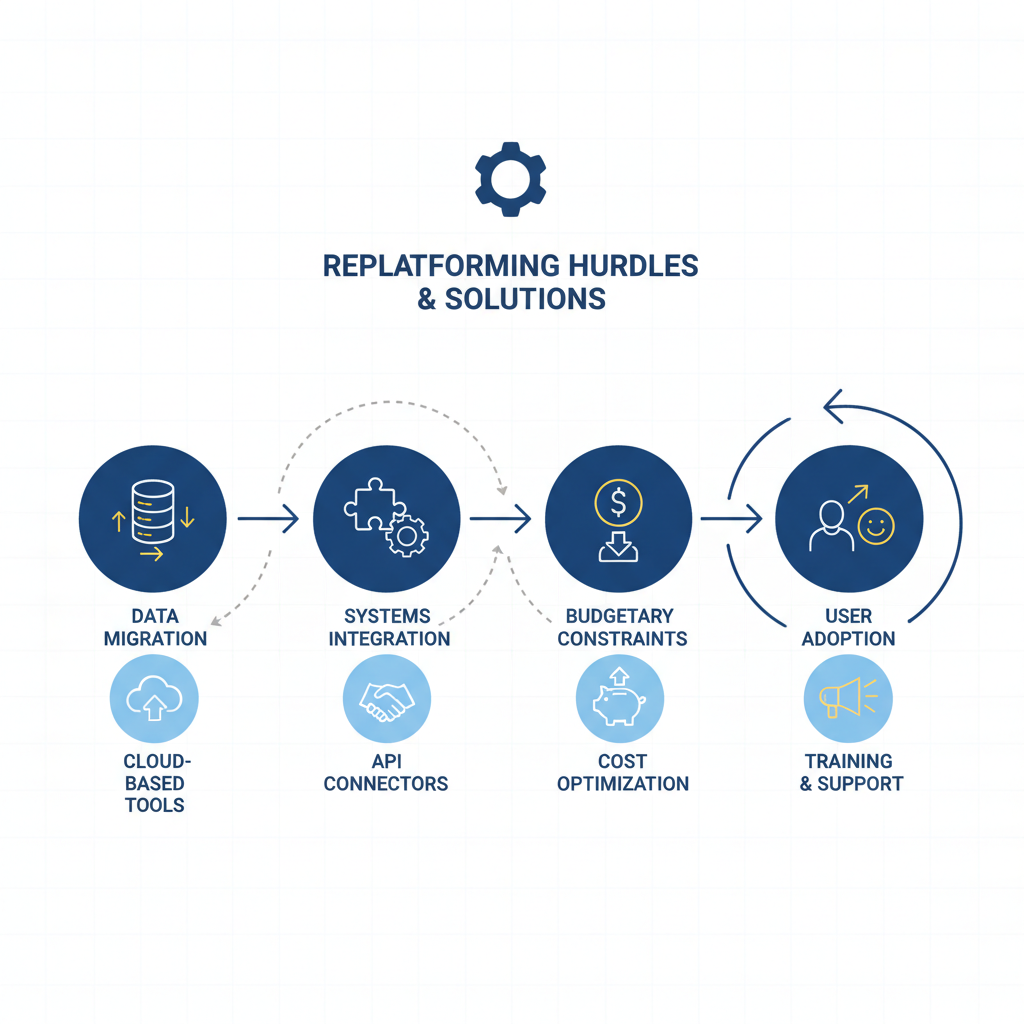
Data migration is often cited as one of the most significant replatforming challenges. Moving vast amounts of sensitive data from an old system to a new one without loss, corruption, or downtime requires meticulous planning. Incompatible data formats and structures can further complicate this process.
Solution: Develop a comprehensive data migration strategy that includes data auditing, cleansing, transformation, and validation. Automate as much of the migration process as possible using specialized tools. Conduct pilot migrations and thorough testing to ensure data integrity before the final cutover.
Integrating the new platform with existing systems (CRMs, ERPs, payment gateways) presents another technical hurdle. APIs might differ, or legacy systems may lack modern integration capabilities. These complexities can lead to unexpected delays and functionality gaps.
Solution: Prioritize integrations based on business criticality and conduct a detailed integration analysis early in the project. Utilize robust middleware or integration platform as a service (iPaaS) solutions to bridge compatibility gaps. Design flexible, future-proof integration architectures.
Cost Overruns and Budget Management
Replatforming projects can quickly exceed initial budget estimates if not managed carefully. Hidden costs, scope creep, and unforeseen technical issues frequently contribute to financial strain. This makes accurate budgeting and cost control paramount.
Solution: Conduct a detailed cost analysis upfront, including licensing fees, development, migration, testing, training, and ongoing maintenance. Build a contingency budget of at least 15-20% into the overall plan. Regularly monitor expenditure against the budget and adjust as necessary.
Project Management and Timeline Delays
Large-scale replatforming projects are complex, involving multiple stakeholders and interdependencies. Poor project management, unrealistic timelines, and a lack of clear communication can lead to significant delays. These delays can impact business operations and customer satisfaction.
Solution: Employ experienced project managers who understand replatforming challenges and solutions guide principles. Use agile methodologies to break the project into manageable sprints, allowing for flexibility and iterative progress. Establish clear communication channels and regular progress reporting to all stakeholders.
A detailed infographic showing interconnected challenges of replatforming, such as data migration, integration, cost, and user adoption, with arrows pointing to corresponding solutions.
Resistance to Change and User Adoption
Any major system change can encounter resistance from end-users accustomed to the old platform. A lack of proper training or perceived inconveniences can lead to low user adoption rates. This can undermine the benefits of the new platform.
Solution: Implement a robust change management strategy from the outset. Involve end-users early in the planning and testing phases to foster a sense of ownership. Provide comprehensive training, create user-friendly documentation, and offer ongoing support to ease the transition. Highlight the clear benefits for users.
Vendor Lock-in and Dependency Issues
Choosing a new platform or vendor can inadvertently lead to vendor lock-in, making future migrations or changes difficult and expensive. Over-reliance on a single vendor’s proprietary technology can limit flexibility and increase long-term costs. It is important to consider this aspect for long term replatforming challenges and solutions strategies.
Solution: Carefully evaluate vendor contracts, focusing on data portability, integration capabilities, and exit strategies. Favor open standards and APIs where possible to maintain flexibility. Diversify your technology stack to avoid excessive reliance on one provider.
Strategic Planning for a Successful Replatforming Project
A well-defined strategy is the cornerstone of overcoming replatforming challenges and solutions. Hasty decisions or inadequate planning can lead to project failure and wasted resources. Strategic foresight minimizes risks and maximizes the chances of a smooth transition. This involves meticulous preparation and a clear roadmap.
Developing a robust replatforming strategy is crucial for guiding the entire process. It ensures alignment with business goals and stakeholder expectations. Effective planning acts as a preventative measure against many common replatforming pain points solutions.
Defining Clear Objectives and Scope
Before any technical work begins, clearly articulate why replatforming is necessary and what it aims to achieve. Vague objectives can lead to scope creep and a diluted return on investment. Specific, measurable, achievable, relevant, and time-bound (SMART) goals are essential.
Define the project’s scope precisely, outlining what functionalities will be migrated, what will be redeveloped, and what might be left behind. This clarity helps manage expectations and prevent unnecessary feature creep. A detailed scope document serves as a crucial reference throughout the project.
Vendor Selection and Due Diligence
Choosing the right platform and vendor is a critical decision that impacts the entire replatforming project. A thorough evaluation process is indispensable. This includes assessing technical capabilities, support, security, and the vendor’s financial stability.
Conduct extensive due diligence, including reference checks and proof-of-concept demonstrations. Understand the vendor’s long-term roadmap and how it aligns with your business goals. Negotiate contracts carefully to ensure favorable terms regarding service level agreements (SLAs), data ownership, and exit clauses.
Building a Skilled Project Team
A successful replatforming effort requires a diverse team with a wide range of skills. This includes project managers, architects, developers, quality assurance engineers, and change management specialists. External consultants can also provide invaluable expertise.
Ensure the team has a deep understanding of both the legacy system and the new platform. Foster strong communication and collaboration within the team. Regular training and skill development can also prepare the team for the technical demands of the project.
Developing a Robust Replatforming Strategy
The replatforming strategy should outline the approach to be taken, considering architectural decisions, migration methodologies, and integration plans. It serves as the blueprint for execution. This detailed plan helps manage how to replatforming challenges and solutions effectively.
Consider whether a “big bang” migration or a phased approach is more suitable for your organization. A phased approach might reduce risk but prolong the migration timeline. The strategy should also address data governance, security, and compliance requirements from the outset.
✓ Free consultation ✓ No commitment required ✓ Trusted by experts
Key Strategies for Overcoming Replatforming Pain Points
Once the strategic planning is complete, the focus shifts to execution. This phase requires meticulous attention to detail and proactive problem-solving to address emerging replatforming pain points solutions. Implementing best practices across various aspects of the project is crucial.
These strategies provide actionable advice for tackling specific replatforming challenges, offering practical guidance for project teams. They are essential for anyone seeking a comprehensive replatforming challenges and solutions guide. Following these tips can significantly improve project outcomes.
Data Migration Best Practices
Successful data migration is paramount for maintaining business continuity. Start with a thorough data audit to identify redundant, outdated, or trivial data. Cleanse and normalize your data before migration to ensure quality in the new system.
Develop a detailed migration plan, including mapping old data fields to new ones. Use automated tools for data extraction, transformation, and loading (ETL) to minimize manual errors. Perform extensive testing on migrated data to verify accuracy and completeness.
Ensuring Seamless Integrations
Integrations are the circulatory system of modern platforms; their failure can cripple functionality. Begin by identifying all necessary integrations and their dependencies. Prioritize critical integrations that directly impact core business processes.
Design flexible, API-driven integrations that can adapt to future changes. Use integration platforms (iPaaS) to manage complex integration landscapes, providing centralized monitoring and error handling. Test integrations rigorously in a staging environment before deployment.
Effective Change Management and Communication
Managing the human element of replatforming is as important as the technical aspects. Develop a comprehensive change management plan to prepare users for the transition. Communicate the benefits of the new platform clearly and frequently.
Establish a feedback loop to address user concerns and suggestions throughout the project. Appoint change champions within different departments to advocate for the new system. Provide continuous support channels, such as a dedicated help desk, post-launch.
Testing and Quality Assurance
Thorough testing is non-negotiable for a successful replatforming project. Develop a comprehensive test plan that covers functionality, performance, security, and user acceptance testing (UAT). Automate testing wherever possible to ensure efficiency and repeatability.
Execute tests in environments that closely mirror production. Involve end-users in UAT to validate that the new system meets their operational needs. Document all test cases and results meticulously, addressing any identified issues promptly.
Post-Launch Support and Optimization
The replatforming journey doesn’t end at launch. Robust post-launch support is crucial for addressing unforeseen issues and optimizing performance. Establish clear channels for incident reporting and resolution.
Monitor system performance and user feedback continuously to identify areas for improvement. Plan for iterative enhancements and ongoing maintenance to keep the platform aligned with evolving business requirements. This ensures the long-term success of the replatforming initiative.
Implementing Your SaaS Replatforming Strategy
Implementing a SaaS replatforming strategy requires a structured approach to execution. This section provides a practical, step-by-step framework for managing the transition. A thoughtful implementation plan minimizes disruption and maximizes the benefits of the new platform. These steps offer a replatforming challenges and solutions tutorial for effective deployment.
Successful execution hinges on meticulous planning and agile adaptation. Organizations seeking best replatforming challenges and solutions often prioritize a methodical rollout. This phased approach allows for continuous learning and adjustment.
Step-by-Step Approach to Execution
1. Discovery and Planning: Define objectives, scope, team, and high-level architecture. Perform a thorough audit of the existing system and data. 2. Vendor and Platform Selection: Evaluate potential vendors, conduct due diligence, and make a selection based on requirements and long-term vision. 3. Design and Architecture: Develop the detailed architecture for the new platform, including data models, integrations, and customization requirements. 4. Development and Configuration: Build new functionalities, configure the platform, and develop necessary integrations. 5. Data Migration: Execute the data migration plan, moving and transforming data from the old system to the new. 6. Testing and Quality Assurance: Conduct extensive functional, performance, security, and user acceptance testing. 7. Training and Change Management: Prepare users for the new system through comprehensive training and communication. 8. Deployment and Cutover: Execute the go-live plan, switching from the old system to the new. 9. Post-Launch Support and Optimization: Monitor performance, address issues, and continuously optimize the platform.
Phased Rollout vs. Big Bang Approach
Choosing between a phased rollout and a “big bang” approach is a critical decision in any SaaS replatforming strategy. Each has distinct advantages and risks that need careful consideration based on organizational context. This choice significantly impacts replatforming challenges and solutions tips.
A big bang approach involves switching over all users and functionalities to the new platform simultaneously. This can be quicker but carries higher risks, as any issues affect all users immediately. It’s suitable for smaller, less complex projects or when downtime can be strictly controlled.
A phased rollout involves migrating users or functionalities in stages. This reduces risk, allowing for lessons learned and adjustments between phases. However, it can extend the project timeline and require running parallel systems temporarily, adding complexity. This approach is often recommended for larger, more complex replatforming initiatives.
Monitoring Progress and Adapting
Continuous monitoring is essential throughout the replatforming process and post-launch. Establish key performance indicators (KPIs) to track project progress, system performance, and user adoption. Regular check-ins and status meetings help identify and address issues promptly.
Be prepared to adapt your plans based on new insights or unforeseen obstacles. Flexibility is a virtue in replatforming projects. This iterative approach allows teams to pivot when necessary, ensuring the project stays on track and delivers the desired outcomes.
Real-World Replatforming Examples and Case Studies
Examining real-world replatforming challenges and solutions examples provides invaluable insights for organizations embarking on similar journeys. These case studies highlight common pitfalls and successful strategies, offering practical lessons. Learning from others’ experiences can significantly mitigate risks.
Understanding these scenarios helps contextualize the advice provided in this replatforming challenges and solutions guide. It demonstrates how different businesses have navigated complex migrations. These examples underscore the importance of planning and adaptability.
Many e-commerce businesses have successfully replatformed their online stores from legacy monolithic systems to modern, headless commerce platforms. This often improved site speed, conversion rates, and the ability to integrate with various front-end experiences. The challenge typically involved complex product catalog and order data migration.
A common example includes companies moving their entire IT infrastructure from on-premise servers to a public cloud provider like AWS, Azure, or Google Cloud. This shift aims for greater scalability, reduced operational costs, and enhanced disaster recovery capabilities. Data security and network latency are often significant considerations in these replatforming pain points solutions.
Another instance involves an enterprise replacing an outdated CRM system with a new, cloud-based solution. While promising improved sales efficiency and customer insights, this often presents significant challenges in migrating historical customer data and integrating with existing marketing automation tools. Thorough user training is crucial for adoption here.
A Comprehensive Replatforming Challenges and Solutions Tutorial
This section serves as a practical replatforming challenges and solutions tutorial, consolidating the best practices and actionable steps. It aims to provide a clear roadmap for anyone, especially replatforming challenges and solutions for beginners, looking to navigate this complex process successfully. Following these steps can help avoid common pitfalls and ensure a smooth transition.
These tips combine strategic thinking with tactical execution, offering a holistic approach to managing replatforming projects. They are designed to empower teams with the knowledge to address various replatforming challenges and solutions effectively.
1. Start with a Clear “Why”: Before anything else, define the specific business problems the replatforming will solve. Is it scalability, cost, security, or feature limitations? This clarity drives all subsequent decisions. 2. Assess Your Current State: Conduct a thorough audit of your existing platform, including architecture, integrations, data volume, and user workflows. Understand its limitations and dependencies. 3. Choose the Right Destination: Research potential platforms carefully, considering factors like scalability, security, cost model, ecosystem, and vendor support. Ensure it aligns with your future business needs. 4. Build a Strong Business Case: Quantify the expected benefits (ROI) and present a compelling argument for the investment required. Include potential risks and mitigation strategies. 5. Assemble an Expert Team: Gather individuals with diverse skills – project management, architecture, development, QA, and change management. Consider external expertise for specialized areas. 6. Develop a Detailed Roadmap: Break the project into phases with clear milestones, deliverables, and responsibilities. Outline the migration strategy (phased vs. big bang). 7. Prioritize Data Integrity: Create a robust data migration plan. Cleanse, transform, and validate data meticulously before and after transfer. Test repeatedly. 8. Plan for Integrations Early: Map out all necessary integrations with existing systems. Prioritize critical ones and design for flexibility and future growth. 9. Embrace Change Management: Don’t underestimate the human element. Communicate proactively, train users thoroughly, and provide ongoing support to foster adoption. 10. Test, Test, Test: Conduct comprehensive testing across all aspects – functional, performance, security, and user acceptance. Bug fixes before launch save significant headaches later. 11. Have a Rollback Plan: Always prepare a contingency plan in case something goes wrong during deployment. Knowing you can revert provides a safety net. 12. Monitor and Optimize Post-Launch: The journey continues after go-live. Continuously monitor performance, gather feedback, and iterate to optimize the new platform.
Frequently Asked Questions (FAQ)
Replatforming can be a complex topic, and many common questions arise. This FAQ section addresses some of the most pressing inquiries regarding replatforming challenges and solutions. These answers provide quick, expert insights into critical aspects of the process.
Understanding these fundamental concepts is key for anyone beginning to explore replatforming. The aim is to clarify typical replatforming challenges and solutions for beginners.
What is replatforming?
Replatforming is the process of migrating an existing software application or system from one underlying technology platform to another. This typically involves moving code, data, and integrations to a new environment without significantly altering the application’s core functionality. The goal is often to achieve better performance, scalability, security, or cost efficiency.
Why is replatforming challenging?
Replatforming is challenging due to several factors, including the complexity of data migration, ensuring seamless integration with existing systems, potential cost overruns, and managing resistance to change from users. Technical incompatibilities, extensive testing requirements, and the need for specialized skills also contribute to its difficulty. It often requires significant planning and resources.
How can data migration be managed effectively during replatforming?
Effective data migration management involves a multi-step process. First, conduct a thorough data audit to identify, cleanse, and normalize data. Next, develop a detailed migration plan with clear data mapping and validation rules. Utilize automated ETL (Extract, Transform, Load) tools for efficiency and accuracy. Finally, perform rigorous testing on migrated data to ensure its integrity and completeness in the new system.
What is a SaaS replatforming strategy?
A SaaS replatforming strategy involves migrating an application to or between Software-as-a-Service (SaaS) platforms. This could mean moving from an on-premise system to a SaaS offering, or from one SaaS provider to another. The strategy focuses on leveraging the benefits of SaaS, such as reduced infrastructure management and automatic updates, while addressing challenges like data portability, integration with existing SaaS tools, and subscription cost management.
How do you ensure user adoption after replatforming?
Ensuring user adoption after replatforming requires a proactive change management strategy. This includes communicating the benefits of the new platform clearly and early, involving users in the testing and feedback process, and providing comprehensive training. Offering ongoing support channels, creating user-friendly documentation, and addressing concerns promptly also helps build user confidence and encourage widespread adoption.
What are the main replatforming pain points solutions?
The main replatforming pain points solutions involve strategic planning, robust execution, and effective change management. Key solutions include thorough data auditing and automated migration for data integrity, utilizing integration platforms for seamless connectivity, implementing agile project management to stay on schedule, budgeting with a contingency for cost control, and providing comprehensive user training to mitigate resistance to change. Proactive communication is also critical.
✓ Free consultation ✓ No commitment required ✓ Trusted by experts
Conclusion
Navigating the complexities of replatforming challenges and solutions demands a strategic, informed approach. By understanding common pitfalls and proactively implementing proven strategies, organizations can transform a daunting task into a successful modernization effort. From meticulous planning and vendor selection to robust data migration and effective change management, every step contributes to a smoother transition.
This comprehensive guide has provided a detailed roadmap, covering everything from the fundamental aspects of replatforming challenges and solutions for beginners to advanced strategies and real-world examples. By focusing on critical replatforming pain points solutions and leveraging a well-defined SaaS replatforming strategy, businesses can achieve their modernization goals. Embracing these best practices ensures that replatforming projects deliver tangible benefits, setting the stage for future growth and innovation.
Jacob Stålbro is a seasoned digitalization and transformation leader with over 20 years of experience, specializing in AI-driven innovation. As Head of Innovation and Co-Founder at Opsio, he drives the development of advanced AI, ML, and IoT solutions. Jacob is a sought-after speaker and webinar host known for translating emerging technologies into real business value and future-ready strategies.