Navigate Enterprise AWS Migration Successfully with Expert Insights
March 11, 2026|7:45 AM
Unlock Your Digital Potential
Whether it’s IT operations, cloud migration, or AI-driven innovation – let’s explore how we can support your success.
Home /
Work /
Blogs /
Navigate Enterprise AWS Migration Successfully with Expert Insights
Introduction to Enterprise AWS Migration
Embarking on an enterprise aws migration is a significant strategic undertaking for any large organization. It represents far more than just moving servers; it signifies a fundamental shift in how a business operates, innovates, and serves its customers. This comprehensive guide outlines the essential steps and considerations for a successful enterprise aws migration.
A well-executed enterprise aws migration can unlock immense value, driving business transformation and fostering agility. It involves a meticulous approach to planning, execution, and optimization across various departments. Understanding the complexities of a large scale migration is crucial for minimizing disruption and maximizing the benefits of corporate cloud adoption.
Why Undertake an Enterprise AWS Migration?
The decision to pursue an enterprise aws migration stems from a desire to address critical business challenges and seize new opportunities. Modern enterprises seek greater flexibility, enhanced security, and improved cost efficiency. AWS provides a robust, scalable, and secure cloud environment to meet these demanding requirements.
Moving to AWS often enables a complete data center exit, eliminating the overhead of managing on-premises infrastructure. This shift liberates IT resources from maintenance tasks, allowing them to focus on innovation and strategic initiatives. Furthermore, AWS offers a vast array of services that foster rapid prototyping and deployment, accelerating time-to-market for new products and services.
Key drivers for enterprise aws migration include:
Scalability and Elasticity: Easily scale resources up or down based on demand, avoiding over-provisioning.
Cost Optimization: Shift from capital expenditures (CapEx) to operational expenditures (OpEx), paying only for what you consume.
Increased Agility and Innovation: Rapidly deploy new applications, experiment with cutting-edge technologies like AI/ML, and respond quickly to market changes.
Global Reach: Deploy applications closer to users worldwide, improving performance and user experience.
Resilience and Disaster Recovery: Build highly available and fault-tolerant architectures with built-in redundancy across regions and Availability Zones.
The AWS Cloud Adoption Framework (CAF)
The AWS Cloud Adoption Framework (CAF) provides a structured approach to guide organizations through their corporate cloud adoption journey. It emphasizes that a successful enterprise aws migration is a blend of technology, process, and people. Understanding and leveraging the CAF is a key enterprise aws migration tip for managing the inherent complexities.
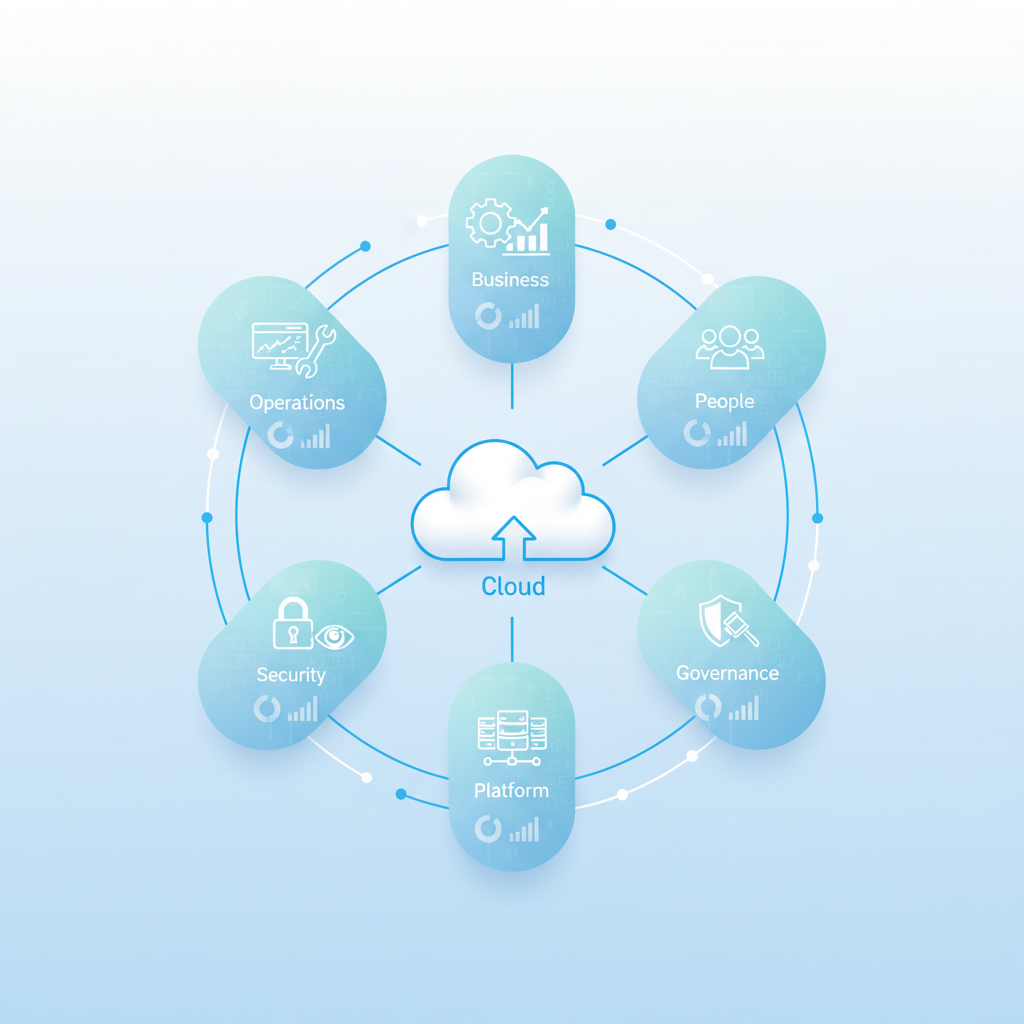
CAF is organized into six perspectives, each focusing on distinct areas of an organization. These perspectives ensure that all critical aspects of an enterprise architecture are considered, from technical capabilities to organizational change management. Adopting this framework helps establish a comprehensive enterprise cloud strategy.
The six core perspectives of the AWS CAF are:
Business: Focuses on aligning IT investments with business outcomes.
People: Addresses skills, training, and organizational changes required for cloud adoption.
Governance: Ensures that IT aligns with business strategy and organizational policies.
Platform: Defines the target state architecture, services, and tools.
Security: Establishes security controls, policies, and processes in the cloud.
Operations: Focuses on managing and monitoring cloud infrastructure and applications.
A diagram illustrating the six perspectives of the AWS Cloud Adoption Framework, showing “Business,” “People,” “Governance,” “Platform,” “Security,” and “Operations” as interconnected pillars surrounding a central cloud icon.
Phase 1: Assess and Discover
The initial phase of any enterprise aws migration involves a thorough assessment and discovery of the current IT landscape. This foundational step is critical for understanding what needs to be moved, its dependencies, and the potential impact on business operations. A comprehensive discovery process is fundamental to developing a realistic enterprise cloud strategy.
Without a detailed understanding of the existing environment, the risks of unexpected issues and cost overruns increase significantly. This phase helps in identifying the scope of the large scale migration and setting clear objectives. It also informs the subsequent planning and design stages, ensuring a smoother transition.
Key activities in the Assess and Discover phase: 1. Application Portfolio Analysis: Identify all applications, their business criticality, technical characteristics, and interdependencies. Categorize applications for migration readiness. 2. Infrastructure Inventory: Document all servers, storage, networking devices, databases, and associated configurations. Understand resource utilization patterns. 3. Dependency Mapping: Crucially, map all application-to-application, application-to-database, and application-to-infrastructure dependencies. This prevents critical services from failing post-migration. 4. TCO Analysis (Total Cost of Ownership): Compare the current on-premises costs (hardware, software, power, cooling, labor) with projected AWS cloud costs. This builds a strong business case for the migration and supports corporate cloud adoption. 5. Security and Compliance Review: Evaluate existing security controls and compliance requirements to ensure they can be met or enhanced in the AWS environment. 6. Skills Assessment: Identify current team capabilities and any gaps that need to be addressed through training or external support for the enterprise aws migration.
✓ Free consultation ✓ No commitment required ✓ Trusted by experts
Phase 2: Plan and Design
With a clear understanding of the existing environment, the next step is to meticulously plan and design the target AWS architecture. This phase defines the “how” of the enterprise aws migration, outlining strategies, timelines, and the overall blueprint for the cloud environment. A well-crafted plan is one of the best enterprise aws migration practices for mitigating risks.
This stage involves choosing the right migration strategies and designing a secure, scalable, and cost-effective landing zone. It also focuses on establishing governance policies and preparing the organization for the upcoming changes. Effective planning is crucial for managing organizational change throughout the migration process.
Key activities in the Plan and Design phase: 1. Migration Strategy Definition (6 Rs):Rehost (Lift and Shift): Moving applications as-is to AWS. Replatform (Lift, Tinker, and Shift): Minor cloud optimizations without changing core architecture. Refactor/Rearchitect: Reimagining how an application is architected and developed using cloud-native features. Repurchase: Moving to a different product, typically SaaS. Retire: Decommissioning applications no longer needed. Retain: Keeping some applications on-premises for specific reasons. 2. AWS Landing Zone Design: Create a multi-account AWS environment with pre-configured security, networking, and governance controls. This forms the foundation for secure and scalable corporate cloud adoption. 3. Network Architecture Design: Plan VPCs, subnets, routing, IP addressing, and connectivity back to on-premises resources (e.g., VPN, AWS Direct Connect). 4. Security and Compliance Blueprint: Define identity and access management (IAM), data encryption strategies, network security, and logging/monitoring solutions. Ensure all compliance requirements are met. 5. Operating Model Definition: Outline the new operational processes, tools, and team structures for managing the cloud environment. Address organizational change implications early. 6. Migration Wave Planning: Group applications into logical waves based on dependencies, complexity, and business priority. This iterative approach helps manage the large scale migration. 7. Pilot Migration Execution: Conduct a small, non-critical pilot migration to validate the chosen strategy, tools, and processes. This provides valuable insights and lessons learned.
Phase 3: Migrate and Validate
This is the execution phase where applications and data are actively moved to the AWS cloud. It involves careful orchestration, continuous monitoring, and rigorous validation to ensure a seamless transition. The success of an enterprise aws migration hinges on the precision and thoroughness of this stage.
Maintaining business continuity during migration is paramount. Detailed cutover plans and rollback strategies are essential for mitigating risks. Teams must work collaboratively to address any issues that arise promptly.
Key activities in the Migrate and Validate phase: 1. Data Migration: Transfer databases, file systems, and object storage to AWS using appropriate tools (e.g., AWS DMS, AWS DataSync, Snow Family). 2. Application Migration: Move applications using the chosen “R” strategy. This may involve rehosting VMs using AWS Migration Hub and Application Migration Service (MGN), or refactoring applications into containers or serverless functions. 3. Automated Provisioning: Utilize Infrastructure as Code (IaC) tools like AWS CloudFormation or Terraform to automate the deployment of infrastructure resources. This ensures consistency and reduces manual errors. 4. Testing and Validation:Functional Testing: Ensure applications behave as expected in the new environment. Performance Testing: Validate that performance meets or exceeds pre-migration benchmarks. Security Testing: Verify that all security controls are effective. User Acceptance Testing (UAT): Involve business users to confirm that the migrated applications meet their needs. 5. Cutover Planning and Execution: Develop detailed cutover runbooks, including rollback procedures. Execute cutover during planned maintenance windows, minimizing downtime. 6. Post-Migration Sanity Checks: Immediately after cutover, perform critical checks to ensure all services are operational and accessible. 7. Decommissioning (Data Center Exit): Once applications are successfully running in AWS, decommission the corresponding on-premises infrastructure. This confirms the benefits of the data center exit.
Phase 4: Optimize and Operate
A successful enterprise aws migration doesn’t end with the cutover; it transitions into a continuous cycle of optimization and operational excellence. This phase focuses on maximizing the value of cloud investments, improving performance, and evolving the environment. Long-term success requires ongoing attention to cost, security, and operational efficiency.
This continuous improvement mindset is a cornerstone of best enterprise aws migration practices. It ensures that the enterprise cloud strategy remains aligned with business goals and leverages the latest AWS innovations. Regular reviews and adjustments are crucial for sustaining benefits and fostering innovation.
Key activities in the Optimize and Operate phase: 1. Cost Optimization:Right-sizing: Continuously adjust instance types and services to match actual usage patterns. Reserved Instances/Savings Plans: Commit to usage for predictable workloads to significantly reduce costs. Automated Shutdowns: Implement policies to shut down non-production resources outside business hours. Cloud Financial Management (FinOps): Establish processes and tools to manage and optimize cloud spending proactively. 2. Performance Optimization: Monitor application performance, identify bottlenecks, and make adjustments to architecture or configurations. 3. Security Posture Improvement: Continuously review and enhance security controls, implement threat detection, and conduct regular vulnerability assessments. 4. Operational Excellence:Automation: Automate routine operational tasks using AWS services like Systems Manager, Lambda, and CloudWatch Events. Monitoring and Alerting: Establish comprehensive monitoring for infrastructure and applications, with automated alerting for critical issues. * Incident Response: Develop and practice incident response procedures for cloud environments. 5. Continuous Innovation: Explore new AWS services and features to further enhance existing applications or develop new capabilities. This aligns with the original goal of business transformation. 6. Knowledge Transfer and Training: Ensure the operational team has the necessary skills and knowledge to manage the cloud environment effectively. This addresses the ongoing needs for organizational change.
Challenges and Best Practices for Enterprise AWS Migration
Undertaking an enterprise aws migration comes with its unique set of challenges, particularly given the scale and complexity involved. Recognizing these hurdles early and adopting best practices can significantly improve success rates. Effective management of organizational change is paramount throughout this journey.
One common challenge is the resistance to new technologies and processes. Addressing this through clear communication, training, and involving stakeholders early can mitigate negative impacts. Another significant hurdle is managing security and compliance in a new cloud paradigm.
Here are some enterprise aws migration tips and best practices:
Secure Executive Buy-in: Ensure strong leadership support and sponsorship from the outset. This is crucial for resource allocation and overcoming internal resistance.
Start Small, Think Big: Begin with a pilot project or a non-critical application to gain experience before undertaking a large scale migration. Learn from initial experiences.
Invest in Training: Prioritize upskilling your teams in AWS services, cloud architecture, and operational best practices. This empowers internal staff and reduces reliance on external consultants.
Automate Everything Possible: Leverage Infrastructure as Code (IaC) for provisioning resources and CI/CD pipelines for deployment. Automation reduces errors and increases efficiency.
Prioritize Security from Day One: Design security into your cloud architecture from the ground up, rather than adding it as an afterthought. Follow the principle of least privilege.
Establish a Cloud Center of Excellence (CCoE): Create a dedicated team that defines standards, provides guidance, and fosters cloud expertise across the organization. This drives consistent corporate cloud adoption.
Focus on Cost Management: Implement a robust FinOps framework to monitor, allocate, and optimize cloud spending continuously. Uncontrolled costs can derail an otherwise successful migration.
Communicate Continuously: Keep all stakeholders informed about progress, challenges, and successes. Manage expectations and address concerns openly to facilitate organizational change.
Engage with AWS and Partners: Leverage AWS professional services, solutions architects, and experienced migration partners. Their expertise can accelerate the journey and help avoid common pitfalls.
Refactor Strategically: While rehosting is often a good starting point, identify key applications for refactoring to truly harness cloud-native benefits and achieve significant business transformation.
Frequently Asked Questions (FAQ)
What is enterprise aws migration?
Enterprise aws migration refers to the process of moving an organization’s entire IT infrastructure, applications, and data from on-premises data centers or other cloud environments to Amazon Web Services (AWS). It typically involves a large scale migration, impacting multiple departments and requiring a strategic approach to corporate cloud adoption. This comprehensive process aims to achieve business transformation, leveraging AWS’s scalability, security, and cost-efficiency.
How long does an enterprise aws migration typically take?
The duration of an enterprise aws migration varies significantly based on the size and complexity of the organization’s IT landscape, the number of applications, data volumes, and the chosen migration strategies. A small-to-medium enterprise might complete a migration in 6-12 months, while a large enterprise with thousands of applications and petabytes of data could take 2-5 years. Planning and preparation phases often consume a substantial portion of this timeline.
What are the main challenges in enterprise aws migration?
Key challenges often include managing complex interdependencies between applications, addressing skill gaps within existing IT teams, ensuring robust security and compliance in the new cloud environment, and managing the financial aspects of cloud spending. Overcoming resistance to organizational change and maintaining business continuity throughout the large scale migration are also significant hurdles. Proper planning and a structured approach like the AWS CAF help mitigate these risks.
What is the AWS Cloud Adoption Framework (CAF) and why is it important?
The AWS Cloud Adoption Framework (CAF) is a set of best practices, guidance, and tools designed to help organizations plan and execute a successful journey to the cloud. It’s important because it provides a holistic view, covering not just technical aspects but also business, people, governance, security, and operations. Adopting CAF ensures that all facets of an enterprise architecture are considered, facilitating a smoother corporate cloud adoption and business transformation.
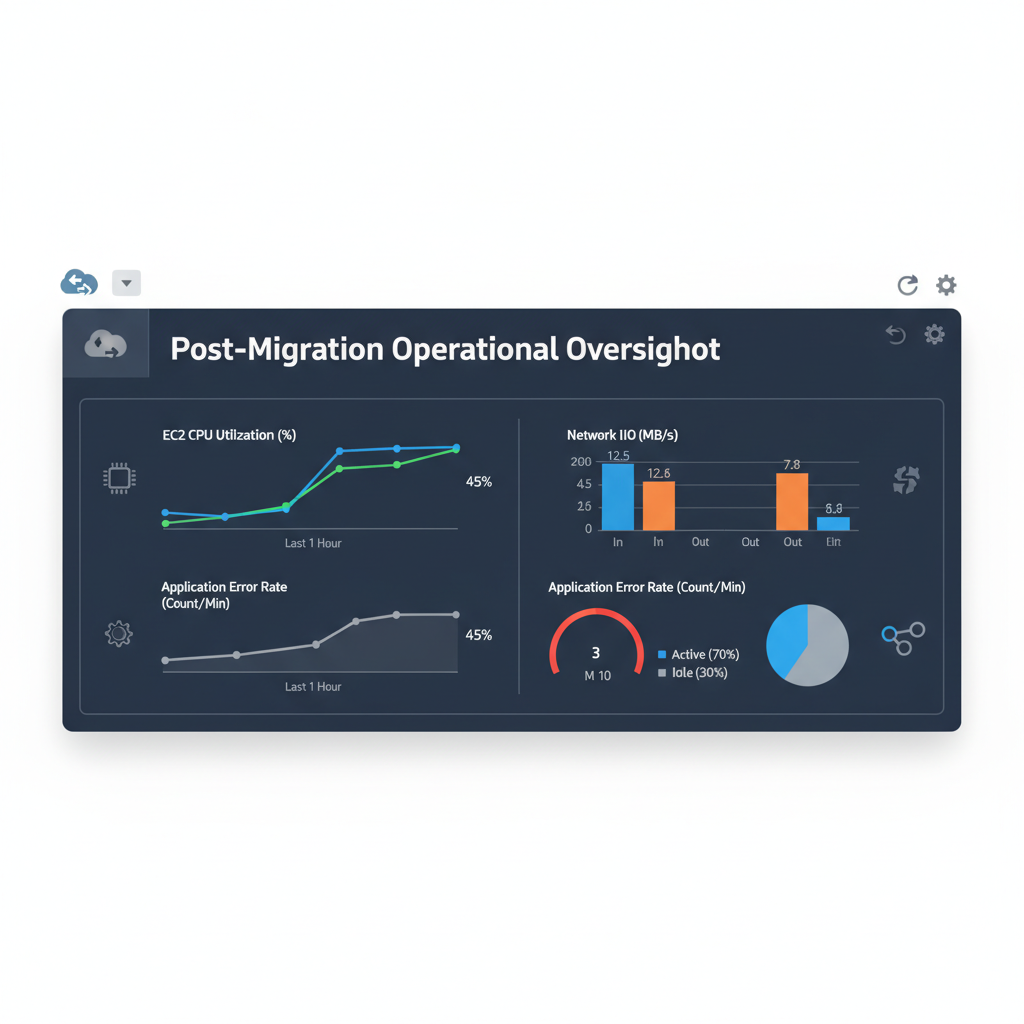
A screenshot of the AWS Management Console showing the CloudWatch dashboard with various monitoring metrics like CPU utilization, network I/O, and error rates, illustrating operational oversight post-migration.
✓ Free consultation ✓ No commitment required ✓ Trusted by experts
Conclusion
Undertaking an enterprise aws migration is a monumental but highly rewarding journey. It demands meticulous planning, strategic execution, and a commitment to continuous optimization. By following a structured approach, such as the one outlined in this enterprise aws migration guide, organizations can navigate the complexities of corporate cloud adoption effectively.
The benefits of a successful enterprise aws migration extend beyond technical efficiencies, driving profound business transformation, fostering innovation, and enhancing competitive advantage. Embrace this journey with a clear enterprise cloud strategy, a focus on organizational change, and a dedication to continuous improvement to unlock the full potential of the cloud.
Johan Carlsson is a cloud architecture specialist and frequent speaker focused on scalable workloads, AI/ML, and IoT innovation. At Opsio, he helps organizations harness cutting-edge technology, automation, and purpose-built services to drive efficiency and achieve sustainable growth. Johan is known for enabling enterprises to gain a competitive advantage by transforming complex technical challenges into powerful, future-ready cloud solutions.