Mastering Large Scale AWS Migration: Your Step-by-Step Strategy
March 11, 2026|2:30 PM
Unlock Your Digital Potential
Whether it’s IT operations, cloud migration, or AI-driven innovation – let’s explore how we can support your success.
Home /
Work /
Blogs /
Mastering Large Scale AWS Migration: Your Step-by-Step Strategy
Introduction to Large Scale AWS Migration Success
Embarking on a large scale AWS migration represents a pivotal strategic move for many organizations aiming to modernize their infrastructure and enhance operational agility. This complex undertaking involves moving substantial IT assets, applications, and data from on-premises data centers or other cloud environments to Amazon Web Services (AWS). It’s more than just a technical task; it’s a transformative journey requiring meticulous planning, robust execution, and a clear understanding of cloud capabilities.
This guide provides a comprehensive roadmap for navigating the intricacies of a successful large scale AWS migration. We will delve into the essential phases, address common challenges, and outline best practices to ensure a smooth transition. Our aim is to equip you with the knowledge needed for an efficient and impactful enterprise migration.
Why Undertake a Large Scale AWS Migration?
The decision to pursue a large scale AWS migration is often driven by a multitude of strategic imperatives. Organizations seek to escape the limitations and costs associated with maintaining traditional on-premises infrastructure. A full data center exit can free up significant capital and operational resources.
Moving to AWS provides access to a vast array of scalable, secure, and cost-effective services. This transformation empowers businesses to innovate faster, improve resilience, and achieve greater operational efficiency. It enables a shift from capital expenditure to a more flexible operational expenditure model.
Benefits of Cloud Migration
Migrating to AWS unlocks numerous advantages that directly impact business performance and innovation. Scalability is a primary benefit, allowing resources to be provisioned or de-provisioned on demand. This agility ensures that infrastructure can flex with fluctuating business needs.
Cost optimization is another significant driver, as AWS’s pay-as-you-go model and extensive cost management tools help reduce total cost of ownership. Enhanced security, improved performance, and global reach also stand out as compelling reasons for cloud adoption. AWS invests heavily in security measures, often exceeding what individual organizations can achieve on their own.
Common Challenges in Large Scale Migrations
Despite the clear benefits, large scale AWS migrations are not without their complexities. Managing interdependencies between applications, dealing with legacy systems, and ensuring data integrity across high volume migration are significant hurdles. These complex environments demand careful planning and strategic execution.
Security and compliance requirements also pose considerable challenges, particularly for regulated industries. Organizations must navigate data sovereignty, privacy regulations, and robust access controls. Overcoming these obstacles requires a structured approach and deep technical expertise.
The Phases of a Successful Large Scale AWS Migration
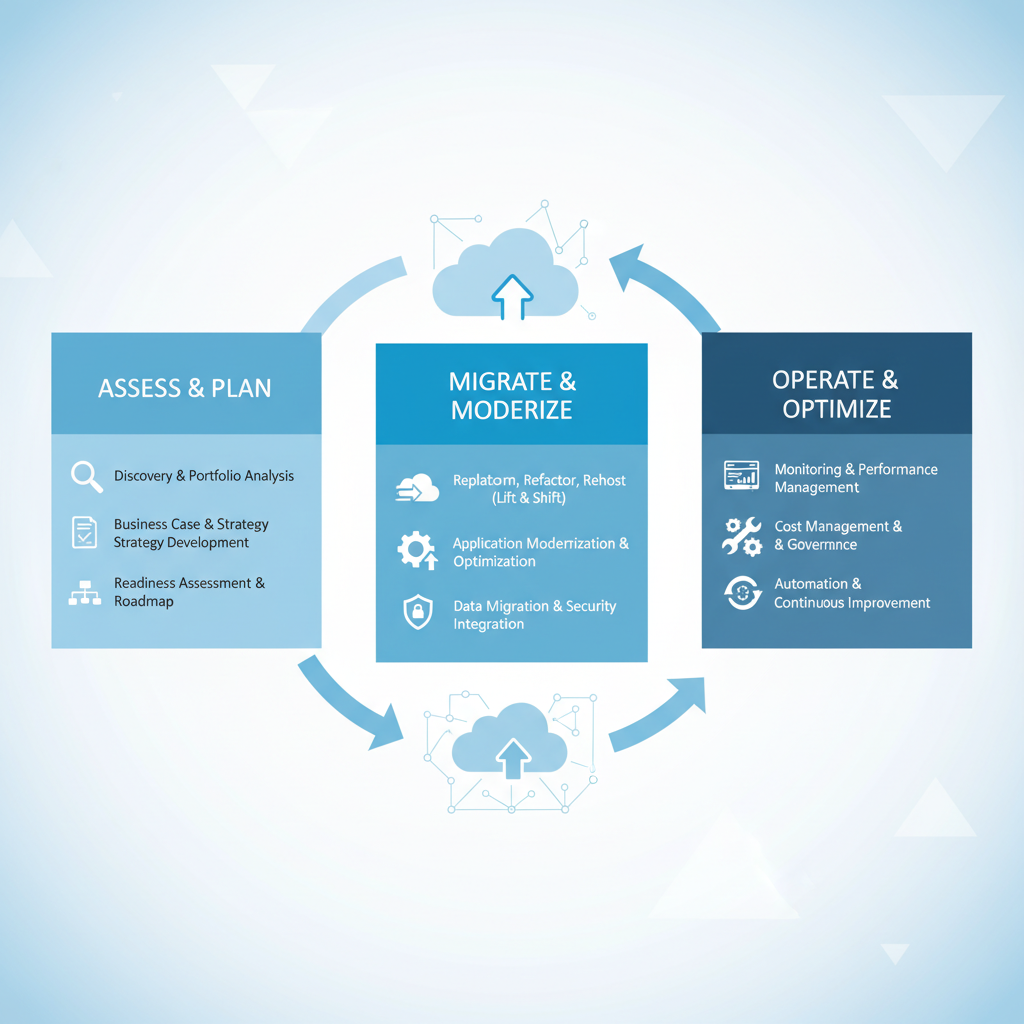
A well-executed large scale AWS migration typically follows a structured, phased approach. This systematic methodology breaks down the immense task into manageable stages, ensuring thoroughness and minimizing disruption. Adhering to these phases is crucial for a successful enterprise migration. This large scale aws migration guide emphasizes careful progression through each stage.
A detailed infographic illustrating the three main phases of cloud migration: Assess & Plan, Migrate & Modernize, and Operate & Optimize, with key activities listed under each phase.
Phase 1: Assessment and Planning
The initial phase is foundational, setting the stage for the entire migration journey. It involves a deep dive into your existing IT landscape to understand what needs to be moved and how. This comprehensive assessment is critical for developing a realistic and effective migration strategy. Without it, later stages can encounter unexpected roadblocks.
#### Discovery and Portfolio Analysis
This step focuses on gaining a comprehensive inventory of your IT assets, including applications, servers, databases, storage, and network configurations. Understanding application interdependencies and resource utilization is paramount. Tools can automate much of this discovery process, providing critical insights into your current environment.
Analyzing the portfolio helps categorize applications based on their criticality, complexity, and migration readiness. This analysis informs prioritization and helps identify potential quick wins alongside more challenging components. It’s the first step in crafting a robust large scale aws migration plan.
#### Business Case and Strategy Development
Developing a clear business case involves quantifying the expected benefits and costs of the migration. This includes identifying potential cost savings, improved operational efficiency, and new business capabilities. A strong business case gains executive buy-in and provides a clear North Star for the project.
The migration strategy outlines the overall approach, including timelines, resource allocation, and target architecture on AWS. It defines the “why” and “what” of the migration, guiding subsequent decisions. This critical step sets the strategic direction for your enterprise migration.
#### AWS Landing Zone Setup
An AWS Landing Zone provides a secure, multi-account AWS environment with pre-configured networking, security, and governance. It establishes a solid foundation for your cloud presence, ensuring compliance and best practices from the outset. This setup is crucial for managing scale and security for mass migration.
Setting up the landing zone involves defining account structure, identity and access management (IAM), network topology, and security services. It ensures that all future migrations land in a well-governed, compliant, and scalable environment. This proactive step prevents significant rework later on.
Phase 2: Migration Planning and Execution
With a solid plan in place, this phase focuses on the actual movement of applications and data to AWS. This is where the rubber meets the road, and the chosen migration strategies come into play. Effective execution is key to realizing the benefits outlined in the planning phase.
#### Migration Strategy Selection (6 Rs)
AWS outlines six common migration strategies, often referred to as the “6 Rs”: Rehost, Replatform, Refactor, Repurchase, Retire, and Retain. Each strategy offers different levels of effort, cost, and cloud-native benefits. The best large scale aws migration approach often involves a combination of these.
Rehost (Lift-and-Shift): Moving applications as-is to AWS. This is often the fastest strategy for high volume migration.
Replatform (Lift-and-Reshape): Moving applications to AWS while making some cloud-native optimizations, like migrating from self-managed databases to AWS RDS.
Refactor/Rearchitect: Reworking applications to fully leverage cloud-native features and services. This offers the most long-term benefits but requires significant development effort.
Repurchase: Switching to a different product, typically a SaaS solution.
Retire: Decommissioning applications that are no longer needed.
Retain: Keeping some applications on-premises due to specific constraints or lack of business justification for migration.
Selecting the appropriate strategy for each application ensures alignment with business goals and technical feasibility. A phased approach allows for iteration and learning.
#### Data Migration
Migrating data is often one of the most challenging aspects of a large scale aws migration. It requires careful planning to ensure data integrity, minimize downtime, and manage large volumes efficiently. Various AWS services, like AWS DataSync, AWS Snowball, and AWS Database Migration Service (DMS), facilitate this process.
Considerations include data volume, network bandwidth, data sensitivity, and the required cutover window. Strategies can range from online migrations with continuous replication to offline transfers for massive datasets. Proper validation post-migration is essential to confirm data accuracy.
#### Application Migration
Once data is handled, applications are moved based on the chosen 6 Rs strategy. This step involves configuring the application environment on AWS, installing dependencies, and integrating with other services. Automation tools are crucial here for efficiency and consistency in complex environments.
Testing is paramount during application migration to ensure functionality, performance, and security in the new AWS environment. This stage requires close collaboration between migration teams, application owners, and business stakeholders. Iterative migrations using a phased approach can reduce risk.
Phase 3: Validation and Optimization
The final phase ensures that the migrated environment meets all requirements and performs optimally. It also looks beyond the migration itself to continuous improvement and modernization. This stage is vital for realizing the full value of your hyperscale migration.
#### Testing and Validation
Comprehensive testing is non-negotiable before going live. This includes functional testing, performance testing, security testing, and user acceptance testing (UAT). Validate that applications perform as expected and integrate correctly with all dependent systems. Testing should simulate real-world usage patterns.
This step also involves validating data integrity and accessibility post-migration. Any issues identified during testing must be thoroughly addressed and retested. A robust testing plan minimizes post-cutover surprises, enhancing trust in the new environment.
#### Cutover and Post-Migration Activities
The cutover is the moment applications switch from the old environment to the new AWS environment. This critical event requires precise coordination and a well-rehearsed plan to minimize downtime. A rollback plan should always be in place as a contingency.
Post-cutover, ongoing monitoring is essential to ensure stability and performance. Addressing any immediate issues and gathering user feedback are crucial in the days and weeks following the switch. This marks the formal completion of the initial migration effort.
#### Optimization and Modernization
Migration is not the end goal; it’s the beginning of continuous improvement. This stage focuses on optimizing costs, performance, and security within AWS. Leveraging cloud-native services like serverless functions, containers, and managed databases can further enhance efficiency and agility.
Regular architectural reviews, cost analysis, and security audits help maintain an optimized cloud footprint. This ongoing process ensures that your large scale aws migration continues to deliver value and supports future innovation. It’s an iterative journey towards cloud excellence.
✓ Free consultation ✓ No commitment required ✓ Trusted by experts
Key Considerations for Complex Environments
When dealing with complex environments, certain factors require heightened attention throughout the large scale AWS migration process. These considerations can significantly impact the success and security of your mass migration. Proactive planning for these areas is vital.
Security and Compliance
Security is a shared responsibility in AWS, with AWS managing the security of the cloud and the customer responsible for security in the cloud. Establishing robust security controls, adhering to compliance frameworks, and implementing identity and access management are paramount. This involves configuring security groups, network ACLs, WAF, and logging.
For enterprise migration, meeting regulatory requirements (e.g., GDPR, HIPAA, PCI DSS) is non-negotiable. This requires a deep understanding of compliance mandates and how to implement them effectively within AWS services. Regular security audits and vulnerability assessments are also essential.
Network Connectivity and Bandwidth
Ensuring robust and low-latency network connectivity between your on-premises data centers and AWS is critical, especially during the migration phase and for hybrid architectures. AWS Direct Connect provides dedicated network connections, offering more consistent network performance than internet-based VPNs.
Adequate bandwidth is crucial for data transfer, particularly for high volume migration. Planning for network capacity helps avoid bottlenecks and delays. Consider the implications of network architecture on application performance and user experience.
Organizational Change Management
A large scale AWS migration is not just a technical project; it’s a significant organizational change. Resistance to change, skill gaps, and fear of the unknown can impede progress. Effective communication, training, and stakeholder engagement are crucial for success.
Investing in upskilling your teams to manage and operate in the AWS cloud is vital. Fostering a cloud-first culture helps ensure long-term adoption and utilization of cloud benefits. This holistic approach addresses the human element of transformation.
Professional visual illustration related to large scale aws migration
Best Practices for High Volume Migration
Executing a high volume migration demands efficiency, consistency, and intelligent resource utilization. Several best practices can streamline the process and mitigate risks for any large scale aws migration. These tips focus on leveraging automation and a structured approach.
Automation and Tooling
Automation is indispensable for mass migration. AWS Migration Hub, AWS Application Migration Service (MGN), and third-party tools can automate discovery, replication, and cutover processes. Automation reduces manual effort, minimizes human error, and accelerates migration timelines.
Scripting common tasks, using Infrastructure as Code (IaC) with tools like AWS CloudFormation or Terraform, ensures consistency and repeatability. This is particularly valuable when migrating numerous similar workloads. Leveraging automation is a cornerstone of the best large scale aws migration strategies.
Prioritization and Phased Approach
Not all applications can or should be migrated simultaneously. A phased approach, starting with less critical applications or those easier to move, allows teams to gain experience and refine processes. This reduces overall risk and builds confidence.
Prioritization should be based on factors like business criticality, technical complexity, interdependencies, and potential for immediate business value. Grouping applications into migration waves helps manage complexity and maintain momentum. This structured methodology is a core component of successful large scale aws migration tips.
Monitoring and Governance
Post-migration, robust monitoring and governance are essential to maintain performance, security, and cost efficiency. AWS CloudWatch, AWS X-Ray, and AWS Config provide visibility into your cloud environment. Setting up alerts and dashboards ensures proactive issue resolution.
Implementing a strong governance framework, including cost management policies, security baselines, and operational runbooks, is critical for long-term success. Regular audits and reviews help enforce these policies and identify areas for improvement. This ensures the cloud environment remains optimized and compliant.
Ensuring Trustworthiness and Security
Trustworthiness and security are paramount concerns in any hyperscale migration, especially for sensitive data and critical applications. AWS provides a secure global infrastructure, but customers must implement their own security measures within that framework. Addressing security comprehensively builds confidence and mitigates risks.
Data Protection Strategies
Implementing robust data protection strategies is a fundamental aspect of cloud security. This includes encryption of data at rest and in transit using AWS Key Management Service (KMS) or customer-managed keys. Regular backups and disaster recovery plans are also vital to ensure data availability and resilience.
Data sovereignty requirements must be carefully considered, ensuring data resides in appropriate AWS regions. Implementing data loss prevention (DLP) measures further safeguards sensitive information. These strategies are crucial for maintaining data integrity during a large scale aws migration.
Identity and Access Management
AWS Identity and Access Management (IAM) is foundational for controlling who can do what within your AWS environment. Implementing the principle of least privilege, multi-factor authentication (MFA), and strong password policies are critical. Managing access effectively prevents unauthorized actions and reduces the attack surface.
Integrating AWS IAM with existing enterprise identity providers ensures a consistent and manageable access control framework. Regular reviews of IAM policies and roles help maintain security hygiene. Proper IAM setup is essential for securing complex environments.
Compliance Frameworks
For many organizations, especially in regulated industries, adhering to specific compliance frameworks is mandatory. AWS offers services and certifications that align with various global and industry-specific compliance standards (e.g., ISO 27001, SOC 1/2/3, PCI DSS, HIPAA). Understanding shared responsibility helps clarify compliance obligations.
Utilizing AWS services like AWS Config, AWS Security Hub, and AWS Audit Manager can help automate compliance checks and generate audit reports. Documenting compliance efforts and architectural decisions is also critical for demonstrating adherence to regulatory bodies. This comprehensive approach to compliance reinforces trustworthiness.
Frequently Asked Questions
This section addresses common inquiries about large scale AWS migration, providing concise answers to key concerns. Understanding these points is crucial for anyone planning or executing an enterprise migration.
What is a large scale AWS migration?
A large scale AWS migration involves moving a significant number of applications, databases, and IT infrastructure from on-premises data centers or other cloud environments to Amazon Web Services. This typically encompasses hundreds or thousands of servers and vast amounts of data, representing a substantial transformation for an organization. It’s often referred to as a mass migration or data center exit.
Why is a phased approach recommended for large scale AWS migration?
A phased approach is recommended for large scale AWS migration to reduce risk, allow for continuous learning, and maintain business continuity. Migrating in smaller, manageable waves enables teams to refine processes, test thoroughly, and address issues incrementally, rather than attempting a high volume migration all at once. This strategy minimizes disruption and builds confidence over time.
What are the common challenges in an enterprise migration to AWS?
Common challenges in an enterprise migration to AWS include managing application interdependencies, dealing with legacy systems that may not be cloud-ready, ensuring data integrity during transfer, and addressing security and compliance requirements. Other hurdles include network bandwidth limitations, skill gaps within IT teams, and the organizational change management aspect. These complex environments require robust planning.
How does AWS help with security during a large scale migration?
AWS provides a highly secure global infrastructure and numerous services to aid security during a large scale migration. This includes services for identity and access management (IAM), network security (VPCs, Security Groups), data encryption (KMS), and logging and monitoring (CloudTrail, CloudWatch). AWS also adheres to various compliance certifications, which simplifies meeting regulatory requirements for customers.
What tools are essential for high volume migration to AWS?
Essential tools for a high volume migration to AWS include AWS Migration Hub for central tracking, AWS Application Migration Service (MGN) for server replication, and AWS Database Migration Service (DMS) for database migration. AWS DataSync facilitates large-scale data transfers, while services like AWS CloudFormation or Terraform enable Infrastructure as Code for automated provisioning. These tools streamline the process and enhance efficiency.
✓ Free consultation ✓ No commitment required ✓ Trusted by experts
Conclusion
Undertaking a large scale AWS migration is a significant undertaking that offers profound benefits, from enhanced agility and scalability to substantial cost savings. While the journey involves navigating complex environments and overcoming numerous challenges, a structured, phased approach combined with robust planning and the right tools can ensure success. This large scale aws migration guide has highlighted the critical steps and considerations for a smooth transition.
By focusing on assessment, strategic execution, and continuous optimization, organizations can unlock the full potential of the cloud. Embracing this transformation positions businesses for future innovation and sustained growth. The best large scale aws migration is a well-planned one, executed with precision and a clear vision for the future.
Fredrik Karlsson
- Chief Operating Officer (Group) & Chief Information Security Officer, Opsio
Fredrik Karlsson is the Group Chief Operating Officer and Chief Information Security Officer at Opsio in Sweden. With extensive experience in operations, governance, and information security, he focuses on aligning business objectives with risk management, compliance, and scalable IT operations. Fredrik works closely with leadership and delivery teams to ensure resilient, secure, and efficient cloud and hybrid technology environments.