Master Cloud SLA Monitoring: Your Essential Tutorial Guide
March 6, 2026|2:45 PM
Unlock Your Digital Potential
Whether it’s IT operations, cloud migration, or AI-driven innovation – let’s explore how we can support your success.
Home /
Work /
Blogs /
Master Cloud SLA Monitoring: Your Essential Tutorial Guide
Navigating the Cloud: Your Comprehensive Cloud SLA Monitoring Tutorial Guide
In today’s digital landscape, businesses increasingly rely on cloud services for critical operations. Ensuring these services meet agreed-upon performance standards is paramount for operational continuity and customer satisfaction. This comprehensive Cloud sla monitoring tutorial will guide you through the essential steps and best practices for effectively overseeing your cloud Service Level Agreements (SLAs). We aim to provide a practical SLA monitoring guide for beginners and experienced professionals alike.
Understanding and actively monitoring your cloud SLAs is not just a technical task; it’s a strategic imperative. This guide offers a detailed SLA monitoring walkthrough, covering everything from fundamental concepts to advanced implementation strategies. By the end, you will learn cloud SLA monitoring techniques that empower you to maintain high service quality and avoid costly disruptions.
Understanding Cloud Service Level Agreements (SLAs)
A Cloud Service Level Agreement (SLA) is a contractual agreement between a cloud service provider and a customer. It defines the minimum level of service the provider guarantees to deliver. These agreements are crucial for establishing expectations and accountability within a cloud environment.
SLAs typically cover aspects like uptime, performance metrics, data availability, and incident response times. They provide a measurable framework against which the service provider’s performance can be evaluated. Without clear SLAs, it becomes challenging to hold providers accountable for service disruptions or subpar performance.
Why Cloud SLA Monitoring is Crucial
Effective Cloud sla monitoring is essential for several key reasons, directly impacting business operations and user experience. It ensures that the cloud services you depend on consistently meet the performance standards outlined in your contracts. Proactive monitoring helps identify potential issues before they escalate into major outages.
By implementing robust SLA monitoring instructions, organizations can verify compliance with contractual obligations. This not only protects their interests but also helps in making informed decisions about cloud service providers. Regular monitoring provides the data needed for strategic planning and resource allocation.
Ensuring Business Continuity and Performance
Uninterrupted service delivery is vital for modern businesses. Cloud SLA monitoring directly contributes to business continuity by alerting teams to performance deviations in real-time. This allows for swift intervention, minimizing downtime and its associated financial losses.
Performance monitoring ensures that applications and services respond quickly and reliably, providing a seamless experience for end-users. Consistent performance helps maintain customer trust and satisfaction. It underpins the reliability of your entire digital infrastructure.
Cost Management and Resource Optimization
Monitoring cloud SLAs also plays a significant role in cost management. By understanding actual service usage and performance, businesses can identify areas where they might be overpaying for underutilized or underperforming resources. This detailed insight supports more efficient resource allocation.
It helps in renegotiating contracts with providers based on empirical data, ensuring you get the best value for your investment. Furthermore, avoiding costly downtime through proactive monitoring saves significant expenses related to recovery and lost revenue. Thus, this practical SLA monitoring guide supports both operational excellence and financial prudence.
Key Metrics to Monitor in Cloud SLAs
To effectively monitor cloud SLAs, it’s vital to focus on specific, measurable metrics that reflect service health and performance. These metrics vary depending on the type of cloud service, but several core categories are universally important. A comprehensive Cloud sla monitoring tutorial will always highlight these critical performance indicators.
Understanding what to monitor is the first step in setting up an effective monitoring system. It ensures that the data collected is relevant and actionable. This section will detail the most common and important metrics to track for your cloud services.
Uptime and Availability
Uptime refers to the percentage of time a service is operational and accessible. This is often expressed as “nines,” such as 99.9% or 99.999% availability. It is perhaps the most fundamental SLA metric, directly impacting business operations.
Availability ensures that users can access your applications and data when needed. Downtime, even for short periods, can lead to significant revenue loss and reputational damage. Continuous monitoring of uptime is paramount for any critical cloud service.
Performance metrics provide insight into how quickly and efficiently your cloud services are operating. Latency measures the delay before a transfer of data begins following an instruction. High latency can lead to sluggish application responsiveness.
Throughput measures the amount of data processed over a period. Low throughput indicates bottlenecks or capacity issues. Error rates track the percentage of failed requests or operations, signaling potential problems with the service or application logic.
Data Durability and Backup Success Rates
For storage services, data durability is a critical metric, indicating the likelihood of data loss over a specified period. Cloud providers often guarantee extremely high durability, for example, 99.999999999% (eleven nines). Monitoring this ensures your data remains intact.
Backup success rates verify that your data protection strategies are working as intended. Regular checks on backup completion and restorability are essential for disaster recovery planning. This safeguards against data corruption or accidental deletion.
Incident Response and Resolution Times
SLAs often include commitments regarding how quickly a provider will respond to and resolve reported incidents. Monitoring these metrics helps assess the provider’s efficiency in addressing issues. Fast resolution times minimize the impact of service disruptions.
Tracking Mean Time To Respond (MTTR) and Mean Time To Resolve (MTTR) for incidents provides valuable data. This ensures the provider adheres to their contractual promises regarding support and maintenance. Effective incident management is a hallmark of a reliable cloud provider.
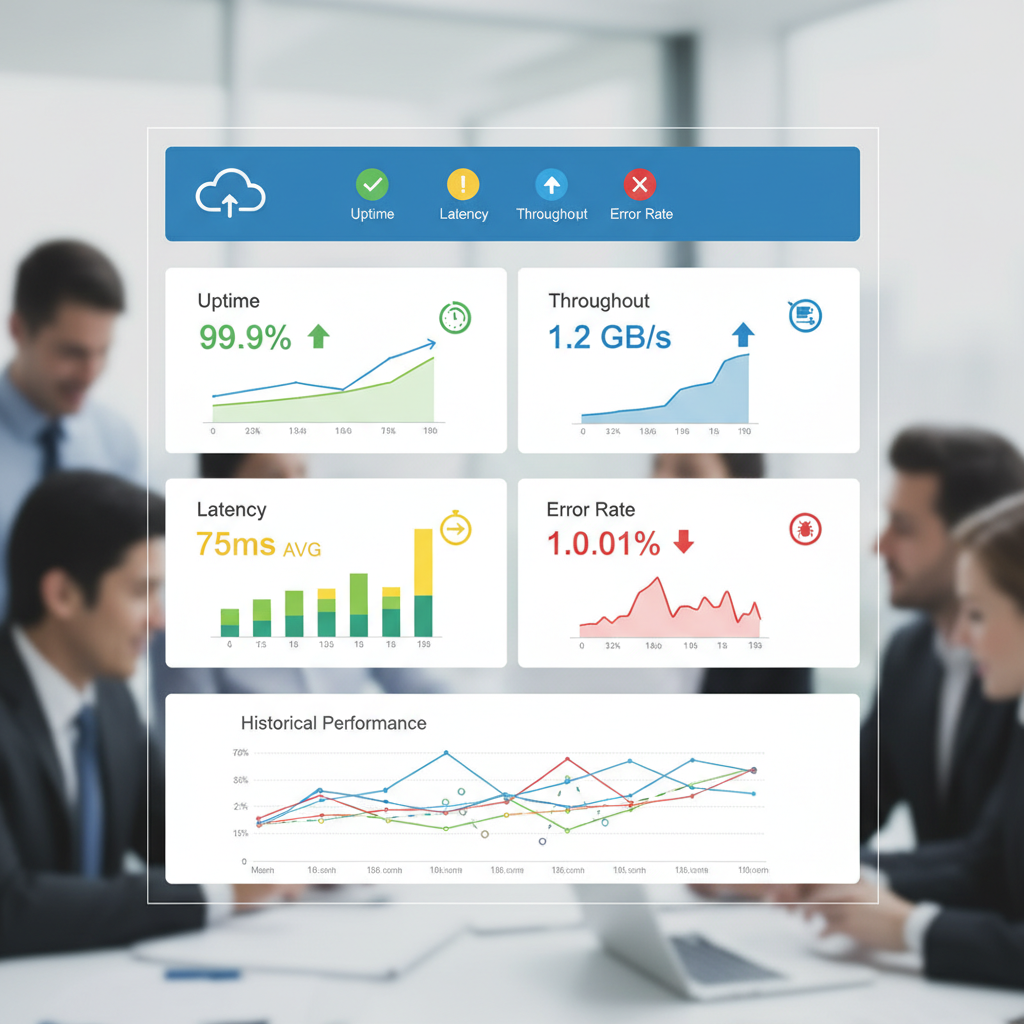
A dashboard displaying various cloud SLA monitoring metrics with graphs and charts for uptime, latency, throughput, and error rates, clearly showing status indicators.
ENSURE UNINTERRUPTED SERVICE
Ensure uninterrupted service delivery and proactively prevent costly SLA breaches. Leverage our automated, real
✓ Free consultation ✓ No commitment required ✓ Trusted by experts
Tools and Technologies for Cloud SLA Monitoring
Implementing effective Cloud sla monitoring requires the right set of tools and technologies. The market offers a wide array of solutions, ranging from native cloud provider tools to third-party platforms. Choosing the best Cloud sla monitoring tutorial involves understanding these options.
These tools automate the collection, analysis, and reporting of performance data. They also provide crucial alerting capabilities to notify teams of any deviations from SLA targets. Selecting the appropriate tool depends on your specific cloud environment, budget, and monitoring needs.
Native Cloud Provider Monitoring Tools
Major cloud providers like AWS, Azure, and Google Cloud offer their own robust monitoring suites. AWS CloudWatch, Azure Monitor, and Google Cloud Monitoring provide comprehensive visibility into their respective services. These tools are often deeply integrated with the cloud infrastructure.
They allow users to collect metrics, logs, and events directly from their cloud resources. This native integration simplifies setup and often provides the most granular data. However, they typically focus only on services within their specific cloud ecosystem.
Third-Party Monitoring Platforms
For multi-cloud environments or more specialized monitoring needs, third-party platforms offer a consolidated view across different providers. Solutions like Datadog, Dynatrace, New Relic, and AppDynamics provide end-to-end visibility. These platforms can integrate with various cloud services, on-premises infrastructure, and applications.
They often feature advanced analytics, AI-powered anomaly detection, and customizable dashboards. This allows for a more unified and sophisticated approach to SLA monitoring. These tools can be invaluable for gaining a holistic understanding of your entire IT estate.
Open-Source Solutions and Custom Scripts
For organizations with specific requirements or budget constraints, open-source tools like Prometheus, Grafana, and Zabbix offer powerful monitoring capabilities. These require more technical expertise for setup and maintenance but provide immense flexibility. They are highly customizable and can be tailored to unique monitoring scenarios.
Custom scripts, often combined with serverless functions, can also be used to perform specific checks and send alerts. While requiring development effort, this approach offers ultimate control over the monitoring process. This flexibility is a key Cloud sla monitoring tutorial tip for those with unique compliance needs.
Cloud sla monitoring tutorial: A Step-by-Step Guide
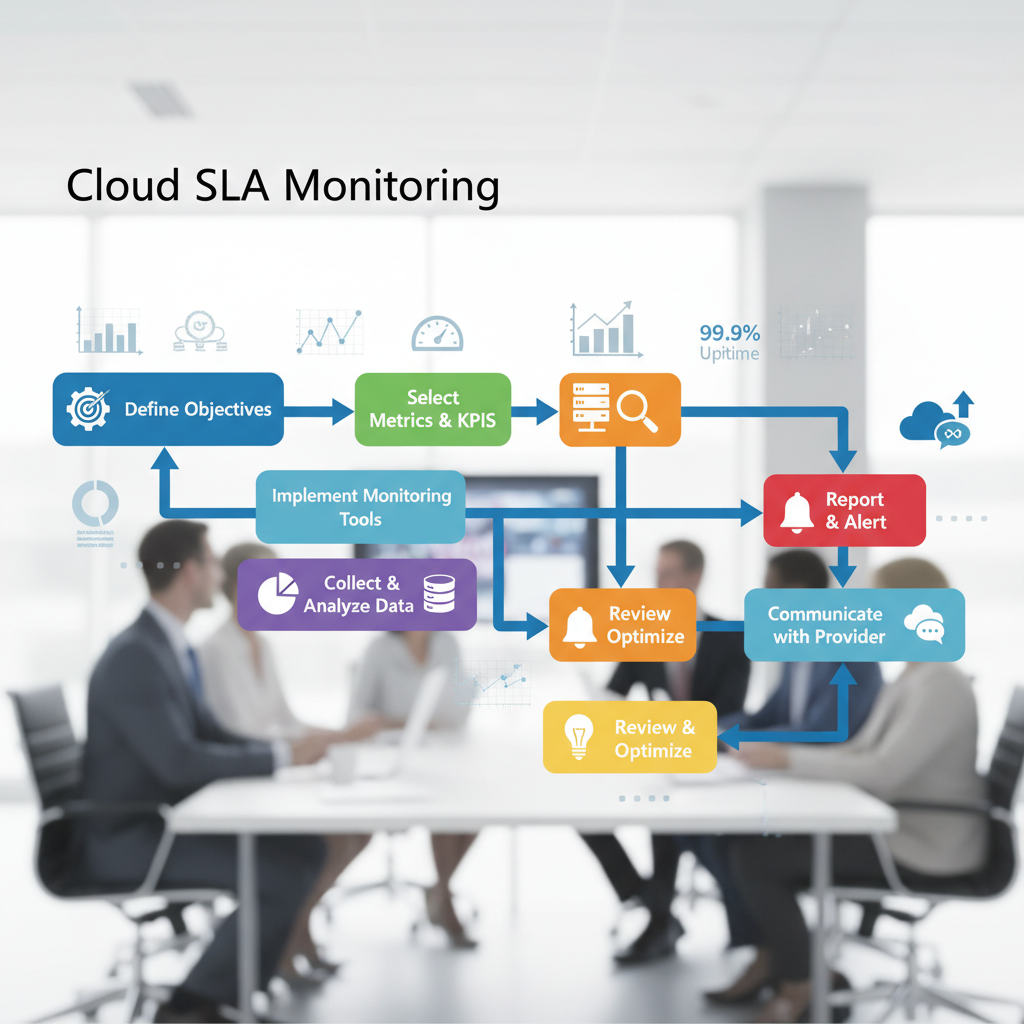
Embarking on a Cloud sla monitoring tutorial journey requires a structured approach. This section provides a comprehensive, step-by-step guide on how to set up SLA monitoring effectively. Following these SLA monitoring instructions will ensure you build a robust and reliable system.
This detailed process outlines the key phases from defining objectives to continuous optimization. Each step builds upon the previous one, creating a systematic framework for achieving your SLA compliance goals. This is the core of our beginners guide to cloud SLA.
Step 1: Define Your SLA Objectives and Metrics
Before implementing any monitoring solution, clearly define what “success” means for your cloud services. Review your existing cloud SLAs and identify the specific metrics and thresholds you need to track. This initial clarity is crucial for effective monitoring.
List the critical services, their associated performance indicators (e.g., uptime, latency, error rates), and the agreed-upon targets. For example, an objective might be “maintain 99.9% uptime for the primary web application.” This foundational step is often overlooked but is absolutely vital for any practical SLA monitoring guide.
Step 2: Choose the Right Monitoring Tools
Based on your defined objectives, existing cloud infrastructure, and budget, select the most appropriate monitoring tools. Consider whether native cloud tools suffice, if a third-party platform is needed for multi-cloud visibility, or if open-source solutions are more suitable. Evaluate ease of integration, features, and scalability.
Experiment with trial versions if available to ensure the chosen tool meets your technical requirements. The best Cloud sla monitoring tutorial strategy involves selecting tools that align perfectly with your operational context. This decision significantly impacts the efficiency and effectiveness of your monitoring efforts.
Step 3: Configure Monitoring Agents and Data Collection
Once tools are selected, proceed with configuring them to collect the necessary data. This typically involves deploying agents on virtual machines, configuring API integrations with cloud providers, or setting up synthetic monitoring checks. Ensure comprehensive coverage of all critical components.
Define which specific metrics (e.g., CPU utilization, network I/O, database queries) need to be collected at what frequency. Proper data collection is the backbone of any effective monitoring system. Without accurate data, insights will be flawed, making this a critical Cloud sla monitoring tutorial step.
Step 4: Set Up Alerting and Notification Systems
Effective monitoring isn’t just about collecting data; it’s about acting on it. Configure robust alerting rules based on your defined SLA thresholds. For instance, an alert might trigger if uptime drops below 99.9% or if database latency exceeds a certain millisecond threshold.
Integrate these alerts with your preferred notification channels, such as email, SMS, Slack, or PagerDuty. Ensure alerts reach the right teams promptly to enable quick response. Clear, actionable alerts are a hallmark of any successful Cloud sla monitoring tutorial examples.
Step 5: Implement Reporting and Analytics
Beyond real-time alerts, regular reporting and historical analytics are crucial for long-term SLA management. Configure dashboards that visualize key SLA metrics over time, showing trends and compliance status. This provides a clear overview of service performance.
Generate regular reports (daily, weekly, monthly) that summarize SLA compliance. These reports can be used for internal reviews, stakeholder communication, and discussions with your cloud provider. Analytics help identify recurring issues and areas for improvement.
Step 6: Regularly Review and Optimize
Cloud environments are dynamic, and so too should be your monitoring strategy. Regularly review your SLA objectives, metrics, and monitoring setup to ensure they remain relevant. As your applications evolve, new services are adopted, or SLAs are renegotiated, adjust your monitoring accordingly.
Analyze historical data and incident reports to identify patterns and refine your alerting thresholds. Optimize your monitoring tools for efficiency and cost-effectiveness. Continuous review and optimization are key to maintaining an adaptive and effective SLA monitoring system.
A flowchart illustrating the Cloud SLA monitoring process, from defining objectives to continuous optimization, with arrows indicating the flow between each step.
Best Practices for Effective Cloud SLA Monitoring
Achieving optimal Cloud sla monitoring goes beyond simply setting up tools; it requires adhering to certain best practices. These tips enhance the reliability, accuracy, and actionability of your monitoring efforts. Following these recommendations ensures you get the most out of your Cloud sla monitoring tutorial.
Implementing these practices fosters a proactive and efficient approach to managing cloud service performance. They help build a resilient infrastructure and maintain strong relationships with your cloud providers. These are essential for mastering the art of SLA monitoring.
Automate Monitoring and Alerting
Wherever possible, automate the collection of metrics, analysis, and the triggering of alerts. Manual checks are prone to human error and simply not scalable in dynamic cloud environments. Automation ensures consistent and timely data acquisition.
Automated alerts ensure that issues are detected and escalated immediately, reducing Mean Time To Detect (MTTD) and overall impact. This is a fundamental Cloud sla monitoring tutorial tip for efficiency. It frees up your team to focus on resolution rather than detection.
Establish Clear Communication Channels
When an SLA breach occurs, clear and predefined communication channels are vital. Ensure that relevant internal teams (operations, development, business stakeholders) and external parties (cloud providers) are notified appropriately. A communication plan minimizes confusion during critical events.
This includes defining who gets what information, when, and through which medium. Effective communication accelerates incident resolution and helps manage stakeholder expectations. It’s a critical component of any comprehensive SLA monitoring walkthrough.
Conduct Regular Audits and Reviews
Scheduled audits of your cloud services and their associated SLAs are crucial. Verify that your monitoring setup is still aligned with current agreements and business needs. Technology and contracts evolve, so your monitoring must too.
Review historical performance data to identify trends, persistent issues, or areas where SLAs are consistently exceeded or missed. These reviews provide valuable insights for contract renegotiation or service optimization. This practice helps to learn cloud SLA monitoring thoroughly.
Integrate with Incident Management Systems
For seamless incident resolution, integrate your SLA monitoring tools with your existing incident management systems. When an alert triggers an SLA breach, it should automatically create a ticket or incident in your system. This streamlines the response workflow.
This integration ensures that all incidents are tracked, assigned, and resolved according to established processes. It provides a single source of truth for incident data. This holistic approach is recommended by experts providing the best Cloud sla monitoring tutorial guidance.
Common Challenges and Solutions
Even with a detailed Cloud sla monitoring tutorial, organizations may encounter various challenges. Anticipating these hurdles and having prepared solutions is key to maintaining an effective monitoring strategy. This section addresses common difficulties in cloud SLA monitoring.
Understanding these potential pitfalls allows for proactive planning and mitigation. It helps ensure your monitoring system remains robust and reliable despite evolving complexities. These insights offer valuable Cloud sla monitoring tutorial tips for real-world scenarios.
Challenge: Data Overload and Alert Fatigue
Problem: Modern cloud environments generate vast amounts of data, leading to an overwhelming number of alerts. This can cause “alert fatigue,” where critical warnings are missed amidst the noise. It makes it difficult to discern true SLA breaches.
Solution: Implement intelligent filtering and aggregation for alerts. Utilize machine learning capabilities of advanced monitoring tools to identify true anomalies versus routine fluctuations. Refine alert thresholds to focus only on deviations that truly impact SLAs. Regularly review and tune your alerting rules to reduce false positives.
Challenge: Lack of Visibility in Multi-Cloud Environments
Problem: Managing applications and infrastructure across multiple cloud providers (e.g., AWS, Azure, Google Cloud) can create fragmented visibility. Each provider has its own monitoring tools, making it difficult to get a unified view of end-to-end service performance.
Solution: Adopt a centralized, third-party monitoring platform that offers multi-cloud integration capabilities. These platforms can consolidate data from various cloud sources into a single dashboard. This provides a holistic view, enabling effective SLA monitoring instructions across your entire distributed environment.
Challenge: Evolving SLAs and Dynamic Cloud Services
Problem: Cloud services and their associated SLAs are constantly evolving, with new features, updates, or changes in terms of service. Keeping monitoring configurations aligned with these dynamic changes can be a continuous challenge.
Solution: Establish a process for regularly reviewing and updating your monitoring configurations whenever cloud services or SLAs change. Automate as much of this process as possible. Maintain close communication with your cloud providers to stay informed about upcoming changes. A flexible monitoring architecture is a key element of any practical SLA monitoring guide.
Challenge: Proving SLA Breaches with Insufficient Data
Problem: In the event of an alleged SLA breach, collecting sufficient and undeniable evidence can be difficult if monitoring isn’t comprehensive or data isn’t properly stored. This weakens your position in discussions with providers.
Solution: Ensure your monitoring strategy collects detailed, time-stamped metrics and logs from all critical points. Implement robust data retention policies for historical performance data. This ensures you have irrefutable evidence to present when disputing service non-compliance. Detailed Cloud sla monitoring tutorial examples often highlight the importance of meticulous data collection.
Frequently Asked Questions
What is a Cloud SLA?
A Cloud Service Level Agreement (SLA) is a contractual agreement defining the guaranteed minimum performance and availability of a cloud service. It sets expectations between a cloud provider and its customer regarding service quality, uptime, and other key metrics. These agreements ensure accountability and provide a framework for service delivery.
Why is Cloud SLA monitoring important?
Cloud SLA monitoring is crucial for ensuring that cloud services meet agreed-upon performance standards, preventing service disruptions, and maintaining business continuity. It helps verify compliance with contractual obligations, optimizes costs by identifying underperforming resources, and provides data for informed decision-making. Proactive monitoring helps identify issues before they impact users.
What are common metrics monitored in Cloud SLAs?
Common metrics include uptime and availability (e.g., 99.9%), performance indicators like latency and throughput, error rates, and data durability for storage services. Incident response and resolution times are also frequently monitored. These metrics collectively provide a comprehensive view of service health and compliance.
Can I monitor Cloud SLAs manually?
While basic manual checks are possible for very small setups, manual Cloud sla monitoring is highly impractical and unreliable for most production environments. The dynamic nature and scale of cloud services necessitate automated monitoring tools. Manual processes are prone to errors, slow, and cannot provide real-time insights or comprehensive data collection.
How often should I review my Cloud SLA monitoring setup?
You should review your Cloud SLA monitoring setup regularly, ideally on a quarterly or semi-annual basis, and whenever there are significant changes to your cloud services or SLAs. This ensures that your monitoring strategy remains relevant, accurate, and aligned with evolving business needs and provider contracts. Continuous review and optimization are key.
ENSURE UNINTERRUPTED SERVICE
Ensure uninterrupted service delivery and proactively prevent costly SLA breaches. Leverage our automated, real
✓ Free consultation ✓ No commitment required ✓ Trusted by experts
Conclusion
Effective Cloud sla monitoring is indispensable for any organization leveraging cloud services. By following this detailed Cloud sla monitoring tutorial, you can establish a robust system to track, analyze, and ensure compliance with your service level agreements. From understanding key metrics to implementing best practices and addressing common challenges, the insights provided here empower you to maintain high service quality.
Proactive monitoring not only safeguards your business operations but also strengthens your relationship with cloud providers through clear performance accountability. Embrace these SLA monitoring instructions to build a resilient and high-performing cloud infrastructure. Start implementing these strategies today to secure your digital future.
Jacob Stålbro is a seasoned digitalization and transformation leader with over 20 years of experience, specializing in AI-driven innovation. As Head of Innovation and Co-Founder at Opsio, he drives the development of advanced AI, ML, and IoT solutions. Jacob is a sought-after speaker and webinar host known for translating emerging technologies into real business value and future-ready strategies.