Master Cloud SLA Monitoring: Your Essential Guide for 2026 Performance
March 6, 2026|2:42 PM
Unlock Your Digital Potential
Whether it’s IT operations, cloud migration, or AI-driven innovation – let’s explore how we can support your success.
Home /
Work /
Blogs /
Master Cloud SLA Monitoring: Your Essential Guide for 2026 Performance
Navigating the Cloud with Confidence: Your Cloud SLA Monitoring Guide in 2026
The rapid adoption of cloud services has transformed how businesses operate, offering unprecedented scalability and flexibility. However, relying on external providers also necessitates a clear understanding and validation of service level agreements (SLAs). This comprehensive Cloud sla monitoring guide will equip you with the knowledge and tools to effectively track and manage your cloud service performance in 2026, ensuring your digital infrastructure remains robust and reliable.
This definitive SLA monitoring guide provides a practical approach to understanding, implementing, and maintaining robust monitoring strategies. From outlining key metrics to discussing best practices, we cover everything you need to know for effective Cloud sla monitoring guide implementation. Understanding how to manage these agreements is crucial for operational excellence.
What is Cloud SLA Monitoring?
Cloud Service Level Agreement (SLA) monitoring involves systematically tracking the performance and availability of cloud services against the specific commitments outlined in a contract. These agreements legally bind cloud providers to deliver a certain standard of service, encompassing aspects like uptime, response times, and data security. Effective monitoring ensures that these critical commitments are consistently met, providing peace of mind for organizations.
It goes beyond simply checking if a service is “up”; it delves into the granular details of performance. This includes verifying latency, throughput, error rates, and the speed of incident resolution. For any organization leveraging the cloud, robust SLA monitoring is not just an option but a strategic imperative.
Why is Cloud SLA Monitoring Critical in 2026?
As cloud environments become increasingly complex and integral to business operations, the criticality of Cloud sla monitoring guide practices intensifies. In 2026, with hybrid and multi-cloud strategies becoming the norm, a proactive approach to SLA adherence is non-negotiable. This foresight helps prevent service disruptions and financial penalties.
Proper monitoring ensures that businesses can sustain their competitive edge and continue to innovate without unforeseen obstacles. It directly impacts customer satisfaction and operational efficiency. The landscape of cloud services is constantly evolving, making diligent tracking more important than ever.
Ensuring Business Continuity and Performance
Uninterrupted service delivery is paramount for modern businesses, where even brief outages can lead to significant revenue loss and reputational damage. Cloud SLA monitoring provides the visibility needed to detect potential issues before they impact end-users. It allows organizations to verify that cloud services consistently meet the performance benchmarks required for their critical applications.
By actively monitoring, businesses can identify bottlenecks, resolve problems swiftly, and maintain optimal operational efficiency. This proactive stance is essential for guaranteeing that crucial business processes remain stable and reliable. Ultimately, it secures the continuity of services that clients and internal teams depend on daily.
Meeting Compliance and Regulatory Standards
Many industries operate under strict regulatory frameworks that mandate specific data handling, security, and availability requirements. Financial services, healthcare, and government sectors, for instance, must demonstrate adherence to various standards. Cloud SLA monitoring provides the essential audit trails and performance data required to prove compliance.
It helps organizations ensure that their cloud providers also meet these stringent obligations, safeguarding sensitive information and operations. Failing to comply can result in severe legal penalties, hefty fines, and significant damage to an organization’s trust and standing. Therefore, a comprehensive Cloud sla monitoring guide must address these critical compliance aspects directly.
Optimizing Cloud Spend
Cloud services offer a pay-as-you-go model, but without proper oversight, costs can escalate rapidly. Effective SLA monitoring helps in ensuring that you are getting the value promised for your investment. It allows you to identify instances where services are underperforming or not meeting agreed-upon metrics, which can impact resource utilization.
If an SLA is consistently breached, it might indicate that the service is not delivering the expected performance for the price paid. This insight enables organizations to negotiate credits, switch providers, or re-evaluate their cloud architecture. Optimized spending through diligent monitoring ensures maximum return on investment.
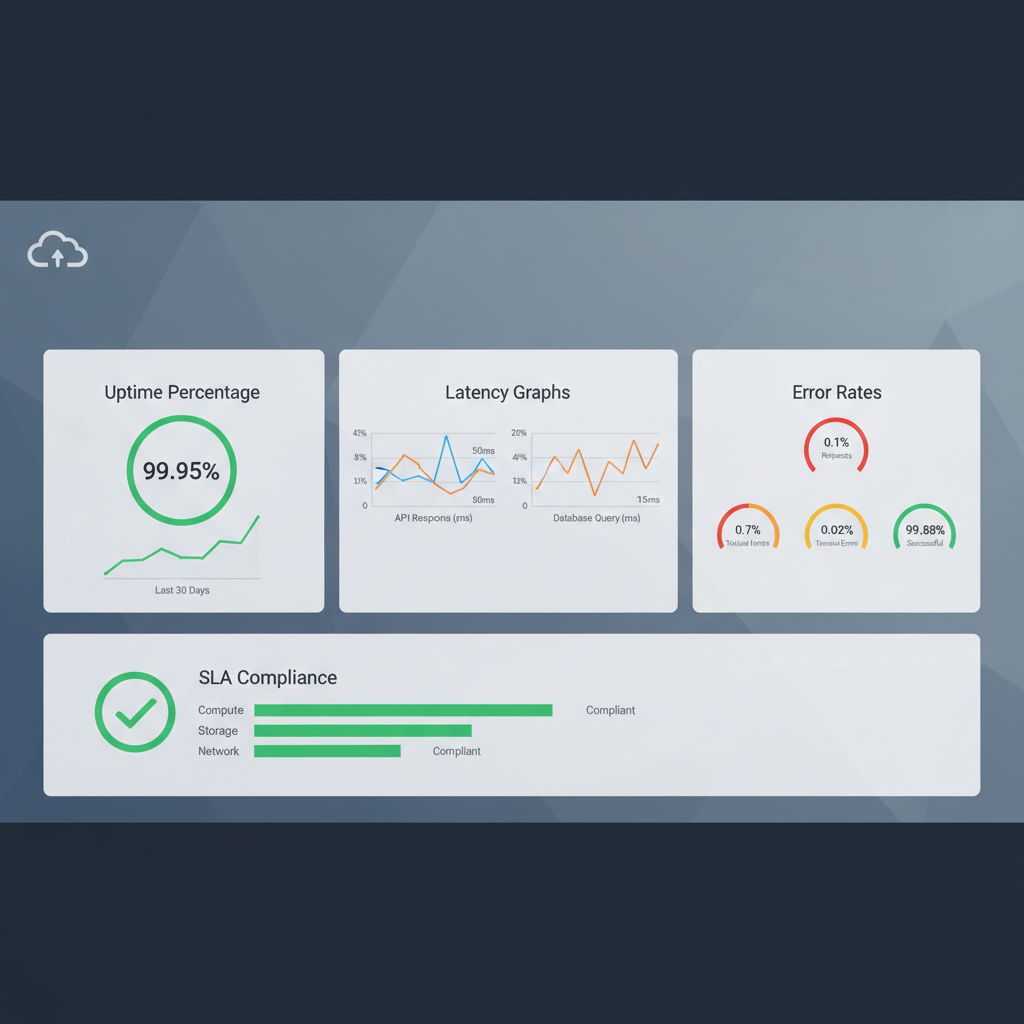
A dashboard displaying various cloud service metrics like uptime percentage, latency graphs, and error rates, with a green checkmark indicating SLA compliance.
ENSURE UNINTERRUPTED SERVICE
Ensure uninterrupted service delivery and proactively prevent costly SLA breaches. Leverage our automated, real
✓ Free consultation ✓ No commitment required ✓ Trusted by experts
Key Components of a Cloud SLA
A robust Cloud SLA typically encompasses several critical areas that define the expectations and responsibilities of both the service provider and the customer. Understanding these components is the first step in any effective SLA monitoring tutorial. Each element contributes to a complete guide to cloud performance.
Knowing what to look for and how to measure it is crucial for navigating your cloud journey successfully. This comprehensive overview will help you dissect your existing or future cloud contracts. It will also prepare you for thorough step-by-step SLA tracking.
Uptime and Availability Metrics
Uptime and availability are perhaps the most fundamental components of any cloud SLA, typically expressed as a percentage (e.g., 99.9% or 99.999%). This metric indicates the proportion of time a service is operational and accessible to users. Monitoring tools measure this by continuously pinging services and observing their responsiveness.
Downtime, conversely, is the period when the service is unavailable, and SLAs often specify what constitutes downtime and how it’s calculated. It’s crucial to understand whether scheduled maintenance is included or excluded from uptime calculations. Businesses must carefully track these percentages to confirm their operational reliability.
Performance and Latency Parameters
Beyond just being available, a cloud service must also perform adequately to be useful. SLAs often define specific performance metrics like latency (response time), throughput (data processed per unit of time), and error rates. These parameters directly impact user experience and application efficiency.
For example, a web application might have an SLA guaranteeing page load times under a certain threshold. Monitoring involves continuous measurement of these metrics from various geographical locations to ensure consistent performance. Deviations from these benchmarks can significantly impact business operations and customer satisfaction.
Data Security and Privacy Guarantees
While harder to quantify with a simple percentage, data security and privacy are non-negotiable components of a cloud SLA. These guarantees typically outline the provider’s responsibilities for protecting customer data from unauthorized access, loss, or corruption. They often refer to industry certifications (e.g., ISO 27001) and compliance with regulations like GDPR or HIPAA.
Monitoring for these aspects involves reviewing security audits, incident reports, and verifying the implementation of security controls. Although direct real-time monitoring can be challenging, a Cloud sla monitoring guide emphasizes scrutinizing security compliance reports and incident logs. Trust in data protection is paramount for any cloud service relationship.
Incident Response and Resolution Times
Even with the best planning, incidents can occur, and how quickly a cloud provider responds and resolves them is critical. SLAs typically specify maximum allowable times for incident acknowledgement, diagnosis, and resolution, often tiered by severity. These are vital for minimizing the impact of service disruptions.
Tracking involves logging incident reports, noting timestamps for each phase of resolution, and comparing them against the agreed-upon terms. This aspect of the SLA monitoring manual is crucial for understanding the true recovery capabilities of your provider. Prompt response is key to maintaining business continuity during unforeseen challenges.
A Step-by-Step Cloud SLA Monitoring Guide
Implementing an effective Cloud sla monitoring guide requires a structured approach. This how-to guide for cloud SLA monitoring breaks down the process into actionable steps, ensuring you cover all essential aspects. Following this step-by-step SLA tracking methodology will build a robust monitoring framework for your organization.
This comprehensive guide to cloud performance starts with defining your needs and extends to continuous optimization. Each step is designed to make your monitoring efforts systematic and impactful. You will gain a clear understanding of how to manage cloud service agreements effectively.
Step 1: Define Your Monitoring Objectives
Before diving into tools and metrics, clearly articulate what you aim to achieve with SLA monitoring. What critical business processes depend on your cloud services? What are the key performance indicators (KPIs) that directly impact your users or operations?
For example, your objectives might include ensuring 99.95% uptime for your e-commerce platform or maintaining database query response times under 100ms. Clearly outlining these objectives will guide your entire monitoring strategy and tool selection. Without specific goals, your monitoring efforts will lack direction.
Step 2: Understand Your Cloud Provider’s SLA
Thoroughly review the SLA document provided by your cloud service provider. Pay close attention to the definitions of uptime, downtime, performance metrics, and credit policies. Understand what is included and excluded from their guarantees.
Crucially, identify the specific metrics the provider promises and the remedies available for breaches. A detailed understanding of the Cloud sla monitoring guide from your provider’s perspective is vital for effective comparison. Discrepancies between your expectations and their commitments must be identified early.
Step 3: Select the Right Monitoring Tools
Choosing appropriate monitoring tools is a cornerstone of any effective SLA monitoring tutorial. Cloud providers often offer native monitoring solutions (e.g., AWS CloudWatch, Azure Monitor), but third-party tools (e.g., Datadog, Dynatrace, New Relic) provide multi-cloud visibility and advanced analytics. Evaluate tools based on their ability to collect relevant metrics, integrate with your cloud environment, and provide comprehensive dashboards.
Consider factors like cost, ease of use, and reporting capabilities. The best Cloud sla monitoring guide tools will offer real-time data, historical trends, and customizable alerts. This decision impacts your ability to perform effective step-by-step SLA tracking.
Step 4: Configure Monitoring Agents and Metrics
Once tools are selected, deploy monitoring agents or configure API integrations to collect data from your cloud services. Set up specific metrics to track, aligning them with your defined monitoring objectives. This might include CPU utilization, memory usage, network latency, application response times, and error rates.
Ensure data collection is consistent and covers all critical components of your cloud infrastructure. A well-configured monitoring setup is foundational for accurate data collection and subsequent analysis. This stage forms the backbone of a robust SLA monitoring manual.
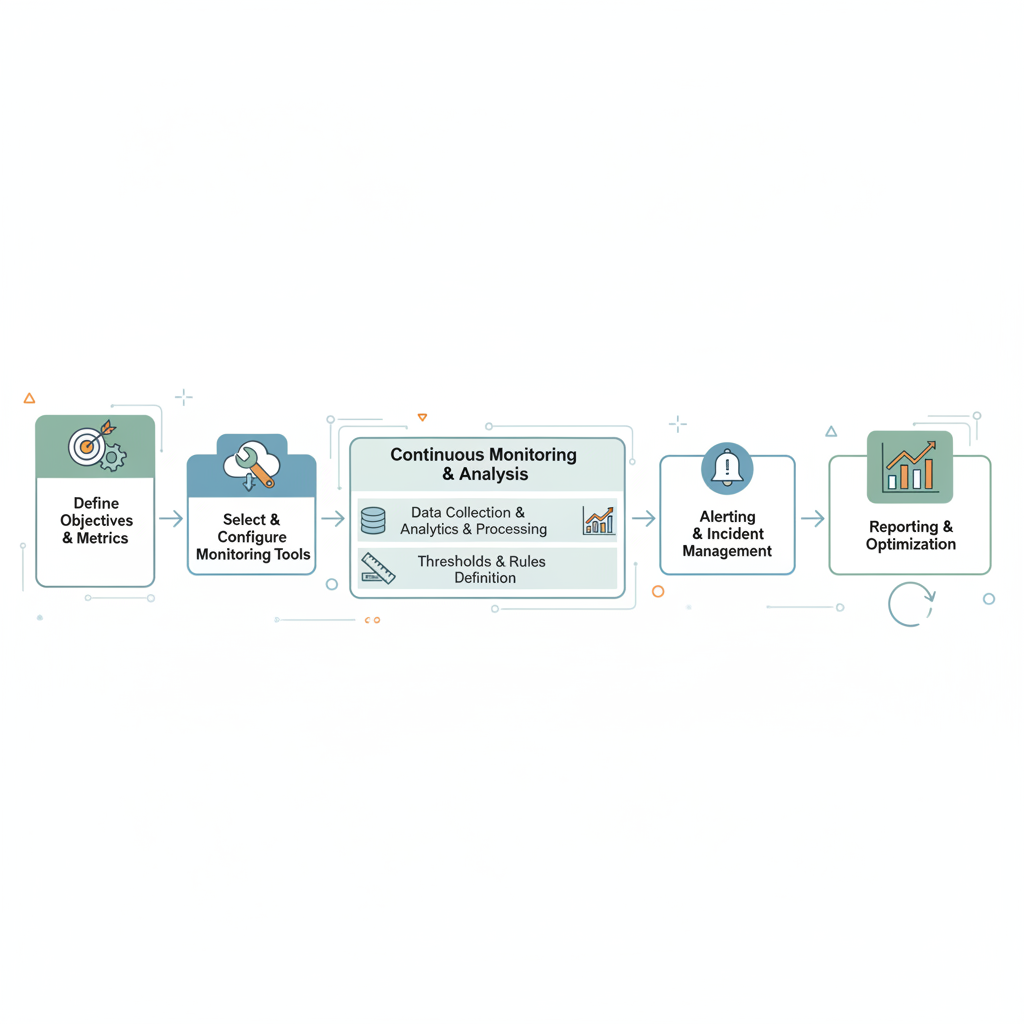
A flowchart illustrating the Cloud SLA monitoring process, starting from defining objectives, moving through tool selection and configuration, to alerting and reporting.
Step 5: Establish Alerting and Reporting Mechanisms
Effective monitoring isn’t just about collecting data; it’s about acting on it. Configure alerts to trigger when metrics deviate from established thresholds, indicating a potential SLA breach or performance degradation. Alerts should be routed to the appropriate teams (e.g., operations, development) via email, SMS, or integration with incident management systems.
Develop regular reporting that summarizes SLA performance, identifies trends, and highlights any breaches. These reports are crucial for internal stakeholders and for discussions with your cloud provider. They serve as tangible proof of service delivery for your Cloud sla monitoring guide guide.
Step 6: Regularly Review and Optimize
SLA monitoring is not a one-time setup but an ongoing process. Regularly review your monitoring objectives, tool configurations, and alert thresholds. As your cloud environment evolves and business needs change, your monitoring strategy must adapt accordingly.
Analyze performance data to identify long-term trends, anticipate potential issues, and optimize resource allocation. This continuous optimization loop ensures that your Cloud sla monitoring guide remains relevant and effective. It’s about refinement to achieve the best Cloud sla monitoring guide practices.
Best Practices for Effective Cloud SLA Monitoring
To truly master your Cloud sla monitoring guide, beyond the basic steps, adopting best practices is essential. These tips help you move from reactive observation to proactive management, ensuring your cloud investments consistently deliver. Implementing these practices enhances the efficiency and reliability of your cloud operations significantly.
They are designed to improve visibility, accelerate response times, and strengthen your relationship with cloud providers. These actionable insights build upon the core principles of the definitive SLA monitoring guide.
Proactive vs. Reactive Monitoring
Shift your focus from merely reacting to SLA breaches to proactively identifying and mitigating potential issues. Proactive monitoring involves setting up predictive alerts based on trends and patterns, allowing you to intervene before a full-blown incident occurs. Use historical data to forecast potential future performance degradations.
For example, if memory usage consistently spikes before an outage, set an alert for specific memory thresholds. Implement predictive analytics where possible to foresee potential problems and address them preemptively. This approach significantly reduces the impact of performance issues.
Centralized Monitoring Dashboards
Managing multiple cloud services and monitoring tools can quickly become overwhelming. Consolidate your monitoring data into centralized dashboards that provide a unified view of your entire cloud infrastructure’s performance against SLAs. These dashboards should display key metrics, alert statuses, and historical trends at a glance.
A single pane of glass simplifies troubleshooting and provides a holistic understanding of your service health. It enables quick identification of interdependencies and cascading failures. This centralized approach is a vital Cloud sla monitoring guide tip for complex environments.
Automating Responses to Breaches
For certain types of SLA breaches or performance degradations, consider automating remedial actions. This could involve automatically scaling up resources, restarting services, or escalating incidents to specific teams. Automation reduces human error and accelerates response times.
However, carefully design and test automated responses to prevent unintended consequences. Start with simple, low-risk automations and gradually expand as you gain confidence. Automation enhances the efficiency of your SLA monitoring manual significantly.
Real-World Cloud SLA Monitoring Examples
Understanding Cloud sla monitoring guide concepts is one thing, but seeing them in action provides valuable context. These examples illustrate how different organizations might apply a robust monitoring strategy to ensure their cloud services meet crucial business needs. They highlight the practical application of best Cloud sla monitoring guide principles.
These scenarios demonstrate the impact of effective step-by-step SLA tracking. They also underscore the importance of continuous vigilance in cloud environments.
E-commerce Platform Uptime
An online retail business relies heavily on its e-commerce website, hosted on a public cloud provider, for sales and customer engagement. Their SLA with the provider guarantees 99.99% uptime for the web servers and database. They configure monitoring tools to continuously check the availability of their website from multiple global locations.
If an outage occurs, alerts are immediately sent to the operations team, detailing the affected region and service. The monitoring system also tracks transaction success rates and page load times, ensuring not just availability but also optimal user experience. This comprehensive approach is a prime example of Cloud sla monitoring guide practices in action.
SaaS Application Performance
A Software-as-a-Service (SaaS) company provides a subscription-based productivity application to thousands of businesses worldwide. Their SLA with their cloud provider focuses on application response times for key features, database query performance, and the speed of data backups. They deploy application performance monitoring (APM) tools that track user experience metrics.
These tools trace individual user requests through various cloud services, identifying latency bottlenecks. If a specific API endpoint consistently exceeds its response time SLA, an alert is triggered, allowing developers to investigate and optimize. This proactive monitoring ensures customer satisfaction and adherence to service commitments, providing clear Cloud sla monitoring guide examples.
Frequently Asked Questions
This section addresses common queries regarding the Cloud sla monitoring guide, offering concise answers to help clarify key aspects.
What is the primary purpose of Cloud SLA monitoring?
The primary purpose of Cloud SLA monitoring is to ensure that cloud service providers adhere to the performance, availability, and security commitments outlined in their service level agreements. It provides crucial visibility into service delivery. This helps businesses verify they receive the expected value and maintain operational stability.
How do I choose the right metrics for SLA monitoring?
Choosing the right metrics involves identifying which aspects of cloud service performance directly impact your business operations and user experience. Focus on key indicators like uptime percentage, response times, throughput, error rates, and security compliance reports. Align these metrics with your specific business objectives and the details in your cloud provider’s SLA.
Can I use my cloud provider’s native monitoring tools?
Yes, cloud providers like AWS, Azure, and Google Cloud offer robust native monitoring tools (e.g., CloudWatch, Azure Monitor, Google Cloud Monitoring). These tools are often deeply integrated with their respective ecosystems and can be very effective. However, for multi-cloud or hybrid environments, third-party tools might offer more centralized visibility.
What happens if an SLA is breached?
If an SLA is breached, the specific consequences are typically detailed within the agreement itself. Common remedies include service credits (a reduction in your monthly bill), or in severe or persistent cases, the right to terminate the contract. It’s crucial to document breaches meticulously to claim any entitled compensation.
How often should I review my SLA monitoring strategy?
Your SLA monitoring strategy should not be a static document. It should be reviewed regularly, at least quarterly or whenever there are significant changes to your cloud architecture, business requirements, or cloud provider agreements. Continuous review ensures your monitoring remains relevant and effective.
ENSURE UNINTERRUPTED SERVICE
Ensure uninterrupted service delivery and proactively prevent costly SLA breaches. Leverage our automated, real
✓ Free consultation ✓ No commitment required ✓ Trusted by experts
Conclusion
Effective Cloud sla monitoring guide practices are indispensable for any organization leveraging cloud services in 2026. By understanding what constitutes an SLA, meticulously tracking performance, and implementing best practices, businesses can safeguard their operations, ensure compliance, and optimize their cloud investments. This complete guide to cloud performance equips you with the framework needed to confidently manage your cloud environment.
Embracing a proactive and systematic approach to Cloud sla monitoring guide principles will not only prevent costly disruptions but also foster a stronger, more transparent relationship with your cloud providers. Start implementing these steps today to enhance your digital resilience and achieve greater operational excellence.
Jacob Stålbro is a seasoned digitalization and transformation leader with over 20 years of experience, specializing in AI-driven innovation. As Head of Innovation and Co-Founder at Opsio, he drives the development of advanced AI, ML, and IoT solutions. Jacob is a sought-after speaker and webinar host known for translating emerging technologies into real business value and future-ready strategies.