Expert AWS Migration Solutions for Your Business Transformation
March 11, 2026|7:52 AM
Unlock Your Digital Potential
Whether it’s IT operations, cloud migration, or AI-driven innovation – let’s explore how we can support your success.
Home /
Work /
Blogs /
Expert AWS Migration Solutions for Your Business Transformation
Understanding aws migration solutions
Migrating existing infrastructure and applications to the cloud has become a strategic imperative for many organizations today. This comprehensive guide will delve into the world of aws migration solutions, providing you with the knowledge and steps needed for a successful journey. Understanding these solutions is the first step towards unlocking agility, scalability, and cost efficiency for your business.
aws migration solutions encompass a broad range of services, tools, and methodologies designed to help businesses move their IT workloads from on-premises data centers to Amazon Web Services (AWS) cloud. These offerings support various migration strategies, ensuring a tailored approach for different application types and business requirements. Successfully executing a cloud transformation can significantly enhance operational capabilities.
Moving to AWS offers numerous benefits, making it an attractive destination for workload migration. Organizations can leverage the global infrastructure to improve performance and disaster recovery capabilities. The pay-as-you-go model transforms capital expenditures into operational costs, optimizing budgets effectively.
Furthermore, AWS provides a vast ecosystem of integrated services, from computing and storage to advanced analytics and machine learning. This extensive offering allows businesses to innovate faster and scale operations seamlessly without the overhead of managing physical hardware. These benefits collectively drive the widespread adoption of cloud solutions.
However, cloud migration is not without its challenges. Complex dependencies, data sovereignty concerns, and potential downtime during the transition can pose significant hurdles. Addressing these proactively with a well-defined plan is crucial for a smooth and efficient migration process. Proper planning helps mitigate risks and ensures successful project outcomes.
Planning Your AWS Migration Journey
A successful migration to AWS begins with meticulous planning and a clear understanding of your current environment. This foundational phase involves a detailed assessment of your existing applications, infrastructure, and data. Identifying dependencies and performance requirements is critical for informing your overall migration strategies.
The assessment phase helps organizations gain clarity on what needs to be moved and how it should be optimized for the cloud. This includes cataloging all servers, applications, databases, and network components. Understanding their interconnections and usage patterns is vital for a smooth transition.
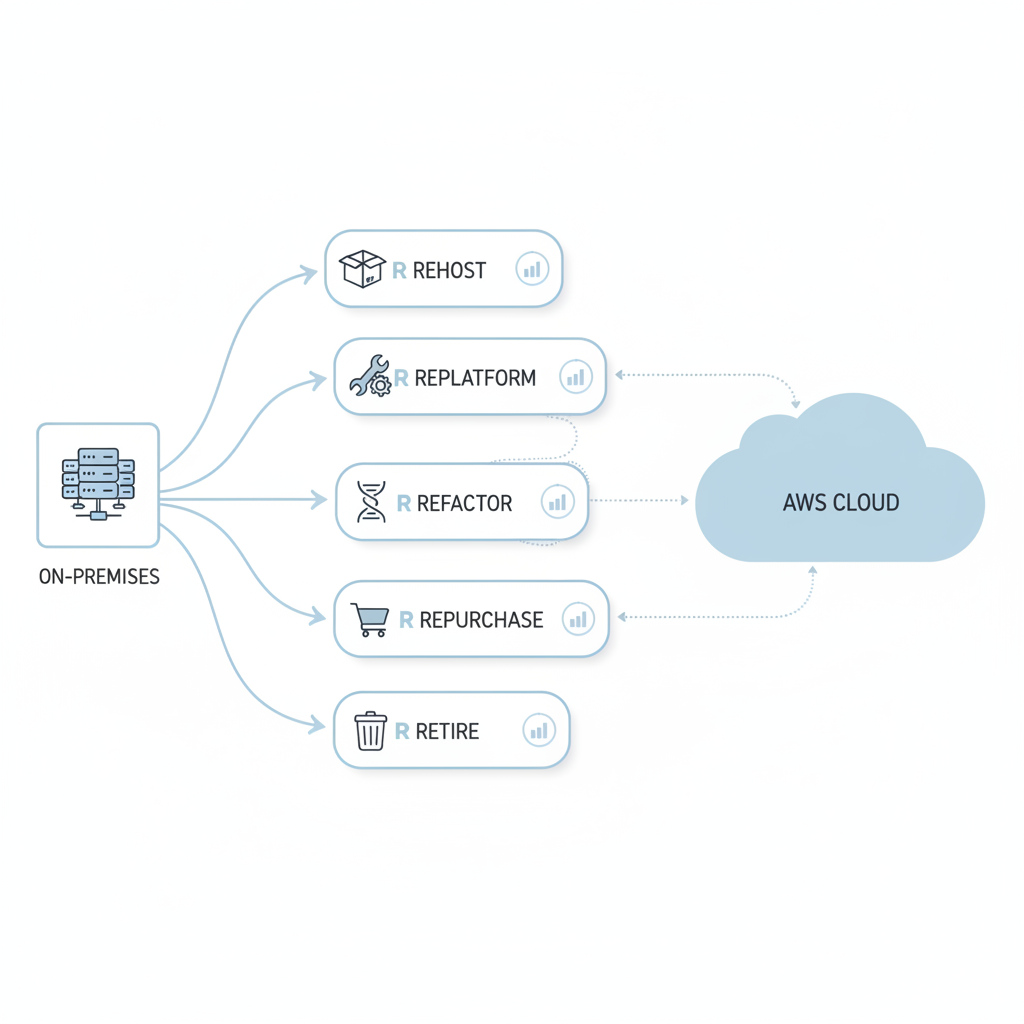
One of the most crucial aspects of planning is defining your migration strategy, often framed by the “6 R’s” model developed by AWS. Each ‘R’ represents a different approach to moving applications, offering flexibility based on business needs and technical complexity. Choosing the right strategy minimizes risk and maximizes cloud benefits.
Here are the 6 R’s for migration strategies:
Rehost (Lift-and-Shift): Moving applications as-is to AWS, often the fastest initial migration method. This strategy is ideal for quickly moving a large number of applications to the cloud.
Replatform (Lift-Tinker-and-Shift): Making minor cloud-native optimizations without changing the core architecture. This might involve updating to managed database services or containerizing applications for better scalability.
Refactor/Rearchitect: Reimagining how an application is architected and developed, typically leveraging cloud-native features fully. This option provides the most long-term benefits but requires significant investment.
Repurchase (Drop-and-Shop): Moving to a different product, typically a Software-as-a-Service (SaaS) offering. This approach often reduces operational overhead and simplifies management.
Retain: Deciding not to migrate some applications that are not critical, too complex, or are nearing end-of-life. These workloads remain in the on-premises environment for the foreseeable future.
Retire: Decommissioning applications that are no longer needed or used. This helps reduce clutter and unnecessary costs, streamlining the migration scope.
Building a robust migration plan also involves assembling the right team with the necessary skill sets. This team should include cloud architects, network engineers, database administrators, and security specialists. Effective communication and collaboration are paramount throughout the entire project lifecycle.
A flowchart illustrating the AWS 6 R’s migration strategies, showing arrows from on-premises to AWS cloud with each ‘R’ (Rehost, Replatform, Refactor, Repurchase, Retain, Retire) as a distinct path.
Exploring Different aws migration solutions
AWS provides a comprehensive suite of tools and services specifically designed to facilitate seamless migrations, supporting various types of workload migration. These integrated services cater to different migration needs, from moving databases to entire server fleets. Leveraging the best aws migration solutions can significantly streamline your cloud adoption.
AWS Migration Hub acts as a central location to track the progress of application migrations across multiple AWS and partner tools. It provides a single pane of glass to monitor the status of migrations and helps manage migration strategies effectively. This tool is invaluable for orchestrating complex migrations.
For database migrations, AWS Database Migration Service (DMS) is an incredibly powerful tool. It supports homogeneous migrations (e.g., Oracle to Oracle) as well as heterogeneous migrations (e.g., Oracle to Amazon Aurora). DMS minimizes downtime for databases by performing continuous data replication, ensuring business continuity during the transition.
When it comes to migrating servers and virtual machines, AWS offers Application Migration Service (AWS MGN), which is the primary service for lift-and-shift migrations. AWS MGN helps automate the migration of physical servers, virtual machines, and cloud instances to AWS. It ensures minimal downtime by using block-level replication, creating a replica of your source servers in your AWS account.
For large-scale data transfer, especially petabytes of data, AWS DataSync is an excellent service. DataSync simplifies, automates, and accelerates moving data between on-premises storage and AWS storage services like S3, EFS, or FSx. It handles security, encryption, and data integrity checks, making it a reliable solution for big data transfers.
The AWS Snow Family provides physical devices for transferring large amounts of data into and out of AWS. Services like AWS Snowball Edge and Snowmobile are perfect for situations where network bandwidth is limited or moving data over the internet is impractical. These are practical aws migration solutions tips for handling massive datasets.
✓ Free consultation ✓ No commitment required ✓ Trusted by experts
Executing Your AWS Migration
Executing an AWS migration involves a series of structured steps, ensuring that applications and data are moved securely and efficiently. This phase requires careful coordination and adherence to the plan developed earlier. Proper execution is key to realizing the benefits of cloud transformation.
Before initiating the actual migration, several pre-migration activities are essential. This includes setting up your AWS accounts, configuring virtual private clouds (VPCs), and establishing network connectivity between your on-premises environment and AWS. Implementing robust security measures from the outset is also paramount.
Step-by-step migration process for different workloads:
1. Prepare the Target Environment: Provision the necessary AWS resources, such as EC2 instances, RDS databases, and S3 buckets, according to your application requirements. Ensure network configurations, security groups, and IAM roles are correctly defined. 2. Replicate Data: Use tools like AWS DMS for databases or AWS MGN for servers to replicate data from your source environment to AWS. This replication happens continuously or in batches, depending on the tool and data type. 3. Test Applications: After data replication, perform thorough testing of applications in the AWS target environment. Validate functionality, performance, and integration with other services. This step is critical to identify and resolve any issues before the final cutover. 4. Perform Cutover: Once testing is complete and satisfactory, schedule a cutover window. During this period, direct traffic from the old on-premises environment to the newly migrated AWS environment. This might involve DNS changes or load balancer reconfigurations. 5. Decommission Source Environment: After a successful cutover and a stabilization period, you can decommission the legacy on-premises infrastructure. This frees up resources and reduces operational costs.
Thorough testing and validation are non-negotiable aspects of the execution phase. It involves more than just ensuring the application starts; it means verifying data integrity, performance under load, and adherence to security policies. Comprehensive testing minimizes post-migration issues.
Post-Migration Optimization and Management
Successfully migrating to AWS is not the end of the journey; it marks the beginning of continuous optimization and effective cloud management. Post-migration, organizations must focus on refining their cloud environment to maximize efficiency, security, and cost-effectiveness. This phase is crucial for long-term success with cloud solutions.
Cost optimization is a continuous process within AWS. This involves analyzing resource utilization, identifying idle or underutilized resources, and right-sizing instances based on actual needs. Leveraging Reserved Instances, Savings Plans, and Spot Instances can lead to significant cost reductions over time.
Performance tuning is another key aspect, ensuring applications run optimally in the cloud environment. This might involve optimizing database queries, improving application code, or scaling resources dynamically based on demand. Continuous monitoring helps identify performance bottlenecks proactively.
Implementing robust security best practices in the cloud is paramount. This includes regular security audits, enforcing least privilege access with IAM, utilizing AWS WAF for application security, and encrypting data at rest and in transit. A strong security posture protects your assets and data effectively.
For ongoing management, many organizations opt for managed services offered by AWS or third-party providers. Services like AWS Managed Services (AMS) provide operational excellence and reduce the burden of day-to-day cloud management. These services help maintain compliance and optimize operations.
Ongoing monitoring with tools like Amazon CloudWatch and AWS X-Ray helps maintain visibility into application and infrastructure health. These tools provide valuable insights into performance, errors, and resource utilization, enabling proactive issue resolution. Effective monitoring is a cornerstone of managed services in the cloud.
Best Practices for Successful aws migration solutions
Adhering to best practices is vital for navigating the complexities of cloud migration and ensuring a smooth cloud transformation. These aws migration solutions tips are drawn from extensive experience and help mitigate common pitfalls, contributing to the success of your project. Applying these principles will significantly enhance your migration outcomes.
1. Start Small, Iterate Often: Instead of attempting a massive, “big bang” migration, begin with a pilot project or a non-critical application. This allows your team to gain experience, refine processes, and learn from smaller iterations before tackling more complex workloads. This agile approach reduces risk and builds confidence.
2. Automate Wherever Possible: Manual processes are prone to errors and consume valuable time. Leverage AWS services like CloudFormation, AWS CDK, and third-party tools for infrastructure as code (IaC) to automate provisioning, configuration, and deployment. Automation accelerates migration and improves consistency.
3. Prioritize Security from Day One: Security should be an integral part of your migration strategy, not an afterthought. Implement security controls, define access policies, and encrypt data from the very beginning of your planning phase. This proactive approach ensures your cloud environment is secure by design.
4. Foster Internal Skill Development: Invest in training your team on AWS services and cloud best practices. Empowering your staff with cloud expertise reduces reliance on external consultants and builds internal capacity for future innovation and management. Continuous learning is essential for cloud transformation.
5. Data Governance and Compliance: Understand your data residency requirements and compliance obligations (e.g., GDPR, HIPAA). Design your AWS architecture to meet these standards, utilizing relevant AWS services and regions. Proper data governance is crucial for maintaining trust and avoiding penalties.
6. Create a Financial Governance Model: Establish clear cost management practices, including budgeting, forecasting, and cost allocation. Regularly review your AWS spending and implement optimization strategies. This ensures that the financial benefits of the cloud are fully realized and maintained.
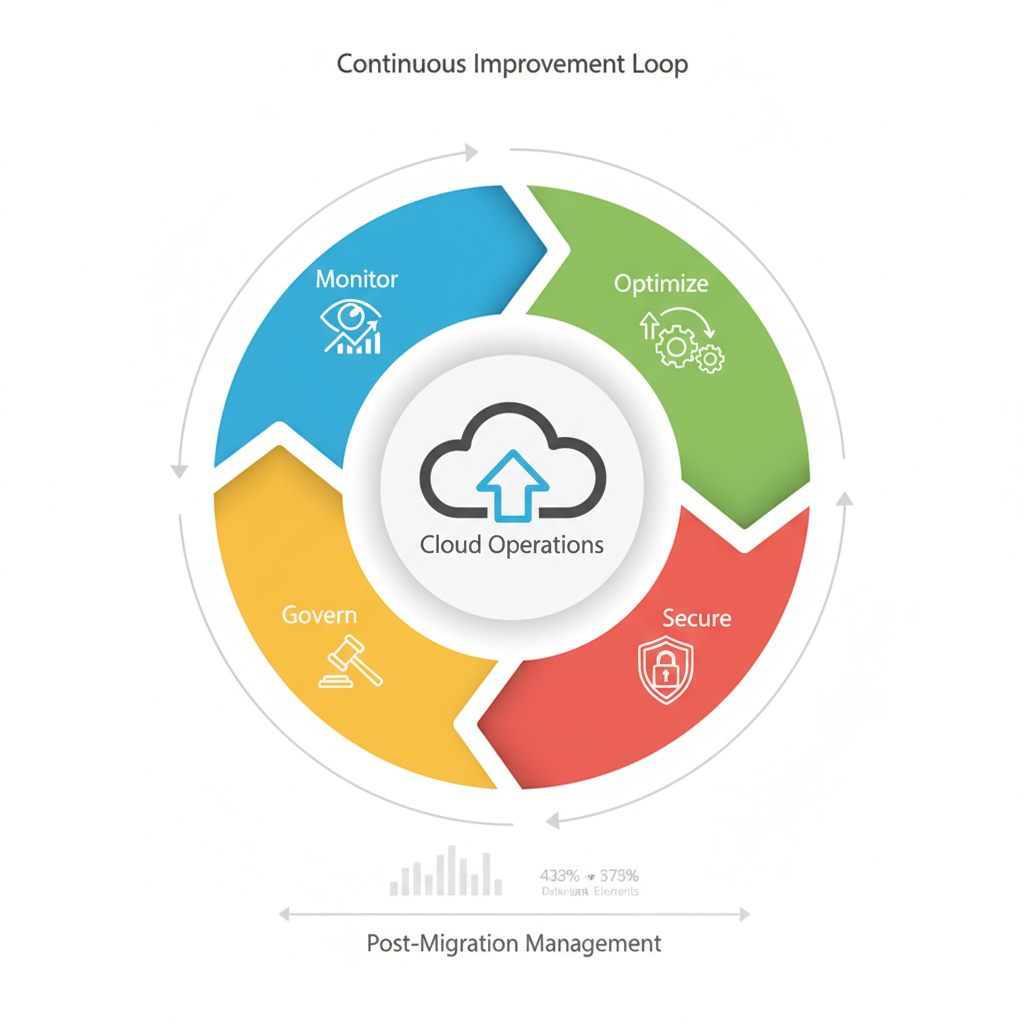
A diagram showing a cyclical process of continuous improvement for cloud operations, including stages like “Monitor,” “Optimize,” “Secure,” and “Govern” in a loop, emphasizing ongoing management post-migration.
Frequently Asked Questions
What are the typical phases of an AWS migration?
An AWS migration typically involves several distinct phases: Assessment, Planning, Migration Execution, and Post-Migration Optimization. The Assessment phase involves understanding the current environment and identifying migration candidates, while Planning defines the strategy and roadmaps. Execution focuses on moving workloads, and Optimization ensures the cloud environment is efficient and secure long-term.
How do I choose the right migration strategy for my applications?
Choosing the right migration strategy depends on various factors, including application complexity, business criticality, desired cloud benefits, and budget. AWS’s 6 R’s (Rehost, Replatform, Refactor, Repurchase, Retain, Retire) provide a framework. Rehost is often for quick wins, while Refactor offers the most cloud-native benefits for mission-critical applications. A thorough assessment helps align strategy with business goals.
What tools does AWS offer for migration?
AWS offers a robust suite of tools for various aspects of migration. Key services include AWS Application Migration Service (MGN) for server migration, AWS Database Migration Service (DMS) for databases, AWS DataSync for large-scale data transfer, and AWS Migration Hub for centralized tracking. The AWS Snow Family is also available for physical data transfer.
How can I minimize downtime during an AWS migration?
Minimizing downtime during an AWS migration is crucial for business continuity. Strategies include using continuous data replication services like AWS DMS and AWS MGN, which keep target environments synchronized with sources. Phased migrations, thorough testing in pre-production, and carefully planned cutover windows also help significantly reduce downtime.
Is AWS migration cost-effective in the long run?
Yes, AWS migration can be highly cost-effective in the long run. By moving from capital expenditures to an operational expenditure model, organizations can reduce upfront hardware costs. Additionally, the ability to right-size resources, leverage auto-scaling, and utilize cost optimization tools like Reserved Instances and Savings Plans often leads to substantial savings over time compared to on-premises solutions.
What are some common pitfalls to avoid during an AWS migration?
Common pitfalls include inadequate planning and assessment, underestimating the complexity of dependencies, neglecting security early on, and failing to train internal teams. It’s also critical to avoid a “lift-and-shift everything” mentality without considering cloud-native optimizations. Not having a robust cost management strategy post-migration can also lead to unexpected expenses.
✓ Free consultation ✓ No commitment required ✓ Trusted by experts
Conclusion
Embarking on a cloud migration journey with aws migration solutions offers a transformative opportunity for organizations to enhance agility, scalability, and operational efficiency. From careful planning and strategic tool selection to robust execution and continuous optimization, each phase plays a critical role in achieving a successful cloud transformation. By leveraging the comprehensive solutions provided by AWS and adhering to best practices, businesses can unlock the full potential of the cloud. This guide provides foundational knowledge and aws migration solutions tips for a smooth transition.
Johan Carlsson is a cloud architecture specialist and frequent speaker focused on scalable workloads, AI/ML, and IoT innovation. At Opsio, he helps organizations harness cutting-edge technology, automation, and purpose-built services to drive efficiency and achieve sustainable growth. Johan is known for enabling enterprises to gain a competitive advantage by transforming complex technical challenges into powerful, future-ready cloud solutions.