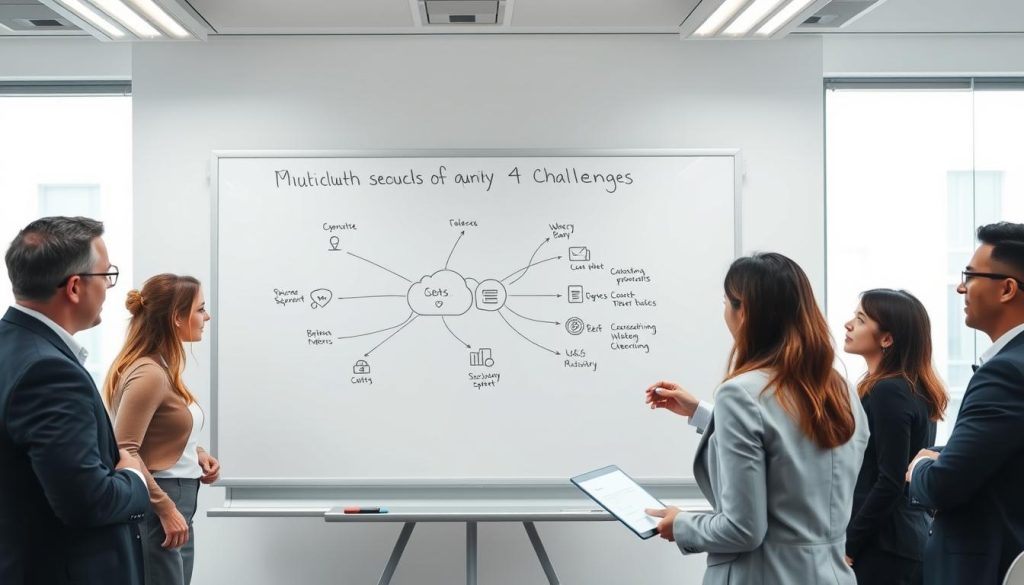
Most enterprises today run workloads across two or more clouds — and with that agility comes complexity. Choosing the wrong security mix can mean persistent misconfiguration, visibility gaps, compliance violations, and costly breaches. This guide provides a structured framework to evaluate and implement multi-cloud security solutions that align with your organization’s risk profile and operational needs.
The Rise of Multi-Cloud Adoption and Security Implications
Enterprises are embracing hybrid and multi-cloud models to optimize cost, avoid vendor lock-in, and match workloads to the best service. According to Flexera’s State of the Cloud Report, 78% of organizations are now operating in hybrid and multi-cloud environments, with 35% specifically adopting multi-cloud strategies. This shift brings significant benefits but also introduces new security challenges.
The multi-cloud approach creates a complex security landscape where teams must manage:
- Hybrid workloads spread across public clouds (AWS, Azure, Google Cloud) and private clouds
- Inconsistent security controls and configurations between providers
- Expanded attack surfaces with multiple management interfaces
- Fragmented visibility across disparate environments
- Complex compliance requirements that vary by cloud provider and region
Organizations need a structured approach to evaluate and implement security solutions that work effectively across this diverse landscape. This guide will help you navigate these challenges with practical, actionable strategies.
Key Goals of This Evaluation Guide
This comprehensive guide will equip you with:
- A framework to identify and prioritize multi-cloud security challenges specific to your organization
- Practical criteria for comparing multi-cloud security solutions and services
- Strategies to balance cloud-native controls with third-party security tools
- Methods to evaluate security tools through effective proof-of-concept testing
- Approaches to operationalize security across multiple cloud environments
Need Expert Guidance on Multi-Cloud Security?
Our security specialists can help you navigate the complexities of securing multiple cloud environments with a personalized assessment.
Schedule a Consultation
Who Should Use This Multi-Cloud Security Evaluation Guide
Security Leaders & CISOs
Responsible for overall security strategy and risk management across cloud environments. Need to align security investments with business objectives and compliance requirements.
Cloud Architects & Engineers
Tasked with designing and implementing secure cloud infrastructure. Need practical guidance on selecting and integrating security controls across platforms.
DevOps & Platform Teams
Focused on embedding security into CI/CD pipelines and operational workflows. Need solutions that balance security with development velocity.
Understanding Multi-Cloud Security Challenges
Common Multi-Cloud Security Challenges Organizations Face
Data Sprawl
As organizations distribute workloads across multiple clouds, data inevitably spreads across environments. This creates challenges in maintaining visibility, consistent protection, and compliance across all data locations.
Inconsistent Policy Enforcement
Each cloud provider implements security controls differently, making it difficult to maintain consistent security policies. What works in AWS may require a completely different approach in Azure or Google Cloud.
Identity Complexity
Managing identities, roles, and permissions across multiple cloud platforms creates significant complexity. Organizations struggle with privilege management, role proliferation, and maintaining least-privilege principles.
Visibility Gaps
Different monitoring tools, log formats, and alerting mechanisms across clouds create visibility gaps. Security teams often lack a unified view of threats and vulnerabilities across their entire cloud estate.
Configuration Drift
Maintaining consistent configurations across multiple environments is challenging. Manual changes, different IaC templates, and varying deployment processes lead to security drift over time.
Tool Fragmentation
Using separate security tools for each cloud environment creates operational overhead, alert fatigue, and potential security gaps at the boundaries between tools.
How These Challenges Increase Risk
According to IBM’s Cost of a Data Breach Report, cloud misconfigurations are among the most common root causes of data breaches, with an average cost of $4.5 million per incident. Multi-cloud environments amplify these risks through:
- Expanded attack surface when multiple cloud services and APIs are exposed
- Increased probability of configuration errors across diverse environments
- Complex compliance requirements that vary by provider and region
- Delayed detection and response due to fragmented visibility
- Skill gaps as teams struggle to maintain expertise across multiple platforms
Assess Your Multi-Cloud Security Posture
Our experts can help identify gaps in your current multi-cloud security approach and recommend targeted improvements.
Request an Assessment
Building a Multi-Cloud Security Strategy
Principles of an Effective Multi-Cloud Security Strategy
Centralized Governance with Decentralized Enforcement
Establish centralized security policies and standards while implementing enforcement mechanisms close to the workloads. This balances consistency with the need for cloud-specific controls.
Shared Security Controls
Leverage a combination of cloud-native and third-party security controls to create defense-in-depth. Native controls provide deep integration while cross-cloud tools ensure consistent coverage.
Least Privilege by Default
Implement strict identity and access controls that grant only the minimum permissions needed. Use time-bound access and just-in-time privilege elevation to reduce standing permissions.
Automation and Policy-as-Code
Codify security policies and automate their enforcement across environments. This ensures consistency, reduces manual errors, and enables security to scale with cloud adoption.
Visibility-First Approach
Prioritize comprehensive visibility across all cloud environments before implementing complex controls. You can’t secure what you can’t see.
Risk-Based Resource Allocation
Focus security resources on protecting the most critical assets and addressing the highest-risk scenarios first. Not all workloads require the same level of protection.
Policy, Identity, and Access Management Across Clouds
Identity and access management form the foundation of multi-cloud security. Implement these key strategies:
- Centralize authentication with a federated identity provider that works across all cloud platforms
- Implement consistent role-based access control (RBAC) frameworks across environments
- Enforce multi-factor authentication (MFA) for all administrative access
- Use short-lived credentials and just-in-time access to minimize standing privileges
- Implement policy-as-code using tools like Open Policy Agent or Cloud Custodian
- Regularly audit and prune unused roles and permissions
Comparing Multi-Cloud Security Solutions and Services
Categories of Multi-Cloud Security Solutions
| Solution Category |
Primary Function |
Key Capabilities |
Typical Deployment |
| Cloud-Native Controls |
Provider-specific security |
IAM, security groups, KMS, logging |
Per-cloud configuration |
| CASB (Cloud Access Security Broker) |
SaaS security and shadow IT control |
Data protection, access control, threat detection |
Proxy or API-based |
| CSPM (Cloud Security Posture Management) |
Configuration security |
Misconfiguration detection, compliance monitoring |
API-based scanning |
| CWPP (Cloud Workload Protection Platform) |
Workload security |
Runtime protection for VMs, containers, serverless |
Agent-based or agentless |
| SIEM / XDR |
Threat detection and response |
Log analysis, correlation, incident response |
Centralized platform |
| Network Security |
Network protection |
Firewalls, micro-segmentation, traffic analysis |
Virtual appliances or cloud-native |
Comparing Cloud Security Services: Criteria and Trade-offs
When evaluating multi-cloud security solutions, consider these key criteria:
Technical Criteria
- Cloud coverage (AWS, Azure, GCP, others)
- Service coverage within each cloud
- Detection accuracy and false positive rate
- Prevention capabilities vs. detection-only
- Automation and remediation options
- API availability and integration capabilities
- Performance impact and scalability
Business Criteria
- Total cost of ownership (licensing, operations)
- Implementation complexity and time-to-value
- Vendor support quality and availability
- Compliance certifications and reporting
- Vendor roadmap and innovation pace
- Vendor financial stability
- Contract flexibility and exit options
Get Expert Help Selecting the Right Multi-Cloud Security Solutions
Our security experts can help you evaluate options based on your specific environment and requirements.
Contact Our Team
Evaluation Framework and Decision Checklist
A Repeatable Framework to Compare Options
Use a weighted scoring model to objectively compare multi-cloud security solutions:
| Category |
Weight |
Scoring Criteria (0-5) |
| Coverage |
20% |
Breadth of cloud platforms and services supported |
| Detection |
20% |
Accuracy, comprehensiveness, and false positive rate |
| Policy Enforcement |
15% |
Ability to enforce policies and remediate issues |
| Automation |
15% |
Level of automation for detection and remediation |
| Integration |
10% |
Ease of integration with existing tools and workflows |
| Cost |
10% |
Total cost of ownership relative to value |
| Support |
10% |
Quality of vendor support and documentation |
Calculate the final score by multiplying each category’s score (0-5) by its weight and summing the results. Adjust weights based on your organization’s priorities.
Practical Decision Checklist Before Purchase or Deployment
Technical Validation
- Does the solution provide unified visibility across all target clouds?
- Can it enforce policies automatically, or is it detect-only?
- What integrations exist for your SIEM, ticketing, and CI/CD systems?
- How does it handle new cloud services and features?
- What is the performance impact on cloud resources?
Business Validation
- What is the onboarding time and expected tuning effort?
- What are the costs for data ingestion, API calls, and scaling?
- What SLAs and support levels are included?
- How does the vendor handle data residency and compliance?
- What is the exit strategy and data retention policy?
Quick Mitigation List for Immediate Threats
While evaluating long-term solutions, implement these high-impact controls immediately:
- Enforce MFA across all cloud accounts and administrative access
- Restrict inbound management ports and tighten security groups
- Scan for and close publicly accessible storage (S3, Blob) and databases
- Apply least privilege to service accounts and remove unused access keys
- Centralize logging and enable alerts for critical security events
- Use temporary access and session limits for cross-account roles
- Implement basic cloud security guardrails using native tools
Operationalizing and Managing Multi-Cloud Security
Implementing Controls and Automation at Scale
Scale your multi-cloud security through automation and integration:
CI/CD Integration
Embed security checks into your CI/CD pipelines to catch issues before deployment:
- Scan infrastructure-as-code (IaC) templates using tools like Checkov or Terraform Sentinel
- Validate container images for vulnerabilities before deployment
- Implement policy gates that block deployments with critical security issues
- Automate security testing as part of the build process
Policy Automation
Use policy-as-code to enforce consistent security across environments:
- Define policies in code using Open Policy Agent (OPA) or similar tools
- Implement automated remediation for common misconfigurations
- Use event-driven security to respond to changes in real-time
- Create self-service security guardrails for development teams
Ongoing Multi-Cloud Risk Management and Governance
Sustain risk management with structured governance processes:
- Establish a risk monitoring cadence (daily alerts, weekly reviews, quarterly assessments)
- Define key performance indicators (KPIs) for security effectiveness:
- Mean time to detect (MTTD) security issues
- Mean time to remediate (MTTR) vulnerabilities
- Percentage of workloads meeting compliance requirements
- Number of high-risk identities and permissions
- Maintain a cloud security steering committee with cross-functional representation
- Implement a formal exception process for security policy deviations
- Conduct regular security posture reviews across all cloud environments
Conclusion: Moving from Assessment to Secure Multi-Cloud Operations
Effective multi-cloud security requires a balanced approach that combines robust evaluation, strategic implementation, and ongoing management. By following the framework outlined in this guide, organizations can:
- Systematically identify and address multi-cloud security challenges
- Select the right mix of cloud-native and third-party security solutions
- Implement consistent security controls across diverse environments
- Automate security processes to scale with cloud adoption
- Maintain ongoing visibility and governance across all cloud platforms
Start by conducting a focused multi-cloud risk assessment of your critical workloads. Then pilot a CSPM solution integrated with your existing security monitoring to establish baseline visibility. From there, progressively implement additional controls based on your specific risk profile and operational requirements.
Remember that multi-cloud security is not a one-time project but an ongoing program that must evolve with your cloud strategy. The right combination of people, processes, and technology will enable you to realize the benefits of multi-cloud while keeping risks in check.
Start Your Multi-Cloud Security Evaluation Today
Our team can help you assess your current multi-cloud security posture and develop a roadmap for improvement.
Contact Us