Ensure Cloud SLA Compliance with Uptime Monitoring Strategies
March 6, 2026|2:18 PM
Unlock Your Digital Potential
Whether it’s IT operations, cloud migration, or AI-driven innovation – let’s explore how we can support your success.
Home /
Work /
Blogs /
Ensure Cloud SLA Compliance with Uptime Monitoring Strategies
Understanding uptime monitoring or Cloud sla monitoring: A Foundational Guide
In today’s interconnected digital landscape, the continuous availability and performance of online services are paramount. Businesses and users alike rely heavily on websites, applications, and cloud infrastructures functioning without interruption. This critical need drives the importance of robust monitoring strategies, particularly uptime monitoring or Cloud sla monitoring. Understanding these concepts is fundamental for maintaining operational excellence and ensuring user satisfaction.
This comprehensive guide will delve into the nuances of these vital monitoring practices. We will explore what each entails, highlight their distinctions, and illustrate how they collectively contribute to a resilient digital presence. By the end, you will have a clear picture of how to leverage these tools effectively.
What is Uptime Monitoring? Unpacking the Essentials
Uptime monitoring is the process of continuously checking the availability of an online service, such as a website, server, or application. Its primary goal is to determine if a service is accessible and functioning from an external perspective. Essentially, it answers the fundamental question: Is my service online and reachable?
This form of monitoring typically involves automated checks performed at regular intervals from various geographical locations. These checks simulate user requests to verify that the service responds as expected. If a service fails to respond, or responds with an error, an alert is triggered.
Key Aspects of Uptime Monitoring
Uptime monitoring focuses on the binary state of a service: up or down. It provides immediate notification of outages, allowing teams to react swiftly. This proactive approach minimizes downtime and its associated negative impacts.
Many uptime monitoring solutions offer detailed reports on service availability over time, often expressed as a percentage. These reports are crucial for understanding historical performance and identifying recurring issues. They help ensure consistent service delivery.
How Uptime Monitoring Works
Uptime monitors send requests to specific endpoints, such as HTTP/HTTPS requests to a website, ping requests to a server, or custom port checks. If the monitor receives a successful response within a defined timeframe, the service is considered up. Conversely, a timeout or error response indicates downtime.
Different protocols and checks can be configured based on the service being monitored. This flexibility ensures that various components of a digital infrastructure can be accurately assessed for availability. It provides a broad coverage of essential systems.
Exploring Cloud SLA Monitoring: Service Level Agreements in Action
Cloud SLA monitoring, or Service Level Agreement monitoring, extends beyond simple uptime checks to evaluate performance against predefined contractual obligations. SLAs are formal agreements between a service provider and a customer, outlining specific performance metrics, availability guarantees, and responsibilities. Cloud SLA monitoring specifically applies this to cloud-based services.
This type of monitoring assesses whether the actual performance of a cloud service aligns with the promises made in the SLA. It encompasses not just availability, but also performance metrics like response time, throughput, and error rates. It provides a holistic view of service quality.
Components of Cloud SLA Monitoring
Cloud SLA monitoring involves tracking various performance indicators relevant to the agreement. These might include latency, data transfer rates, and the success rate of API calls, in addition to raw uptime. The focus is on the quality of service delivered.
Alerts are generated not just for outages, but also when performance metrics fall below the agreed-upon thresholds. This allows for early intervention before service quality significantly degrades, helping maintain customer satisfaction. It ensures compliance with contractual terms.
The Role of SLAs in Cloud Computing
Service Level Agreements are critical in cloud environments, where services are often provided by third-party vendors. They establish clear expectations and provide a basis for accountability. Without robust SLA monitoring, it is challenging to verify if cloud providers are meeting their commitments.
Effective Cloud SLA monitoring ensures that businesses receive the value they expect from their cloud investments. It acts as a continuous audit of service provider performance, enabling informed decisions and fostering trust. This transparency is vital for long-term partnerships.
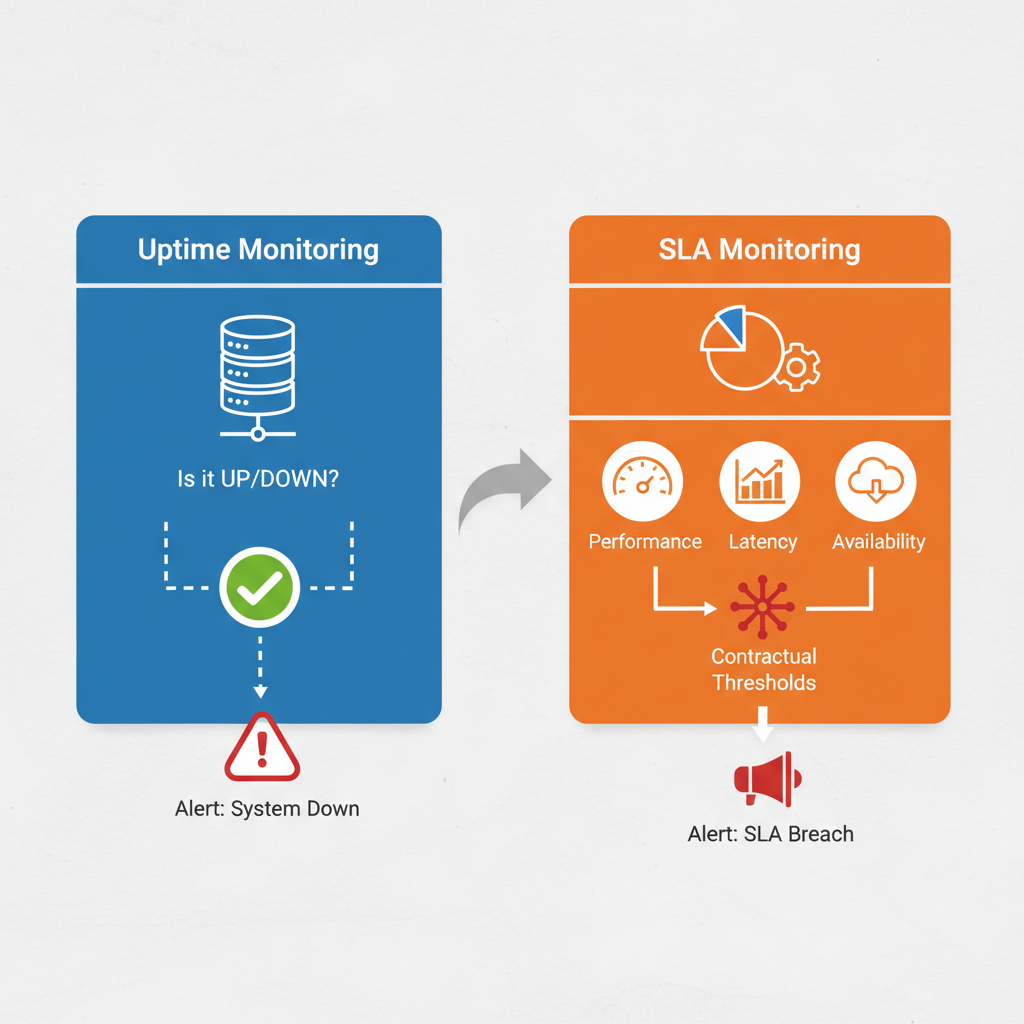
A diagram contrasting uptime monitoring with SLA monitoring, showing uptime as a binary check and SLA monitoring as a check against multiple performance metrics and contractual thresholds. Arrows show alerts for both scenarios.
uptime vs SLA monitoring: Pinpointing the Key Differences
While both uptime monitoring and Cloud SLA monitoring aim to ensure service reliability, their scope and focus differ significantly. Understanding the difference between uptime and SLA is crucial for implementing a comprehensive monitoring strategy. It’s not a matter of which is better: uptime or SLA, but rather how they complement each other.
Uptime monitoring provides a foundational check on basic accessibility. It’s the first line of defense, immediately flagging if a service is down. Its simplicity makes it universally applicable to any online resource.
Core Distinctions in Focus
Uptime monitoring primarily focuses on the “reachability” of a service. It answers yes/no questions about whether a website loads or a server responds. It’s about fundamental availability, indicating whether the service is alive.
Cloud SLA monitoring, conversely, delves into the “quality” of the service delivered against a contract. It measures specific performance metrics defined in an agreement. This includes factors beyond simple up/down status, like speed and efficiency.
Metrics and Triggers
For uptime monitoring, the key metric is binary availability (up or down) and the trigger is an unreachable service. An alert fires when the service stops responding. This keeps teams informed of critical outages.
Cloud SLA monitoring considers a wider array of metrics, such as response times, error rates, and resource utilization. Alerts are triggered when any of these metrics deviate from agreed-upon thresholds, even if the service is technically “up.” This addresses performance degradation.
Scope and Purpose
The scope of uptime monitoring is generally internal or proactive self-assessment. Its purpose is to quickly identify and respond to outages impacting direct access. It helps operational teams maintain immediate control.
Cloud SLA monitoring has a broader, often external, and contractual scope. Its purpose is to verify compliance with service provider agreements and ensure business continuity. It provides a basis for service level reporting and accountability.
ENSURE UNINTERRUPTED SERVICE
Ensure uninterrupted service delivery and proactively prevent costly SLA breaches. Leverage our automated, real
✓ Free consultation ✓ No commitment required ✓ Trusted by experts
Why Both Matter: The Synergy of Complementary Monitoring
Choosing between uptime vs SLA monitoring is often a false dilemma; true digital resilience requires both. They offer complementary monitoring: uptime and SLA together provide a complete picture of service health. One addresses basic availability, while the other ensures adherence to quality standards.
A service can be “up” but still perform poorly, failing to meet SLA targets. Conversely, an SLA can be met for certain metrics even if brief intermittent outages occur, which uptime monitoring would immediately catch. Both perspectives are invaluable.
Enhancing Network Uptime vs Service Level
Network uptime vs service level highlights this synergy perfectly. Uptime monitoring ensures the network infrastructure is physically reachable and responsive. It verifies basic connectivity and prevents total network outages.
Service level monitoring, especially in a cloud context, then assesses the performance over that network. It checks if applications running on the network are meeting their performance guarantees, even when the network itself is technically “up.” This covers both infrastructure and application layers.
Comprehensive Website Availability and SLA
For websites, website availability and SLA are intrinsically linked. Uptime monitoring confirms your website is accessible to users from different locations. It’s the first check that a user can even reach your site.
Cloud SLA monitoring then ensures that the user experience is satisfactory. It checks page load times, transaction success rates, and other critical performance indicators against agreed benchmarks. This provides a holistic view of user experience and business impact.
Best Practices for Implementing uptime monitoring or Cloud sla monitoring
Implementing an effective uptime monitoring or Cloud sla monitoring strategy requires careful planning and execution. Adhering to best practices ensures accuracy, relevance, and actionable insights. This uptime monitoring or Cloud sla monitoring guide outlines key considerations.
Start by clearly defining what you need to monitor for each service. Identify critical endpoints, expected performance thresholds, and specific SLA metrics. A well-defined scope prevents over-monitoring or missing crucial data.
Setting Up Proactive Alerts
Configure alerts for both uptime failures and SLA breaches. Ensure these alerts are routed to the appropriate teams or individuals for immediate action. Prompt notifications are vital for minimizing impact.
Leverage different notification channels like email, SMS, or integrated messaging platforms. Escalate alerts if they remain unaddressed for a specified period, ensuring accountability and rapid resolution. This is a core uptime monitoring or Cloud sla monitoring tip.
Global Monitoring Locations
Utilize monitoring agents from various geographical locations. This provides a realistic view of how your service performs for users worldwide. It helps identify region-specific issues or network bottlenecks.
Diversifying monitoring points also helps distinguish between a genuine outage and a localized network problem. This broad perspective is key for robust website availability and SLA verification.
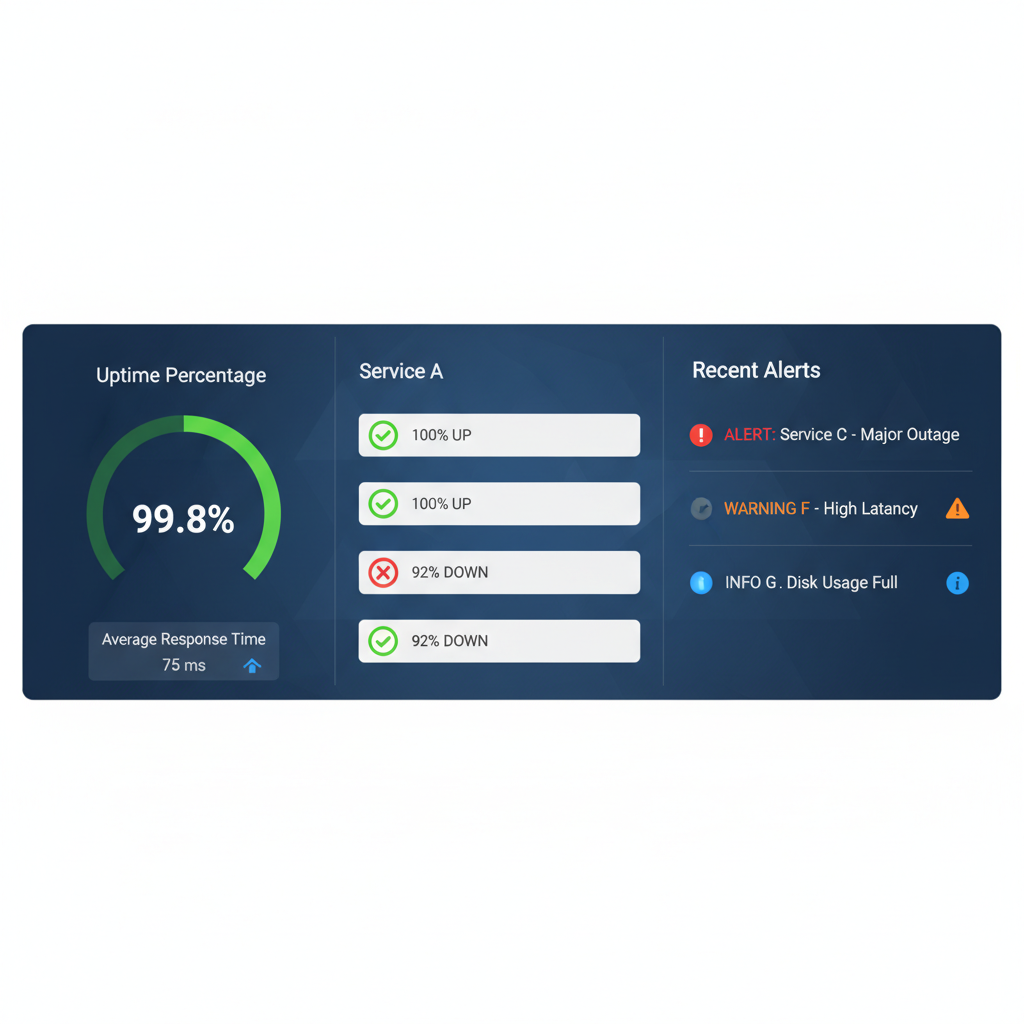
A dashboard screenshot showing real-time uptime percentages, average response times, and a list of recent alerts for various monitored services, highlighting green ‘up’ statuses and red ‘down’ alerts.
Real-World Applications and uptime monitoring or Cloud sla monitoring Examples
Understanding uptime monitoring or Cloud sla monitoring becomes clearer through practical applications. Numerous scenarios benefit from these monitoring practices, ensuring business continuity and customer satisfaction. These uptime monitoring or Cloud sla monitoring examples illustrate their value.
Consider an e-commerce platform that processes thousands of transactions daily. Uptime monitoring will immediately detect if the website or its payment gateway becomes unreachable. This allows the operations team to restore service quickly, preventing significant revenue loss.
SaaS Application Performance
For a Software-as-a-Service (SaaS) provider, both types of monitoring are critical. Uptime monitoring verifies the basic accessibility of their application from various user locations. It confirms the service is online.
Cloud SLA monitoring takes this further by tracking application response times for key features, database query speeds, and API success rates. If the application becomes slow, even if still “up,” SLA monitoring will trigger alerts, ensuring performance guarantees are met. This addresses the difference between uptime and SLA in a practical context.
Infrastructure as a Service (IaaS)
When utilizing Infrastructure-as-a-Service (IaaS) from a cloud provider, organizations rely heavily on network uptime vs service level monitoring. Uptime checks verify that virtual machines and network components are operational. This is the foundational layer.
SLA monitoring then assesses the performance of those VMs, such as CPU utilization, disk I/O, and network latency, against the provider’s contractual promises. This ensures the purchased resources deliver expected performance. It’s an ideal example of complementary monitoring: uptime and SLA working together.
Choosing the Right Solutions for uptime monitoring or Cloud sla monitoring
Selecting the best uptime monitoring or Cloud sla monitoring tools is crucial for effective implementation. The market offers a wide array of solutions, each with distinct features and capabilities. This uptime monitoring or Cloud sla monitoring guide helps in making informed decisions.
Consider tools that offer comprehensive monitoring capabilities, including both basic uptime checks and advanced SLA metric tracking. Look for features like multi-location checks, custom alert configurations, and detailed reporting dashboards. The best uptime monitoring or Cloud sla monitoring solution will align with your specific needs.
Integration and Scalability
Ensure the chosen solution integrates seamlessly with your existing IT infrastructure and incident management systems. API access and webhook support are often key for automation. Integration streamlines workflows and enhances operational efficiency.
Scalability is another vital factor. As your services grow and evolve, your monitoring solution should be able to expand with your needs. It should effortlessly handle an increasing number of monitored endpoints and data volume.
Reporting and Analytics
Robust reporting features are essential for demonstrating compliance, identifying trends, and making data-driven decisions. Look for tools that offer customizable dashboards, historical data analysis, and exportable reports. These help in understanding website availability and SLA performance over time.
Advanced analytics can help predict potential issues before they impact users. This proactive intelligence is invaluable for maintaining high service levels and continuous improvement. It provides deeper insights than simple up/down status.
Frequently Asked Questions
What is the primary goal of uptime monitoring?
The primary goal of uptime monitoring is to continuously check if an online service, like a website or server, is accessible and functioning. It aims to detect outages immediately and notify responsible teams so they can restore service quickly. This ensures basic operational availability.
How does Cloud SLA monitoring differ from basic uptime checks?
Cloud SLA monitoring extends beyond basic uptime by evaluating service performance against predefined contractual agreements. While uptime checks for basic accessibility, SLA monitoring measures specific metrics like response times, error rates, and throughput to ensure compliance with quality guarantees outlined in a service level agreement.
Why should I use both uptime and Cloud SLA monitoring?
Using both uptime and Cloud SLA monitoring provides a holistic view of service health. Uptime monitoring quickly identifies if a service is down, while SLA monitoring ensures that even when a service is up, it performs to agreed-upon standards. Together, they cover both availability and performance quality, offering complementary insights for optimal service delivery.
Can a service be “up” but still fail its SLA?
Yes, absolutely. A service can be technically “up” and accessible but still fail to meet its Service Level Agreement (SLA) if its performance metrics, such as response time or transaction success rate, fall below the agreed thresholds. This highlights why Cloud SLA monitoring is crucial alongside basic uptime checks.
What kind of alerts should I set up for uptime monitoring or Cloud sla monitoring?
You should set up alerts for both critical downtime detected by uptime monitoring and for performance degradation or non-compliance identified by Cloud SLA monitoring. Alerts should be actionable, routed to the correct teams, and potentially escalated if issues persist, ensuring prompt response and resolution.
What are some common uptime monitoring or Cloud sla monitoring examples?
Common examples include monitoring an e-commerce website for availability and page load times, tracking a SaaS application’s API response rates against a service guarantee, or ensuring a cloud provider’s virtual machines meet promised CPU and memory performance benchmarks. These cover basic accessibility and quality of service.
ENSURE UNINTERRUPTED SERVICE
Ensure uninterrupted service delivery and proactively prevent costly SLA breaches. Leverage our automated, real
✓ Free consultation ✓ No commitment required ✓ Trusted by experts
Conclusion: Ensuring Digital Reliability with uptime monitoring or Cloud sla monitoring
The digital economy thrives on reliability and performance. Both uptime monitoring and Cloud SLA monitoring are indispensable tools for any organization operating online. While uptime monitoring provides the fundamental assurance of accessibility, Cloud SLA monitoring elevates this by guaranteeing service quality and contractual adherence. They are not alternatives but rather essential components of a robust monitoring strategy.
By implementing the best uptime monitoring or Cloud sla monitoring practices and leveraging advanced solutions, businesses can minimize downtime, enhance user experience, and build trust. A comprehensive approach ensures that your digital services are not only available but also perform at their peak, consistently meeting user expectations and business objectives. Embracing these monitoring paradigms is key to sustained success in the competitive digital landscape.
Jacob Stålbro is a seasoned digitalization and transformation leader with over 20 years of experience, specializing in AI-driven innovation. As Head of Innovation and Co-Founder at Opsio, he drives the development of advanced AI, ML, and IoT solutions. Jacob is a sought-after speaker and webinar host known for translating emerging technologies into real business value and future-ready strategies.