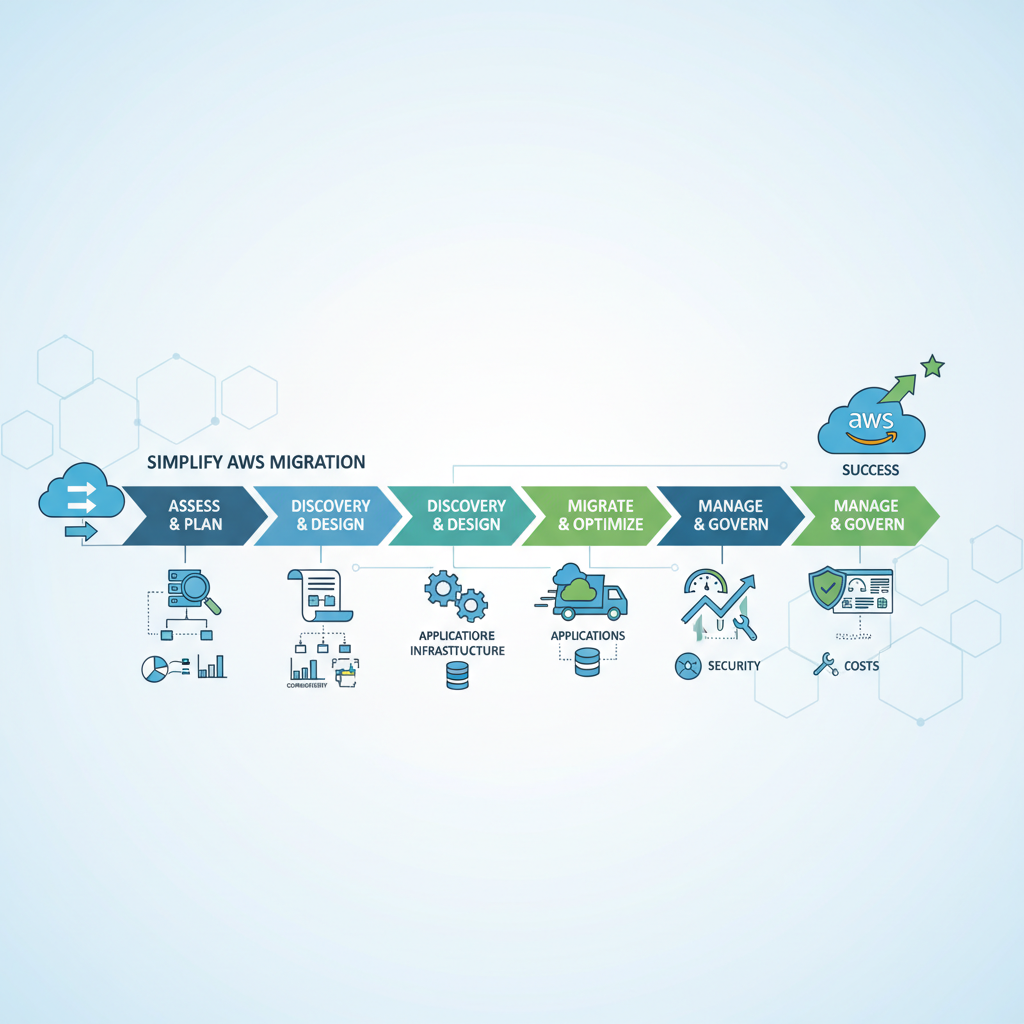
Effortlessly simplify AWS migration process with our expert guide.
March 11, 2026|2:30 PM
Unlock Your Digital Potential
Whether it’s IT operations, cloud migration, or AI-driven innovation – let’s explore how we can support your success.
Home /
Work /
Blogs /
Effortlessly simplify AWS migration process with our expert guide.
Understanding the Need to simplify aws migration process
Migrating to the cloud, particularly to Amazon Web Services (AWS), offers unparalleled benefits in terms of scalability, flexibility, and cost efficiency. However, the process can often seem daunting, involving complex infrastructure, data integrity concerns, and potential downtime risks. This comprehensive guide aims to simplify aws migration process, providing a clear roadmap for organizations of all sizes. By adopting a structured and strategic approach, businesses can navigate the complexities with greater ease and confidence.
The journey to the cloud doesn’t have to be a labyrinth of technical challenges. Our focus here is on demystifying each step, from initial assessment to post-migration optimization. We will explore how to streamline migration effectively, ensuring a smoother transition for your applications and data. This proactive strategy helps mitigate common pitfalls and maximizes the return on your cloud investment.
Why Prioritize an efficient workflow to simplify aws migration process?
An efficient workflow is paramount when undertaking an AWS migration. Without a clear and simplified approach, projects can quickly become mired in delays, cost overruns, and unexpected technical hurdles. Prioritizing efficiency helps to reduce the overall time and resources spent on the migration, making it a more predictable and manageable endeavor. This focus directly contributes to a successful and less stressful transition.
A streamlined migration process also minimizes business disruption, which is often a major concern for companies. By implementing best practices and leveraging appropriate tools, organizations can ensure that critical operations continue uninterrupted. The goal is to achieve an accelerated process, moving workloads to AWS with minimal impact on daily activities. This strategic planning leads to a much better experience for everyone involved.
Consider these key benefits of an efficient migration workflow:
Reduced Risk: A well-planned and simplified migration steps help identify and mitigate potential risks early on. This proactive stance prevents issues from escalating during the actual migration.
Cost Savings: Efficient use of resources and a faster migration cycle directly translate into lower operational costs. You avoid prolonged parallel infrastructure expenses and optimize cloud spending sooner.
Faster Time to Value: Accelerating the migration means your business can start leveraging AWS capabilities much quicker. This allows for innovation and competitive advantages to be realized sooner.
Improved Agility: A smooth transition to AWS enhances your organization’s agility, enabling quicker responses to market demands and business changes. This foundational agility is key for future growth.
Enhanced Security Posture: By design, a structured migration plan integrates robust security measures from the outset. This ensures that your applications and data are secure in their new cloud environment.
Key Phases to simplify aws migration process
Embarking on an AWS migration involves several critical phases, each requiring careful planning and execution. Understanding these distinct stages is fundamental to an ease of migration and achieving successful outcomes. Breaking the migration into manageable phases helps maintain control and visibility throughout the entire journey. This phased approach also allows for continuous learning and adjustments.
Implementing a structured framework is essential for anyone looking to simplify aws migration process. We will delve into each phase, highlighting the key activities and considerations that contribute to an accelerated process. This detailed breakdown provides a practical guide for organizations at any stage of their cloud adoption.
Phase 1: Assessment and Planning
The initial phase is arguably the most crucial for any migration project, laying the groundwork for all subsequent activities. It involves a thorough understanding of your existing environment and defining clear objectives for the move to AWS. This comprehensive assessment ensures that no critical aspects are overlooked.
Inventory Existing Infrastructure: Begin by cataloging all applications, databases, servers, and network components. Document dependencies between applications and their resource requirements. Understanding your current landscape is the first step to simplify aws migration process.
Define Migration Goals and Scope: Clearly articulate what you aim to achieve with the migration, such as cost reduction, improved performance, or enhanced scalability. Define which applications will be migrated and in what order. Establishing clear goals provides direction for the entire project.
Choose the Right Migration Strategy: AWS outlines “6 Rs” of migration: Rehost (lift-and-shift), Replatform (lift-tinker-and-shift), Refactor (re-architect), Repurchase, Retire, and Retain. Select the most appropriate strategy for each application based on business value, complexity, and available resources.
Risk Assessment: Identify potential challenges, such as data corruption, security vulnerabilities, or performance issues. Develop contingency plans to mitigate these risks. A thorough risk assessment is vital for a smooth transition.
Cost Analysis: Estimate the costs associated with both the migration process and the ongoing operational expenses in AWS. Compare this with your current on-premises costs to build a strong business case.
Phase 2: Preparation and Design
Once the assessment is complete, the next step involves preparing the target AWS environment and designing the architecture for your migrated workloads. This phase translates the planning into concrete technical specifications. It is here that the architectural blueprint for your cloud presence truly takes shape.
AWS Environment Setup: Configure your AWS accounts, Virtual Private Clouds (VPCs), subnets, and security groups. Establish a well-architected foundation that aligns with your organizational needs and best practices.
Networking and Security Considerations: Design robust network connectivity between your on-premises environment and AWS, if applicable, using services like AWS Direct Connect or VPN. Implement strong identity and access management (IAM) policies.
Data Migration Strategy: Determine how your data will be moved to AWS, considering volume, latency, and downtime tolerance. Options include online replication, offline data transfer, or snapshot-based migration.
Application Modernization Planning: For applications identified for replatforming or refactoring, design their new architecture leveraging AWS native services like containers (ECS, EKS), serverless functions (Lambda), or managed databases (RDS). Planning this early can greatly streamline migration efforts.
An infographic showing the key phases of AWS migration: Assess, Plan, Migrate, Optimize, with circular arrows indicating an iterative process.
Phase 3: Migration Execution
This is the phase where the actual movement of applications and data occurs, putting your preparation and design into action. Successful execution relies heavily on the right tools and a meticulous approach. This stage brings your carefully laid plans to fruition, transforming your IT landscape.
Tools and Services for Migration: Leverage AWS services specifically designed for migration, such as AWS Migration Hub, AWS Server Migration Service (SMS), AWS Database Migration Service (DMS), and AWS Application Migration Service (MGN). These tools greatly simplify aws migration process by automating many tasks.
Data Transfer: Execute the chosen data migration strategy. This might involve setting up replication jobs, initiating bulk data transfers, or using physical appliances like AWS Snowball. Monitoring data transfer progress is essential.
Application Migration: Move applications based on the selected migration strategy (rehost, replatform, or refactor). This could involve deploying EC2 instances, configuring containers, or setting up serverless functions.
Testing and Validation: Thoroughly test migrated applications in the AWS environment to ensure functionality, performance, and security. Conduct user acceptance testing (UAT) with stakeholders. Comprehensive testing is vital for a smooth cutover.
Cutover Strategy: Plan the final switch from the source environment to the AWS target environment. This typically involves updating DNS records and redirecting traffic. Minimize downtime during this critical step through careful orchestration.
Phase 4: Post-Migration Optimization
Migration doesn’t end with cutover; optimization is a continuous process that ensures your AWS environment delivers maximum value. This phase focuses on refining your cloud resources and operations for efficiency and performance. It is an ongoing commitment to excellence in your cloud journey.
Performance Tuning: Monitor application performance in AWS and make adjustments to instance types, database configurations, and scaling policies. Optimize configurations to meet performance benchmarks.
Cost Optimization: Continuously analyze AWS spending using tools like AWS Cost Explorer and implement strategies like right-sizing instances, utilizing reserved instances or savings plans, and leveraging spot instances where appropriate.
Monitoring and Governance: Establish robust monitoring and logging solutions using AWS CloudWatch and CloudTrail. Implement governance policies to manage resources, security, and compliance effectively. This ensures ongoing operational excellence.
Security Posture Improvement: Regularly review and enhance your security configurations, keeping up with best practices and evolving threat landscapes. Continuous security audits are crucial.
Automation: Explore further opportunities for automation within your AWS environment, such as infrastructure as code (IaC) with AWS CloudFormation, automated backups, and incident response. This enhances your operational efficiency significantly.
✓ Free consultation ✓ No commitment required ✓ Trusted by experts
Tools and Services to simplify aws migration process
AWS provides a powerful suite of tools and services specifically designed to assist and simplify aws migration process. Leveraging these resources can significantly reduce manual effort, minimize downtime, and accelerate your journey to the cloud. Understanding which tool to use for specific tasks is key to an efficient workflow. These services are engineered to address various migration challenges.
These specialized tools embody the principles of migration automation, making complex transfers more manageable. They offer robust features for data transfer, server migration, and database replication, catering to a wide range of use cases. Utilizing them effectively can transform a challenging migration into a streamlined success.
Here are some of the most critical AWS migration services:
AWS Migration Hub: This central dashboard allows you to track the progress of migrations from various AWS and partner solutions. It provides a single pane of glass to simplify aws migration process by offering unified visibility into your entire migration portfolio. It integrates with other migration tools for a holistic view.
AWS Server Migration Service (SMS) / AWS Application Migration Service (MGN): MGN (Application Migration Service) is the next generation of SMS, providing a highly automated, resilient, and fast lift-and-shift solution. It minimizes downtime by replicating source servers into AWS and allows for quick cutover. This service is ideal for rehosting applications with minimal changes.
AWS Database Migration Service (DMS): DMS helps migrate databases to AWS quickly and securely, often with minimal downtime. It supports homogenous migrations (e.g., Oracle to Oracle) and heterogeneous migrations (e.g., Oracle to Amazon Aurora). This tool offers continuous replication, making it a critical component for complex database migrations.
AWS DataSync: DataSync simplifies and accelerates moving large amounts of data online between on-premises storage and AWS storage services. It can copy data up to 10x faster than open-source tools. This service is particularly useful for large datasets and initial bulk transfers.
AWS Snow Family: For moving extremely large amounts of data (petabytes to exabytes) or when network bandwidth is limited, the AWS Snow Family (Snowcone, Snowball Edge, Snowmobile) offers physical devices for offline data transfer. These devices are robust and secure for challenging environments.
AWS Application Discovery Service: This service helps identify applications and their dependencies in on-premises data centers, providing valuable data for migration planning. It gathers configuration and usage data from your servers to inform your migration strategy.
Professional visual illustration related to simplify aws migration process
Best Practices for an efficient workflow
Adhering to best practices is crucial for anyone looking to simplify aws migration process. These guidelines ensure that your migration is not only successful but also efficient, secure, and cost-effective. Implementing these practices can significantly contribute to an accelerated process and an overall positive migration experience.
Following these tips helps to establish a strong foundation for your cloud operations. They provide actionable advice that can be applied across different migration scenarios, enhancing the ease of migration for your teams.
Start Small, Iterate: Begin with a small, non-critical application as a pilot project. Learn from this experience and refine your process before tackling larger, more complex workloads. This iterative approach minimizes risk and builds confidence.
Automate Everything Possible: Leverage infrastructure as code (IaC) tools like AWS CloudFormation or Terraform to automate the provisioning of AWS resources. Use migration automation tools to simplify aws migration process, particularly for server and database transfers. Automated migration significantly reduces manual errors and speeds up deployment.
Prioritize Applications: Categorize applications based on business criticality, complexity, and dependencies. Migrate less critical applications first to gain experience, then move on to more challenging ones. This strategic prioritization leads to a smoother progression.
Comprehensive Testing: Never underestimate the importance of testing. Perform thorough functional, performance, security, and user acceptance testing (UAT) in the AWS environment before cutover. This step identifies issues before they impact production.
Disaster Recovery Planning: Design and implement a robust disaster recovery (DR) strategy for your migrated applications within AWS. Test your DR plan regularly to ensure business continuity.
Right-size Resources: Avoid over-provisioning resources in AWS from the start. Monitor usage post-migration and adjust instance types and storage as needed to optimize costs. This ongoing optimization is key for cloud efficiency.
Addressing Common Challenges in AWS Migration
Even with careful planning, AWS migrations can present various challenges that require proactive solutions. Recognizing these potential obstacles beforehand allows organizations to simplify aws migration process by preparing effective mitigation strategies. Addressing these challenges head-on contributes to a more controlled and successful migration.
A thorough understanding of common difficulties is part of the best simplify aws migration process strategy. By anticipating these issues, teams can build resilience into their migration plan and maintain an efficient workflow.
Data Integrity: Ensuring data remains consistent and uncorrupted during transfer is paramount. Use checksums, replication services with built-in validation, and thorough post-migration data verification.
Downtime Concerns: Minimizing service interruption during migration is often a top priority. Employ strategies like phased cutovers, active-passive configurations, and continuous data replication to reduce downtime to an absolute minimum.
Security and Compliance: Maintaining security posture and adhering to regulatory compliance requirements (e.g., GDPR, HIPAA) in the cloud is complex. Implement robust IAM policies, network security groups, encryption, and regular audits.
Skill Gaps: Teams may lack the necessary AWS expertise. Invest in training, leverage AWS Professional Services, or engage experienced AWS partners. Building in-house cloud skills is a long-term investment.
Network Bandwidth: Transferring large volumes of data can be constrained by network bandwidth. Utilize AWS DataSync, VPNs, AWS Direct Connect, or the AWS Snow Family for efficient and accelerated process data movement.
Application Dependencies: Complex interdependencies between applications can complicate migration. Thoroughly map these dependencies during the assessment phase to plan migration waves that minimize disruption.
Tips for an ease of migration
Achieving an ease of migration to AWS goes beyond just technical execution; it involves strategic organizational alignment and continuous improvement. These practical tips are designed to further simplify aws migration process by fostering collaboration and leveraging available expertise. They collectively contribute to a smoother and less stressful transition.
Implementing these recommendations can significantly improve your migration experience, making it more predictable and manageable. They represent valuable insights for anyone embarking on an AWS journey, providing actionable advice for an efficient workflow. These simplify aws migration process tips are designed to enhance your chances of success.
Dedicated Migration Team: Assemble a cross-functional team with representation from operations, development, security, and business units. A dedicated team ensures focused effort and clear communication.
Utilize AWS Partners: Leverage the expertise of AWS Partner Network (APN) consulting partners who specialize in migration. They bring valuable experience, best practices, and can accelerate process timelines.
Phased Approach: Adopt a phased migration strategy, moving applications in manageable batches rather than attempting a monolithic migration. This reduces risk and allows for iterative learning.
Continuous Monitoring: Implement robust monitoring from day one in AWS. This helps detect performance issues, security threats, and cost anomalies quickly. Continuous monitoring is key to maintaining an efficient cloud environment.
Document Everything: Maintain thorough documentation throughout the migration process, including architectural designs, configuration details, and lessons learned. This institutional knowledge is invaluable for future operations.
Consider Modernization Early: While lift-and-shift might be the initial strategy, constantly evaluate opportunities for application modernization. Refactoring applications to be cloud-native can unlock greater benefits in the long run.
Frequently Asked Questions
Understanding the common queries surrounding AWS migration can further simplify aws migration process for many organizations. This FAQ section addresses key concerns and provides concise answers to help clarify aspects of your cloud journey. These insights aim to offer quick solutions and guidance.
What is the primary goal to simplify aws migration process?
The primary goal is to make the journey to the AWS cloud less complex, faster, and more efficient, reducing risks and minimizing business disruption. It aims to deliver the benefits of cloud adoption without unnecessary technical or operational hurdles. By simplifying the process, organizations can accelerate their time to value.
What AWS services help streamline migration?
AWS offers several key services to streamline migration, including AWS Migration Hub for central tracking, AWS Application Migration Service (MGN) for server rehosting, and AWS Database Migration Service (DMS) for database transfers. AWS DataSync also helps with large-scale data movement, creating an efficient workflow.
How does migration automation contribute to an efficient workflow?
Migration automation significantly contributes to an efficient workflow by reducing manual effort, minimizing human error, and accelerating the overall process. Tools like MGN automate server replication and cutover, allowing teams to focus on strategic tasks rather than repetitive operations. This directly helps to simplify aws migration process by reducing complexity.
What are the key simplified migration steps?
The key simplified migration steps involve initial assessment and planning, preparing the AWS environment, executing the migration using appropriate tools, and finally, optimizing the cloud environment post-migration. Each step is designed to be manageable and contribute to an ease of migration.
Can I reduce downtime during the migration process?
Yes, reducing downtime is a critical aspect of an accelerated process and can be achieved through strategies like continuous data replication, phased cutovers, and utilizing AWS services that support minimal downtime migrations (e.g., AWS DMS, MGN). Careful planning and testing are essential.
How does a simplify aws migration process guide differ from a general one?
A simplify aws migration process guide specifically focuses on actionable strategies, best practices, and tool usage designed to explicitly reduce complexity and make the migration more accessible. It emphasizes an efficient workflow and ease of migration, rather than just a technical overview of steps. It prioritizes clarity and practicality.
✓ Free consultation ✓ No commitment required ✓ Trusted by experts
Conclusion
Embarking on an AWS migration journey can seem challenging, but by adopting a structured approach and leveraging the right strategies, you can significantly simplify aws migration process. From thorough planning and assessment to utilizing specialized AWS tools and implementing best practices, each step contributes to a smoother, faster, and more successful transition. The aim is to create an efficient workflow that minimizes disruption and maximizes the benefits of cloud adoption.
Remember that an accelerated process is achievable with deliberate effort and the integration of migration automation where possible. By focusing on simplified migration steps and continuously optimizing your AWS environment, your organization can fully realize the power of the cloud. This guide provides the foundation for an ease of migration, empowering you to confidently move your workloads to AWS. Start your cloud journey with a clear vision and the tools to make it a success.
Jacob Stålbro is a seasoned digitalization and transformation leader with over 20 years of experience, specializing in AI-driven innovation. As Head of Innovation and Co-Founder at Opsio, he drives the development of advanced AI, ML, and IoT solutions. Jacob is a sought-after speaker and webinar host known for translating emerging technologies into real business value and future-ready strategies.