Cloud Managed vs On Premise: Which is Right for Your Business?
March 5, 2026|1:19 PM
Unlock Your Digital Potential
Whether it’s IT operations, cloud migration, or AI-driven innovation – let’s explore how we can support your success.
Home /
Work /
Blogs /
Cloud Managed vs On Premise: Which is Right for Your Business?
Understanding Cloud Managed vs On Premise
Choosing the right IT infrastructure is a pivotal decision for any organization navigating the complexities of modern technology. The debate between cloud managed vs on premise solutions represents a fundamental choice that impacts everything from daily operations to long-term strategic goals. Understanding the nuances of each model is crucial for making an informed decision that aligns with your business objectives and resources.
This guide will delve into the core aspects of both cloud managed and on premise environments, exploring their benefits, drawbacks, and practical implications. We will examine critical factors such as costs, scalability, security, and control, providing a comprehensive overview to help you determine the best fit for your enterprise in today’s dynamic digital landscape.
What is On-Premise Infrastructure?
On-premise infrastructure refers to IT systems that are physically located and managed within an organization’s own facilities. This traditional model involves purchasing, housing, and maintaining all necessary hardware, software, and networking components directly. The company is responsible for every aspect of its information technology stack.
Businesses utilizing an on-premise setup house their servers, storage, and networking equipment in their own data center. This gives them complete infrastructure control over their data and systems. However, it also means bearing the full responsibility for maintenance, updates, security, and disaster recovery.
What is Cloud Managed Infrastructure?
Cloud managed infrastructure, conversely, involves utilizing computing services delivered over the internet by a third-party provider. Instead of owning and operating physical hardware, organizations subscribe to services like computing power, storage, and applications on a pay-as-you-go basis. The cloud provider handles the underlying infrastructure and its maintenance.
This model allows businesses to access resources remotely, often through a web interface, without needing to manage the physical servers themselves. Examples include public cloud offerings from major vendors. Companies can deploy applications and store data without significant upfront hardware costs.
The Hybrid Approach: Best of Both Worlds
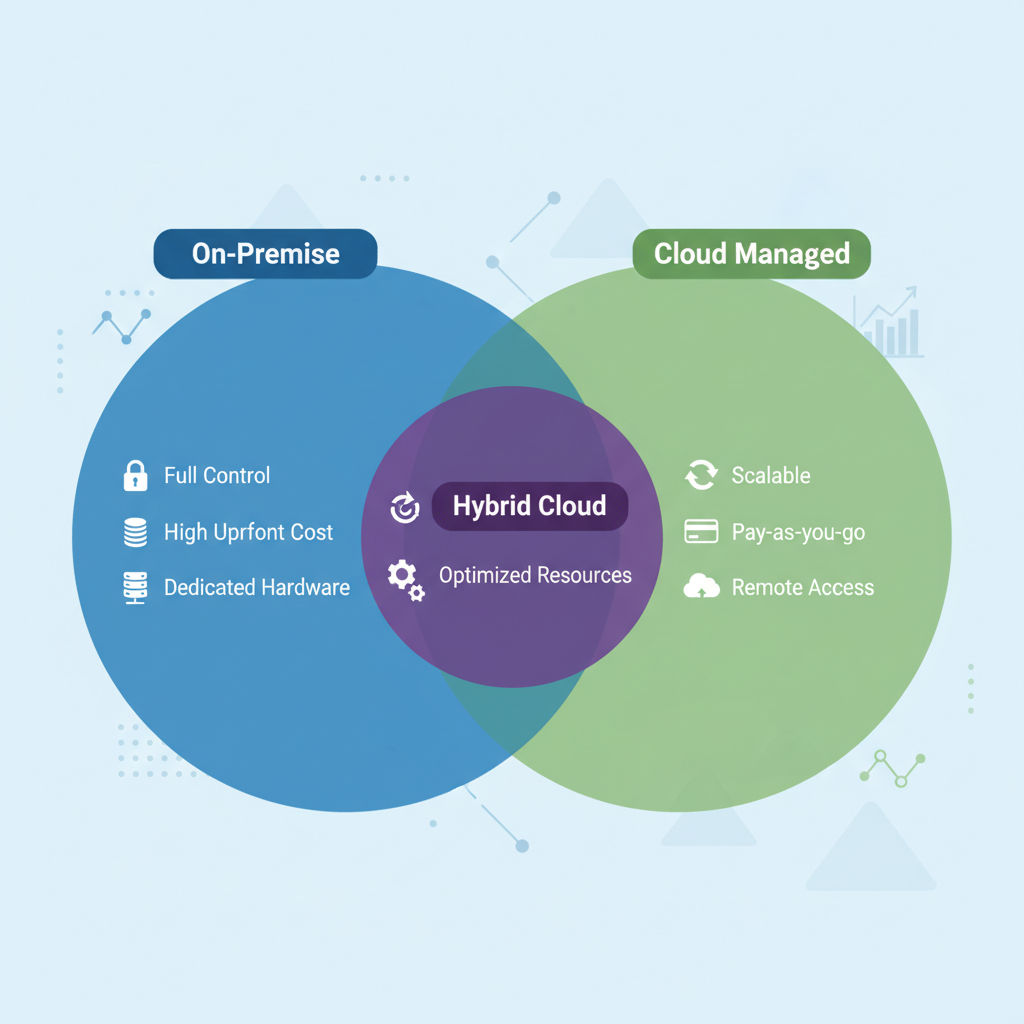
A hybrid approach combines elements of both on-premise and cloud managed solutions, creating a flexible and optimized IT environment. This strategy allows organizations to keep sensitive data or critical applications within their private data center while leveraging the agility and scalability of the public cloud for other workloads. Many businesses find this balanced model provides the best blend of control and flexibility.
It often involves integrating existing on-premise infrastructure with cloud services, creating a seamless operational framework. A hybrid cloud can offer enhanced data portability and workload management across different environments. This approach is gaining significant traction as companies seek tailored solutions for their unique operational needs.
A Venn diagram comparing “On-Premise” and “Cloud Managed” solutions, with “Hybrid Cloud” in the overlapping center. Each section lists key characteristics like “Full Control,” “High Upfront Cost” for On-Premise; “Scalable,” “Pay-as-you-go” for Cloud Managed; and “Flexibility,” “Optimized Resources” for Hybrid.
Key Differences: cloud managed vs on premise
The core distinctions between cloud managed vs on premise revolve around ownership, control, cost structure, and operational responsibility. These differences manifest across various aspects of IT management, influencing both day-to-day operations and long-term strategic planning. Understanding these disparities is fundamental to selecting the appropriate infrastructure model.
On-premise solutions demand significant capital expenditure upfront for hardware, software licenses, and physical data center setup. In contrast, cloud managed services typically operate on an operational expenditure (OpEx) model, where costs are incurred as services are consumed. This distinction impacts budgeting and financial forecasting for businesses of all sizes.
Furthermore, infrastructure control is a major differentiator. On-premise grants complete control over hardware, software, and data security policies. Cloud managed environments delegate much of this control to the third-party provider, offering convenience at the expense of direct oversight. This trade-off requires careful consideration of trust and compliance requirements.
Financial Implications: hardware costs and OpEx vs CapEx
The financial models underpinning cloud managed vs on premise solutions are vastly different, impacting budget allocation and long-term spending. Understanding these implications is crucial for making an economically sound decision for your organization. Initial investments, ongoing operational expenses, and the overall cost of ownership vary significantly between the two approaches.
Many businesses initially focus solely on visible upfront costs without fully considering the total cost of ownership (TCO). This often leads to underestimating the financial commitment required for an on-premise setup or overestimating the long-term expenses of cloud adoption. A thorough financial analysis must encompass all aspects of the IT lifecycle.
Initial Investment and Hardware Costs
An on-premise setup requires substantial upfront capital expenditure (CapEx) for purchasing servers, storage devices, networking equipment, and software licenses. Beyond the primary hardware, there are additional costs for cooling systems, power infrastructure, physical security, and redundant components. These hardware costs can be a significant barrier for startups and small businesses.
Cloud managed solutions, on the other hand, demand minimal to no upfront capital investment. Businesses pay for resources as they use them, converting CapEx into operational expenditure (OpEx). This allows organizations to allocate capital to other areas, improving cash flow and reducing financial risk associated with large-scale IT purchases. The shift from owning assets to subscribing to services is a defining characteristic of cloud economics.
Ongoing Operational Expenses
Operational expenses also differ greatly between the two models. For on-premise environments, ongoing costs include electricity, cooling, facility maintenance, hardware upgrades, software license renewals, and the salaries of IT staff dedicated to managing the infrastructure. Regular maintenance, patching, and troubleshooting are continuous responsibilities, contributing to significant operational overhead.
Cloud managed services simplify ongoing costs by bundling many of these operational aspects into a single monthly or annual fee. The cloud provider handles hardware maintenance, power consumption, data center security, and often basic software updates. While usage fees can fluctuate, they typically eliminate many hidden costs associated with traditional IT management, allowing businesses to focus their IT staff on strategic initiatives rather than infrastructure upkeep.
MAXIMIZE YOUR CLOUDS
Maximize your cloud’s potential with expert management. Discover custom cloud solutions
✓ Free consultation ✓ No commitment required ✓ Trusted by experts
Performance and Scalability: addressing scalability differences
Performance and scalability differences are critical factors when evaluating cloud managed vs on premise solutions, directly impacting an organization’s ability to respond to changing demands. The capacity to grow or shrink IT resources on demand can provide a significant competitive advantage. Each model offers distinct approaches to handling fluctuations in workload and data volume.
Businesses must consider their current performance requirements and future growth projections when making this infrastructure decision. An infrastructure that cannot scale efficiently can lead to bottlenecks, poor user experience, and lost revenue opportunities. The ability to adapt quickly to market changes is paramount in today’s fast-paced digital economy.
On-Premise Scalability Challenges
Scaling an on-premise infrastructure typically involves a significant lead time and investment. When demand increases, organizations must purchase, install, and configure new hardware, which can be a slow and expensive process. This “buy big just in case” approach often leads to over-provisioning resources, resulting in underutilized equipment and wasted capital.
Conversely, scaling down in an on-premise environment is rarely feasible; once hardware is purchased, its cost is sunk. This lack of elasticity can make it difficult for businesses with fluctuating workloads to manage their resources efficiently. Planning for peak loads often means having idle capacity during off-peak times, incurring unnecessary hardware costs.
Cloud Managed Scalability Advantages
Cloud managed solutions offer unparalleled scalability differences, allowing businesses to instantly provision or de-provision resources as needed. This elasticity means you can rapidly expand computing power or storage during peak periods and then scale back down to save costs when demand is low. The pay-as-you-go model perfectly complements this dynamic scaling capability.
This ability to scale vertically (adding more power to existing resources) and horizontally (adding more instances of resources) without physical constraints is a major advantage. It ensures optimal performance during high-traffic events and cost efficiency during quieter times. This responsiveness is crucial for applications with unpredictable usage patterns, making cloud a highly attractive option for many modern businesses.
Security and Compliance: security considerations in both models
Security considerations are paramount in the cloud managed vs on premise debate, as data breaches and compliance failures can have devastating consequences. Both models present unique challenges and advantages concerning data protection and regulatory adherence. A comprehensive understanding of these aspects is vital for safeguarding sensitive information and maintaining trust.
Organizations must assess their specific security requirements, industry regulations, and risk tolerance when choosing an infrastructure model. The responsibility for security is shared differently in each environment, demanding a clear understanding of where accountability lies. This includes everything from physical security to data encryption and access controls.
On-Premise Security Control
With an on-premise solution, an organization retains complete infrastructure control, including all aspects of security. This means designing, implementing, and managing firewalls, intrusion detection systems, access controls, and encryption methods. For businesses with stringent regulatory requirements or highly sensitive data, this level of control can be a significant advantage. They manage their own data center.
However, this also places the full burden of security expertise, investment, and vigilance on the company. Maintaining a robust security posture requires skilled personnel, continuous monitoring, and significant financial resources to defend against evolving cyber threats. Organizations must invest heavily in security personnel, training, and tools to meet these demands effectively.
Cloud Managed Security Model
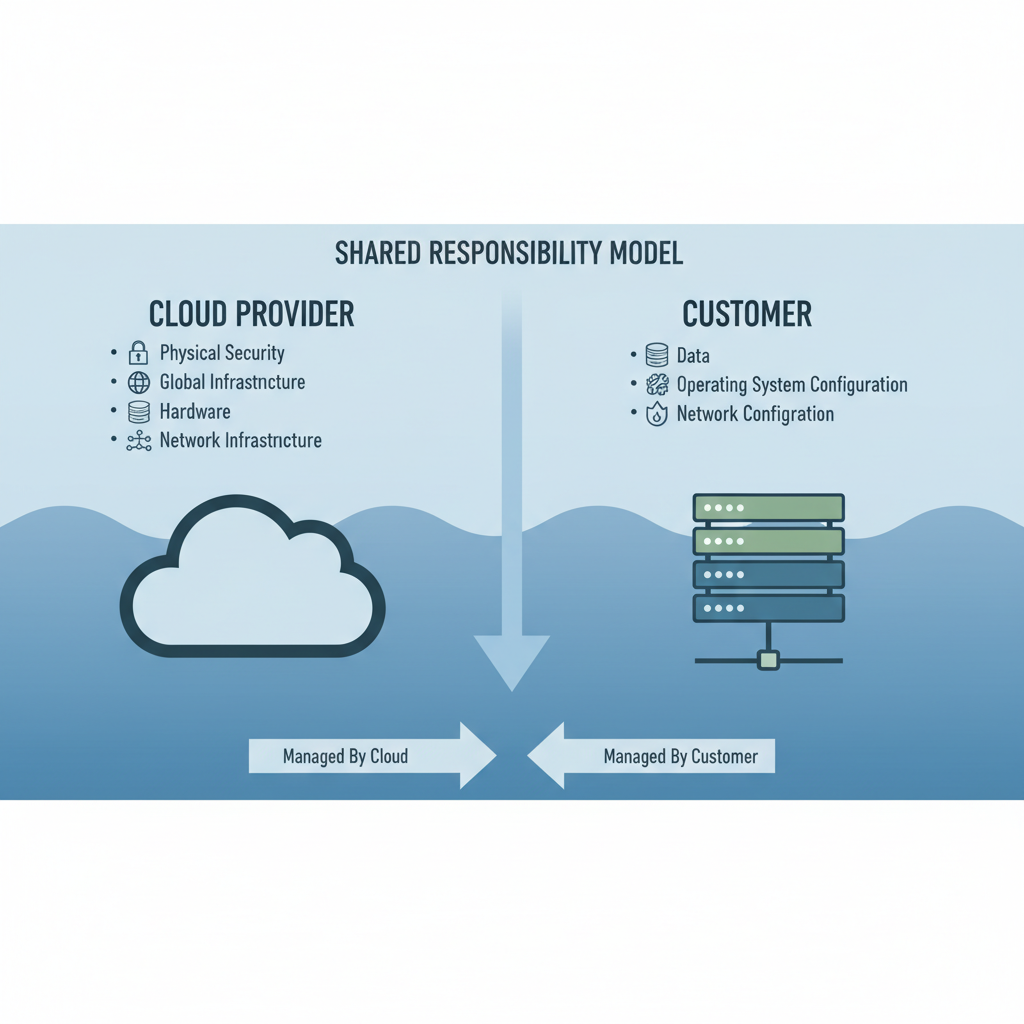
In a cloud managed environment, security responsibilities are shared between the cloud provider and the customer, often referred to as the “shared responsibility model.” The provider is responsible for the security of the cloud (e.g., physical security of data centers, underlying infrastructure, networking, virtualization). Customers are responsible for security in the cloud (e.g., configuring firewalls, managing access control, encrypting data, securing applications).
Leading cloud providers invest heavily in state-of-the-art security measures, compliance certifications, and expert security teams, often surpassing what individual businesses can achieve on their own. This can offer a higher baseline of security and compliance, especially for smaller organizations. However, understanding your responsibilities in the shared model is critical to prevent security gaps.
A diagram illustrating the shared responsibility model in cloud security, showing a clear division of responsibilities between “Cloud Provider” (e.g., physical security, global infrastructure) and “Customer” (e.g., data, applications, operating system configuration, network configuration).
Infrastructure Control and Management
The degree of infrastructure control and the associated management overhead are defining characteristics when comparing cloud managed vs on premise systems. These factors directly influence IT operational efficiency, resource allocation, and overall business agility. Organizations must decide how much control they need versus how much management responsibility they are willing to delegate.
This choice often boils down to a strategic decision about where IT resources are best spent. Should your team focus on managing hardware and software, or should they concentrate on developing innovative applications and services that drive business value? The answer significantly shapes the ideal infrastructure model.
Degree of Infrastructure Control
An on-premise solution offers maximum infrastructure control. Businesses have direct access to all hardware, operating systems, and applications, allowing for highly customized configurations and direct troubleshooting. This level of control can be vital for highly specialized applications or environments with unique regulatory demands that necessitate granular oversight.
However, this extensive control comes with the full responsibility for every component. Any hardware failure, software bug, or network issue requires in-house expertise and immediate attention from your IT team. While offering bespoke customization, it also demands robust internal capabilities and continuous resource allocation for system upkeep.
Management and Maintenance Overhead
Cloud managed services offload significant management and maintenance overhead to the provider. The cloud vendor handles physical hardware, patching, updates, and often even operating system maintenance and security. This frees up internal IT staff from routine infrastructure tasks, allowing them to focus on higher-value activities that directly support business objectives.
While customers still manage their applications, data, and configurations within the cloud environment, the reduced infrastructure burden is a major appeal. This shift allows businesses to optimize their IT teams, directing their expertise towards innovation rather than infrastructure upkeep. The convenience of managed services greatly simplifies the operational complexity.
Decision-Making Factors for Your Business
Choosing between cloud managed vs on premise is not a one-size-fits-all decision; it depends heavily on your specific business context, industry, budget, and strategic goals. Several factors warrant careful consideration to ensure you select the infrastructure that best supports your current needs and future ambitions. A thorough evaluation will help avoid costly mistakes and optimize resource allocation.
Consider not only the immediate benefits but also the long-term implications for growth, agility, and competitive advantage. The right choice will empower your business to innovate, scale, and secure its digital assets effectively. It’s an investment in your company’s future operational capabilities.
Assessing Your Needs
Start by evaluating your existing IT infrastructure and current business requirements.
Data Sensitivity: How sensitive is your data? Are there strict compliance requirements (e.g., HIPAA, GDPR, NIS2) that might favor one model over another, or require a specific hybrid approach?
Workload Volatility: Do your workloads have predictable or highly fluctuating demands? The scalability differences of cloud might be crucial for variable workloads.
Budget & Resources: What is your budget for initial investment versus ongoing operational costs? Do you have the in-house expertise and staff to manage an on-premise data center effectively? Consider the impact of hardware costs.
Performance Requirements: What are your latency and performance requirements? For extremely low-latency applications, on-premise might sometimes be preferred.
Future-Proofing Your Infrastructure
Consider how your chosen infrastructure will support your business’s growth and technological evolution over the next 3-5 years.
Innovation Pace: Cloud platforms often provide quicker access to the latest technologies like AI, machine learning, and advanced analytics tools, accelerating innovation.
Competitive Landscape: How are your competitors leveraging technology? Staying competitive often means adopting agile and scalable infrastructure.
Disaster Recovery: How robust is your disaster recovery strategy? Cloud services often offer built-in, cost-effective disaster recovery capabilities that are difficult to replicate on-premise.
Strategic Flexibility: A hybrid approach can offer maximum flexibility, allowing you to gradually migrate workloads or keep specific systems on-premise while leveraging the cloud for others. This strategic flexibility can be a significant asset in an unpredictable market.
Frequently Asked Questions (FAQ)
What are the main benefits of cloud managed over on premise?
Cloud managed solutions offer numerous benefits, including reduced upfront **hardware costs**, enhanced **scalability differences** with on-demand resource provisioning, and lower operational overhead as the provider handles infrastructure maintenance. They also provide greater agility, faster deployment of new services, and often superior disaster recovery capabilities.
Can I combine cloud managed and on premise solutions?
Yes, absolutely. Many organizations adopt a **hybrid approach**, which combines on-premise infrastructure with **public cloud** services. This strategy allows businesses to leverage the strengths of both models, maintaining control over critical data on-premise while utilizing the flexibility and scalability of the cloud for other workloads.
How do security considerations differ between the two models?
In on-premise environments, an organization has full **infrastructure control** over its security, but also bears full responsibility for implementing and maintaining all security measures. Cloud managed services operate on a shared responsibility model, where the provider secures the underlying infrastructure, and the customer is responsible for securing their data and applications within that cloud environment. Robust **security considerations** are vital for both.
Which model is more cost-effective in the long run?
The cost-effectiveness of **cloud managed vs on premise** depends heavily on an organization’s specific needs, scale, and usage patterns. Cloud managed solutions typically convert capital expenses into operational expenses, reducing upfront investment. However, for highly stable, large-scale workloads, on-premise can sometimes offer lower long-term costs due to the absence of recurring subscription fees, especially if **hardware costs** have been amortized over a long period. A careful TCO analysis is recommended.
What role does a data center play in on-premise solutions?
A **data center** is central to on-premise solutions, serving as the physical location where an organization houses all its IT infrastructure, including servers, storage, networking equipment, and related operational components like power and cooling systems. It is the core facility that enables and supports all on-premise computing and data storage activities, requiring significant investment in physical space and environmental controls.
MAXIMIZE YOUR CLOUDS
Maximize your cloud’s potential with expert management. Discover custom cloud solutions
✓ Free consultation ✓ No commitment required ✓ Trusted by experts
Conclusion: Making the Right Choice in 2026
The choice between cloud managed vs on premise infrastructure is a foundational decision with far-reaching implications for any business. There is no universally superior option; the ideal solution depends entirely on your specific operational needs, financial capabilities, compliance requirements, and long-term strategic vision. Carefully weighing factors like initial hardware costs, scalability differences, security considerations, and the degree of desired infrastructure control is paramount.
As technology continues to evolve rapidly, many organizations are finding value in a hybrid approach, strategically combining the strengths of both models. This allows for optimized resource allocation, enhanced flexibility, and resilient operations. By conducting a thorough assessment of your unique circumstances and future aspirations, you can confidently select the infrastructure model that empowers your business to thrive in 2026 and beyond. Make an informed decision that drives innovation and secures your digital future.
Fredrik Karlsson
- Chief Operating Officer (Group) & Chief Information Security Officer, Opsio
Fredrik Karlsson is the Group Chief Operating Officer and Chief Information Security Officer at Opsio in Sweden. With extensive experience in operations, governance, and information security, he focuses on aligning business objectives with risk management, compliance, and scalable IT operations. Fredrik works closely with leadership and delivery teams to ensure resilient, secure, and efficient cloud and hybrid technology environments.