Affordable Cloud SLA Monitoring Pricing Options for Your Business
March 6, 2026|2:43 PM
Unlock Your Digital Potential
Whether it’s IT operations, cloud migration, or AI-driven innovation – let’s explore how we can support your success.
Home /
Work /
Blogs /
Affordable Cloud SLA Monitoring Pricing Options for Your Business
Understanding Cloud SLA Monitoring
Cloud Service Level Agreement (SLA) monitoring is an essential practice for organizations relying on cloud services. It involves systematically tracking key performance indicators (KPIs) to ensure that cloud providers meet their contractual obligations. This proactive approach helps maintain service quality and business continuity.
Effective Cloud SLA monitoring ensures that your cloud environment performs as expected, safeguarding critical applications and user experience. It provides real-time visibility into uptime, response times, and resource utilization, which are vital for operational excellence. Understanding Cloud sla monitoring pricing is key to budgeting for these crucial services.
Factors Influencing Cloud SLA Monitoring Pricing
Several core factors significantly impact Cloud sla monitoring pricing. These elements determine the overall SLA monitoring cost and help providers tailor solutions to specific business needs. Evaluating these factors is crucial when comparing different services.
The scope of monitoring is a primary determinant. This includes the number of cloud services, applications, and endpoints you need to monitor. A broader scope naturally leads to higher costs, as it requires more resources and sophisticated tools.
Monitoring frequency and granularity also play a significant role. Continuous, real-time monitoring with fine-grained data collection is generally more expensive than less frequent checks. Businesses must balance their need for immediate insights with their budget constraints.
The features and capabilities offered by a monitoring solution directly influence its price. Advanced analytics, AI-powered anomaly detection, customizable dashboards, and extensive integration options all add value and contribute to a higher cost. Different SLA tool pricing tiers often reflect these feature sets.
Data retention policies are another factor affecting the overall Cloud sla monitoring pricing. Storing performance data for longer periods, especially for compliance or historical analysis, typically incurs additional charges. Users should consider how long they need to keep their monitoring logs.
Support levels from the provider also impact the final cost. Premium support, which might include dedicated account managers, faster response times, or 24/7 assistance, will increase the SLA monitoring cost. Standard support packages are often included but may have limitations.
Finally, the geographical distribution of your cloud infrastructure and monitoring probes can influence pricing. Monitoring services across multiple regions or continents may require a more complex setup, potentially increasing Cloud sla monitoring pricing. Providers might offer different pricing models for global deployments.
Common Pricing Models for Cloud SLA Monitoring
Providers utilize various pricing models for cloud SLA monitoring to cater to diverse customer requirements and scale. Understanding these pricing models for cloud SLA is fundamental to finding the most cost-effective solution for your organization. Each model has its advantages and is suited to different operational scales.
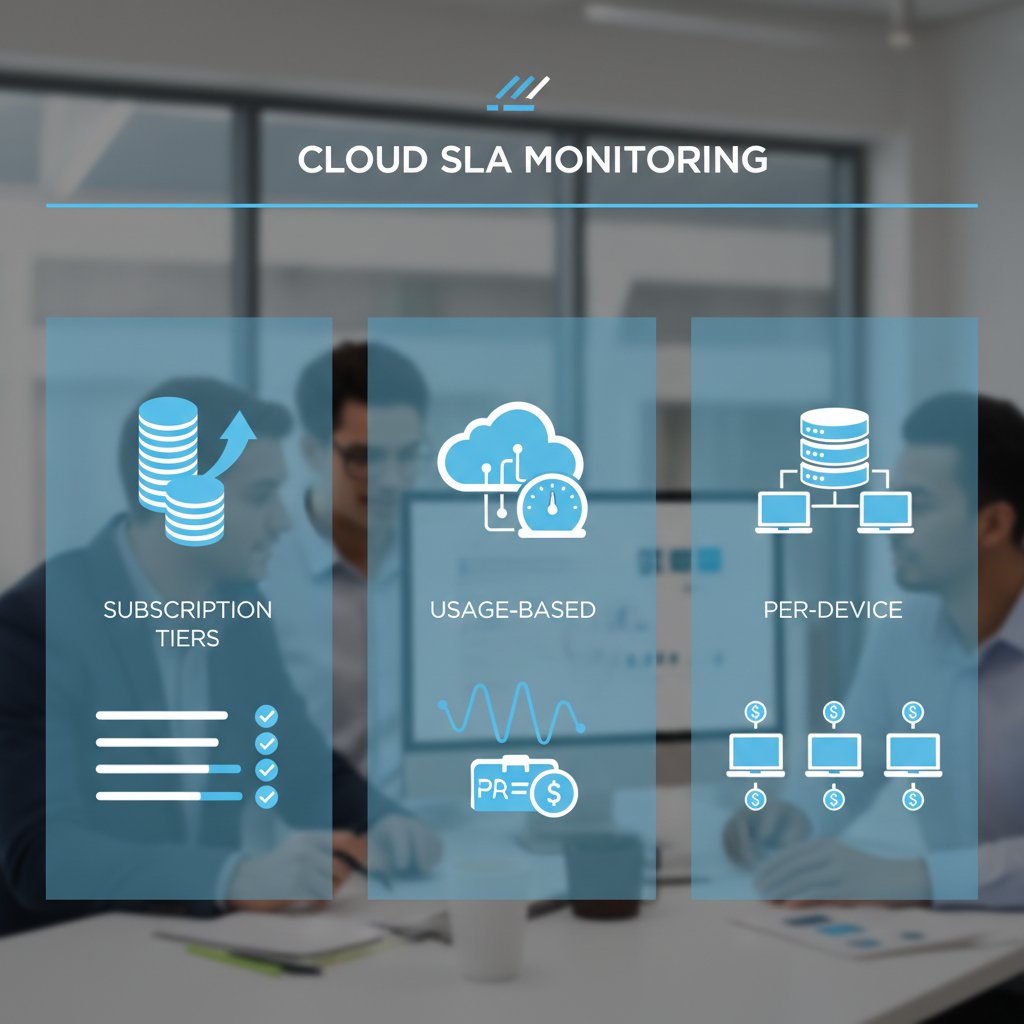
One common approach is subscription-based pricing, often seen with SLA monitoring subscription plans. Customers pay a recurring fee, typically monthly or annually, for access to the monitoring platform and its features. These plans often come in different tiers, such as basic, standard, and enterprise, each offering varying levels of features and support.
Usage-based pricing is another prevalent model. Here, the cost is tied directly to how much of the service you consume. This could be based on the number of monitors deployed, the volume of data collected, the frequency of checks, or the number of alerts generated. This model can be very flexible for businesses with fluctuating monitoring needs.
Per-device or per-instance pricing is straightforward, where you pay for each cloud instance, virtual machine, or specific service endpoint being monitored. This provides predictability, especially for organizations with a stable cloud infrastructure footprint. It’s a transparent way to calculate your total cloud service level agreement costs.
Some providers offer a tiered pricing structure, which includes predefined packages with a set number of monitors, data retention limits, and feature sets. As your monitoring needs grow, you can upgrade to a higher tier. This model simplifies decision-making, as specific benefits are bundled into each tier.
An infographic illustrating different pricing models for cloud SLA monitoring, such as subscription tiers, usage-based billing, and per-device costs, with icons representing each model.
Enterprise-level pricing often involves custom quotes, especially for large organizations with complex, extensive monitoring requirements. These bespoke packages consider unique integrations, dedicated support, and specialized features, providing a tailored Cloud sla monitoring pricing structure. It’s designed to meet specific and comprehensive needs.
ENSURE UNINTERRUPTED SERVICE
Ensure uninterrupted service delivery and proactively prevent costly SLA breaches. Leverage our automated, real
✓ Free consultation ✓ No commitment required ✓ Trusted by experts
Breaking Down the Cost of Cloud Performance Monitoring
The cost of cloud performance monitoring extends beyond just the subscription fee. It encompasses various direct and indirect expenses that businesses must consider for accurate budgeting. A thorough understanding of these components helps in making informed decisions about your Cloud sla monitoring pricing.
Direct costs typically include the base fee for the monitoring tool or service itself. This can be a monthly subscription, per-usage charge, or an annual license. This forms the foundational SLA monitoring cost that you will regularly incur.
Beyond the base fee, additional direct costs might arise from specific feature add-ons. These could include advanced reporting, synthetic transaction monitoring, API monitoring, or specialized integrations with other IT systems. Each add-on contributes incrementally to the overall cost of cloud performance monitoring.
Data transfer and storage costs are often overlooked but can accumulate, especially for high-volume monitoring. Cloud providers might charge for egress data or for storing large quantities of historical performance metrics. These charges directly impact your cloud service level agreement costs.
Indirect costs include the internal resources required to manage and interpret the monitoring data. This involves staff time spent configuring the tools, analyzing alerts, and generating reports. While not a direct vendor charge, it’s a real expense to the business.
Training costs for your IT team to effectively use the monitoring solution can also be a factor. While some tools are highly intuitive, others require specialized knowledge to leverage their full capabilities, impacting the total Cloud sla monitoring pricing. This ensures your team can maximize the tool’s value.
Furthermore, the cost of integrating the monitoring solution with existing incident management systems, dashboards, or other operational tools should be considered. These integration efforts can require developer time and resources, adding to the overall expenditure. These are all critical elements of the cost of cloud performance monitoring.
Choosing the Right Cloud SLA Monitoring Solution
Selecting the best Cloud sla monitoring pricing and solution requires careful consideration of your specific business needs, budget, and technical requirements. A strategic approach ensures you invest in a system that truly adds value. This section provides a Cloud sla monitoring pricing guide for decision-makers.
Begin by assessing your current cloud infrastructure and the services you rely on. Identify which KPIs are most critical for your business operations and which SLAs need to be rigorously enforced. This clarity will help define the scope of your monitoring needs, directly influencing your SLA monitoring cost.
Evaluate different providers based on their feature sets, scalability, and integration capabilities. Does the solution support your specific cloud providers (AWS, Azure, GCP, etc.) and the services you use within them? Look for tools that offer comprehensive coverage and ease of integration.
Consider the user interface and ease of use. A solution with intuitive dashboards and clear reporting can significantly reduce the time your team spends on monitoring tasks. This contributes to a lower total cost of ownership by improving operational efficiency.
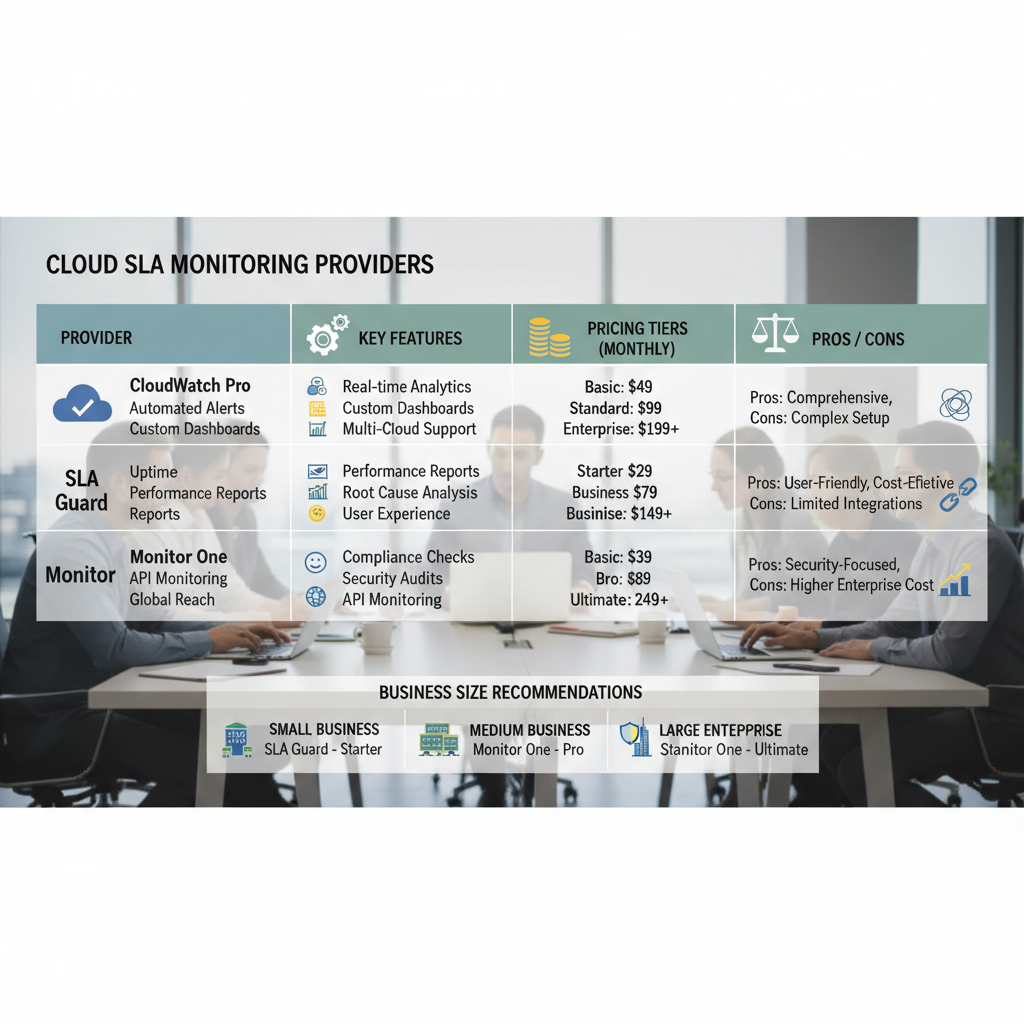
Review the available SLA tool pricing tiers and models carefully. Compare subscription plans, usage-based options, and enterprise packages against your anticipated monitoring volume and budget. Seek transparency in pricing to avoid unexpected cloud service level agreement costs.
A comparative table or chart illustrating different cloud SLA monitoring providers, their key features, and typical pricing tiers, highlighting pros and cons for various business sizes.
Look for solutions that offer robust alerting and notification capabilities. Timely and actionable alerts are crucial for quick incident response and minimizing downtime. Customizable alert thresholds and delivery channels are important considerations.
Finally, read reviews and seek recommendations from peers or industry experts. Understanding real-world experiences can provide valuable insights into a solution’s reliability, support quality, and overall value proposition. This due diligence is key to finding the best Cloud sla monitoring pricing for your organization.
Tips for Optimizing Your Cloud SLA Monitoring Costs
Optimizing your Cloud sla monitoring pricing is about smart resource allocation and making informed choices. With some strategic planning, businesses can reduce their SLA monitoring cost without compromising on service quality or visibility. These Cloud sla monitoring pricing tips can help you achieve greater efficiency.
Regularly review your monitoring configurations to eliminate unnecessary checks or redundant data collection. Over-monitoring can lead to increased usage-based costs without adding proportional value. Trim down to only the most critical metrics and endpoints.
Leverage tiered pricing models effectively. Start with a lower tier that meets your immediate needs and scale up only when absolutely necessary. Many providers offer flexible SLA monitoring subscription plans that allow for easy upgrades or downgrades. This approach ensures you’re not overpaying for unused capacity.
Negotiate with providers, especially for larger deployments or custom requirements. Some vendors are open to tailoring pricing for significant commitments or unique circumstances. Exploring custom Cloud sla monitoring pricing examples can provide leverage.
Automate wherever possible. Use APIs and integration features to automate alert routing, report generation, and configuration updates. This reduces manual effort, saving on the indirect cost of cloud performance monitoring (staff time).
Centralize your monitoring efforts if you use multiple cloud providers or environments. A unified platform can reduce complexity and potentially lower overall cloud service level agreement costs compared to managing disparate tools. Look for solutions with broad multi-cloud support.
Take advantage of free trials and proof-of-concept deployments. This allows you to thoroughly evaluate a solution’s fit for your specific environment before committing to a paid plan. It’s a smart way to gauge the true cost of cloud performance monitoring versus the value it delivers.
Ensure your team is well-trained on the chosen monitoring tool. Efficient use of features means you get maximum value from your investment, avoiding wasted resources or the need for costly external support. Effective training is one of the best Cloud sla monitoring pricing tips.
Implementing Cloud SLA Monitoring: A Step-by-Step Guide
Implementing Cloud SLA monitoring effectively requires a structured approach to ensure comprehensive coverage and accurate reporting. This step-by-step process helps organizations establish robust monitoring practices and understand the implications for Cloud sla monitoring pricing.
Step 1: Define Your SLAs and Critical KPIs
Begin by clearly identifying your service level agreements with cloud providers and internal stakeholders. Determine the key performance indicators (KPIs) that directly impact business operations, such as uptime, response time, error rates, and resource utilization. This forms the basis of your monitoring strategy and helps define the scope, impacting your SLA monitoring cost.
Step 2: Inventory Your Cloud Resources
Create a comprehensive inventory of all your cloud services, applications, and infrastructure components that require monitoring. This includes virtual machines, databases, serverless functions, network components, and storage. Understanding the full landscape is crucial for accurate planning and Cloud sla monitoring pricing.
Step 3: Select a Monitoring Solution
Research and choose a Cloud SLA monitoring solution that aligns with your defined SLAs, KPIs, and budget. Compare different pricing models for cloud SLA, feature sets, and integration capabilities. Consider providers that offer transparent SLA tool pricing tiers and robust support.
Step 4: Configure Monitoring Agents and Probes
Deploy and configure monitoring agents or integrate API-based monitoring for your selected cloud resources. Set up synthetic transaction monitoring for critical user paths and real user monitoring where applicable. Ensure that data collection is accurate and consistent.
Step 5: Set Up Thresholds and Alerts
Establish appropriate performance thresholds for each monitored KPI. Configure alerting mechanisms to notify relevant teams immediately when these thresholds are breached. Implement escalation policies to ensure critical issues are addressed promptly. This proactive approach helps manage the cost of cloud performance monitoring by preventing downtime.
Step 6: Create Dashboards and Reports
Design intuitive dashboards that visualize key performance metrics and SLA compliance status. Generate regular reports that provide insights into historical performance, trends, and adherence to service level agreements. These reports are vital for demonstrating the value of your Cloud sla monitoring pricing investment.
Step 7: Regularly Review and Optimize
Continuously review your monitoring strategy, configurations, and the performance of your chosen solution. Adjust thresholds, add new monitors for evolving services, and remove redundant ones. This ongoing optimization ensures your monitoring remains effective and helps manage your overall cloud service level agreement costs. This iterative process is key to getting the best Cloud sla monitoring pricing.
Frequently Asked Questions About Cloud SLA Monitoring Pricing
This section addresses common inquiries about Cloud sla monitoring pricing, offering clear and concise answers to help clarify potential concerns. Understanding these FAQs can assist organizations in budgeting and selecting appropriate solutions.
What factors most influence Cloud sla monitoring pricing?
The primary factors influencing Cloud sla monitoring pricing include the scope of monitoring (number of services, applications), the frequency and granularity of data collection, the feature set of the monitoring solution, data retention policies, and the level of technical support required. More comprehensive and detailed monitoring generally leads to higher costs.
Are there different pricing models for Cloud SLA monitoring?
Yes, cloud SLA monitoring solutions typically offer several pricing models. These commonly include subscription-based plans with different tiers, usage-based pricing tied to specific metrics like data volume or number of monitors, and per-device or per-instance pricing. Some providers also offer custom enterprise pricing for large organizations.
Can I reduce my SLA monitoring cost?
You can absolutely reduce your SLA monitoring cost through several strategies. These include regularly reviewing and optimizing your monitoring configurations, leveraging tiered pricing effectively, negotiating with providers, automating tasks, and consolidating monitoring tools. Focus on monitoring what is truly critical to avoid unnecessary expenses.
What is the typical cost of cloud performance monitoring for a small business?
The typical cost of cloud performance monitoring for a small business can vary significantly. It might range from a few hundred dollars to several thousand dollars per month, depending on the number of cloud resources, the complexity of services, and the chosen feature set. Many providers offer affordable basic SLA monitoring subscription plans suitable for smaller operations.
How does data retention impact Cloud sla monitoring pricing?
Data retention significantly impacts Cloud sla monitoring pricing because storing large volumes of historical performance data for extended periods requires substantial storage resources. Providers often charge extra for longer data retention policies, especially for compliance or in-depth historical analysis. Shorter retention periods usually result in lower costs.
Why is understanding cloud service level agreement costs important?
Understanding cloud service level agreement costs is critical because it allows businesses to accurately budget for maintaining cloud service quality and compliance. It helps prevent unexpected expenses, ensures optimal resource allocation, and enables organizations to select a monitoring solution that provides the best value for their investment and operational needs.
ENSURE UNINTERRUPTED SERVICE
Ensure uninterrupted service delivery and proactively prevent costly SLA breaches. Leverage our automated, real
✓ Free consultation ✓ No commitment required ✓ Trusted by experts
Conclusion
Navigating the landscape of Cloud sla monitoring pricing requires a clear understanding of your organizational needs, available solutions, and various cost factors. From defining your critical KPIs to selecting the right pricing model, every decision influences your overall SLA monitoring cost and the efficacy of your cloud operations. By strategically approaching your monitoring requirements, you can ensure robust performance and compliance without overspending.
Effectively managing your cloud service level agreement costs involves continuous optimization and informed choices. Investing in the best Cloud sla monitoring pricing means more than just finding the cheapest option; it means securing a solution that delivers reliable performance, insightful analytics, and strong support tailored to your specific cloud environment. Empower your business with transparency and control over your cloud performance and spending.
Jacob Stålbro is a seasoned digitalization and transformation leader with over 20 years of experience, specializing in AI-driven innovation. As Head of Innovation and Co-Founder at Opsio, he drives the development of advanced AI, ML, and IoT solutions. Jacob is a sought-after speaker and webinar host known for translating emerging technologies into real business value and future-ready strategies.