Calculate Your AWS Migration Cost Accurately Today
March 11, 2026|8:45 AM
Unlock Your Digital Potential
Whether it’s IT operations, cloud migration, or AI-driven innovation – let’s explore how we can support your success.
Home /
Work /
Blogs /
Calculate Your AWS Migration Cost Accurately Today
Understanding aws migration cost: A Foundational Overview
Migrating to the cloud offers numerous benefits, from enhanced scalability and flexibility to improved operational efficiency. However, a successful transition hinges on a clear understanding and accurate estimation of your aws migration cost. This isn’t just about the immediate transfer fees; it encompasses a wide array of expenses that demand careful planning and foresight.
Understanding aws migration cost is crucial for budgeting, securing stakeholder buy-in, and ensuring the long-term financial viability of your cloud strategy. Failing to adequately assess these costs can lead to budget overruns, unexpected challenges, and a diminished return on investment. This guide aims to demystify the complexities involved in estimating these crucial migration expenses.
Key Factors Influencing Your aws migration cost
Estimating your aws migration cost requires a comprehensive look at various factors that contribute to the overall expenditure. These aren’t just limited to the actual data transfer but include an entire ecosystem of services, resources, and human effort. A thorough cost analysis involves breaking down your existing infrastructure and mapping it to suitable AWS services, considering all potential impacts on your cloud spending.
Let’s delve into the specific components that will shape your overall aws migration cost. Each element plays a significant role in the total investment required for a smooth and efficient transition to the AWS cloud. Ignoring any of these factors can lead to an inaccurate total cost of ownership (TCO) assessment.
Compute Costs
Compute services are often a significant portion of your aws migration cost, as they form the backbone of your application infrastructure. This category primarily includes Amazon EC2 (Elastic Compute Cloud) instances, which provide scalable computing capacity. The cost varies based on instance type, size, region, and purchasing option (On-Demand, Reserved Instances, Savings Plans, Spot Instances).
Evaluating your current server utilization is essential to right-size your new EC2 instances, preventing both under-provisioning and overspending. Workloads that are idle for certain periods might benefit from Auto Scaling groups, which dynamically adjust capacity to save on cloud spending. This ensures you only pay for what you truly need.
Storage Costs
Data storage is another substantial component of aws migration cost, especially for organizations with large datasets. AWS offers a wide range of storage services, each with different pricing models and performance characteristics. Amazon S3 (Simple Storage Service) for object storage, Amazon EBS (Elastic Block Store) for block storage, and Amazon EFS (Elastic File System) for file storage are primary examples.
The choice of storage tier directly impacts costs. For instance, frequently accessed data may reside in S3 Standard, while archival data can move to S3 Glacier Deep Archive at a much lower price point. Understanding your data access patterns and retention policies is critical for optimizing storage costs and reducing your overall aws migration cost.
Data Transfer Costs
Data transfer costs can quickly add up and become a surprising element of aws migration cost if not properly planned. While data transfer into AWS is generally free, data transferred out of AWS (egress) to the internet or across regions incurs charges. This includes traffic from EC2 instances to the public internet, data egress from S3 buckets, and cross-region replication.
Minimizing outbound data transfer is a key strategy for cost optimization. Utilizing Content Delivery Networks (CDNs) like Amazon CloudFront can cache content closer to users, reducing direct egress from your primary AWS region. Careful network architecture and service placement can significantly mitigate these migration expenses.
A detailed infographic illustrating various AWS services like EC2, S3, RDS, Lambda, and their interconnections, with arrows showing data flow and associated cost categories (compute, storage, data transfer, database, serverless).
Networking and Security Costs
Networking services like Amazon VPC (Virtual Private Cloud), Elastic Load Balancing (ELB), and AWS Direct Connect also contribute to your aws migration cost. While basic VPC components are often free, features like NAT Gateways, VPN connections, and dedicated network links have associated charges. Robust security measures are also essential but come with their own expenses.
AWS security services such as AWS WAF (Web Application Firewall), AWS Shield, and AWS KMS (Key Management Service) offer protection and compliance, but their usage adds to your cloud spending. A balanced approach between security posture and cost-effectiveness is vital during the migration and beyond. Ensuring proper configuration can also prevent unnecessary data transfer charges within your network.
Migration Tooling and Services
AWS provides a suite of migration tools and services designed to simplify the transition, such as AWS Migration Hub, AWS Database Migration Service (DMS), and AWS Server Migration Service (SMS). While these tools streamline the process, their usage typically incurs costs based on data volume processed, resources provisioned, or duration of use. These are direct migration expenses.
Choosing the right migration strategy – rehosting, replatforming, refactoring, etc. – will dictate which tools are most appropriate and thus impact your aws migration cost. For example, using DMS to migrate a large database will have a different cost profile than a manual rehost of an EC2 instance. Factor these into your budgeting from the outset.
Human Resources and Professional Services
Beyond the technical aspects, the human element represents a substantial portion of your aws migration cost. This includes the time and effort of your internal teams involved in planning, executing, and validating the migration. Additionally, many organizations opt for external professional services from AWS partners or consultants.
These experts provide specialized knowledge, accelerate the migration process, and help ensure best practices are followed. Their fees, whether hourly or project-based, are significant migration expenses that must be included in your budget. Don’t underestimate the investment in skilled personnel, as it often determines the success and speed of your migration.
Licensing and Support
Software licenses can be a complex part of your aws migration cost. Some applications might require new licenses for cloud environments, while others can leverage “bring your own license” (BYOL) models. Understanding your current licensing agreements and how they translate to AWS is critical to avoid unexpected expenses.
AWS Support plans, ranging from Basic to Enterprise, offer varying levels of technical assistance and proactive guidance. While Basic support is free, higher-tier plans provide faster response times, dedicated technical account managers, and architectural reviews, which are invaluable during a complex migration. These ongoing costs contribute to your overall cloud spending.
Strategies for Optimizing aws migration cost
Effective cost optimization is not just a post-migration activity; it should be integrated into every stage of your planning for aws migration cost. By proactively implementing strategies, you can significantly reduce your cloud spending and maximize the value of your AWS investment. This involves intelligent resource provisioning, purchasing models, and continuous monitoring.
Right-Sizing Instances
One of the most effective ways to optimize aws migration cost is by right-sizing your compute instances. This involves analyzing the actual resource utilization of your on-premises servers (CPU, memory, disk I/O, network throughput) and provisioning EC2 instances that closely match those requirements, rather than simply replicating existing specifications. Many on-premises servers are often over-provisioned.
Using tools like AWS Compute Optimizer can help identify and recommend optimal EC2 instance types and sizes for your workloads, leading to substantial savings. Avoid the common pitfall of selecting larger instances than necessary, as this directly inflates your monthly cloud spending.
Leveraging Reserved Instances and Savings Plans
For stable, predictable workloads, Reserved Instances (RIs) and Savings Plans offer significant discounts compared to On-Demand pricing. RIs provide a discount in exchange for committing to a specific instance type in a particular region for a 1-year or 3-year term. Savings Plans offer more flexibility, applying discounts across various compute services (EC2, Fargate, Lambda) for a committed spend amount.
Integrating these purchasing options into your budgeting strategy can dramatically lower your ongoing aws migration cost. They are particularly beneficial for core infrastructure components that run continuously.
Utilizing Spot Instances
For fault-tolerant, flexible, and stateless workloads, AWS Spot Instances can provide substantial cost savings, often up to 90% off On-Demand prices. These instances leverage unused AWS compute capacity, but they can be interrupted with a two-minute warning.
Workloads suitable for Spot Instances include batch processing, containerized applications, big data analytics, and development/test environments. Incorporating Spot Instances where appropriate is a powerful cost optimization technique that can significantly reduce your cloud spending for specific tasks.
Optimizing Storage Tiers
As discussed, AWS offers various storage classes with different price points based on access frequency and performance requirements. Migrating data to the most appropriate storage tier is a crucial aspect of managing your aws migration cost. Implement lifecycle policies for S3 buckets to automatically move older, less-frequently accessed data to colder storage classes like S3 Glacier.
Reviewing your data retention policies and eliminating unnecessary data before migration can also reduce storage-related migration expenses. Regularly audit your storage usage post-migration to ensure optimal tiering and identify opportunities for further cost savings.
Minimizing Data Transfer Out
Data egress costs can be a hidden driver of aws migration cost. Strategically placing resources within AWS, leveraging private connections (like VPC Endpoints for S3 and DynamoDB), and utilizing CDNs for content delivery can help minimize data transferred out to the internet.
Designing your architecture to keep data within the AWS network as much as possible will reduce these charges. Additionally, ensure that your monitoring identifies any unexpected or excessive data egress that could indicate a misconfiguration or an area for further cost optimization.
Cost Monitoring and Management
Implementing robust cost monitoring and management tools is essential for maintaining control over your aws migration cost and ongoing cloud spending. AWS Cost Explorer, AWS Budgets, and AWS Billing and Cost Management provide visibility into your expenditure. These tools allow you to track spending, set alerts for budget overruns, and identify cost trends.
Regularly review your AWS bills and reports to understand where your money is going and identify areas for further optimization. Establishing a clear governance framework for resource provisioning and tagging can also greatly aid in attributing costs and managing your budget effectively.
✓ Free consultation ✓ No commitment required ✓ Trusted by experts
The Total Cost of Ownership (TCO) Perspective
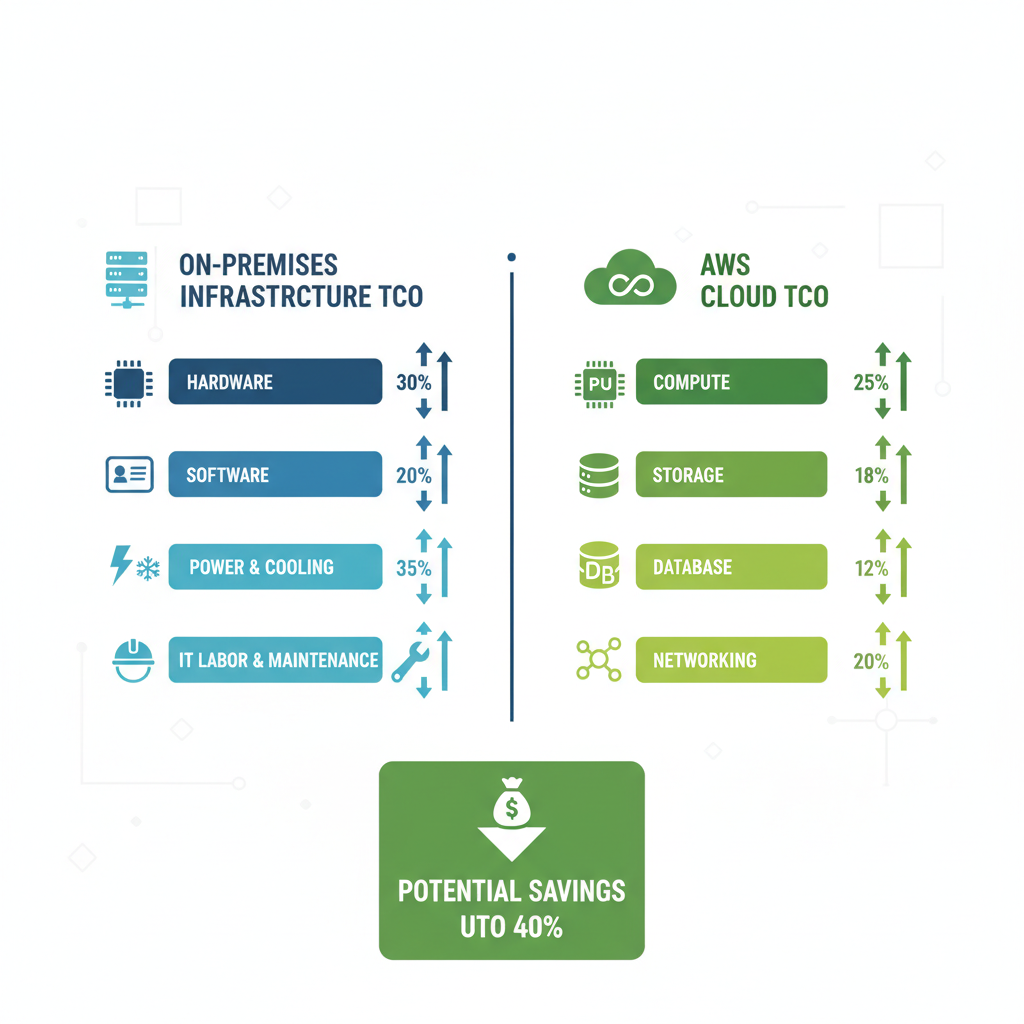
When considering aws migration cost, it’s vital to adopt a Total Cost of Ownership (TCO) perspective, rather than focusing solely on immediate migration expenses. TCO encompasses not just the upfront costs of moving to AWS but also the ongoing operational costs, potential savings, and the value derived from the migration over time. It offers a more holistic view of the financial implications.
A TCO analysis typically compares the costs of maintaining your current on-premises infrastructure with the projected costs of running your workloads on AWS. This includes hardware, software licenses, data center space, power, cooling, maintenance, and IT staff salaries for on-premises. For AWS, it covers compute, storage, networking, database, management services, and support, as well as the initial aws migration cost itself.
AWS provides a TCO Calculator to help organizations estimate potential savings by migrating to AWS. This tool considers various factors to provide a comparative analysis. Understanding TCO helps justify the initial investment in migration and highlights the long-term financial benefits of cloud adoption, going beyond simple cloud spending comparisons.
A comparative chart showing a breakdown of Total Cost of Ownership (TCO) for both on-premises infrastructure and AWS cloud, highlighting categories like hardware, software, power, and IT labor for on-premises versus compute, storage, database, and networking for AWS, with a clear indication of potential savings.
Step-by-Step Guide to Estimating aws migration cost
Estimating your aws migration cost involves a systematic approach to ensure accuracy and comprehensive coverage. Follow these steps to develop a robust budget that accounts for all significant migration expenses and future cloud spending.
Step 1: Assess Your Current Infrastructure
Begin by thoroughly documenting your existing on-premises environment. This includes an inventory of all physical and virtual servers, databases, storage arrays, network devices, and software licenses. Collect data on CPU utilization, memory usage, storage capacity, I/O performance, and network throughput for each component.
Understanding your current resource consumption is foundational for accurate right-sizing on AWS. This assessment will also help identify interdependencies between applications and data that need to be considered during the migration planning phase.
Step 2: Define Your Migration Strategy
Determine the migration strategy for each application and workload. Common strategies include rehosting (lift-and-shift), replatforming, refactoring, re-purchasing, retire, and retain. Each strategy has different implications for complexity, timelines, and ultimately, your aws migration cost.
For example, a “lift-and-shift” rehost might have lower initial migration expenses but potentially less cost optimization potential post-migration. Refactoring, while more complex upfront, can lead to significant long-term savings through the adoption of cloud-native services.
Step 3: Map Resources to AWS Services
Based on your infrastructure assessment and migration strategy, map your existing resources to equivalent AWS services. For instance, a physical server might map to an EC2 instance, a SAN might map to EBS or EFS, and an Oracle database might map to Amazon RDS or AWS DMS for migration to Aurora.
Consider the specific features and pricing of each AWS service. Don’t simply replicate your on-premises setup; look for opportunities to leverage cloud-native services that offer better performance, scalability, and cost efficiency. This mapping is critical for accurate AWS pricing estimation.
Step 4: Estimate AWS Service Costs
Once resources are mapped, use the AWS Pricing Calculator or AWS Cost Explorer to estimate the monthly cost of running these services on AWS. Input details such as instance types, storage volumes, data transfer estimates, and regional selection. Factor in different purchasing options like Reserved Instances or Savings Plans for predictable workloads.
Remember to consider charges for data transfer out of AWS, which can be significant. Break down the costs by service to get a granular view of your projected cloud spending.
Step 5: Account for Migration-Specific Expenses
Beyond the operational costs on AWS, include the direct migration expenses. This involves the cost of migration tools (e.g., AWS DMS, SMS), temporary resources needed during the migration (e.g., additional bandwidth, temporary storage), and professional services if you’re engaging external consultants.
Factor in any potential downtime costs or data transfer charges incurred during the actual migration phase. These are often one-time or short-term costs but are crucial components of your overall aws migration cost.
Step 6: Plan for Post-Migration Operations
The aws migration cost extends beyond the move itself to the ongoing operational expenses. Consider the cost of AWS Support plans, monitoring tools, security services, and any new licensing required for cloud-based software. Also, factor in the cost of training your team on AWS services and cloud management best practices.
Regular cost analysis and optimization efforts post-migration are essential to ensure long-term cost-effectiveness. This phase highlights the importance of budgeting for continuous improvement in your cloud spending.
Step 7: Refine and Monitor Your Budget
Treat your aws migration cost estimate as a living document. Regularly review and refine your budget as you progress through the migration. Utilize AWS Budgets to set spending thresholds and receive alerts. Continuously monitor your actual cloud spending against your projections using AWS Cost Explorer.
This iterative approach allows you to adjust your plans, identify unexpected costs, and implement further cost optimization strategies. Accurate budgeting and diligent monitoring are key to a financially successful migration journey.
Common Pitfalls to Avoid in aws migration cost Estimation
Estimating aws migration cost can be complex, and several common pitfalls can lead to budget overruns or an inaccurate view of TCO. Being aware of these challenges can help you navigate the migration process more smoothly and ensure your budgeting remains realistic.
One frequent mistake is underestimating data transfer costs, particularly data egress fees. While data into AWS is generally free, transferring data out can accumulate quickly, especially for large datasets or frequent user access from outside AWS. Another pitfall is failing to right-size instances properly, leading to over-provisioning and higher compute costs than necessary. Many organizations simply “lift-and-shift” existing on-premises server specifications without optimizing for the cloud environment.
Neglecting the human element, including internal staff time and external professional services, is another common oversight in calculating migration expenses. These “soft costs” are very real and contribute significantly to the overall aws migration cost. Finally, failing to plan for ongoing cost optimization and governance post-migration can lead to escalating cloud spending over time. Without continuous monitoring and adjustment, initial savings can quickly erode.
Frequently Asked Questions
What is included in aws migration cost?
aws migration cost encompasses a wide range of expenses, including compute (EC2), storage (S3, EBS), data transfer, database services, migration tooling, and networking. It also includes “soft costs” like human resources, professional services for planning and execution, and ongoing licensing and support fees. A comprehensive estimate considers both immediate migration expenses and future operational cloud spending.
How can I reduce my aws migration cost?
You can reduce your aws migration cost through several strategies. These include right-sizing instances based on actual usage, leveraging Reserved Instances or Savings Plans for predictable workloads, utilizing Spot Instances for flexible tasks, optimizing storage tiers by moving less-frequently accessed data to cheaper options, and minimizing data transfer out of AWS. Proactive cost optimization and diligent monitoring are also crucial.
Is it cheaper to migrate to AWS or stay on-premises?
For most organizations, migrating to AWS proves cheaper in the long run when considering the Total Cost of Ownership (TCO). While there are upfront aws migration costs, AWS eliminates expenses like hardware procurement, data center maintenance, power, cooling, and significant operational overhead. The scalability, elasticity, and extensive service offerings of AWS often lead to significant operational savings and improved business agility compared to traditional on-premises environments.
What are the hidden costs of AWS migration?
Hidden costs in aws migration cost can include unexpected data transfer egress fees, underestimation of the effort required for application refactoring or replatforming, security and compliance tool subscriptions, and the cost of training internal staff on new AWS environments. Inadequate monitoring and governance post-migration can also lead to unforeseen increases in cloud spending.
How long does it take to estimate aws migration cost?
The time it takes to estimate aws migration cost varies widely depending on the complexity and scale of your existing infrastructure, the number of applications, and the chosen migration strategies. A preliminary estimate might take a few days, while a detailed, comprehensive cost analysis and budgeting process for a large enterprise could span several weeks or even months.
What tools can help with aws migration cost estimation?
AWS offers several tools to aid in aws migration cost estimation. The AWS Pricing Calculator helps estimate service costs for new architectures, while AWS Cost Explorer provides detailed insights into current cloud spending. AWS Migration Hub helps track migration progress, and the AWS TCO Calculator provides a comparative analysis of on-premises versus AWS costs. Third-party cloud cost management platforms can also offer advanced analytics and optimization recommendations.
✓ Free consultation ✓ No commitment required ✓ Trusted by experts
Conclusion
Successfully navigating your AWS migration journey requires a thorough understanding and accurate estimation of your aws migration cost. It’s more than just calculating immediate migration expenses; it involves a holistic look at cloud spending, from compute and storage to networking, security, and the invaluable human effort involved. By adopting a TCO perspective and meticulously planning each step, organizations can avoid common pitfalls and optimize their investment.
Embrace cost optimization strategies from the outset, continuously monitor your AWS pricing, and adapt your budget as you progress. This diligent approach ensures not only a successful migration but also sustainable, cost-effective operations in the cloud. A well-planned migration budget is the cornerstone of achieving the full economic benefits that AWS offers.
Jacob Stålbro is a seasoned digitalization and transformation leader with over 20 years of experience, specializing in AI-driven innovation. As Head of Innovation and Co-Founder at Opsio, he drives the development of advanced AI, ML, and IoT solutions. Jacob is a sought-after speaker and webinar host known for translating emerging technologies into real business value and future-ready strategies.