AWS Migration Process Overview: Streamline Your Cloud Journey
March 11, 2026|8:23 AM
Unlock Your Digital Potential
Whether it’s IT operations, cloud migration, or AI-driven innovation – let’s explore how we can support your success.
Home /
Work /
Blogs /
AWS Migration Process Overview: Streamline Your Cloud Journey
Embracing the Cloud: An Introduction to AWS Migration
Migrating your infrastructure to the cloud offers unprecedented flexibility, scalability, and cost efficiency. For many organizations, Amazon Web Services (AWS) stands out as a leading platform for this transformation. Understanding the aws migration process overview is fundamental for any successful cloud journey, ensuring a smooth transition with minimal disruption.
This comprehensive guide will walk you through the essential phases and considerations for moving your applications and data to AWS. We will explore the various stages of migration, providing a clear roadmap from initial assessment to ongoing optimization. By following a structured migration workflow, you can unlock the full potential of cloud computing.
Understanding the AWS Migration Process Overview
The aws migration process overview encompasses a structured approach designed to guide organizations through their cloud adoption journey. It is not merely a technical undertaking but a strategic business initiative that requires careful planning and execution. This high-level process outlines the necessary steps to transition existing on-premises or co-located infrastructure to the AWS cloud environment.
Successful migration involves a clear understanding of your current IT landscape and a vision for your future cloud architecture. By adhering to a proven methodology, businesses can mitigate risks, control costs, and accelerate their time to value in the cloud. This systematic approach ensures every aspect of the migration is addressed comprehensively.
Phase 1: Assess and Plan Your Migration
The initial phase of any cloud transition is critical for setting the foundation for success. This stage involves a deep dive into your existing environment and strategic planning for the move. It is where you lay out the entire project phases and define clear objectives for your AWS journey.
Initial Discovery and Assessment
Begin by thoroughly assessing your current IT infrastructure, applications, and data. This discovery process helps identify dependencies, performance requirements, and security considerations. Understanding your current state is paramount before embarking on any cloud move.
Gathering data on CPU utilization, memory usage, storage consumption, and network traffic for each application is crucial. This detailed inventory forms the basis for sizing your AWS resources accurately. It also helps in prioritizing applications for migration, starting with those that offer the quickest wins or fewest complexities.
Defining Your Migration Strategy
Once the assessment is complete, you can define the most appropriate migration steps and strategy for each application. AWS often refers to the “6 R’s” of migration: Rehost, Replatform, Refactor, Repurchase, Retire, and Retain. Each strategy dictates a different level of effort and potential benefit.
Choosing the right strategy depends on factors like application complexity, business criticality, and desired future state. Some applications might be suitable for a simple rehost (lift-and-shift), while others may require refactoring to leverage cloud-native services fully. This decision heavily influences the subsequent lifecycle of the application in the cloud.
Building a Business Case and TCO Analysis
Developing a strong business case for migration involves evaluating the Total Cost of Ownership (TCO) of your current infrastructure versus the projected costs in AWS. This financial analysis helps justify the investment and demonstrate potential long-term savings. Factors include hardware, software licenses, operational staff, and data center costs.
A comprehensive TCO analysis should also account for the intangible benefits of cloud adoption, such as increased agility, improved disaster recovery capabilities, and faster innovation. Presenting a clear financial picture helps secure executive buy-in and resource allocation for your cloud initiatives. This step is vital for the overall success of the aws migration process overview guide.
✓ Free consultation ✓ No commitment required ✓ Trusted by experts
Phase 2: Mobilize and Prepare for Migration
With a solid plan in place, the mobilize phase focuses on building the foundational environment in AWS and preparing your teams. This stage is about readiness, ensuring everything is in place for a smooth transition. It includes setting up the necessary infrastructure and tools for the migration workflow.
Establishing the AWS Landing Zone
An AWS Landing Zone provides a secure, multi-account AWS environment with predefined best practices for security, networking, identity, and governance. It acts as the operational base for your cloud presence, ensuring compliance and scalability from day one. This foundational setup is critical for enterprise-level migrations.
The Landing Zone establishes a well-architected framework, allowing new accounts to be provisioned quickly and consistently. It includes centralized logging, billing, and security controls, making it easier to manage your AWS resources as you scale. Building this robust foundation prevents future technical debt and security vulnerabilities.
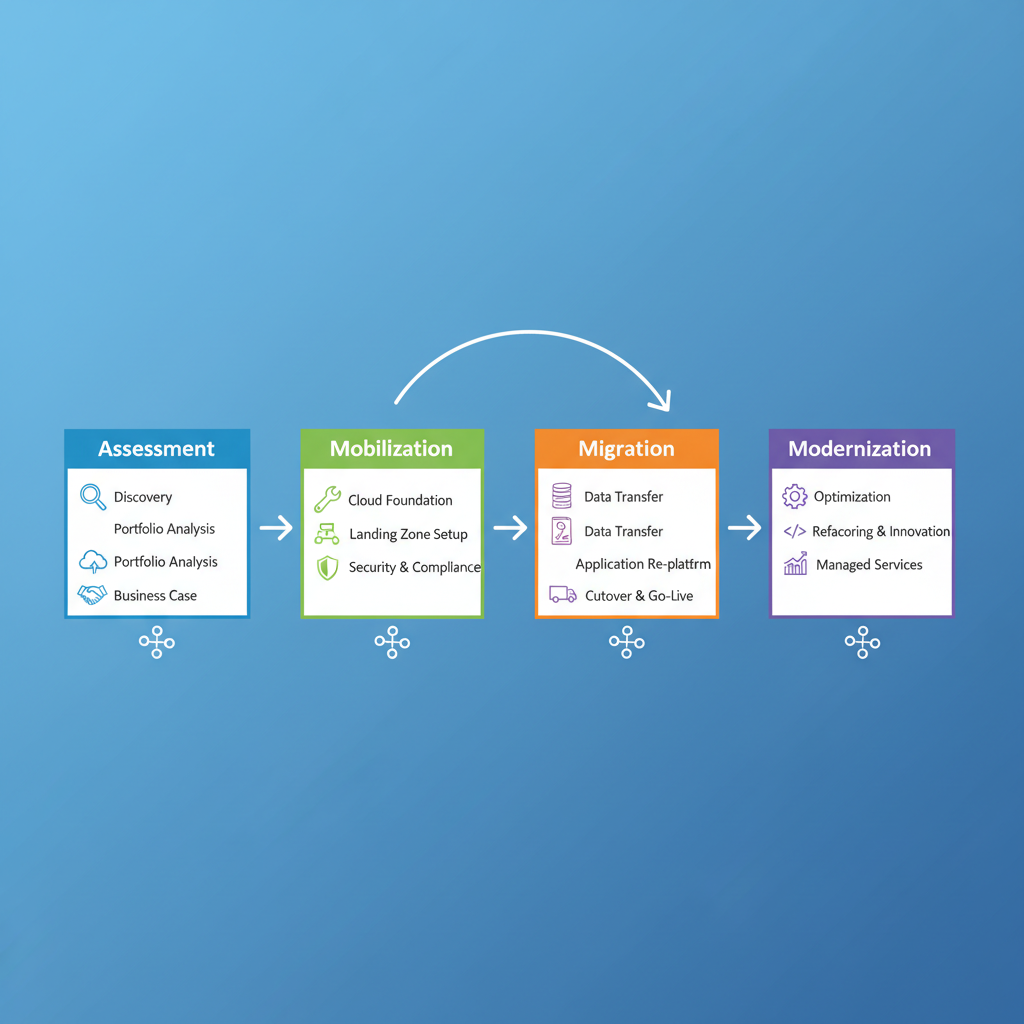
A diagram showing the AWS Migration Process Flow with arrows connecting Assessment, Mobilization, Migration, and Modernization phases. Each phase has sub-bullets indicating key activities like “Discovery,” “Landing Zone Setup,” “Data Transfer,” and “Optimization.”
Setting Up Migration Tools and Processes
AWS offers a suite of services and tools specifically designed to facilitate migration, such as AWS Migration Hub, AWS Application Migration Service (MGN), AWS Database Migration Service (DMS), and AWS DataSync. Selecting and configuring these tools is a crucial step in preparing for the actual move. These tools automate many aspects of the migration, reducing manual effort and potential errors.
Beyond the tools, establishing clear processes for managing the migration is equally important. This includes defining roles and responsibilities, communication protocols, and change management procedures. A well-defined migration workflow ensures everyone involved understands their part in the larger effort.
Training and Skill Development
Cloud migration requires new skills and a shift in operational mindsets for your IT teams. Investing in training and upskilling your staff on AWS services, best practices, and cloud-native operations is paramount. This ensures your team can effectively manage the new cloud environment post-migration.
Training should cover areas like AWS architecture, security, cost management, and specific services relevant to your chosen migration strategies. Empowering your team with the right knowledge fosters confidence and ownership, contributing significantly to the long-term success of your cloud adoption. This proactive approach helps implement the best aws migration process overview.
Professional visual illustration related to aws migration process overview
Phase 3: Migrate Your Applications
This is the execution phase where applications and data are actively moved to the AWS cloud. It’s often the most visible and resource-intensive part of the aws migration process overview. Careful coordination and meticulous execution are key to minimizing downtime and ensuring data integrity.
Executing the Migration Waves
Migrations are typically executed in waves, grouping applications with similar characteristics or dependencies. This phased approach allows for testing and validation after each wave, minimizing overall risk. Starting with less critical applications can provide valuable learning experiences before tackling more complex systems.
Each wave involves detailed planning, including cutover strategies, rollback plans, and communication with stakeholders. Close monitoring during and after each migration event is essential to quickly identify and resolve any issues. This structured approach helps manage the complexity of large-scale moves.
Data Migration Strategies
Data migration is often one of the most challenging aspects of the entire process. Depending on the volume, velocity, and variety of your data, you might use different AWS services. For example, AWS DataSync can automate and accelerate data transfer to and from AWS storage services. For large datasets, AWS Snowball or Snowmobile can physically transport data.
Database migration requires specialized tools like AWS Database Migration Service (DMS), which supports homogeneous and heterogeneous database migrations with minimal downtime. Selecting the right data migration strategy is vital for data integrity and business continuity during the transition.
Application Migration Techniques (6 R’s)
As discussed, the “6 R’s” guide the approach for each application.
Rehost (Lift-and-Shift): Moving applications as-is without significant changes. This is often the fastest migration path.
Replatform (Lift-Tinker-Shift): Making minor cloud optimizations to realize some benefits without rewriting core architecture. An example is moving from a self-managed database to Amazon RDS.
Refactor/Rearchitect: Modifying an application’s architecture to fully leverage cloud-native features and services, often involving significant code changes. This offers the most long-term benefits but requires the most effort.
Repurchase (Drop-and-Shop): Moving to a different product, typically a SaaS solution.
Retire: Decommissioning applications that are no longer needed.
Retain: Keeping some applications on-premises, usually due to specific compliance, latency, or cost reasons.
Choosing the correct technique for each application is a critical part of the project phases and directly impacts the effort and benefits derived from the migration.
Phase 4: Modernize and Optimize in AWS
The migration doesn’t end once applications are running in AWS. The final phase, and indeed an ongoing process, involves optimizing and modernizing your cloud environment. This ensures you continuously derive maximum value from your AWS investment. This is an integral part of the aws migration process overview tips for long-term success.
Post-Migration Validation and Testing
After each application is migrated, thorough validation and testing are essential. This includes functional testing, performance testing, security testing, and user acceptance testing (UAT) to ensure everything works as expected in the new environment. Any discrepancies must be addressed promptly.
Monitoring application performance and resource utilization post-migration provides crucial insights. This data helps confirm that the migrated applications meet their operational requirements and that the AWS resources are appropriately provisioned. Continuous validation builds trust in the new cloud infrastructure.
Cost Optimization and Performance Tuning
One of the significant benefits of the cloud is the ability to optimize costs and performance continuously. This involves right-sizing instances, leveraging Reserved Instances or Savings Plans, and utilizing serverless technologies where appropriate. Regularly reviewing your AWS spend ensures you are not over-provisioning resources.
Performance tuning involves identifying bottlenecks and making adjustments to improve application responsiveness and efficiency. This could mean optimizing database queries, reconfiguring network settings, or scaling resources dynamically. These efforts contribute to the efficiency and cost-effectiveness of your lifecycle in the cloud.
Continuous Modernization and Innovation
Cloud adoption is an ongoing journey of continuous improvement and innovation. Post-migration, organizations should look for opportunities to further modernize applications, leverage more cloud-native services, and integrate advanced features like machine learning or analytics. This allows businesses to remain agile and competitive.
The AWS cloud provides a vast array of services that can enhance existing applications and enable new capabilities. Embracing this mindset of continuous modernization ensures that your investment in the cloud continues to deliver increasing value over time. It’s a key takeaway from any effective aws migration process overview guide.
Best Practices for a Smooth AWS Migration
A successful cloud migration requires more than just following steps; it demands careful planning, strong leadership, and a commitment to best practices. Incorporating these aws migration process overview tips can significantly improve your chances of a smooth transition.
Key Considerations for Success
Executive Sponsorship: Strong leadership support is vital for driving the migration initiative and allocating necessary resources.
Dedicated Migration Team: Assemble a cross-functional team with technical, business, and project management expertise.
Clear Communication Plan: Establish transparent communication channels with all stakeholders to manage expectations and provide updates.
Security First Approach: Integrate security considerations into every phase of the migration, leveraging AWS’s robust security features.
Automation: Automate as many migration and operational tasks as possible to reduce manual effort and human error.
Start Small, Learn Fast: Begin with less critical applications to gain experience and refine your processes before tackling complex workloads.
Common Challenges and How to Overcome Them
Migrations often present unforeseen challenges, but proactive planning can mitigate many of them.
Skill Gaps: Invest in training and certification for your team. Consider engaging AWS Professional Services or experienced partners.
Data Latency and Bandwidth: Plan data transfer strategies carefully, potentially using AWS Direct Connect or Snow Family services for large volumes.
Application Dependencies: Conduct thorough dependency mapping during assessment to avoid surprises during cutover. Use tools to visualize application relationships.
Security and Compliance: Work with security experts to ensure all compliance requirements are met in the AWS environment from the outset.
Cost Management: Implement cost monitoring tools and establish governance policies to track and control cloud spending effectively.
Frequently Asked Questions about AWS Migration
This section addresses some common questions regarding the aws migration process overview.
What is the primary benefit of an aws migration process overview?
The primary benefit of following a defined aws migration process overview is achieving a structured, predictable, and lower-risk transition to the cloud. It helps organizations plan effectively, optimize resources, and minimize business disruption, ultimately leading to improved agility, cost savings, and enhanced scalability.
How long does an AWS migration typically take?
The duration of an AWS migration varies significantly based on the complexity, size of the environment, and the chosen migration strategies. Small-scale migrations can take a few weeks, while large enterprise migrations with hundreds of applications may span several months to a year or more. Effective planning in the initial project phases can help reduce timelines.
What are the “6 R’s” in AWS migration?
The “6 R’s” are common strategies for migrating applications to the cloud: Rehost, Replatform, Refactor, Repurchase, Retire, and Retain. Each “R” represents a different approach to moving or managing applications, ranging from a simple lift-and-shift to a complete architectural rewrite.
Is data security a concern during the migration process?
Yes, data security is a paramount concern throughout the entire migration workflow. AWS provides robust security features, but it’s crucial for organizations to implement best practices such as encryption in transit and at rest, identity and access management (IAM), and network security configurations. A “security first” mindset is essential.
Can I migrate only a part of my infrastructure to AWS?
Absolutely. Many organizations adopt a hybrid cloud strategy, migrating certain applications or workloads to AWS while keeping others on-premises. The aws migration process overview allows for flexible approaches, enabling businesses to move specific components based on their strategic priorities and technical requirements.
✓ Free consultation ✓ No commitment required ✓ Trusted by experts
Conclusion
Embarking on a cloud migration journey to AWS is a transformative step for any organization. By following a well-defined aws migration process overview, businesses can navigate the complexities with confidence and achieve their cloud objectives. From the initial assessment and planning to active migration and continuous optimization, each phase is crucial for success.
Leveraging the insights and aws migration process overview tips shared in this guide will empower your team to execute a strategic and efficient transition. The benefits of AWS—scalability, agility, and innovation—await, ready to drive your business forward into the future. Embracing this comprehensive approach ensures your cloud journey is not just a migration, but a true modernization effort.
Johan Carlsson is a cloud architecture specialist and frequent speaker focused on scalable workloads, AI/ML, and IoT innovation. At Opsio, he helps organizations harness cutting-edge technology, automation, and purpose-built services to drive efficiency and achieve sustainable growth. Johan is known for enabling enterprises to gain a competitive advantage by transforming complex technical challenges into powerful, future-ready cloud solutions.