Master aws migration guide with These Proven Techniques
March 11, 2026|7:48 AM
Unlock Your Digital Potential
Whether it’s IT operations, cloud migration, or AI-driven innovation – let’s explore how we can support your success.
Home /
Work /
Blogs /
Master aws migration guide with These Proven Techniques
Understanding the aws migration guide Journey
Embarking on a cloud migration journey can seem daunting, but with a well-structured approach, it transforms into a strategic advantage. This comprehensive aws migration guide offers a detailed look at moving your operations to Amazon Web Services (AWS), providing you with a step-by-step guide to navigate this complex process. We will explore everything from initial planning to post-migration optimization.
Migrating to AWS enables organizations to harness scalable infrastructure, robust security features, and a vast ecosystem of services. A successful migration requires careful planning, execution, and continuous optimization. This tutorial aims to equip you with the knowledge and best practices guide needed for a smooth transition.
Why Migrate to AWS?
Migrating to AWS offers numerous benefits that can significantly impact business operations and growth. It allows companies to reduce operational costs by moving from a capital expenditure model to an operational expenditure model. This shift frees up valuable resources that can be reinvested into innovation and core business functions.
Scalability is another key advantage, as AWS allows businesses to easily scale resources up or down based on demand. This flexibility ensures optimal performance during peak times and cost efficiency during lulls. Furthermore, AWS provides a highly secure and compliant environment, meeting various industry standards and regulations.
Common Migration Strategies
Choosing the right migration strategy is crucial for a successful aws migration guide. AWS identifies several common strategies, often referred to as the “7 Rs of Migration.” Understanding these can help tailor your migration roadmap to your specific needs. Each strategy presents a unique approach to transitioning workloads.
These strategies range from simple rehosting to more complex re-architecting. Selecting the appropriate one depends on factors like application criticality, technical complexity, budget, and desired business outcomes. Carefully assessing your applications will inform the best path forward.
Rehost (Lift and Shift): Moving applications without making any changes. This is often the fastest migration path.
Replatform (Lift, Tinker, and Shift): Making minor cloud-native optimizations to applications to take advantage of AWS features without altering the core architecture.
Refactor/Re-architect: Rebuilding applications using cloud-native features to improve agility, performance, and scalability. This is the most costly but yields the greatest long-term benefits.
Repurchase: Moving to a different product, typically a Software-as-a-Service (SaaS) offering.
Retain: Deciding not to migrate some applications that are not critical or are already nearing end-of-life.
Retire: Decommissioning applications that are no longer needed, saving resources and reducing complexity.
Relocate: Moving entire virtual environments to AWS without purchasing new hardware or rewriting applications.
Phase 1: Planning Your aws migration guide
Effective planning is the cornerstone of any successful aws migration guide. This initial phase sets the foundation for the entire project, ensuring that all objectives are clearly defined and potential challenges are addressed proactively. A comprehensive planning guide helps mitigate risks and streamlines the execution process.
Without thorough planning, even the best aws migration guide can encounter significant hurdles. This phase involves a deep dive into your existing infrastructure, applications, and business requirements. It’s about establishing a clear vision and practical steps to achieve it.
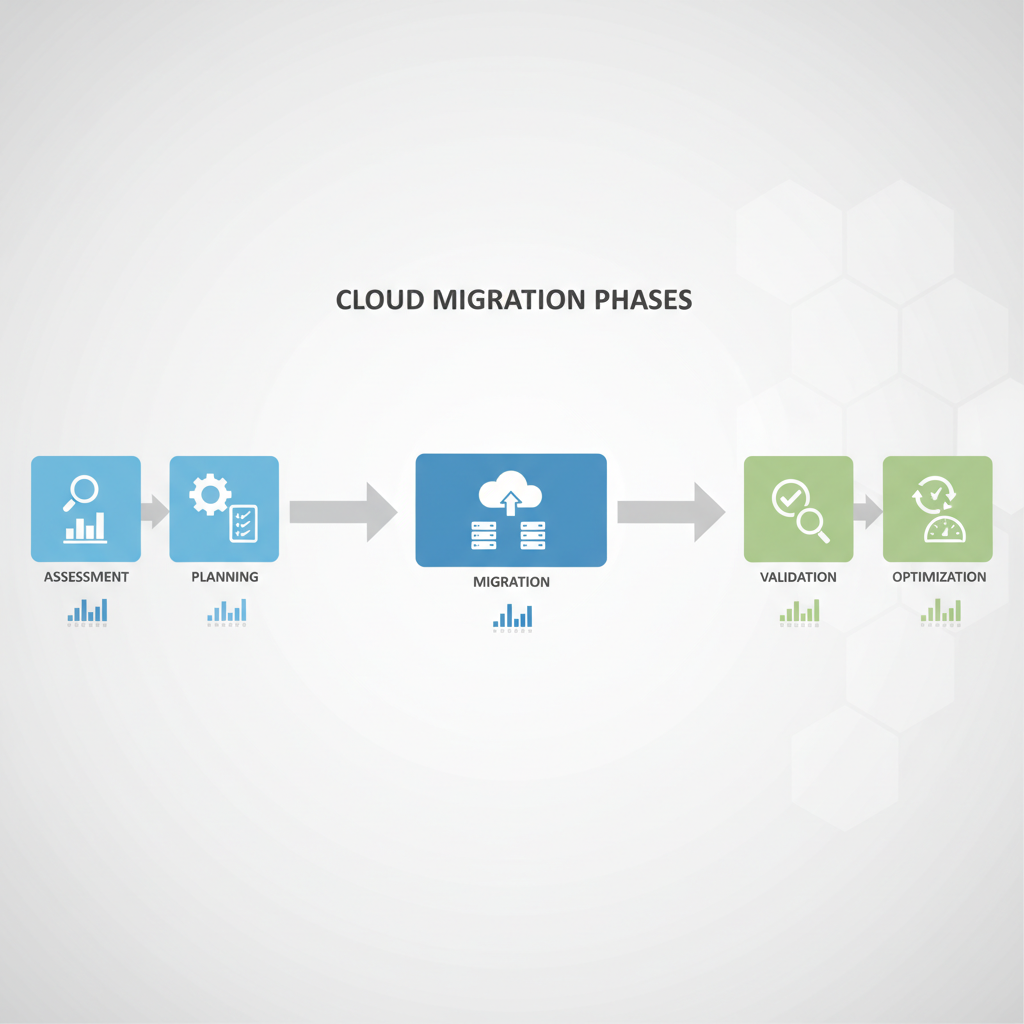
A flowchart illustrating the phases of cloud migration, starting with ‘Assessment’ and ‘Planning’, moving through ‘Migration’ and ‘Validation’, and ending with ‘Optimization’.
Defining Your Migration Goals
Before initiating any technical work, it is essential to clearly articulate what you aim to achieve with your AWS migration. These goals should align with your broader business strategy and be specific, measurable, achievable, relevant, and time-bound (SMART). Well-defined goals provide direction and criteria for success.
Common migration goals include reducing IT operational costs, improving application performance and scalability, enhancing security posture, increasing business agility, and enabling digital transformation initiatives. Documenting these objectives ensures everyone involved is on the same page.
Assessing Your Current Environment
A comprehensive assessment of your on-premises environment is critical for an effective aws migration guide. This involves inventorying all applications, databases, servers, and network infrastructure. Understanding dependencies, performance metrics, and resource utilization provides valuable insights.
Tools like AWS Migration Hub or third-party discovery tools can automate much of this data collection. The assessment should also identify any legacy systems, licensing constraints, or compliance requirements that might influence your migration strategy. This detailed review forms the basis for your migration planning guide.
Building Your Migration Roadmap
Developing a detailed migration roadmap is an indispensable part of your aws migration guide. This roadmap outlines the sequence of migration activities, specifying which applications will move when and using what strategy. It should also include timelines, resource allocation, and key milestones.
A well-structured migration roadmap helps manage expectations and ensures a phased approach to migration. Prioritize applications based on factors like business criticality, complexity, and interdependencies. Starting with less critical applications can provide valuable lessons learned before tackling more complex workloads.
Phase 2: Preparing for Your aws migration guide
Once your planning is complete, the preparation phase focuses on setting up the necessary infrastructure and processes within AWS. This involves configuring your target environment and preparing your data and applications for the move. Careful preparation minimizes disruption during the actual migration.
This phase is about building the landing zone and ensuring everything is ready for the influx of workloads. It’s an essential step in any aws migration guide. Thorough preparation ensures that the execution phase runs as smoothly as possible, reducing potential downtime and errors.
Setting Up Your AWS Environment
Establishing a robust and secure AWS environment is paramount before migrating any workloads. This typically involves setting up your AWS account structure, Virtual Private Clouds (VPCs), subnets, routing tables, and security groups. Implementing a strong Identity and Access Management (IAM) strategy is also crucial.
Consider using AWS Organizations for multi-account management and AWS Control Tower for setting up a well-architected multi-account AWS environment with governance guardrails. This foundational setup will support all subsequent migration activities and ensure operational efficiency.
Data Preparation and Cleansing
Data is the lifeblood of most applications, and its successful migration is critical. This step in the aws migration guide involves identifying what data needs to be moved, cleansing it of any redundancies or errors, and determining the most appropriate migration method. Data integrity is paramount throughout this process.
Consider using AWS Database Migration Service (DMS) for migrating databases with minimal downtime. For large datasets, AWS Snowball or AWS DataSync can facilitate offline or online transfers respectively. Thorough testing of data consistency post-migration is essential.
Security and Compliance Considerations
Security and compliance must be woven into every stage of your aws migration guide, not treated as an afterthought. Identify all relevant compliance standards (e.g., GDPR, HIPAA, PCI DSS) that apply to your data and applications. Design your AWS environment to meet these requirements from the outset.
Implement strong encryption for data at rest and in transit using AWS Key Management Service (KMS). Configure network access controls, regularly audit security configurations, and leverage AWS security services like GuardDuty and Security Hub. A robust security posture protects your assets and maintains trust.
✓ Free consultation ✓ No commitment required ✓ Trusted by experts
Phase 3: Executing the aws migration guide
With thorough planning and preparation complete, the execution phase involves the actual movement of your applications and data to AWS. This stage requires careful coordination and adherence to your migration roadmap. Following detailed instructions is key to minimizing disruption.
This is where the rubber meets the road, and your migration strategy comes to life. Monitoring progress and addressing issues swiftly are vital for a successful transition. Each application or database migration should be treated as a mini-project within the larger aws migration guide.
Data Migration Techniques
Various techniques exist for migrating data, depending on the volume, criticality, and sensitivity of the information. For databases, AWS DMS allows for continuous data replication, enabling near-zero downtime migrations. This is a common method in a best aws migration guide.
For file systems, AWS DataSync can automate and accelerate data transfer between on-premises storage and AWS storage services like Amazon S3 or Amazon FSx. For extremely large datasets or environments with limited network bandwidth, physical transfer devices like AWS Snowball Edge are invaluable.
Application Migration Approaches
The approach to migrating applications will depend on the strategy chosen in the planning phase (Rehost, Replatform, Refactor). For rehosting, tools like AWS Server Migration Service (SMS) or CloudEndure Migration automate the migration of virtual machines to AWS EC2. This simplifies the process for many users.
For replatforming or refactoring, you might leverage containerization with Amazon ECS or EKS, or serverless computing with AWS Lambda. Each approach requires specific architectural adjustments and testing. A thorough aws migration guide guide will detail these options.
Testing and Validation
Comprehensive testing and validation are non-negotiable steps in the execution phase. Before cutting over to the AWS environment, all migrated applications and data must undergo rigorous testing. This includes functional testing, performance testing, security testing, and user acceptance testing (UAT).
Ensure that all integrations with other systems, both migrated and remaining on-premises, function correctly. Validate data integrity and consistency. Document any issues found and systematically address them. This critical checklist ensures a seamless user experience post-migration.
Phase 4: Post-Migration Optimization and Management
Successfully migrating to AWS is not the final step; it’s the beginning of a continuous journey of optimization and management. This phase focuses on ensuring that your migrated environment is performing optimally, cost-efficiently, and securely. It is a crucial part of any comprehensive aws migration guide.
Ongoing management ensures that you continuously reap the benefits of the cloud. Without proper post-migration care, you risk underperforming assets and ballooning costs. This phase embraces the agile nature of cloud computing.
Performance Optimization
Once workloads are running in AWS, continuously monitor their performance. Identify bottlenecks and areas for improvement. This might involve right-sizing EC2 instances, optimizing database queries, or leveraging content delivery networks (CDNs) like Amazon CloudFront.
Tools such as Amazon CloudWatch and AWS X-Ray provide deep insights into application and infrastructure performance. Regularly review performance metrics and make adjustments to ensure your applications deliver the best possible user experience.
Cost Management
One of the significant advantages of AWS is its pay-as-you-go model, but this also requires proactive cost management. Regularly review your AWS bills using AWS Cost Explorer and identify areas for cost savings. This is a key aws migration guide tip for long-term success.
Implement tagging strategies to allocate costs to specific departments or projects. Consider using Reserved Instances (RIs) or Savings Plans for predictable workloads to significantly reduce costs. Leverage auto-scaling and serverless options where appropriate to pay only for what you consume.
Continuous Monitoring and Improvement
Cloud environments are dynamic, requiring continuous monitoring and improvement. Implement automated alerts for performance issues, security threats, or cost anomalies. Regularly review your architecture against AWS Well-Architected Framework principles.
This involves establishing a feedback loop where monitoring data informs optimization efforts. Stay updated with new AWS services and features that could further enhance your environment. This commitment to continuous improvement ensures your cloud investment delivers maximum value.
Best Practices for a Successful aws migration guide
Adhering to best practices is paramount for a seamless and efficient aws migration guide. These guidelines, drawn from extensive experience, help to streamline the process, minimize risks, and maximize the benefits of cloud adoption. Implementing them can turn a complex project into a manageable one.
A robust best practices guide will emphasize careful planning, phased execution, and rigorous testing. Ignoring these foundational principles often leads to unexpected challenges and cost overruns. Learning from others’ experiences is invaluable here.
Key Considerations and Tips
Start Small: Begin with non-critical applications or proof-of-concept projects to gain experience and refine your processes.
Automate Everything Possible: Leverage infrastructure as code (IaC) tools like AWS CloudFormation or Terraform to automate environment setup and deployments. This provides consistent, repeatable results.
Prioritize Security: Design security into your architecture from day one. Implement the principle of least privilege for IAM roles and users.
Conduct Thorough Testing: Never skip comprehensive testing. Validate functionality, performance, and security before going live.
Train Your Team: Ensure your team has the necessary AWS skills and knowledge. Invest in certifications and continuous learning.
Communicate Clearly: Keep stakeholders informed throughout the migration journey. Transparency helps manage expectations and build confidence.
Plan for Rollback: Have a clear plan to revert to your on-premises environment if unexpected issues arise during or after migration. This safety net provides peace of mind.
Optimize for the Cloud: Don’t just lift and shift; look for opportunities to leverage cloud-native services to improve application performance and cost efficiency.
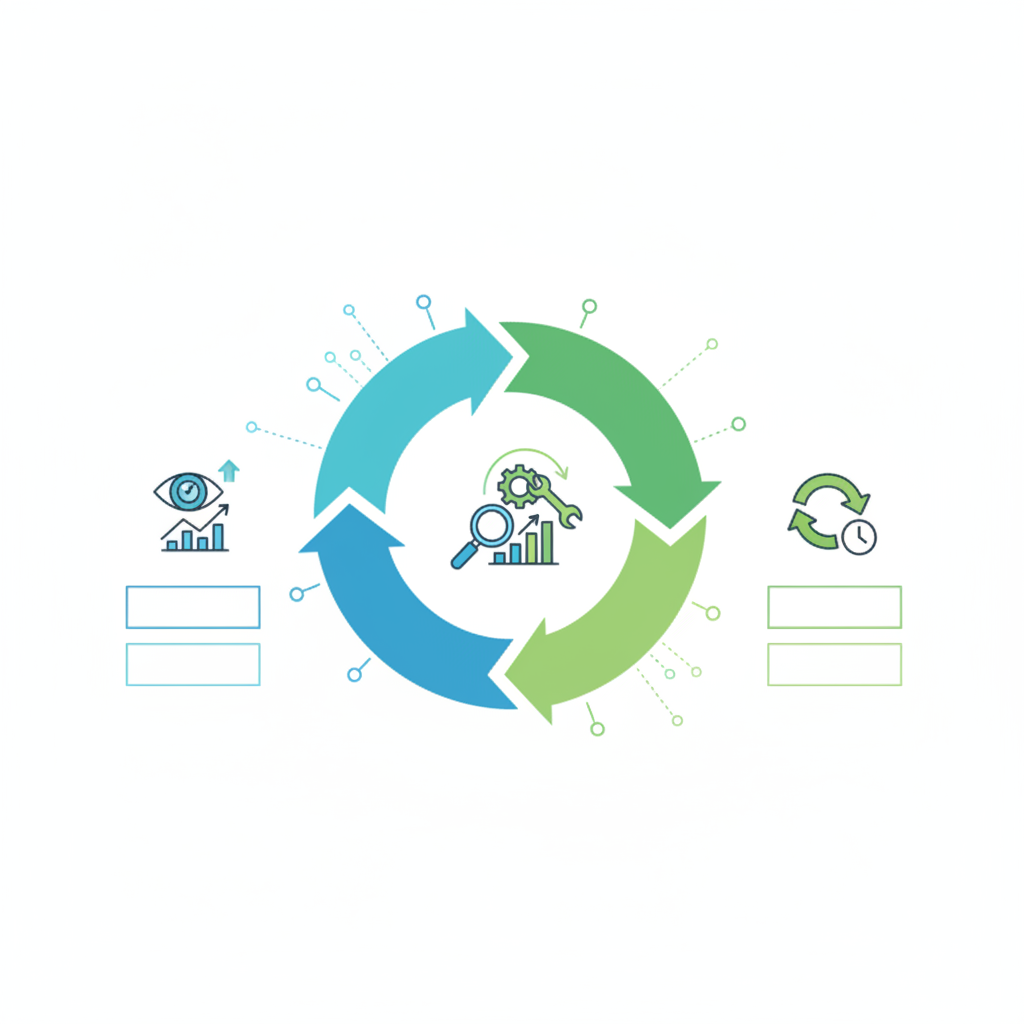
A diagram showing a continuous improvement loop with stages like ‘Monitor’, ‘Analyze’, ‘Optimize’, and ‘Repeat’.
Avoiding Common Pitfalls
Migrating to the cloud comes with its share of potential challenges. Being aware of common pitfalls can help you steer clear of them during your aws migration guide. Overlooking these can lead to delays, increased costs, or even project failure.
Inadequate Planning: Rushing into migration without a clear strategy, comprehensive assessment, or detailed migration roadmap often leads to unexpected issues.
Underestimating Complexity: Failing to recognize the intricate dependencies between applications and infrastructure can cause significant disruptions.
Ignoring Security Best Practices: Neglecting security during the design and execution phases leaves your cloud environment vulnerable.
Lack of Skills: A team without sufficient AWS expertise can struggle with complex configurations and troubleshooting.
Poor Cost Management: Without proper monitoring and optimization, cloud costs can quickly spiral out of control.
Insufficient Testing: Skipping rigorous testing before go-live can result in performance issues, data corruption, or downtime.
Not Optimizing Post-Migration: Treating migration as a one-time event instead of an ongoing optimization process means missing out on cloud benefits.
Frequently Asked Questions (FAQ)
What is an aws migration guide?
An aws migration guide is a comprehensive set of instructions and best practices designed to help organizations move their applications, databases, and IT infrastructure from on-premises data centers or other cloud environments to Amazon Web Services (AWS). It covers planning, preparation, execution, and post-migration optimization.
How long does an AWS migration typically take?
The duration of an AWS migration varies significantly based on the complexity, size, and number of applications being migrated. A small migration of a few applications might take weeks, while a large-scale enterprise migration involving hundreds of workloads could take several months to over a year.
What are the main benefits of migrating to AWS?
Key benefits include reduced operational costs, enhanced scalability and agility, improved security and compliance, increased reliability, and access to a vast ecosystem of innovative cloud services. AWS allows businesses to focus on their core competencies rather than managing physical infrastructure.
What are the common challenges in an AWS migration?
Common challenges include inadequate planning, underestimating application dependencies, security and compliance complexities, managing data migration at scale, skills gaps within the IT team, and ensuring minimal downtime during the transition. Effective planning and a phased approach can mitigate these issues.
What is the AWS Migration Acceleration Program (MAP)?
The AWS Migration Acceleration Program (MAP) is a comprehensive program designed to help organizations accelerate their cloud adoption and migration journey. It provides prescriptive guidance, training, and financial incentives to reduce migration costs and risks, making it easier to leverage AWS expertise.
✓ Free consultation ✓ No commitment required ✓ Trusted by experts
Conclusion
Migrating to AWS represents a significant strategic step for any organization aiming to enhance its agility, scalability, and efficiency. By following this detailed aws migration guide, you can confidently navigate the complexities of cloud migration, from initial planning to ongoing optimization. Embrace the journey with a clear vision, meticulous preparation, and a commitment to continuous improvement.
A successful AWS migration is not merely a technical undertaking; it’s a transformative business initiative. Leverage the insights and best practices outlined here to build a robust and future-ready cloud environment. The benefits of a well-executed migration will empower your business for years to come.
Jacob Stålbro is a seasoned digitalization and transformation leader with over 20 years of experience, specializing in AI-driven innovation. As Head of Innovation and Co-Founder at Opsio, he drives the development of advanced AI, ML, and IoT solutions. Jacob is a sought-after speaker and webinar host known for translating emerging technologies into real business value and future-ready strategies.