Top AWS Migration Strategies for Seamless Cloud Transition
March 11, 2026|7:38 AM
Unlock Your Digital Potential
Whether it’s IT operations, cloud migration, or AI-driven innovation – let’s explore how we can support your success.
Home /
Insights /
Top AWS Migration Strategies for Seamless Cloud Transition
Understanding AWS Migration: Why It Matters
Moving infrastructure and applications to the cloud has become a strategic imperative for many organizations worldwide. Amazon Web Services (AWS) offers a robust, scalable, and secure platform, making it a prime destination for such migrations. Adopting the best aws migration practices is crucial for unlocking the full potential of cloud computing and achieving desired business outcomes.
A well-executed migration can significantly enhance operational efficiency, reduce costs, and accelerate innovation. It allows businesses to pivot faster, scale resources on demand, and leverage cutting-edge services. Conversely, a poorly planned or executed migration can lead to significant disruptions, increased costs, and security vulnerabilities.
The Strategic Benefits of AWS Cloud Adoption
Migrating to AWS provides numerous advantages that extend beyond mere infrastructure modernization. Businesses often seek greater agility and improved performance. AWS delivers on these fronts, offering a vast array of services and global reach.
The cloud platform also provides enhanced security capabilities, often surpassing what many organizations can achieve on-premises. This includes compliance certifications, robust access controls, and continuous monitoring. Cost optimization is another key driver, with the pay-as-you-go model allowing for more efficient resource utilization.
Laying the Foundation: Pre-Migration Assessment and Planning
A robust pre-migration assessment and detailed planning phase are the cornerstones of any successful migration. This initial stage involves a thorough inventory of your existing environment, understanding dependencies, and defining clear objectives. It helps lay the groundwork for effective risk mitigation throughout the entire process.
Without a comprehensive understanding of your current state, you risk encountering unforeseen challenges and delays. Proper planning ensures that all stakeholders are aligned and that the migration path is clear. It also helps in identifying potential bottlenecks and planning for their resolution proactively.
Discovering Your Current Environment
The first step involves a deep dive into your existing on-premises or co-located infrastructure. This discovery phase is critical for understanding your application landscape and its various components. Documenting servers, databases, networking configurations, and interdependencies is essential.
You should catalog all applications, their criticality, performance requirements, and any specific licensing constraints. Tools like AWS Application Discovery Service can assist in automating this data collection. This comprehensive inventory provides the necessary insights for subsequent planning stages.
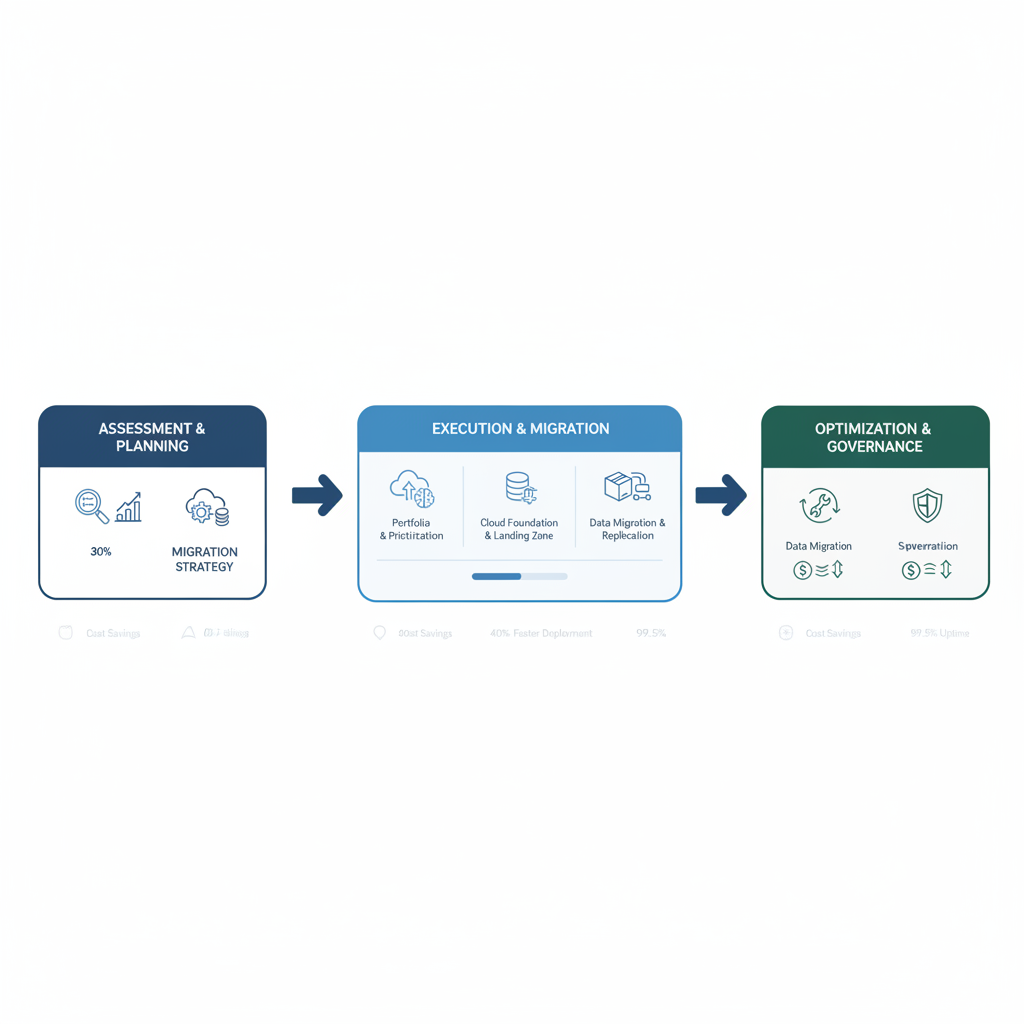
A flowchart illustrating the AWS migration journey, starting from assessment and planning, moving through strategy, execution, and concluding with optimization and governance.
Defining Objectives and Success Metrics
Clearly articulated business and technical objectives are vital for guiding the migration effort. What do you hope to achieve by moving to AWS? Common goals include cost reduction, improved agility, enhanced security, or greater scalability. Each objective should be specific, measurable, achievable, relevant, and time-bound (SMART).
Equally important is defining quantifiable success metrics. How will you measure the success of your migration? This could involve metrics like reduced operational costs, improved application uptime, faster development cycles, or enhanced security posture. These metrics will serve as benchmarks throughout and after the migration.
Developing a Comprehensive Business Case
A compelling business case justifies the investment in cloud migration by outlining the expected return on investment (ROI). It details the financial benefits, such as reduced infrastructure costs and operational expenses, alongside intangible benefits like increased agility and innovation. This also helps in securing executive buy-in.
The business case should also address potential risks and mitigation strategies. It acts as a roadmap, demonstrating how the migration aligns with broader organizational goals. Presenting a clear financial and strategic rationale helps ensure continued support and resources for the project.
Crafting Your Migration Strategy: The 6 Rs of AWS Migration
Choosing the right migration strategy is paramount for a seamless transition to AWS. AWS outlines six common strategies, often referred to as the “6 Rs.” Each R represents a different approach to migrating applications, offering varying levels of effort, cost, and cloud-native optimization. Understanding these options is a core component of the best aws migration practices guide.
Selecting the appropriate strategy for each application ensures that resources are allocated efficiently and that business value is maximized. A single migration project often involves a combination of these approaches. This requires careful consideration of application characteristics, business criticality, and future requirements.
The Six R’s Explained
Rehost (Lift-and-Shift): This involves moving applications as-is from on-premises to AWS. It’s often the fastest migration path, ideal for quickly realizing cloud benefits. Applications are deployed on EC2 instances without significant architectural changes.
Replatform (Lift-Tinker-and-Shift): Similar to rehosting, but with minor optimizations to take advantage of some cloud capabilities. This might involve migrating a database from a self-managed instance to AWS RDS. It offers a balance between speed and optimization.
**Refactor/Rearchitect: This strategy involves modifying or redeveloping applications to fully leverage cloud-native features and services. It provides the most significant long-term benefits in terms of scalability, resilience, and cost. This is often chosen for mission-critical applications.
Repurchase (Drop and Shop): Switching to a different product, typically a SaaS solution. For example, migrating from an on-premises CRM to Salesforce. This can reduce operational overhead significantly but requires careful data migration and user training.
Retain: Deciding not to migrate certain applications that are not critical, have specific regulatory requirements, or are difficult to move. These workloads remain on-premises or in their current environment. This is a valid strategy when migration doesn’t make business sense.
Retire: Decommissioning applications that are no longer needed or used. This helps reduce the migration scope and saves resources that would otherwise be spent on migrating obsolete systems. It’s a key part of tidying up your environment.
✓ Free consultation ✓ No commitment required ✓ Trusted by experts
Executing the Migration: Proven Methods and Tools
With a well-defined strategy in hand, the execution phase brings your migration plans to life. Leveraging proven methods and the right set of AWS tools is essential for a smooth and efficient transition. This stage focuses on the actual movement of data and applications, emphasizing accuracy and minimal disruption.
Effective execution relies on careful sequencing of tasks, robust testing, and continuous monitoring. A phased approach is often preferred, allowing for learning and adjustments along the way. This systematic methodology underpins the best aws migration practices.
Data Migration Techniques and Tools
Migrating data effectively is one of the most critical aspects of the entire process. AWS provides a suite of services designed to facilitate data movement, accommodating various scales and sensitivities. Choosing the right tool depends on data volume, network bandwidth, and acceptable downtime.
AWS DataSync: Ideal for large-scale, online data transfers between on-premises storage and AWS services like S3, EFS, and FSx. It handles encryption, compression, and data integrity checks automatically. DataSync can significantly accelerate data movement.
AWS Database Migration Service (DMS): Facilitates the migration of databases to AWS quickly and securely. It supports homogeneous migrations (e.g., Oracle to Oracle) and heterogeneous migrations (e.g., Oracle to Amazon Aurora). DMS minimizes downtime for database migration, crucial for business continuity.
AWS Snow Family: For extremely large datasets or environments with limited network connectivity, physical appliances like Snowball Edge and Snowmobile enable offline data transfer. These devices are securely shipped to your data center, loaded with data, and then returned to AWS.
Application Migration Tools
Once data migration is underway, attention turns to moving the applications themselves. AWS offers services to streamline the lift-and-shift or replatforming of various workloads. These tools help maintain application integrity and reduce manual effort.
AWS Migration Hub: Provides a central location to track the progress of application migrations across multiple AWS and partner solutions. It gives you a consolidated view of your entire migration portfolio, making it easier to manage complex projects.
AWS Application Migration Service (MGN): This service simplifies and accelerates rehosting applications to AWS. It continuously replicates source servers to AWS, minimizing downtime during cutover. MGN supports a wide range of operating systems and applications, providing a consistent migration experience.
CloudEndure Migration (now part of MGN): Offered similar continuous replication capabilities, ensuring minimal data loss and downtime during the cutover to AWS. It was particularly effective for quickly moving complex enterprise applications.
Professional visual illustration related to best aws migration practices
Ensuring Success: Post-Migration Optimization and Governance
The migration journey doesn’t end with the cutover; it transitions into a continuous phase of optimization and operational excellence. Establishing robust governance and adhering to cloud best practices after migration is vital for maximizing value and sustaining performance. This ensures that the newly migrated environment remains efficient, secure, and cost-effective.
Neglecting post-migration activities can undermine the benefits gained from the initial migration effort. Continuous monitoring, optimization, and refinement are key to long-term cloud success. These ongoing efforts define true best aws migration practices.
Performance Tuning and Cost Optimization
Once applications are running on AWS, it’s crucial to monitor their performance and identify areas for improvement. This might involve right-sizing EC2 instances, optimizing database queries, or leveraging content delivery networks (CDNs). Performance tuning ensures that applications meet user expectations and business demands.
Cost optimization is another ongoing activity. Regularly reviewing your AWS spend, identifying idle resources, and leveraging reserved instances or savings plans can lead to significant savings. Implementing tagging strategies helps attribute costs to specific teams or projects, fostering accountability and efficiency.
Monitoring, Logging, and Alerting
Comprehensive monitoring and logging are indispensable for maintaining the health and performance of your AWS environment. AWS CloudWatch provides monitoring for AWS resources and applications, collecting and tracking metrics, collecting log files, and setting alarms. This proactive approach helps identify and resolve issues before they impact users.
Integrating logging solutions like AWS CloudTrail for API activity and Amazon S3 for centralized log storage is also essential. These services provide audit trails and diagnostic information. Robust alerting mechanisms ensure that relevant teams are notified immediately of any critical events.
Security Hardening and Compliance
Post-migration, it’s critical to review and enhance your security posture in the cloud. This includes refining Identity and Access Management (IAM) policies, ensuring proper network segmentation, and regularly patching systems. Leveraging AWS services like Security Hub and GuardDuty provides continuous security monitoring and threat detection.
Maintaining compliance with industry regulations and internal policies is also an ongoing responsibility. Regularly auditing your AWS environment against compliance frameworks (e.g., HIPAA, GDPR, PCI DSS) is a key part of security best practices. Automation tools can help enforce compliance at scale.
Addressing Key Challenges: Risk Mitigation and Security
AWS migrations, while transformative, come with inherent challenges that demand careful attention. Proactive risk mitigation strategies are crucial to navigate potential pitfalls and ensure a smooth transition. Addressing security comprehensively throughout the migration lifecycle is non-negotiable, aligning with best aws migration practices tips.
Understanding and planning for risks prevents costly delays and disruptions. A robust security framework protects sensitive data and maintains compliance. These two pillars are foundational for a truly successful migration.
Identifying and Mitigating Migration Risks
Several risks can emerge during an AWS migration. These include data loss or corruption, unexpected downtime, performance degradation, and budget overruns. Identifying these risks early allows for the development of specific mitigation strategies.
Data integrity risks: Implement rigorous data validation and backup procedures before, during, and after migration. Use checksums and integrity checks.
Downtime risks: Plan for phased cutovers, test thoroughly in non-production environments, and utilize services like DMS for minimal-downtime database migrations.
Performance risks: Baseline current performance, conduct load testing in AWS, and scale resources appropriately.
Skill gaps: Invest in training for your team or engage experienced AWS partners.
Implementing Security Best Practices
Security must be embedded into every phase of the migration, not treated as an afterthought. AWS provides a shared responsibility model, where AWS is responsible for the security of the cloud, and you are responsible for security in the cloud. This requires active engagement from your team.
Identity and Access Management (IAM): Implement the principle of least privilege, granting only necessary permissions. Use multi-factor authentication (MFA) for all administrative accounts.
Network Security: Utilize AWS VPCs, security groups, and network ACLs to segment networks and control traffic flow. Deploy firewalls (e.g., AWS WAF) to protect web applications.
Data Encryption: Encrypt data at rest using AWS Key Management Service (KMS) or CloudHSM, and data in transit using TLS/SSL.
Vulnerability Management: Regularly scan your AWS environment for vulnerabilities using services like Amazon Inspector. Ensure timely patching of operating systems and applications.
Logging and Monitoring: Centralize logs and actively monitor security events using CloudTrail, CloudWatch, and GuardDuty. Establish clear incident response procedures.
Advanced Considerations for a Successful AWS Migration
Beyond the fundamental steps, several advanced considerations can significantly enhance the success and efficiency of your AWS migration. These proactive measures further solidify your adherence to the best aws migration practices. They ensure not only a smooth transition but also a highly optimized and resilient cloud environment in the long run.
Thinking strategically about automation, hybrid cloud, and disaster recovery can differentiate a good migration from a great one. These elements contribute to a truly best best aws migration practices approach, making your cloud journey more robust.
Leveraging Automation Throughout the Migration
Automation is a powerful enabler for efficient and repeatable migrations. It minimizes manual errors, accelerates processes, and frees up your team to focus on more complex tasks. From infrastructure provisioning to deployment, automation should be a key focus.
Tools like AWS CloudFormation allow you to define your infrastructure as code, ensuring consistency and enabling quick deployments. AWS Systems Manager can automate operational tasks across your EC2 instances. Integrating CI/CD pipelines can streamline application deployments post-migration, maintaining agility.
Hybrid Cloud Strategies
For many organizations, a full-scale migration to the cloud may not be immediately feasible or even desirable. A hybrid cloud strategy, where some workloads remain on-premises while others move to AWS, offers flexibility. AWS services like Outposts extend AWS infrastructure, services, APIs, and tools to virtually any on-premises facility.
Establishing seamless connectivity between your on-premises data centers and AWS using AWS Direct Connect or VPN is critical for a hybrid approach. This ensures consistent operations and data flow across environments. Careful planning is needed to manage data gravity and latency.
Disaster Recovery and Business Continuity
Integrating disaster recovery (DR) and business continuity (BC) planning into your AWS migration strategy is essential. The cloud offers unparalleled opportunities to build highly resilient systems at a lower cost than traditional DR sites. You can leverage AWS regions and Availability Zones for redundancy.
Consider strategies like pilot light, warm standby, or multi-site active-active architectures depending on your recovery time objective (RTO) and recovery point objective (RPO). AWS services like Elastic Disaster Recovery (DRS) and CloudEndure Disaster Recovery can automate replication and recovery, making it easier to meet stringent DR requirements.
Frequently Asked Questions
What are the main benefits of adopting best aws migration practices?
Adopting the best aws migration practices leads to numerous benefits, including reduced operational costs, improved scalability and performance, enhanced security posture, and greater business agility. It minimizes risks and downtime during the transition, ensuring a smoother and more successful outcome. These practices facilitate leveraging AWS’s full potential for innovation.
How long does an AWS migration typically take?
The duration of an AWS migration varies significantly based on the complexity, size of the environment, and chosen migration strategy. Small migrations might take a few weeks, while large-scale enterprise migrations involving hundreds of applications could span several months to over a year. Thorough planning, including a comprehensive discovery phase, is crucial for accurate timelines.
What is the role of a migration strategy in a successful AWS migration?
A robust migration strategy is the blueprint for a successful migration. It dictates how each application will be moved (e.g., rehost, replatform, refactor) and guides resource allocation. Without a clear strategy, projects can suffer from scope creep, unexpected challenges, and increased costs. It ensures alignment with business goals and efficient execution.
How can I mitigate risks during the AWS migration process?
Effective risk mitigation involves proactive identification of potential issues like data loss, downtime, and performance degradation. Strategies include thorough pre-migration assessments, incremental migration waves, comprehensive testing, robust backup and recovery plans, and continuous monitoring. Clear communication and stakeholder management also play a critical role.
What are the key security considerations for AWS migration?
Key security best practices for AWS migration include implementing the principle of least privilege with IAM, encrypting data at rest and in transit, segmenting networks with VPCs and security groups, and regularly patching systems. Continuous monitoring with services like AWS GuardDuty and Security Hub is also essential to detect and respond to threats effectively.
What are the 6 R’s of AWS migration?
The 6 R’s of AWS migration are Rehost, Replatform, Refactor/Rearchitect, Repurchase, Retain, and Retire. These represent different strategic approaches for moving or handling applications during a cloud migration. Each ‘R’ offers distinct advantages and trade-offs, making it crucial to choose the most suitable strategy for each workload.
✓ Free consultation ✓ No commitment required ✓ Trusted by experts
Conclusion
Embarking on an AWS migration journey is a significant undertaking that promises substantial rewards for businesses willing to embrace change. By diligently following the best aws migration practices, organizations can navigate the complexities with confidence, ensuring a smooth and successful migration to the cloud. From meticulous planning and strategic execution to continuous optimization and vigilant security, every phase contributes to realizing the full benefits of AWS.
Embracing these proven methods and continually applying cloud best practices will empower your organization to not only survive but thrive in the digital landscape. A well-executed migration is not just about moving workloads; it’s about building a foundation for future innovation, agility, and sustained growth.
Jacob Stålbro is a seasoned digitalization and transformation leader with over 20 years of experience, specializing in AI-driven innovation. As Head of Innovation and Co-Founder at Opsio, he drives the development of advanced AI, ML, and IoT solutions. Jacob is a sought-after speaker and webinar host known for translating emerging technologies into real business value and future-ready strategies.