Cloud Replatforming Explained: Enhance Your Applications
March 10, 2026|10:10 AM
Unlock Your Digital Potential
Whether it’s IT operations, cloud migration, or AI-driven innovation – let’s explore how we can support your success.
Home /
Work /
Blogs /
Cloud Replatforming Explained: Enhance Your Applications
Understanding Cloud Replatforming
Embarking on a cloud replatforming journey involves more than simply moving applications; it means optimizing them for cloud-native capabilities. This strategic approach transforms existing applications to leverage the elasticity, scalability, and managed services offered by cloud providers. Unlike a straightforward “lift-and-shift” migration, cloud replatforming seeks to enhance an application’s architecture without fully redesigning its core.
Many organizations choose replatforming cloud migration to modernize their legacy systems and improve operational efficiency. It strikes a balance between minimal effort rehosting and complete application refactoring. The goal is to gain cloud benefits with a manageable level of change.
At its core, cloud replatforming involves making significant modifications to an application’s codebase to run more effectively in the cloud environment. These changes often include updating operating systems, databases, or application servers to cloud-optimized versions. It’s a pragmatic step towards digital transformation.
This process allows enterprises to shed the burden of maintaining on-premises infrastructure while embracing the agility of the cloud. It prepares applications for further modernization efforts, such as containerization or microservices architectures, in the future. Understanding how to cloud replatforming is crucial for long-term success.
Benefits of Cloud Replatforming
Adopting a cloud replatforming strategy unlocks a multitude of advantages for businesses aiming to optimize their IT landscape. These benefits extend beyond simple cost savings, touching upon performance, agility, and security. Organizations experience tangible improvements across various operational fronts.
One primary benefit is significantly improved performance and scalability. Replatformed applications can effortlessly scale up or down based on demand, ensuring optimal resource utilization and responsiveness. This dynamic scaling capability is a cornerstone of modern cloud architecture.
Reduced operational costs represent another compelling advantage. By moving to managed cloud services, companies can minimize infrastructure maintenance overheads, hardware refresh cycles, and energy expenses. This shift allows IT teams to focus on innovation rather than infrastructure upkeep.
Cloud replatforming also leads to enhanced developer productivity. Developers can leverage cloud-native tools, services, and automation, accelerating development cycles and deployment frequencies. This fosters a more agile and efficient software development lifecycle.
Furthermore, applications benefit from increased agility and innovation. The cloud environment provides access to a vast ecosystem of services, from machine learning to analytics, which can be easily integrated to create new functionalities. This accelerates the pace of innovation within the organization. Finally, many cloud providers offer robust security features and compliance certifications, which can be leveraged to improve the security posture of replatformed applications. This often results in a more secure and compliant environment than traditional on-premises setups.
Key Cloud Replatforming Strategies
Choosing the right approach for technology replatforming is critical for a successful cloud migration. Replatforming sits strategically among the “6 R’s” of cloud migration, offering a distinct path that balances effort and reward. It involves adapting an application to take advantage of cloud features without a complete rewrite.
When considering replatforming, it’s essential to understand its place among other migration strategies. Unlike “rehosting” (lift-and-shift), which moves an application as-is, replatforming modifies it for cloud optimization. It also differs from “refactoring” (re-architecting), which involves a complete redesign of the application’s code.
Replatforming is often chosen when an application provides significant business value but is constrained by its legacy environment. It’s ideal for applications that can benefit from cloud-managed services, like managed databases or container orchestration, without requiring a fundamental change to their core business logic. This allows for quicker adoption of cloud capabilities.
A common example of replatforming involves migrating a traditional application server to a cloud-managed application platform service. Another scenario might be moving a self-managed database to a database-as-a-service offering. These changes reduce operational burdens while improving performance and reliability.
When to Choose Cloud Replatforming
Deciding when replatforming is the best cloud replatforming strategy depends on several factors. It’s suitable when you need more benefits than rehosting provides but want to avoid the time and cost associated with a full refactor. This middle-ground approach delivers significant modernization.
Consider replatforming if your application has strong architectural components but uses outdated underlying infrastructure. If the existing code base is stable and meets business requirements, but the operational costs are high, replatforming can provide a substantial uplift. It’s about optimizing the environment, not necessarily the application logic.
If your team possesses the skills to adapt the application to cloud services but lacks the resources for a complete architectural overhaul, replatforming is a viable option. It allows for a gradual evolution towards cloud-native patterns. This approach can also be a stepping stone for future refactoring efforts.
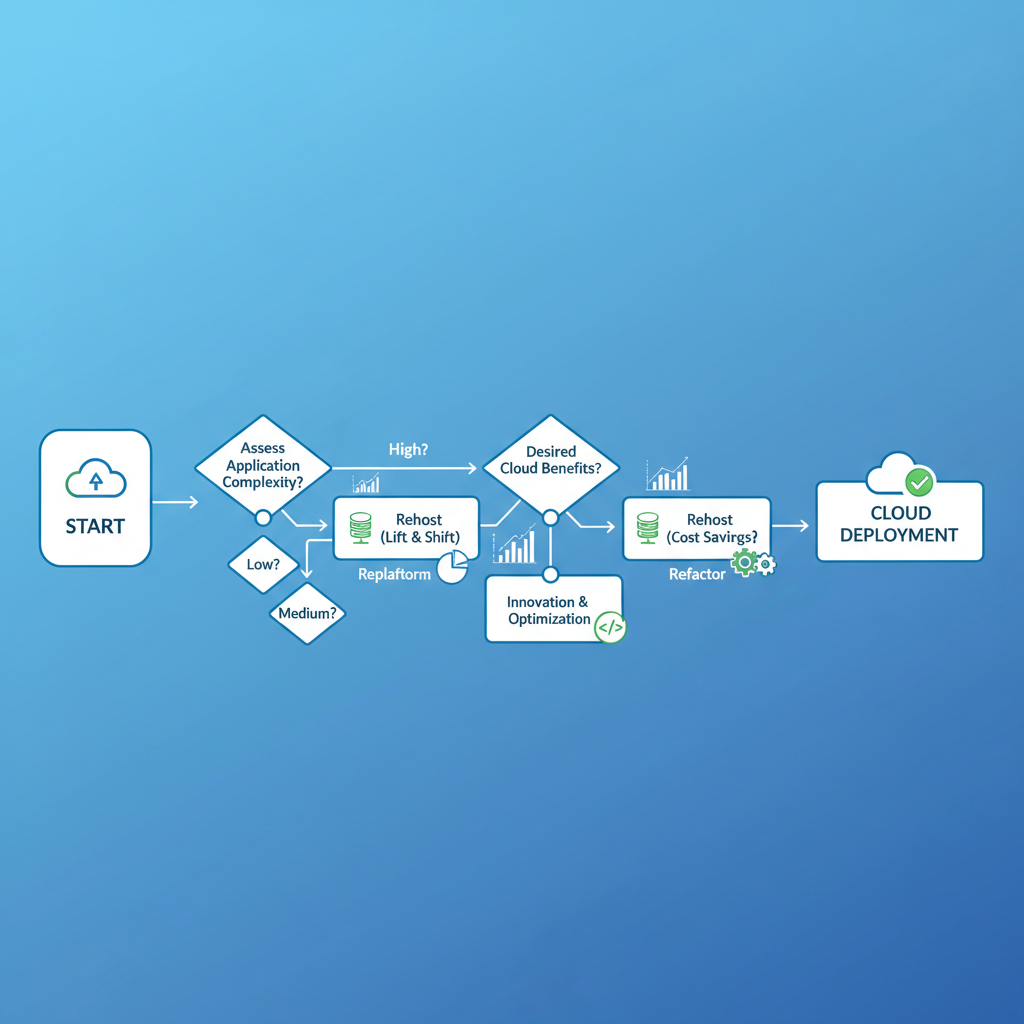
A flowchart illustrating the decision-making process for cloud migration strategies, showing paths for rehost, replatform, and refactor based on application complexity and desired cloud benefits.
✓ Free consultation ✓ No commitment required ✓ Trusted by experts
The Cloud Replatforming Process: A Step-by-Step Guide
Successfully executing a cloud replatforming initiative requires a structured and methodical approach. This process typically involves several distinct phases, each with its own set of activities and considerations. Following a clear roadmap helps mitigate risks and ensures a smooth transition to the cloud.
Step 1: Assessment and Planning
The initial phase involves a thorough evaluation of existing applications, infrastructure, and dependencies. Teams must identify which applications are good candidates for replatforming and understand their current performance characteristics. This comprehensive analysis forms the foundation of your cloud replatforming guide.
Discovery: Inventory all applications, their components, dependencies, and data stores. Document existing architecture and integrations.
Business Case: Define clear business objectives, expected benefits, and key performance indicators (KPIs) for the replatforming effort. Quantify potential cost savings and performance gains.
Risk Assessment: Identify potential challenges, security implications, and compliance requirements. Develop mitigation strategies for known risks.
Tooling Selection: Evaluate potential cloud replatforming services and tools that can automate parts of the migration or provide managed service capabilities.
Migration Plan: Develop a detailed migration roadmap, including timelines, resource allocation, and a phased rollout strategy. Define a rollback plan in case of issues.
Step 2: Tooling and Platform Selection
Once the planning is complete, the next step focuses on selecting the appropriate cloud services and migration tools. This choice directly impacts the efficiency and success of the replatforming effort. Matching the right tools to the application’s needs is paramount.
Cloud Provider Choice: Select a cloud provider (AWS, Azure, Google Cloud, etc.) based on existing relationships, service offerings, cost, and specific requirements.
Managed Services: Identify specific managed services (e.g., database-as-a-service, container orchestration platforms like Kubernetes, managed message queues) that can replace or enhance existing components.
Migration Tools: Choose automated migration tools for code analysis, dependency mapping, and data transfer. These tools can significantly streamline the process.
CI/CD Pipeline: Establish or adapt a robust Continuous Integration/Continuous Deployment (CI/CD) pipeline for building, testing, and deploying replatformed applications. This ensures consistent and reliable deployments.
Step 3: Application Modification and Testing
This is where the actual transformation of the application occurs. Code modifications are made to align with the chosen cloud services, followed by rigorous testing. This iterative process ensures compatibility and performance in the new environment.
Code Adaptation: Modify application code to integrate with new cloud services, APIs, and configuration patterns. This might involve updating libraries, drivers, or connection strings.
Dependency Management: Update and manage external dependencies to be compatible with the cloud environment. Ensure all components can communicate effectively.
Containerization (Optional but Recommended): Package applications into containers (e.g., Docker) for improved portability and simplified deployment, leveraging orchestration services.
Thorough Testing: Conduct comprehensive testing across multiple dimensions:
Unit Testing: Verify individual components function correctly.
Integration Testing: Ensure all application parts work together seamlessly.
Performance Testing: Validate that the application meets performance benchmarks under load.
Security Testing: Check for vulnerabilities and compliance with security policies.
User Acceptance Testing (UAT): Involve end-users to confirm functionality and usability.
Step 4: Deployment and Optimization
With modifications and testing complete, the application is ready for deployment to the cloud. This phase also includes ongoing optimization to ensure peak performance and cost-efficiency. This is a critical stage for seeing the benefits of cloud replatforming.
Phased Rollout: Implement a controlled rollout strategy, such as blue/green deployments or canary releases, to minimize disruption. Migrate a small percentage of traffic first before full cutover.
Monitoring Setup: Establish comprehensive monitoring and logging solutions to track application performance, resource utilization, and potential issues in real time.
Performance Tuning: Continuously monitor and fine-tune application configurations, resource allocations, and cloud service parameters for optimal performance.
Cost Optimization: Regularly review cloud spending and identify opportunities to reduce costs without compromising performance. Leverage reserved instances or spot instances where appropriate.
Step 5: Post-Migration Monitoring and Refinement
The replatforming journey doesn’t end after initial deployment. Ongoing monitoring and continuous refinement are crucial for long-term success and maximizing cloud benefits. This phase embraces the iterative nature of cloud operations.
Continuous Monitoring: Maintain vigilant monitoring of application health, resource usage, and security events. Set up alerts for any anomalies or performance degradation.
Feedback Loop: Gather feedback from users and operations teams to identify areas for further improvement or unexpected issues.
Refinement and Iteration: Continuously refine the application and its cloud environment based on monitoring data and feedback. Look for opportunities to introduce new cloud-native features or further optimize.
Documentation Update: Keep all documentation, including architectural diagrams, configurations, and operational procedures, up-to-date. This ensures knowledge transfer and consistency.
Common Risks and Challenges
While cloud replatforming offers significant advantages, it also presents several inherent risks and challenges that organizations must carefully navigate. Awareness and proactive planning are essential to mitigate these potential pitfalls. Failing to address these challenges can lead to delays, cost overruns, or even project failure.
One significant challenge is the inherent complexity of modifying existing applications. Legacy systems often have intricate dependencies and undocumented behaviors, making changes difficult and prone to errors. This complexity is amplified by potential skill gaps within internal teams regarding cloud-native technologies.
Data migration hurdles frequently arise during replatforming efforts. Moving large volumes of sensitive data between environments requires careful planning, robust security measures, and strict adherence to data integrity protocols. Ensuring minimal downtime during this process adds another layer of difficulty.
Vendor lock-in is another common concern. While leveraging cloud provider-managed services offers convenience, it can also create a dependence on a specific vendor’s ecosystem. This might make future migrations or multi-cloud strategies more challenging. Careful architecture design can help mitigate this.
Unforeseen cost management issues can derail a replatforming project. While cloud promises cost savings, initial migration expenses, unexpected consumption patterns, and the need for specialized skills can lead to budget overruns. Accurate cost estimation and continuous monitoring are vital.
Finally, maintaining stringent security and compliance during and after replatforming poses a continuous challenge. The cloud environment introduces new attack vectors and requires adapting existing security policies and controls. Organizations must ensure that replatformed applications meet all regulatory requirements in the cloud.
Best Practices for Successful Cloud Replatforming
Achieving a successful cloud replatforming outcome relies on adopting a set of proven best practices. These principles help guide organizations through the complexities, ensuring efficient execution and maximum realization of benefits. Following these tips can transform potential pitfalls into opportunities for innovation.
Start Small, Iterate Often: Instead of attempting a massive, “big bang” replatforming, begin with a pilot project or a non-critical application. This approach allows teams to gain experience, refine processes, and learn valuable lessons without high stakes. Incremental delivery reduces risk and builds confidence.
Strong Team and Vendor Collaboration: Foster close collaboration between internal development, operations, and security teams, as well as with cloud providers and replatforming services vendors. Clear communication and shared goals are paramount. Leverage external expertise where internal skills are lacking.
Robust Testing and Validation: Implement a comprehensive testing strategy that covers all aspects of the replatformed application, from functionality and performance to security and disaster recovery. Automated testing is crucial for ensuring consistency and speed. Validate all integrations and data flows thoroughly.
Comprehensive Monitoring and Governance: Establish robust monitoring, logging, and alerting systems to gain deep visibility into the replatformed application’s performance and health. Define clear governance policies for resource provisioning, cost management, and security compliance in the cloud environment. Continuous feedback loops are essential.
Focus on Automation and DevOps: Embrace DevOps principles and automate as many processes as possible, including infrastructure provisioning, code deployment, and testing. This reduces manual errors, speeds up delivery, and improves overall operational efficiency. Infrastructure as Code (IaC) is a fundamental component of this strategy.
Cloud Replatforming Examples and Use Cases
Understanding cloud replatforming strategies is enhanced by examining real-world examples. These use cases demonstrate how various organizations leverage replatforming to modernize their applications and achieve specific business objectives. Seeing cloud replatforming examples helps clarify its practical application.
One common scenario involves legacy applications running on outdated operating systems or application servers. A company might replatform by migrating its Java applications from on-premises WebSphere to managed Tomcat or JBoss on a cloud platform. This allows them to benefit from managed services, reducing patching and maintenance overhead.
Another example often seen in financial services or retail is replatforming a monolithic database to a cloud-native managed database service. Instead of managing Oracle or SQL Server instances on virtual machines, an organization might move to Amazon RDS, Azure SQL Database, or Google Cloud SQL. This provides automatic backups, scaling, and high availability.
E-commerce platforms frequently engage in replatforming their front-end web servers. They might move from self-managed Apache servers to containerized applications running on a Kubernetes service like EKS, AKS, or GKE. This allows for horizontal scaling during peak traffic and easier deployment of updates.
Even data analytics workloads are prime candidates for cloud replatforming. Instead of running on-premises Hadoop clusters, companies might replatform to cloud-native data warehousing solutions like Snowflake, Amazon Redshift, or Google BigQuery. These services offer immense scalability and powerful analytical capabilities without the operational burden. These cloud replatforming tips streamline infrastructure.
Frequently Asked Questions
What is cloud replatforming?
Cloud replatforming is a cloud migration strategy where an application is modified to leverage cloud-native features and services without a complete re-architecture. It involves adapting components like databases or application servers to managed cloud alternatives. This approach aims to gain cloud benefits with less effort than a full rewrite.
It allows applications to run more efficiently and cost-effectively in the cloud. Companies choose replatforming to improve scalability, reduce operational overhead, and enhance performance. It’s a strategic move to modernize legacy systems.
How does replatforming differ from rehosting and refactoring?
Rehosting, often called “lift-and-shift,” moves an application to the cloud with minimal or no changes, typically placing it on virtual machines. Refactoring, on the other hand, involves a significant redesign and rewrite of the application’s architecture to fully embrace cloud-native paradigms, such as microservices.
Replatforming sits between these two. It involves making moderate changes to optimize the application for cloud services, like switching to a managed database or containerizing components, without altering its core business logic. This balance offers greater cloud benefits than rehosting, with less investment than refactoring.
What are the main drivers for cloud replatforming?
The primary drivers for cloud replatforming include the desire to reduce operational costs associated with on-premises infrastructure. Organizations also seek improved scalability and performance to handle fluctuating demand, enhanced developer agility, and faster innovation through access to cloud-native services.
Furthermore, moving away from aging hardware, achieving better security, and fulfilling compliance requirements are significant motivations. Replatforming helps organizations stay competitive and responsive in a rapidly evolving technological landscape.
What kind of applications are best suited for cloud replatforming?
Applications that have solid architectural foundations but are constrained by their underlying legacy infrastructure are excellent candidates for cloud replatforming. This includes applications that can benefit from managed services, such as a switch to a cloud-native database or a container orchestration platform.
If an application is critical to the business but doesn’t warrant the time and expense of a complete re-architecture, replatforming is often the ideal choice. It’s suitable for applications where the business logic is sound, but the operational environment needs modernization.
What are the biggest challenges in a replatforming project?
The biggest challenges in a replatforming project often include managing the complexity of legacy application dependencies and addressing potential skill gaps within the team. Other significant hurdles involve ensuring data integrity and security during migration, avoiding vendor lock-in, and accurately estimating and managing costs.
Dealing with unexpected technical issues and ensuring minimal downtime during the transition also pose substantial challenges. Proactive planning, robust testing, and experienced teams are crucial for overcoming these obstacles.
✓ Free consultation ✓ No commitment required ✓ Trusted by experts
Conclusion
Cloud replatforming stands out as a powerful and pragmatic strategy for organizations seeking to modernize their applications and unlock the full potential of cloud computing. It offers a balanced approach, delivering significant benefits in performance, scalability, and cost reduction without the extensive overhaul required by a full refactor. By carefully planning and executing with the best cloud replatforming strategies, businesses can transform their legacy systems into agile, cloud-optimized assets.
Navigating the complexities and mitigating risks requires a clear understanding of the process, meticulous planning, and a commitment to best practices. Embracing automation, fostering collaboration, and maintaining a focus on continuous improvement are vital for success. As highlighted in this comprehensive cloud replatforming guide, the journey enables greater innovation, efficiency, and a stronger competitive edge in today’s digital landscape.
Jacob Stålbro is a seasoned digitalization and transformation leader with over 20 years of experience, specializing in AI-driven innovation. As Head of Innovation and Co-Founder at Opsio, he drives the development of advanced AI, ML, and IoT solutions. Jacob is a sought-after speaker and webinar host known for translating emerging technologies into real business value and future-ready strategies.