Best Cloud SLA Monitoring Tool: Optimize Uptime & Performance
March 6, 2026|2:39 PM
Unlock Your Digital Potential
Whether it’s IT operations, cloud migration, or AI-driven innovation – let’s explore how we can support your success.
Home /
Work /
Blogs /
Best Cloud SLA Monitoring Tool: Optimize Uptime & Performance
Understanding the Essence of Cloud SLA Monitoring
In today’s highly interconnected digital world, businesses increasingly depend on cloud services to power their critical applications and infrastructure. Ensuring these services consistently perform as expected is not just beneficial, but absolutely crucial for maintaining operational continuity and customer trust. This vital requirement highlights the indispensable role of a robust Cloud sla monitoring tool.
A Cloud sla monitoring tool offers crucial visibility into the performance of cloud-based resources, allowing organizations to track, measure, and verify service levels against predefined Service Level Agreements (SLAs). It acts as a dedicated sentinel, continuously observing the health, efficiency, and availability of your cloud infrastructure. Without such a comprehensive service level agreement tool, businesses risk encountering unaddressed outages, degraded user experiences, and potential breaches of contractual commitments.
Why Cloud SLA Monitoring is Non-Negotiable for Modern Businesses
The widespread adoption of cloud computing brings numerous advantages, yet it also introduces complexities concerning service reliability and accountability. Most organizations operate under strict SLAs established with their cloud providers, which detail commitments regarding uptime, performance metrics, and data accessibility. A proactive Cloud sla monitoring tool is essential for ensuring these crucial commitments are consistently met.
Failure to effectively monitor these critical SLAs can lead to severe consequences, including significant financial penalties, irreparable reputational damage, and a breakdown in trust with both customers and partners. An advanced cloud performance monitor provides real-time, actionable insights, empowering IT teams to quickly identify and resolve potential issues before they escalate into major service disruptions. It moves beyond mere reactive problem-solving, fostering a culture of continuous operational excellence and reliability.
Monitoring cloud service health is paramount for strategic decision-making. By meticulously tracking performance, businesses can accurately assess the value and reliability of their cloud investments. This data-driven approach enables better resource allocation, optimization strategies, and informed negotiations with cloud service providers.
Key Features of an Effective Cloud SLA Monitoring Tool
Choosing the best Cloud sla monitoring tool requires understanding the core functionalities that drive superior performance and compliance. An optimal solution should offer a comprehensive suite of features designed to provide complete visibility and control over your cloud services. These features collectively contribute to robust SLA compliance and operational efficiency.
Real-time Performance Metrics and Dashboards
A leading Cloud sla monitoring tool provides live visibility into critical performance indicators across your cloud environment. This includes metrics such as CPU utilization, memory consumption, network throughput, and disk I/O. Intuitive dashboards aggregate this data, presenting it in an easily digestible format for quick assessments.
These real-time views enable IT operations teams to instantly identify performance bottlenecks or anomalies as they occur. Having a clear, consolidated view of your cloud performance monitor’s data allows for rapid diagnosis and intervention. Without such immediate insights, minor issues can quickly snowball into significant service impacts.
Sophisticated Alerting and Notification Systems
Effective alerting is a cornerstone of any powerful SLA tracking software. A top-tier Cloud sla monitoring tool offers customizable alert thresholds based on specific metrics and conditions. It can send notifications through multiple channels, including email, SMS, instant messaging, and incident management platforms.
The system should support hierarchical escalation paths, ensuring that critical alerts reach the right personnel promptly if initial responders are unavailable. This proactive notification system is vital for minimizing downtime and ensuring rapid response to any deviations from your service level agreement tool’s defined performance standards. Timely alerts are crucial for preventing minor glitches from becoming major incidents.
Comprehensive Reporting and Analytics Capabilities
Beyond real-time monitoring, a valuable Cloud sla monitoring tool delivers detailed historical data and advanced analytics. It generates customizable reports that demonstrate SLA compliance over time, highlight trends, and identify recurring issues. These reports are invaluable for internal reviews, provider accountability, and strategic planning.
The performance analytics tool within the monitoring solution should allow for deep dives into specific incidents, root cause analysis, and long-term capacity planning. Understanding past performance patterns helps in predicting future needs and optimizing cloud resource utilization. This data empowers informed decision-making and continuous improvement initiatives.
Seamless Integration Capabilities
A modern Cloud sla monitoring tool must integrate smoothly with your existing IT ecosystem. This includes integration with other monitoring tools, incident management systems, configuration management databases (CMDBs), and CI/CD pipelines. Such integrations create a unified operational view and automate workflows.
API-driven connectivity is essential for exchanging data and triggering actions across different platforms. The ability to integrate with various cloud providers (AWS, Azure, Google Cloud, etc.) is also critical for multi-cloud or hybrid cloud environments. This ensures comprehensive oversight regardless of where your services reside.
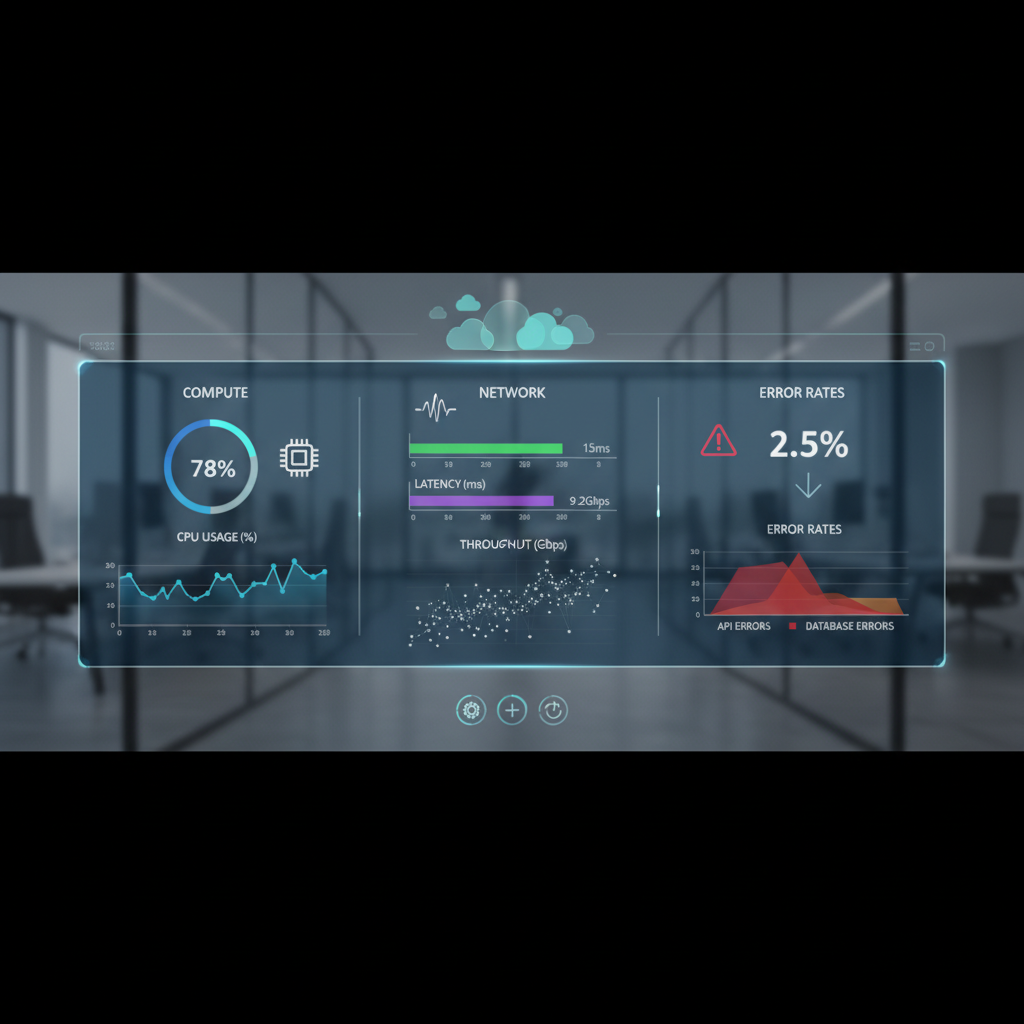
A dashboard displaying various cloud performance metrics like CPU usage, network latency, and error rates, with customizable widgets and real-time graphs.
Scalability and Flexibility
As your cloud footprint evolves, your Cloud sla monitoring tool must be able to scale alongside it. It should effortlessly accommodate increases in monitored resources, services, and data volume without degradation in performance. This ensures that your monitoring capabilities grow with your business needs.
The tool should also offer flexibility in configuration, allowing you to tailor monitoring parameters, reporting frequencies, and alert sensitivities to match specific application requirements and business priorities. Adaptability is key in dynamic cloud environments. A flexible solution supports diverse operational demands, from critical production systems to development environments.
ENSURE UNINTERRUPTED SERVICE
Ensure uninterrupted service delivery and proactively prevent costly SLA breaches. Leverage our automated, real
✓ Free consultation ✓ No commitment required ✓ Trusted by experts
Types of Metrics a Cloud SLA Monitoring Tool Tracks
To effectively manage cloud service performance and ensure SLA compliance, a Cloud sla monitoring tool must meticulously track a wide array of specific metrics. These metrics provide a detailed picture of your cloud service health and operational efficiency. Understanding what to measure is as important as having the tool itself.
Availability and Uptime
Availability is arguably the most fundamental metric for any cloud service, reflecting the percentage of time a service is operational and accessible to users. A Cloud sla monitoring tool continuously pings or tests services to confirm they are online and responsive. Uptime statistics are directly tied to financial penalties and reputational impact.
Downtime events are meticulously recorded, including their duration and frequency. This data forms the backbone of SLA compliance reporting. The tool differentiates between planned maintenance windows and unexpected outages, providing an accurate representation of true service availability against contractual agreements.
Latency and Response Time
Latency measures the delay before a transfer of data begins following an instruction for its transfer, while response time measures the total time it takes for a system to respond to a request. These metrics are crucial indicators of user experience and application performance. High latency directly impacts user satisfaction and productivity.
A Cloud sla monitoring tool actively measures end-to-end response times for various transactions and user journeys. This includes network latency, application processing time, and database query times. Consistent tracking of these metrics helps identify performance bottlenecks and ensures services remain snappy and responsive.
Error Rates
Error rates quantify the frequency of failed requests or operations within a cloud service. This could include HTTP 5xx errors for web services, failed API calls, or database transaction errors. High error rates are a clear sign of underlying issues that need immediate attention.
An effective Cloud sla monitoring tool flags instances where error thresholds are exceeded, triggering alerts for investigation. Monitoring error rates provides crucial insights into the reliability and stability of cloud applications and infrastructure components. It’s a key indicator for the overall quality of service.
Resource Utilization
Resource utilization metrics track how efficiently computing resources like CPU, memory, storage, and network bandwidth are being used. This information is vital for capacity planning, cost optimization, and ensuring that services have adequate resources to perform optimally. Underutilization can lead to unnecessary costs, while overutilization can cause performance degradation.
A Cloud sla monitoring tool helps identify resource contention or under-provisioning, allowing teams to scale resources up or down as needed. It ensures that critical applications always have the necessary resources to meet their performance requirements, thus contributing directly to SLA compliance. This also aids in predicting future resource needs.
Choosing the Best Cloud SLA Monitoring Tool
Selecting the best Cloud sla monitoring tool for your organization is a strategic decision that impacts operational efficiency and compliance. The market offers a diverse range of solutions, each with unique strengths. A methodical approach is essential to find a tool that aligns perfectly with your specific needs and objectives. This Cloud sla monitoring tool guide will help you navigate the selection process.
Define Your Specific Requirements
Before evaluating any tools, clearly define your organization’s unique monitoring needs. Consider the types of cloud services you use (IaaS, PaaS, SaaS), the scale of your infrastructure, and the complexity of your applications. Identify which specific metrics are most critical to your business and your existing SLAs.
Outline your budget constraints, necessary integration points, and the level of technical expertise available within your team to manage the tool. Determining these requirements upfront will help narrow down options and focus your search on solutions that truly fit. This step is foundational for successful deployment.
Evaluate Vendor Offerings and Capabilities
Research reputable vendors known for their Cloud sla monitoring tool offerings. Look beyond basic features and delve into areas like ease of deployment, user interface intuitiveness, and the quality of customer support. Request demos and trials to experience the tools firsthand in your environment.
Compare how each cloud service health checker handles multi-cloud environments if applicable, and assess their scalability for future growth. Pay close attention to their security features and data privacy practices, which are paramount for cloud operations. Gather testimonials and case studies to gauge real-world performance and satisfaction.
Consider Pricing Models and Total Cost of Ownership
Cloud sla monitoring tool pricing models vary significantly, often based on factors like the number of monitored resources, data volume, or user licenses. Understand the full cost implications, including setup fees, ongoing subscription costs, and potential hidden charges. Compare these costs against the value and features offered.
Factor in the total cost of ownership (TCO), which includes not just licensing but also operational costs for maintenance, training, and potential integration development. A seemingly cheaper solution might incur higher operational overhead in the long run. Seek transparent pricing and flexible plans.
Test and Validate with a Proof of Concept
Once you’ve shortlisted a few promising candidates, conduct a proof of concept (PoC) with each potential Cloud sla monitoring tool. Deploy the tools in a representative part of your cloud environment to validate their performance, accuracy, and ease of use. This hands-on experience is invaluable.
During the PoC, verify that the tool accurately captures the necessary metrics, that alerts function correctly, and that reports provide meaningful insights. Solicit feedback from all relevant stakeholders, including operations, development, and management teams. This practical validation ensures the chosen solution meets your operational demands.
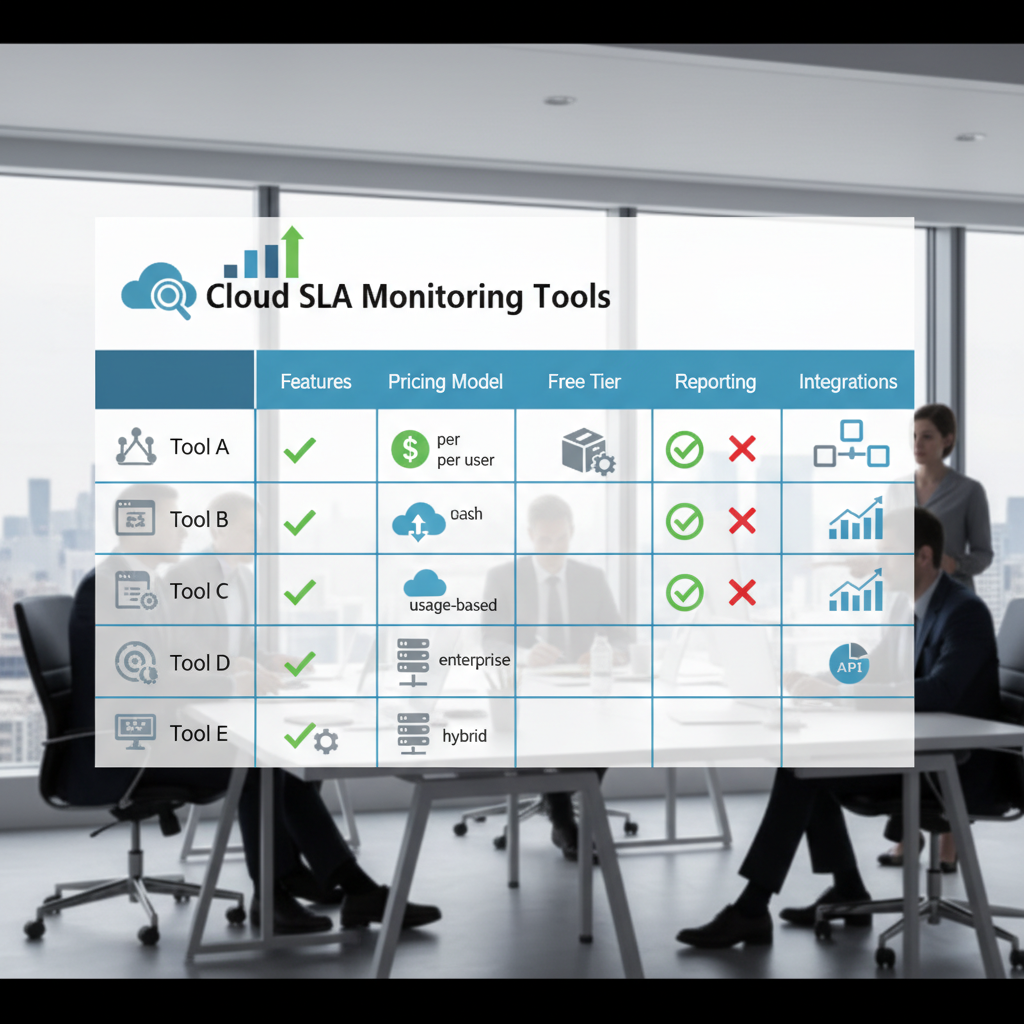
A comparison chart highlighting different features and pricing models of various Cloud sla monitoring tool options, helping users make an informed decision.
Implementing and Optimizing Your Cloud SLA Monitoring
Effective implementation and continuous optimization are crucial for maximizing the value of your Cloud sla monitoring tool. It’s not enough to simply deploy the software; strategic planning and ongoing adjustments are necessary to ensure it continually meets your evolving business needs. These Cloud sla monitoring tool tips will guide you through best practices.
Set Clear Baselines and Performance Thresholds
After deploying your Cloud sla monitoring tool, establish clear performance baselines for all critical services. These baselines represent the normal operating conditions against which future performance will be measured. Use historical data to define realistic and achievable thresholds for alerts.
Always involve stakeholders from business and IT to collaboratively define these baselines and thresholds. This ensures that monitoring aligns with actual business impact and expectations. Regularly review and adjust these settings as your applications evolve or cloud provider services change.
Regularly Review and Refine SLAs
Service Level Agreements are not static documents; they should be reviewed and refined periodically to remain relevant. Your Cloud sla monitoring tool provides the data necessary to inform these reviews, highlighting areas where current SLAs might be too lenient, too strict, or simply outdated.
Use the insights from your SLA tracking software to negotiate more favorable terms with cloud providers or to adjust internal service targets. This proactive approach ensures your monitoring efforts always support current business objectives. Consistent review improves overall SLA compliance.
Automate Where Possible for Efficiency
Leverage the automation capabilities of your Cloud sla monitoring tool to streamline operations and reduce manual effort. Automate the generation of routine compliance reports, the triggering of incident responses, or even certain remediation actions. Automation enhances efficiency and reduces human error.
Explore integrations that allow your cloud performance monitor to automatically escalate tickets to your IT service management system or trigger scripts to restart problematic services. Focus on automating repetitive tasks to free up your team for more strategic initiatives. This maximizes the return on your investment.
Challenges in Cloud SLA Monitoring
While a Cloud sla monitoring tool offers immense benefits, organizations often face specific challenges in its deployment and ongoing management. Understanding these potential hurdles is crucial for developing robust strategies to overcome them and ensure effective SLA compliance. Addressing these challenges proactively enhances the reliability of your cloud services.
One significant challenge is the sheer complexity of modern cloud environments, which often involve multiple cloud providers, hybrid architectures, and a myriad of interdependent services. This distributed nature makes it difficult to gain a unified view of performance and pin down the root cause of issues. A Cloud sla monitoring tool must provide end-to-end visibility across these diverse landscapes.
Another common hurdle is managing the vast volume of monitoring data generated by cloud services. Sifting through petabytes of metrics and logs to identify actionable insights can be overwhelming without advanced analytics and intelligent filtering capabilities. Tools need to process this data efficiently to provide meaningful alerts.
Ensuring consistency in monitoring across various cloud services and regions also presents difficulties. Different cloud providers may expose metrics in varying formats or with different granularity, complicating standardization. The chosen SLA compliance instrument must offer flexible configuration options to adapt to these discrepancies.
Moreover, balancing comprehensive monitoring with cost efficiency is a constant concern. Excessive data collection or over-provisioned monitoring agents can lead to inflated cloud bills. It’s crucial to optimize what is monitored and how frequently, focusing on key performance indicators that directly impact business SLAs.
Future Trends in Cloud SLA Monitoring
The landscape of cloud SLA monitoring is continuously evolving, driven by advancements in technology and the increasing complexity of cloud environments. Several key trends are shaping the future of Cloud sla monitoring tool development and adoption. These innovations promise even greater precision and efficiency in managing cloud service performance.
One major trend is the integration of Artificial Intelligence (AI) and Machine Learning (ML) into monitoring solutions. AI/ML algorithms can analyze vast datasets to detect anomalies, predict potential outages, and identify performance degradation patterns far more accurately and rapidly than traditional rule-based systems. This proactive capability transforms a Cloud sla monitoring tool into a predictive one.
Another emerging trend is the focus on “observability,” which moves beyond traditional monitoring to provide deeper insights into the internal states of systems. This involves collecting not just metrics but also logs, traces, and events, offering a more holistic understanding of application and infrastructure behavior. Comprehensive observability enhances the ability of a service level agreement tool to pinpoint root causes.
The rise of serverless computing and containerization (e.g., Kubernetes) also presents new monitoring challenges and opportunities. Future Cloud sla monitoring tool examples will need specialized capabilities to track the ephemeral and dynamic nature of these microservices and functions. Monitoring solutions are adapting to this shift by providing context-aware and distributed tracing features.
Furthermore, there is a growing emphasis on business impact monitoring. This involves correlating technical performance metrics directly with business outcomes, such as conversion rates, revenue, or customer satisfaction. This allows organizations to understand the true cost of performance issues and prioritize remediation efforts based on business value.
Frequently Asked Questions
What is a Cloud sla monitoring tool?
A Cloud sla monitoring tool is a specialized software solution designed to track, measure, and report on the performance of cloud services against predefined Service Level Agreements (SLAs). It continuously observes key metrics like availability, latency, and error rates to ensure cloud providers meet their contractual obligations and that applications perform optimally. This type of SLA tracking software is vital for maintaining business continuity.
Why is it important to monitor Cloud SLAs?
Monitoring Cloud SLAs is crucial because it ensures that cloud services deliver the expected levels of performance, reliability, and security as agreed upon with providers. It helps businesses avoid financial penalties, mitigate reputational risks, and maintain a high quality of service for end-users. Without proper monitoring, organizations are vulnerable to unaddressed performance issues.
What key metrics does a Cloud sla monitoring tool typically track?
A typical Cloud sla monitoring tool tracks a range of vital metrics, including service availability and uptime, network latency, application response times, error rates (e.g., HTTP 5xx), and resource utilization (CPU, memory, storage). These metrics provide a comprehensive view of the cloud service health and compliance with performance targets. It acts as a cloud performance monitor for critical resources.
How does a Cloud sla monitoring tool help with cost optimization?
By tracking resource utilization, a Cloud sla monitoring tool helps identify over-provisioned resources that are incurring unnecessary costs, or under-provisioned resources causing performance issues. It provides the data needed to right-size cloud instances, optimize spending, and ensure resources are aligned with actual demand. This directly contributes to efficient cloud management.
What should I look for when choosing the best Cloud sla monitoring tool?
When selecting the best Cloud sla monitoring tool, consider features such as real-time performance dashboards, customizable alerting, comprehensive reporting and analytics, and seamless integration with your existing IT tools. Also, evaluate its scalability, flexibility, ease of use, and the vendor’s support quality. A thorough Cloud sla monitoring tool guide emphasizes defining your specific requirements first.
ENSURE UNINTERRUPTED SERVICE
Ensure uninterrupted service delivery and proactively prevent costly SLA breaches. Leverage our automated, real
✓ Free consultation ✓ No commitment required ✓ Trusted by experts
Conclusion
The effective management of cloud services hinges significantly on robust monitoring practices. A dedicated Cloud sla monitoring tool is not merely a technical utility but a strategic imperative for any organization operating in the cloud. It provides the essential visibility, accountability, and control necessary to navigate the complexities of cloud environments successfully.
By meticulously tracking performance, ensuring SLA compliance, and offering deep analytical insights, these tools empower businesses to maintain high service quality, optimize costs, and foster trust with their customers. Investing in the right Cloud sla monitoring tool is an investment in your organization’s future reliability, efficiency, and overall success in the digital era.
Jacob Stålbro is a seasoned digitalization and transformation leader with over 20 years of experience, specializing in AI-driven innovation. As Head of Innovation and Co-Founder at Opsio, he drives the development of advanced AI, ML, and IoT solutions. Jacob is a sought-after speaker and webinar host known for translating emerging technologies into real business value and future-ready strategies.