Best Cloud SLA Monitoring Software Solutions for Uptime
March 6, 2026|2:36 PM
Unlock Your Digital Potential
Whether it’s IT operations, cloud migration, or AI-driven innovation – let’s explore how we can support your success.
Home /
Work /
Blogs /
Best Cloud SLA Monitoring Software Solutions for Uptime
Understanding Cloud SLA Monitoring Software
In the dynamic landscape of cloud computing, maintaining consistent performance and availability is paramount. Cloud sla monitoring software serves as a critical tool for organizations to ensure their cloud services adhere to predefined Service Level Agreements (SLAs). This advanced software solution provides a comprehensive overview of cloud infrastructure and application health, safeguarding against potential disruptions.
The primary function of this software is to continuously track and analyze key performance indicators (KPIs) from various cloud providers. It acts as an indispensable SLA tracking program, offering deep insights into latency, uptime, resource utilization, and error rates. By doing so, it helps businesses confirm that their cloud environments meet the stringent demands of their operations.
The Role of Service Level Agreements (SLAs)
Service Level Agreements are formal contracts between a service provider and a customer, outlining the expected level of service. In the context of cloud computing, these agreements typically cover crucial aspects like uptime guarantees, data recovery times, and performance benchmarks. Understanding these agreements is the first step towards effective monitoring.
Cloud SLAs define the non-negotiable standards for service delivery, ensuring accountability from cloud vendors. Key metrics commonly included are availability percentages, data transfer rates, response times, and incident resolution targets. Organizations rely on these contractual obligations to plan their business continuity and user experience strategies effectively.
Why Monitor Cloud SLAs?
Monitoring cloud SLAs is not just a best practice; it is a fundamental requirement for operational excellence and financial prudence. Without robust monitoring, organizations risk unknowingly falling out of compliance, leading to service degradation and potential penalties. A dedicated cloud service monitoring solution offers the visibility needed to avert such issues.
Effective monitoring ensures SLA compliance system is in place, providing tangible evidence of service adherence or violation. It allows for proactive identification of performance bottlenecks, enabling rapid intervention before minor issues escalate into major outages. Furthermore, a detailed performance management platform supports strategic decision-making by revealing patterns and areas for improvement.
Key Features of Effective Cloud SLA Monitoring Software
Modern Cloud sla monitoring software comes equipped with a suite of sophisticated features designed to provide unparalleled visibility and control over cloud environments. These tools empower IT teams to go beyond basic health checks, offering granular data and actionable insights. Selecting the right software depends heavily on understanding these core capabilities.
The best Cloud sla monitoring software solutions offer a blend of real-time data collection, historical analysis, and intelligent alerting. They aim to simplify complex cloud operations, making it easier to manage performance across diverse services. Robust features are essential for comprehensive oversight and proactive management.
Real-Time Performance Tracking
Real-time performance tracking is a cornerstone of any effective cloud performance software. This functionality involves continuous data collection from cloud resources, applications, and network components. Immediate data processing ensures that any deviation from normal operating parameters is detected without delay.
Instant notifications and alerts are crucial components of real-time monitoring. When an SLA threshold is breached or a critical event occurs, the system should immediately inform relevant personnel. This capability allows for swift response and remediation, minimizing the impact of performance issues on end-users and business operations.
Reporting and Analytics for Compliance
Beyond immediate alerts, comprehensive reporting and analytics capabilities are vital for demonstrating SLA adherence over time. Cloud sla monitoring software must be able to generate detailed, customizable reports that illustrate performance trends and compliance status. These reports are invaluable for internal audits and external vendor reviews.
Historical data analysis allows organizations to identify recurring issues, track improvements, and forecast future performance needs. These insights help in negotiating future SLAs and making informed decisions about resource allocation. A robust service level agreement application provides the data necessary for continuous improvement and strategic planning.
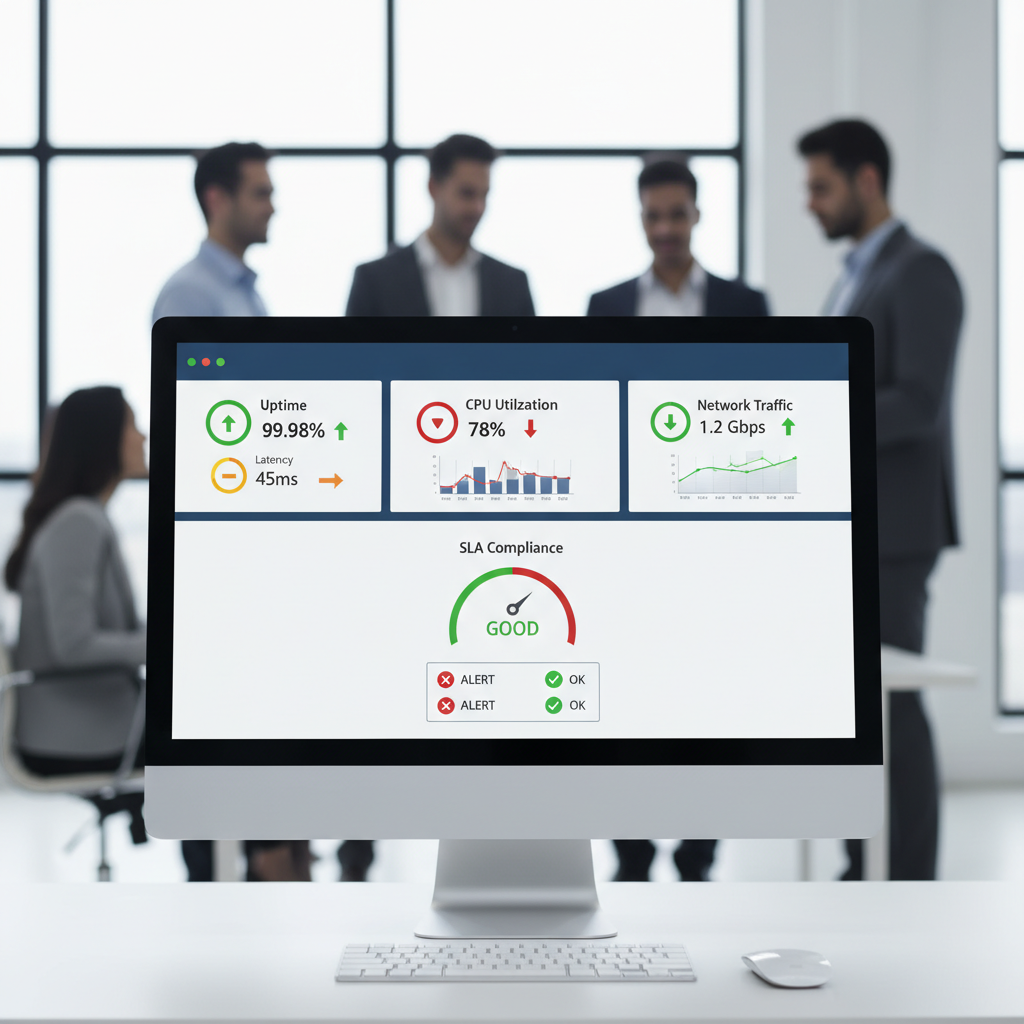
A dashboard showing various cloud service metrics like uptime, latency, CPU utilization, and network traffic, with red and green indicators for SLA compliance.
Benefits of Implementing Cloud SLA Monitoring Software
Implementing Cloud sla monitoring software brings a multitude of advantages that extend beyond mere compliance. It fundamentally transforms how organizations manage their cloud services, leading to greater efficiency, enhanced reliability, and improved business outcomes. These benefits solidify its position as an essential tool in the modern IT arsenal.
The strategic deployment of an SLA tracking program can significantly improve service quality, reduce operational risks, and provide a clear return on investment. It empowers businesses to operate their cloud infrastructure with confidence and precision. Understanding these benefits helps justify the investment in such a critical solution.
Achieving Optimal Cloud Performance
One of the primary benefits is the ability to achieve and maintain optimal cloud performance across all services. By continuously monitoring key metrics, organizations can identify underperforming resources or applications before they impact users. This proactive approach ensures that cloud environments are always operating at their peak efficiency.
Cloud performance software allows for precise resource tuning, preventing both over-provisioning (wasted costs) and under-provisioning (performance bottlenecks). It helps in load balancing and scaling decisions, ensuring that resources are dynamically allocated to meet fluctuating demands. This leads to a smoother, more reliable user experience for customers.
Ensuring Vendor Accountability
Cloud sla monitoring software is indispensable for holding cloud service providers accountable to their contractual obligations. It provides objective, data-driven evidence of performance, making it easier to verify compliance with agreed-upon SLAs. This transparency fosters a stronger, more trust-based relationship with providers.
When SLA breaches occur, the detailed logs and reports generated by the service level agreement application serve as irrefutable proof. This data supports discussions for service credits or other contractual remedies. Ultimately, it empowers organizations to demand and receive the quality of service they pay for, protecting their investments.
ENSURE UNINTERRUPTED SERVICE
Ensure uninterrupted service delivery and proactively prevent costly SLA breaches. Leverage our automated, real
✓ Free consultation ✓ No commitment required ✓ Trusted by experts
Choosing the Best Cloud SLA Monitoring Software in 2026
Selecting the ideal Cloud sla monitoring software requires careful consideration of various factors specific to an organization’s needs and cloud strategy. With numerous options available in the market, making an informed decision is crucial for long-term success. A thoughtful evaluation process will ensure the chosen solution aligns perfectly with business objectives for 2026 and beyond.
The best Cloud sla monitoring software should not only address current challenges but also be scalable and adaptable to future cloud advancements. Factors like integration capabilities, ease of use, cost, and vendor support play significant roles in the selection process. This section provides a Cloud sla monitoring software guide for making an optimal choice.
Evaluating Your Specific Needs
Before diving into product comparisons, it is essential to thoroughly evaluate your organization’s unique requirements. Consider the types of cloud services you utilize (IaaS, PaaS, SaaS), the complexity of your infrastructure, and your existing monitoring tools. A clear understanding of your environment will narrow down the suitable options.
Think about the specific metrics most critical to your business operations and the level of granularity required for monitoring. Determine your budget constraints and the resources available for implementation and ongoing management. These considerations will guide you towards a Cloud sla monitoring software that truly fits your operational model.
Key Considerations for Integration
Seamless integration with your existing IT ecosystem is a non-negotiable feature for any modern Cloud sla monitoring software. The solution should easily connect with cloud platforms (AWS, Azure, GCP), ITSM tools, incident management systems, and other monitoring solutions. This ensures a unified view of your IT landscape and streamlined workflows.
Look for platforms that offer robust APIs and extensive documentation for custom integrations. Compatibility with container orchestration tools like Kubernetes, serverless functions, and microservices architectures is also increasingly important. A well-integrated performance management platform reduces manual effort and improves overall operational efficiency.
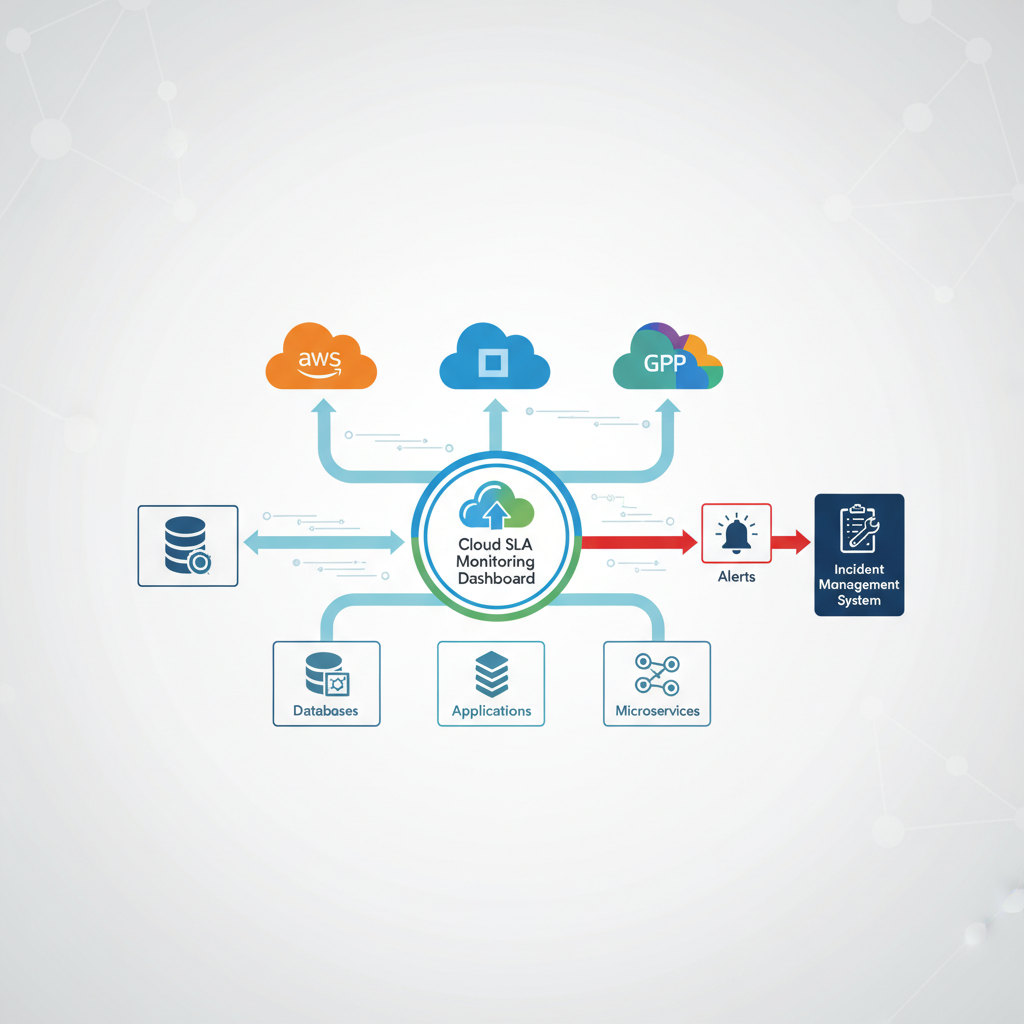
A complex diagram showing various cloud services (AWS, Azure, GCP), applications, and databases connected to a central Cloud SLA monitoring dashboard, with alerts integrating into an incident management system.
Practical Tips for Implementing Cloud SLA Monitoring Software
Successfully implementing Cloud sla monitoring software involves more than just installing the tool; it requires a strategic approach and careful planning. Following best practices ensures that the deployment yields maximum benefits and integrates smoothly into existing operations. These Cloud sla monitoring software tips are designed to guide your team through a successful rollout.
A well-executed implementation minimizes disruption, accelerates time to value, and fosters user adoption within your organization. Prioritizing clear objectives and continuous refinement will set the stage for a highly effective SLA tracking program. Consider these steps to optimize your implementation strategy.
Setting Up Effective Alerting
Effective alerting is critical for transforming raw monitoring data into actionable insights. Begin by defining clear, measurable SLA thresholds for each monitored service. These thresholds should reflect the critical boundaries beyond which service quality is compromised, demanding immediate attention.
Configure your Cloud sla monitoring software to send alerts through multiple channels, such as email, SMS, or integration with collaboration tools like Slack or Microsoft Teams. Prioritize alerts based on severity, ensuring that critical incidents trigger more urgent notifications to the right team members. Regularly review and fine-tune your alerting rules to avoid alert fatigue and ensure relevance.
Leveraging Data for Continuous Improvement
The true power of a cloud service monitoring solution lies in its ability to drive continuous improvement. Don’t just react to alerts; actively analyze the historical data generated by your SLA tracking program. Look for trends, recurring issues, and patterns that indicate underlying problems or areas for optimization.
Use these insights to engage in data-driven discussions with your cloud providers, advocating for improvements or negotiating more favorable terms based on actual performance. Internally, this data can inform architectural changes, resource adjustments, and process enhancements. A proactive approach to data analysis helps evolve your cloud strategy over time.
Future Trends in Cloud SLA Monitoring (2026 Perspective)
The landscape of cloud computing is constantly evolving, and so too are the demands on Cloud sla monitoring software. Looking ahead to 2026, several key trends are poised to reshape how organizations approach SLA management. These advancements will make monitoring solutions more intelligent, proactive, and deeply integrated into the entire IT ecosystem.
Innovation in this space is driven by the increasing complexity of cloud environments, the proliferation of cloud-native technologies, and the growing need for autonomous operations. Organizations must stay abreast of these trends to select future-proof performance management platform solutions.
AI-Powered Predictive Analytics
Artificial Intelligence and Machine Learning are set to revolutionize Cloud sla monitoring software with advanced predictive analytics capabilities. Rather than merely reacting to SLA breaches, AI-powered systems will analyze vast datasets to anticipate potential issues before they occur. This means identifying subtle performance degradations or unusual patterns that could lead to future outages.
These intelligent systems will offer proactive insights, suggesting remediation steps or automatically adjusting resource allocations to prevent service disruptions. Predictive analytics will transform the performance management platform from a reactive tool into a strategic asset, significantly improving uptime and reducing the mean time to resolution for incidents.
The Rise of Observability Platforms
While traditional monitoring focuses on “what happened,” the trend towards observability aims to answer “why it happened.” In 2026, Cloud sla monitoring software will increasingly be integrated into comprehensive observability platforms. These platforms provide a holistic view by correlating metrics, logs, and traces from every component of a distributed cloud system.
This deeper level of insight allows teams to rapidly diagnose root causes of performance issues, even in complex, dynamic microservices architectures. Observability enhances the capabilities of an SLA tracking program by providing the context needed to understand why an SLA was breached and how to prevent it from happening again. This integrated approach ensures a more resilient and performant cloud environment.
Frequently Asked Questions (FAQ)
This section addresses common inquiries regarding Cloud sla monitoring software, providing clear and concise answers to help clarify its role and benefits.
What is Cloud sla monitoring software?
Cloud sla monitoring software is a specialized application designed to continuously track, measure, and analyze the performance and availability of cloud services against predefined Service Level Agreements (SLAs). It ensures that cloud providers meet their contractual obligations, providing crucial data for compliance and operational management.
How does Cloud sla monitoring software ensure compliance?
It ensures compliance by constantly gathering data on key metrics like uptime, latency, and throughput. When these metrics fall outside the agreed-upon SLA thresholds, the software triggers alerts and generates reports, providing objective evidence of performance deviations for accountability.
What are the key metrics monitored by Cloud sla monitoring software?
Key metrics typically include service availability (uptime percentage), response times, latency, data transfer rates, error rates, and resource utilization (CPU, memory, storage). These indicators collectively reflect the overall health and performance of cloud services.
Can Cloud sla monitoring software be used for multi-cloud environments?
Yes, many modern Cloud sla monitoring software solutions are specifically designed to support multi-cloud and hybrid cloud environments. They offer unified dashboards and capabilities to aggregate monitoring data from various cloud providers (AWS, Azure, GCP) into a single, comprehensive view.
What is the difference between monitoring and observability?
Monitoring focuses on predefined metrics and alerts to tell you if something is wrong. Observability provides deeper insights into the internal state of a system, allowing you to ask arbitrary questions about its behavior and understand why something went wrong, often through logs, traces, and metrics correlation.
How can I choose the best Cloud sla monitoring software for my business?
To choose the best Cloud sla monitoring software, evaluate your specific cloud environment, critical SLAs, budget, and integration needs with existing tools. Prioritize solutions offering real-time tracking, comprehensive reporting, multi-cloud support, scalability, and strong vendor support.
ENSURE UNINTERRUPTED SERVICE
Ensure uninterrupted service delivery and proactively prevent costly SLA breaches. Leverage our automated, real
✓ Free consultation ✓ No commitment required ✓ Trusted by experts
Conclusion
Cloud sla monitoring software has firmly established itself as an indispensable asset for any organization leveraging cloud services. It provides the crucial visibility and control necessary to uphold service quality, ensure compliance with contractual agreements, and optimize cloud expenditure. As cloud environments continue to grow in complexity and scale, the strategic importance of a robust SLA tracking program will only intensify.
By embracing these sophisticated tools, businesses can transform reactive problem-solving into proactive performance management, ensuring their cloud infrastructure consistently meets the highest standards. Investing in the right Cloud sla monitoring software is not merely a technical decision; it is a strategic imperative for maintaining operational excellence and securing a competitive edge in the evolving digital landscape of 2026 and beyond.
Jacob Stålbro is a seasoned digitalization and transformation leader with over 20 years of experience, specializing in AI-driven innovation. As Head of Innovation and Co-Founder at Opsio, he drives the development of advanced AI, ML, and IoT solutions. Jacob is a sought-after speaker and webinar host known for translating emerging technologies into real business value and future-ready strategies.