Ensure Uptime: Expert Cloud SLA Monitoring in Cloud Computing
March 6, 2026|2:34 PM
Unlock Your Digital Potential
Whether it’s IT operations, cloud migration, or AI-driven innovation – let’s explore how we can support your success.
Home /
Work /
Blogs /
Ensure Uptime: Expert Cloud SLA Monitoring in Cloud Computing
Understanding Cloud SLA Monitoring in Cloud Computing
Cloud sla monitoring in cloud computing is a fundamental practice for organizations leveraging cloud services. It involves systematically overseeing the performance, availability, and security of cloud resources and applications against predefined Service Level Agreements (SLAs). This proactive approach ensures that cloud providers deliver on their promises, maintaining the quality and reliability of services.
Implementing robust Cloud sla monitoring in cloud computing is crucial for business continuity and operational excellence. It provides vital insights into the health of your cloud infrastructure, allowing for prompt identification and resolution of potential issues. This process helps maintain optimal user experience and operational efficiency across all cloud deployments.
Service Level Agreements (SLAs) are formal contracts between a cloud service provider and a customer, outlining the expected level of service. These agreements typically cover metrics like uptime, response times, data redundancy, and support availability. Effective SLA monitoring for cloud environments ensures adherence to these critical contractual obligations.
The importance of Cloud sla monitoring in cloud computing cannot be overstated in today’s digital landscape. Businesses increasingly rely on cloud services for core operations, making consistent performance and availability non-negotiable. Robust monitoring systems provide the necessary visibility to verify compliance and manage expectations.
Key Components of Cloud SLA Monitoring
Effective Cloud sla monitoring in cloud computing relies on a comprehensive set of metrics and key performance indicators (KPIs). These quantitative measures provide a clear picture of service health and compliance. They help organizations understand if their cloud providers are meeting the agreed-upon cloud computing service levels.
Common metrics include service availability, often expressed as a percentage of uptime, and performance indicators such as latency and throughput. Response times for critical applications and infrastructure components are also frequently monitored. These elements are vital for ensuring a smooth user experience.
Security is another paramount component of SLA tracking within cloud infrastructure. Monitoring security-related events, incident response times, and compliance with security policies forms an essential part of the overall SLA. This ensures data protection and regulatory adherence.
Capacity utilization and resource allocation are also key aspects of Cloud sla monitoring in cloud computing. Tracking these metrics helps ensure that cloud resources are optimized and that performance degradation due to resource constraints is avoided. Proactive management based on these insights is critical.
Challenges in Cloud SLA Monitoring
Despite its importance, Cloud sla monitoring in cloud computing presents several inherent challenges. The dynamic and elastic nature of cloud environments makes consistent tracking difficult. Resources can scale up or down rapidly, altering performance baselines unexpectedly.
Monitoring public/private clouds introduces complexity due to varying architectures, technologies, and management interfaces. Integrating data from disparate cloud providers and on-premises systems can be a significant hurdle. This often requires specialized tools and expertise to achieve a unified view.
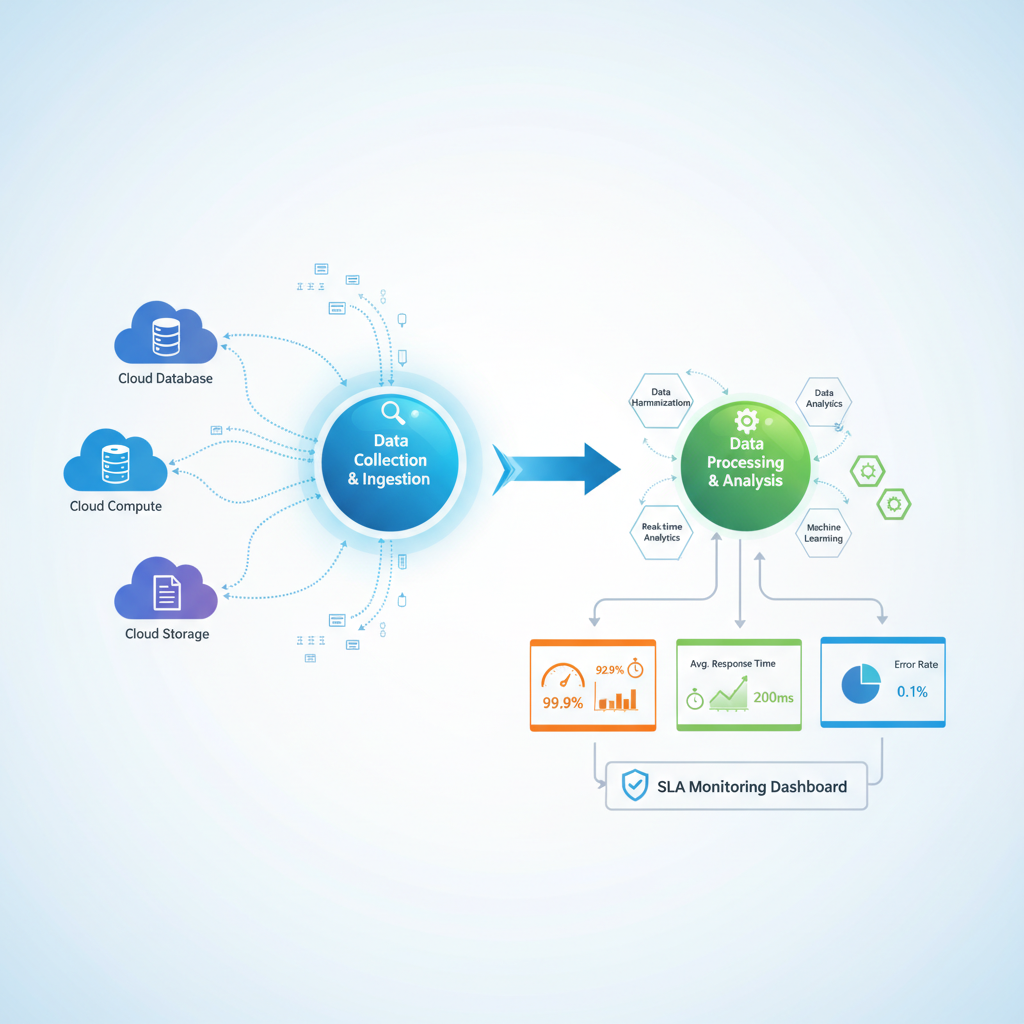
Data collection and correlation from a multitude of cloud services can also be overwhelming. Cloud environments generate vast amounts of telemetry data, including logs, metrics, and traces. Effectively filtering, processing, and correlating this information to pinpoint SLA breaches demands sophisticated analytics capabilities.
Diagram showing the flow of data from various cloud services being collected and analyzed for SLA monitoring, with different metrics being displayed, illustrating the complexity of integrating diverse data sources.
Ensuring Cloud service agreement compliance across these complex landscapes requires constant vigilance and advanced monitoring solutions. Organizations must overcome these challenges to gain true visibility and control over their cloud investments. Without proper tools and strategies, simply tracking cloud computing service levels becomes a daunting task.
ENSURE UNINTERRUPTED SERVICE
Ensure uninterrupted service delivery and proactively prevent costly SLA breaches. Leverage our automated, real
✓ Free consultation ✓ No commitment required ✓ Trusted by experts
Best Practices for Effective Cloud SLA Monitoring
Adopting best practices is essential for successful Cloud sla monitoring in cloud computing. The first step involves clearly defining measurable SLAs that are specific, achievable, relevant, and time-bound. These SLAs should reflect business needs and be communicated effectively to all stakeholders.
Regularly review and adjust your SLAs as your cloud usage evolves and business requirements change. This ensures that monitoring efforts remain aligned with current operational realities. An outdated SLA can lead to misinterpretations of service performance.
Implement continuous performance management in the cloud through automated tools and dashboards. This proactive approach allows for real-time visibility into your cloud resources and applications. Early detection of deviations from expected performance can prevent major service disruptions.
Leveraging automated monitoring tools is a cornerstone of effective Cloud sla monitoring in cloud computing. These tools can collect data, generate alerts, and provide analytics without manual intervention. Automation significantly improves efficiency and accuracy in SLA tracking within cloud infrastructure.
Ensure all stakeholders understand their roles and responsibilities concerning cloud service agreement compliance. Establish clear escalation paths for SLA breaches to facilitate rapid response and resolution. Transparency and accountability are key to successful management.
Consider implementing a multi-layered monitoring strategy that includes both agent-based and agentless monitoring. This provides comprehensive coverage across various cloud services and applications. Such an approach helps to get the best Cloud sla monitoring in cloud computing results.
Tools and Technologies for Cloud SLA Monitoring
A wide array of tools and technologies are available to facilitate Cloud sla monitoring in cloud computing. Cloud providers themselves offer native monitoring services, such as AWS CloudWatch, Azure Monitor, and Google Cloud Monitoring. These tools provide deep insights into their respective ecosystems.
These native tools are excellent for monitoring specific provider services and resources. They often integrate seamlessly with other services within that cloud environment. Utilizing these can be a strong starting point for SLA monitoring for cloud environments.
Third-party monitoring solutions offer capabilities that extend across multiple cloud providers and hybrid environments. Examples include Datadog, Dynatrace, New Relic, and AppDynamics. These platforms provide a unified view, correlating data from various sources to offer end-to-end visibility.
Many of these third-party tools feature advanced analytics, machine learning, and AI capabilities to detect anomalies and predict potential issues. They can automate alert generation and even suggest root causes for performance problems. This significantly enhances performance management in the cloud.
When selecting tools for Cloud sla monitoring in cloud computing, consider factors such as ease of integration, scalability, cost, and the specific metrics you need to track. The chosen solution should align with your organizational requirements and technical stack. This ensures effective SLA tracking within cloud infrastructure.
Benefits of Robust Cloud SLA Monitoring
Robust Cloud sla monitoring in cloud computing delivers a multitude of benefits for organizations. It fosters enhanced transparency and accountability between cloud providers and consumers. Clear metrics and reporting ensure that both parties have a shared understanding of service delivery.
Improved performance and reliability are direct outcomes of effective monitoring. By proactively identifying and addressing performance bottlenecks or service degradations, organizations can maintain high availability and optimal application responsiveness. This contributes to better user experiences.
Infographic illustrating the benefits of cloud SLA monitoring, such as improved uptime, faster resolution, and better resource allocation, with icons for each benefit representing tangible advantages.
Cost optimization is another significant advantage. Monitoring helps identify underutilized resources or inefficient configurations that can lead to unnecessary expenses. By ensuring cloud service agreement compliance, you prevent penalties and ensure you are getting the value you pay for.
Furthermore, Cloud sla monitoring in cloud computing plays a crucial role in risk mitigation. It helps identify potential security vulnerabilities, compliance gaps, and operational risks before they escalate. This proactive risk management protects sensitive data and maintains business continuity.
Ultimately, implementing the best Cloud sla monitoring in cloud computing practices leads to greater confidence in cloud deployments. It empowers organizations to make data-driven decisions, optimize their cloud strategy, and ensure that their cloud investments deliver expected business value. This comprehensive guide highlights the importance of staying on top of your cloud computing service levels.
Frequently Asked Questions
What is Cloud sla monitoring in cloud computing?
Cloud sla monitoring in cloud computing is the continuous process of observing, measuring, and reporting on the performance, availability, and security of cloud services against predefined Service Level Agreements (SLAs). It ensures that cloud providers meet their contractual obligations and that services perform as expected. This practice is vital for maintaining business operations and user satisfaction.
Why is SLA monitoring for cloud environments important?
SLA monitoring for cloud environments is crucial because it ensures businesses receive the service quality they pay for. It helps prevent service disruptions, identifies performance bottlenecks, and ensures compliance with security standards. Without it, organizations would lack visibility into their cloud service performance, risking financial penalties and reputational damage.
How does SLA tracking within cloud infrastructure work?
SLA tracking within cloud infrastructure typically involves deploying monitoring agents or leveraging cloud provider APIs to collect metrics like uptime, latency, error rates, and resource utilization. This data is then analyzed against predefined SLA thresholds, and alerts are triggered if performance falls below the agreed-upon levels. This continuous data collection and analysis forms the backbone of effective monitoring.
What are common challenges in monitoring public/private clouds?
Common challenges in monitoring public/private clouds include the dynamic nature of cloud resources, integrating data from diverse cloud platforms, and managing the sheer volume of telemetry data. Security and compliance variations between different cloud environments also pose significant hurdles. These complexities often require advanced, unified monitoring solutions to overcome effectively.
What makes a good Cloud sla monitoring in cloud computing solution?
A good Cloud sla monitoring in cloud computing solution is comprehensive, offering real-time visibility across all cloud services and applications. It features automated data collection, intelligent analytics with anomaly detection, and customizable alerting. Furthermore, it should support multi-cloud environments, offer clear reporting, and facilitate collaboration to ensure rapid incident resolution and cloud service agreement compliance.
ENSURE UNINTERRUPTED SERVICE
Ensure uninterrupted service delivery and proactively prevent costly SLA breaches. Leverage our automated, real
✓ Free consultation ✓ No commitment required ✓ Trusted by experts
Conclusion
Cloud sla monitoring in cloud computing is an indispensable practice for any organization leveraging the agility and scalability of cloud services. By systematically tracking performance against predefined Service Level Agreements, businesses can ensure service reliability, maintain operational efficiency, and safeguard their investments. The insights gained from effective SLA monitoring for cloud environments are crucial for informed decision-making and strategic planning.
Embracing the best Cloud sla monitoring in cloud computing strategies and tools empowers organizations to navigate the complexities of cloud environments with confidence. It ensures that cloud computing service levels are consistently met, fostering trust with providers and delivering optimal experiences to end-users. As cloud adoption continues to grow, robust SLA monitoring will remain a cornerstone of successful cloud management.
Jacob Stålbro is a seasoned digitalization and transformation leader with over 20 years of experience, specializing in AI-driven innovation. As Head of Innovation and Co-Founder at Opsio, he drives the development of advanced AI, ML, and IoT solutions. Jacob is a sought-after speaker and webinar host known for translating emerging technologies into real business value and future-ready strategies.