Whether it’s IT operations, cloud migration, or AI-driven innovation – let’s explore how we can support your success.
Home /
Work /
Blogs /
Expert Cloud SLA Monitoring: Ensure Uptime & Performance
Navigating the World of Cloud SLA Monitoring
The dynamic landscape of cloud computing offers unparalleled flexibility and scalability for businesses worldwide. However, with this power comes the critical need to ensure that cloud services consistently meet agreed-upon performance and availability standards. This is where robust Cloud sla monitoring becomes indispensable for maintaining operational excellence and trust.
Effective Cloud sla monitoring involves a systematic approach to continuously evaluate whether your cloud provider delivers on its promises. It is far more than just checking boxes; it’s about safeguarding business continuity and optimizing your cloud investment. This comprehensive guide will explore the intricacies of monitoring cloud agreements and optimizing your cloud infrastructure.
Understanding Cloud Service Level Agreements (SLAs)
A Service Level Agreement (SLA) is a contractual commitment between a service provider and a client. In the cloud context, these agreements define the minimum level of service a cloud provider guarantees to its customers. These legally binding documents are crucial for both parties, setting clear expectations for service delivery.
Cloud SLAs typically cover various critical aspects of service performance. They often detail metrics such as uptime percentages, response times, and data durability. Understanding these parameters is the first step toward effective service level agreement tracking.
Key Components of Cloud SLAs
Cloud SLAs are often complex, detailing specific measurable metrics and the remedies for failing to meet them. They ensure transparency and accountability in cloud service delivery. Key components typically include:
Availability: This specifies the percentage of time a service will be operational and accessible. High availability is paramount for most business applications.
Performance: Metrics like latency, throughput, and transaction success rates fall under this category. These define how quickly and efficiently services respond.
Data Durability and Loss: SLAs outline how data is protected against loss and the probability of data corruption. This is crucial for data integrity and recovery strategies.
Support and Resolution Times: Details on how quickly support tickets will be acknowledged and resolved are often included. This impacts overall operational efficiency.
Security: While often covered in separate agreements, some security aspects like data encryption or incident response times might appear. Strong security measures are non-negotiable in the cloud.
Why Cloud SLA Monitoring is Essential
Implementing rigorous Cloud sla monitoring is not merely a best practice; it is a fundamental requirement for any organization relying on cloud services. Without proper oversight, businesses risk encountering unexpected downtime, performance bottlenecks, and significant financial penalties. This continuous vigilance ensures that cloud services consistently meet agreed-upon benchmarks.
Effective monitoring empowers organizations to verify SLA compliance and proactively address potential issues before they impact end-users. It translates directly into enhanced reliability, improved customer satisfaction, and optimized resource utilization. This proactive stance is vital for maintaining business resilience.
Ensuring Cloud Service Health
Monitoring cloud service health goes beyond simple uptime checks; it involves a holistic assessment of various performance indicators. This ensures that the underlying infrastructure and applications function optimally. Consistent performance is key to a seamless user experience.
Regular Cloud sla monitoring provides real-time insights into the operational status of your cloud environment. It allows for immediate identification of deviations from expected performance, safeguarding against disruptions. This comprehensive approach supports robust cloud performance management.
Impact on Business Continuity and User Experience
Unmonitored cloud services can lead to service interruptions, directly impacting business continuity. Downtime can result in lost revenue, damaged reputation, and frustrated customers. Proactive monitoring helps mitigate these risks significantly.
By continuously tracking service uptime, organizations can ensure that their critical applications remain accessible to users. This focus on service uptime tracking directly contributes to a positive user experience and sustained business operations. Consistent performance builds trust and reliability.
Financial Implications and Penalties
Many Cloud SLAs include clauses for service credits or financial penalties if agreed-upon metrics are not met. Without diligent Cloud sla monitoring, businesses might miss out on these credits or be unaware of underperforming services. This oversight can significantly impact the budget.
Monitoring cloud agreements allows businesses to validate performance against contractual terms, enabling them to claim compensation where due. It also provides data to negotiate better terms or evaluate alternative providers if service quality consistently falls short. Financial accountability is a key benefit.
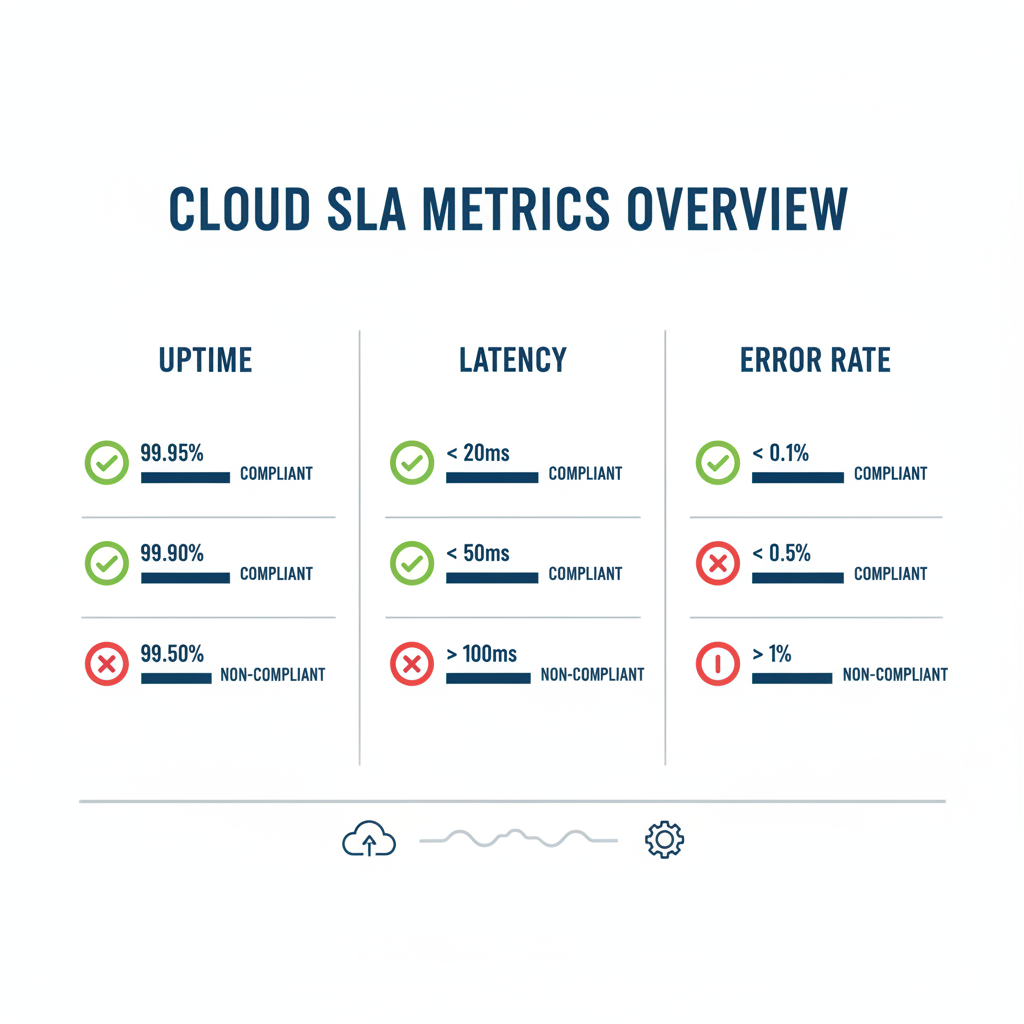
An infographic showing various cloud SLA metrics (uptime, latency, error rate) with green checkmarks and red crosses, illustrating compliance and non-compliance.
Key Metrics and KPIs for Effective Cloud SLA Monitoring
Effective Cloud sla monitoring relies on tracking a diverse set of Key Performance Indicators (KPIs) and metrics. These indicators provide a quantifiable way to assess the performance and reliability of cloud services. Understanding which metrics matter most is crucial for accurate evaluation.
These metrics offer a clear picture of whether your cloud provider is upholding its commitments. They form the backbone of any robust service level agreement tracking strategy. Focusing on relevant KPIs ensures data-driven decision-making.
Availability and Uptime
Availability refers to the percentage of time a service is operational and reachable, while uptime measures the actual period a system is working. High availability is a cornerstone of most cloud SLAs, typically expressed as “nines” (e.g., 99.9% or “three nines”). This metric directly impacts business operations.
Monitoring service uptime tracking is paramount for mission-critical applications where downtime is costly. Tools should continuously verify the accessibility of services from various geographical locations. Real-time alerts are essential for immediate action.
Performance Metrics
Performance metrics assess the speed and efficiency of cloud services, ensuring they deliver an optimal user experience. These metrics help identify bottlenecks and areas for optimization within your cloud environment. Common performance indicators include:
Latency: The delay before a transfer of data begins following an instruction. High latency can lead to slow application response times.
Response Time: The total time taken for a system to respond to a request. This is a crucial indicator for interactive applications.
Throughput: The amount of data processed or transferred over a specific period. This is important for data-intensive workloads.
Error Rate: The percentage of requests that result in an error. High error rates indicate underlying service issues.
Resource Utilization
Monitoring resource utilization provides insights into how efficiently cloud resources like CPU, memory, storage, and network bandwidth are being consumed. While not always directly tied to an SLA, inefficient utilization can impact performance and costs. Over-utilization can lead to performance degradation.
Understanding resource usage patterns helps in optimizing resource allocation and capacity planning. It also informs decisions about scaling services up or down, ensuring that resources align with demand. This contributes to overall cloud performance management.
ENSURE UNINTERRUPTED SERVICE
Ensure uninterrupted service delivery and proactively prevent costly SLA breaches. Leverage our automated, real
✓ Free consultation ✓ No commitment required ✓ Trusted by experts
Methods and Tools for Cloud SLA Monitoring
A variety of methods and tools are available to facilitate comprehensive Cloud sla monitoring, ranging from native cloud provider offerings to sophisticated third-party platforms. The choice of tools often depends on the complexity of your cloud environment, specific SLA requirements, and budget constraints. Selecting the best Cloud sla monitoring solution is critical for success.
Implementing a multi-faceted approach, combining different monitoring techniques, often provides the most robust insights. This strategy ensures broad coverage and deep visibility into cloud service performance. Effective cloud performance management relies heavily on the right toolkit.
Built-in Cloud Provider Tools
Major cloud providers like AWS, Azure, and Google Cloud offer their own suite of monitoring and logging services. These native tools provide deep integration with their respective ecosystems and are often the first line of defense for Cloud sla monitoring. They offer granular data on service performance and health within that specific cloud.
Examples include AWS CloudWatch, Azure Monitor, and Google Cloud Operations (formerly Stackdriver). These tools are excellent for basic service level agreement tracking and provide insights into resource utilization and application performance within their respective environments. They are typically cost-effective for single-cloud deployments.
Third-Party Monitoring Solutions
For multi-cloud or hybrid environments, third-party monitoring solutions offer a unified view across different providers and on-premise infrastructure. These platforms often provide advanced analytics, customizable dashboards, and broader integration capabilities. Many consider these the best Cloud sla monitoring tools for complex setups.
Popular examples include Datadog, Dynatrace, New Relic, and LogicMonitor. These solutions excel at providing end-to-end visibility, correlating performance data, and offering predictive analytics. They are essential for comprehensive monitoring cloud agreements spanning multiple vendors.
Synthetic Monitoring vs. Real User Monitoring (RUM)
These two distinct approaches offer different perspectives on cloud service performance:
Synthetic Monitoring: This involves simulating user interactions with your applications from various global locations. It proactively tests the availability and performance of services, even when no real users are present. Synthetic monitoring is excellent for service uptime tracking and baseline performance measurement.
Real User Monitoring (RUM): RUM collects data from actual user sessions, providing insights into their real-world experience. It captures metrics like page load times, transaction success rates, and geographical performance variations. RUM offers valuable insights into the actual impact of cloud service health on users.
Implementing a Robust Cloud SLA Monitoring Strategy
Developing and implementing an effective Cloud sla monitoring strategy requires careful planning and execution. It’s an ongoing process that involves defining clear objectives, selecting appropriate tools, and establishing robust operational procedures. A well-defined strategy ensures consistent SLA compliance and optimal cloud performance.
Following a structured approach will help you maximize the benefits of your monitoring efforts. This section provides a step-by-step guide to building a resilient monitoring framework. These Cloud sla monitoring tips are designed for practical application.
Step 1: Define Clear Objectives and SLAs
Before deploying any tools, clearly define what success looks like for your cloud services. Identify the critical applications and their respective SLAs. Determine the specific metrics (e.g., 99.9% uptime, 200ms response time) that need to be tracked.
Identify critical business services: Understand which cloud services are essential for your core operations.
Review and understand cloud provider SLAs: Familiarize yourself with the terms of your agreements.
Establish internal performance targets: Set your own, potentially stricter, performance goals beyond the provider’s SLA.
Document expected outcomes: Clearly outline what constitutes acceptable and unacceptable performance.
Step 2: Select the Right Monitoring Tools
Based on your objectives, budget, and cloud architecture (single-cloud, multi-cloud, hybrid), choose the appropriate monitoring tools. Consider a combination of native and third-party solutions for comprehensive coverage. Evaluate tools based on their features, scalability, and integration capabilities.
Assess current infrastructure: Determine if you have a single cloud, multi-cloud, or hybrid environment.
Compare tool features: Look for capabilities like real-time dashboards, alerting, reporting, and integration with existing systems.
Consider cost-effectiveness: Balance advanced features with your budget constraints.
Pilot chosen tools: Test solutions in a controlled environment before full deployment.
Step 3: Configure Monitoring and Alert Systems
Once tools are selected, configure them to continuously collect data on the defined KPIs. Establish thresholds for each metric that, when breached, trigger automated alerts. These alerts are critical for proactive incident management.
Set up data collection: Ensure all relevant metrics are being continuously gathered.
Define alerting thresholds: Configure alerts for deviations from your established SLAs and performance targets.
Establish alert escalation paths: Determine who receives alerts and when, ensuring timely responses.
Integrate with incident management: Connect monitoring alerts with your ticketing and incident response systems.
Step 4: Regular Reporting and Review
Regularly review monitoring data and generate reports to assess SLA compliance and overall cloud performance. These reports provide valuable insights for strategic decision-making and continuous improvement. This is a core part of effective cloud performance management.
Schedule regular performance reviews: Conduct weekly or monthly meetings to discuss monitoring data.
Generate compliance reports: Document how well your cloud services are meeting their SLAs.
Analyze trends and identify patterns: Look for recurring issues or performance degradations over time.
Use data for strategic planning: Inform capacity planning, cost optimization, and vendor negotiations with data.
Step 5: Iterative Optimization
Cloud environments are dynamic, so your Cloud sla monitoring strategy should also be adaptive. Continuously refine your monitoring setup, adjust thresholds, and explore new tools as your needs evolve. This iterative approach ensures sustained effectiveness. Here are some Cloud sla monitoring examples:
Update monitoring for new services: As new cloud services are adopted, ensure they are integrated into your monitoring framework.
Refine alert thresholds: Adjust alerts based on observed performance patterns and business criticality.
Automate responses where possible: Explore automation to address common issues without manual intervention.
Leverage advanced analytics: Utilize AI/ML capabilities in monitoring tools for predictive insights.
Challenges in Cloud SLA Monitoring and How to Overcome Them
While the benefits of Cloud sla monitoring are clear, organizations often encounter significant challenges in its implementation and ongoing management. Addressing these hurdles effectively is crucial for maintaining a truly robust monitoring framework. Understanding these difficulties is the first step toward finding solutions.
Navigating these complexities requires a strategic approach, combining appropriate tools, well-defined processes, and skilled personnel. Proactive planning can turn potential obstacles into manageable tasks. Effective monitoring cloud agreements demands continuous effort and adaptation.
Multi-Cloud Complexity
Managing services across multiple cloud providers (AWS, Azure, GCP, etc.) introduces significant complexity. Each cloud platform has its own monitoring tools, APIs, and terminology, making it difficult to achieve a unified view of performance and SLA compliance. Data silos become a major challenge.
Solution: Implement a centralized third-party monitoring solution that aggregates data from all cloud providers. These platforms offer consolidated dashboards and reporting, simplifying service level agreement tracking across your diverse infrastructure. Standardize metrics where possible.
Dynamic Cloud Environments
Cloud resources are inherently dynamic, scaling up and down automatically in response to demand. This elasticity, while beneficial, makes traditional static monitoring approaches ineffective. Ephemeral resources can appear and disappear, posing challenges for continuous tracking.
Solution: Embrace monitoring tools designed for cloud-native environments that leverage auto-discovery and agentless monitoring. Implement tag-based monitoring to ensure all resources, regardless of their lifecycle, are continuously tracked. Leverage infrastructure-as-code principles for consistent deployment.
Data Silos and Integration
Monitoring data often resides in disparate systems – cloud provider logs, application performance monitoring (APM) tools, security information and event management (SIEM) systems. Integrating these diverse data sources to create a holistic view of cloud service health is a common challenge.
Solution: Utilize monitoring platforms that offer extensive integration capabilities with various data sources. Implement a data lake or centralized logging solution to consolidate all relevant monitoring data for comprehensive analysis and correlation. Standardize data formats where feasible.
Cost Considerations
The cost associated with comprehensive Cloud sla monitoring can be substantial, especially when considering advanced third-party tools and the volume of data generated. Organizations must balance the need for deep visibility with budget constraints. Unoptimized monitoring can lead to spiraling costs.
Solution: Optimize data retention policies, focusing on critical metrics and logs. Leverage native cloud monitoring for basic needs and invest in third-party tools only where advanced features or multi-cloud visibility are essential. Regularly review monitoring costs and remove redundant agents or unnecessary data collection.
A complex network diagram illustrating data flow from multiple cloud providers (AWS, Azure, GCP) into a centralized monitoring dashboard, symbolizing multi-cloud SLA monitoring.
Future Trends in Cloud SLA Monitoring
The field of Cloud sla monitoring is continually evolving, driven by advancements in technology and the increasing sophistication of cloud deployments. Organizations must stay abreast of these emerging trends to ensure their monitoring strategies remain effective and future-proof. These innovations promise even greater efficiency and insight for cloud performance management.
Embracing these trends will enable businesses to move from reactive problem-solving to proactive, predictive maintenance. This shift is crucial for maintaining competitive advantage and ensuring superior service delivery. The future of monitoring cloud agreements is increasingly intelligent and automated.
AI/ML for Predictive Analytics
Artificial Intelligence (AI) and Machine Learning (ML) are transforming Cloud sla monitoring by enabling predictive analytics. These technologies can analyze vast amounts of historical data to identify patterns, predict potential outages or performance degradations before they occur, and highlight anomalies. This allows for proactive intervention rather than reactive responses.
Predictive capabilities significantly enhance service level agreement tracking by forecasting resource needs and identifying risks to SLA compliance. This moves monitoring from merely reporting what happened to anticipating what might happen. AI-driven insights improve decision-making accuracy.
AIOps Integration
AIOps (Artificial Intelligence for IT Operations) combines big data and machine learning to automate IT operations processes, including monitoring. It consolidates disparate monitoring data, filters out noise, correlates events across different systems, and identifies root causes faster. AIOps platforms are becoming central to robust cloud performance management.
Integrating AIOps reduces alert fatigue for operations teams and streamlines incident response. It offers a unified view of IT health, improving efficiency and reducing the mean time to resolution (MTTR). This is a significant leap forward for Cloud sla monitoring.
Enhanced Automation
Automation is expanding beyond basic alerting to include automated remediation for common issues. For instance, scripts can automatically scale resources, restart services, or trigger failovers when specific SLA thresholds are breached. This reduces manual intervention and speeds up recovery times.
Automated responses ensure quicker resolution of performance issues, thereby improving service uptime tracking and reducing human error. This trend is crucial for maintaining high availability in dynamic cloud environments. Automation enhances operational efficiency dramatically.
Focus on FinOps and Cost Optimization
Future Cloud sla monitoring will increasingly integrate with FinOps principles, linking performance and compliance data with financial insights. This means understanding the cost implications of meeting or missing SLAs, optimizing resource usage for both performance and cost-effectiveness. This approach enhances the overall value of cloud services.
By correlating performance with cost, organizations can make more informed decisions about cloud resource allocation and usage. This helps in justifying cloud spending and ensuring that performance objectives are met within budget. This holistic view aids in optimizing cloud agreements.
Frequently Asked Questions
What exactly is Cloud sla monitoring?
Cloud sla monitoring is the continuous process of observing and evaluating cloud service performance against defined Service Level Agreements (SLAs). It involves collecting metrics like uptime, latency, and error rates to ensure cloud providers meet their contractual obligations. This proactive approach helps maintain service quality and verify SLA compliance.
Why is Cloud sla monitoring important for businesses?
Cloud sla monitoring is crucial for businesses to ensure continuity, maintain optimal user experience, and avoid financial penalties. It provides real-time insights into cloud service health, allowing companies to identify and address performance issues before they significantly impact operations or customer satisfaction. This vigilance protects both reputation and revenue.
What are the key metrics to track in Cloud sla monitoring?
Key metrics for Cloud sla monitoring include service availability and uptime, performance indicators like latency and response time, and error rates. Monitoring resource utilization, such as CPU and memory usage, is also important for cloud performance management. These metrics collectively provide a comprehensive view of service health.
Can I use my cloud provider’s tools for Cloud sla monitoring?
Yes, major cloud providers offer built-in monitoring tools (e.g., AWS CloudWatch, Azure Monitor). These tools are excellent for basic service level agreement tracking within their respective ecosystems. However, for multi-cloud environments or advanced analytics, third-party monitoring solutions often provide more comprehensive and unified capabilities.
What are some challenges in monitoring cloud agreements?
Challenges in monitoring cloud agreements include the complexity of multi-cloud environments, the dynamic nature of cloud resources, and integrating data from disparate sources. Cost considerations for comprehensive monitoring also pose a hurdle. Overcoming these requires strategic tool selection and robust processes.
How can I get the best Cloud sla monitoring results?
To achieve the best Cloud sla monitoring results, define clear objectives, select appropriate tools (combining native and third-party solutions), and configure effective alert systems. Regularly review performance reports, continuously optimize your strategy, and embrace emerging technologies like AI/ML for predictive insights. Consistent effort yields the best outcomes.
ENSURE UNINTERRUPTED SERVICE
Ensure uninterrupted service delivery and proactively prevent costly SLA breaches. Leverage our automated, real
✓ Free consultation ✓ No commitment required ✓ Trusted by experts
Conclusion
Effective Cloud sla monitoring is an indispensable practice for any organization leveraging cloud services. It forms the bedrock of reliable operations, ensuring that cloud providers consistently meet their performance and availability commitments. By diligently monitoring cloud agreements, businesses can safeguard their continuity, enhance user experience, and optimize their cloud investments.
Embracing a comprehensive approach, from understanding your SLAs to deploying advanced monitoring tools and strategies, is paramount. As cloud environments continue to evolve, staying informed about future trends and continuously refining your Cloud sla monitoring framework will be key to long-term success. Invest in robust monitoring today to secure your cloud future.
Jacob Stålbro is a seasoned digitalization and transformation leader with over 20 years of experience, specializing in AI-driven innovation. As Head of Innovation and Co-Founder at Opsio, he drives the development of advanced AI, ML, and IoT solutions. Jacob is a sought-after speaker and webinar host known for translating emerging technologies into real business value and future-ready strategies.