Best Cloud SLA Monitoring Tools for Peak Performance
March 6, 2026|1:44 PM
Unlock Your Digital Potential
Whether it’s IT operations, cloud migration, or AI-driven innovation – let’s explore how we can support your success.
Home /
Work /
Blogs /
Best Cloud SLA Monitoring Tools for Peak Performance
Understanding Cloud SLA Monitoring in 2026
The landscape of cloud computing continues to evolve rapidly, making robust service level agreement (SLA) monitoring more critical than ever before. In 2026, organizations heavily rely on cloud services, ranging from infrastructure as a service (IaaS) to platform as a service (PaaS) and software as a service (SaaS). Ensuring these services consistently meet agreed-upon performance and availability standards is paramount for business continuity and customer satisfaction. This comprehensive guide will explore the top Cloud sla monitoring tools available today, helping you navigate their features and benefits effectively.
Cloud SLA monitoring is the process of continuously tracking, measuring, and analyzing the performance, availability, and reliability of cloud services against predefined contractual agreements. These agreements, known as Service Level Agreements, outline the minimum acceptable levels of service. Effective monitoring ensures that cloud providers deliver on their promises, while also giving businesses the insights needed to optimize their cloud consumption and user experience. Identifying the top Cloud sla monitoring tools is essential for maintaining operational excellence.
Why Cloud SLA Monitoring is Crucial for Your Business
In an era defined by digital transformation, the health and performance of your cloud infrastructure directly impact your bottom line and reputation. Robust cloud SLA monitoring provides indispensable visibility into your cloud environment. It empowers organizations to maintain operational stability and adhere to critical performance benchmarks.
Effective monitoring helps in ensuring compliance with various regulatory frameworks, such as NIS2 and GDPR, where service availability and data processing reliability are key. By actively tracking cloud service performance, businesses can identify potential risks before they escalate into major incidents. This proactive approach safeguards against service disruptions, protecting revenue and preserving customer trust.
Moreover, dedicated SLA monitoring assists in validating the true value of your cloud investments. It provides tangible data to justify expenditures and demonstrates the adherence of cloud providers to their contractual obligations. This oversight is vital for financial accountability and strategic resource allocation. Using leading cloud SLA tracking tools offers peace of mind and data-driven decision-making capabilities.
Key Features to Look for in top Cloud sla monitoring tools
When evaluating the top Cloud sla monitoring tools, a range of features are essential for comprehensive coverage and actionable insights. The right tool should provide a holistic view of your cloud performance, ensuring that all aspects of your SLAs are met and exceeded. Prioritizing these functionalities will lead you to the most effective solution for your organization.
Firstly, real-time performance metrics are non-negotiable, offering instant visibility into uptime, latency, throughput, and error rates. These granular metrics allow teams to immediately detect deviations from expected service levels. Without real-time data, reacting to issues becomes a reactive rather than a proactive process, impacting service quality.
Robust alerting and notification capabilities are also critical, ensuring that relevant teams are informed immediately when thresholds are breached. Customizable alerts, delivered via multiple channels like email, SMS, or collaboration tools, prevent minor issues from escalating. This ensures a rapid response and minimal service impact. Comprehensive reporting and analytics for historical data are vital for trend analysis, capacity planning, and demonstrating compliance.
Integration with existing IT ecosystems, including incident management, ITSM, and CI/CD pipelines, streamlines operations and improves workflow efficiency. A tool’s ability to seamlessly connect with other platforms enhances its value proposition significantly. Look for tools that offer broad integration support to avoid creating new data silos.
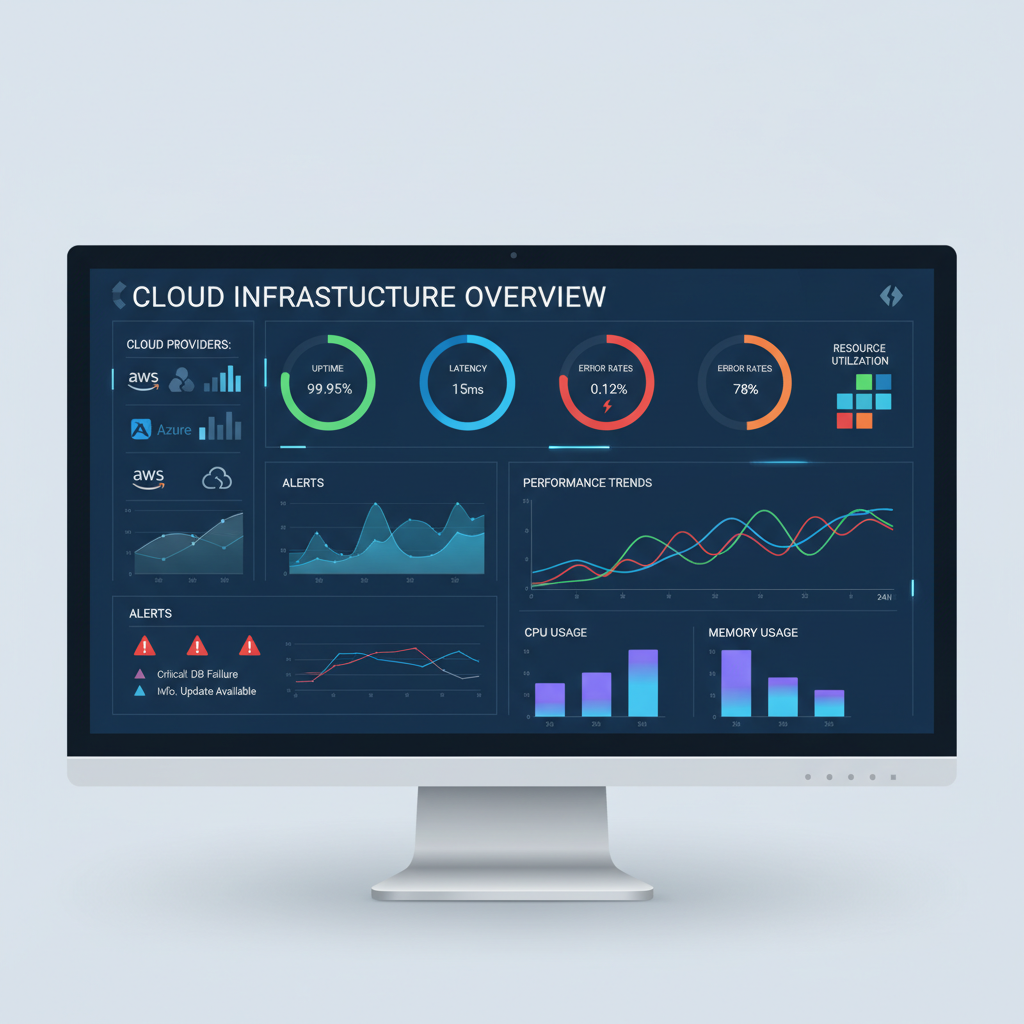
A dashboard showing various cloud performance metrics and alerts, including uptime, latency, error rates, and resource utilization across multiple cloud providers.
Scalability and multi-cloud support are paramount for modern enterprises, allowing consistent monitoring across diverse cloud environments without increasing complexity. As businesses expand their cloud footprint, their monitoring tools must scale effortlessly alongside them. Customizable dashboards and thresholds empower users to tailor views and alerts to their specific operational needs. This personalization ensures that teams focus on the most relevant metrics, enhancing efficiency.
Advanced features such as AI/ML-driven anomaly detection and predictive analytics significantly enhance proactive monitoring capabilities. These intelligent features can identify subtle deviations that human operators might miss, foreseeing potential problems before they impact users. Security considerations, including data encryption and access controls, are also paramount, protecting sensitive performance data. The highest-rated SLA monitoring tools typically incorporate many, if not all, of these advanced capabilities, providing a robust and future-proof monitoring solution.
ENSURE UNINTERRUPTED SERVICE
Ensure uninterrupted service delivery and proactively prevent costly SLA breaches. Leverage our automated, real
✓ Free consultation ✓ No commitment required ✓ Trusted by experts
A Ranking of Leading Cloud SLA Tracking Tools
Identifying the premier cloud performance tools involves looking at their feature sets, market reputation, and suitability for various use cases. The landscape includes offerings from major cloud providers themselves, alongside powerful third-party solutions. Each brings unique strengths to the table, catering to different operational scales and complexities.
For organizations heavily invested in a specific cloud ecosystem, vendor-native tools often provide deep integration and granular insights. AWS CloudWatch offers comprehensive monitoring for Amazon Web Services resources, with highly detailed metrics and logging capabilities. Similarly, Azure Monitor provides integrated monitoring for Microsoft Azure environments, ensuring tight alignment with Azure services. Google Cloud Monitoring (formerly Stackdriver) excels at providing unified visibility across Google Cloud Platform resources, often being a top choice for GCP users.
Beyond vendor-specific options, several third-party platforms stand out for their multi-cloud capabilities and advanced analytics. Datadog is frequently cited among the most popular cloud SLA tools due to its extensive integrations, intuitive dashboards, and AI-powered anomaly detection. It provides a unified view across hybrid and multi-cloud environments, making it ideal for complex infrastructures. Dynatrace offers an all-in-one platform with automatic root-cause analysis, providing deep application performance monitoring alongside infrastructure and SLA tracking.
New Relic also shines as a powerful observability platform, offering comprehensive insights into application performance, infrastructure, and user experience. Its robust querying and reporting features make it a strong contender for detailed SLA analysis. Splunk Observability Cloud (formerly SignalFx) provides real-time monitoring and analytics, leveraging its powerful data processing capabilities for high-cardinality data. These tools consistently feature high in any ranking of SLA monitoring tools, demonstrating their effectiveness and wide adoption. Each offers distinct advantages, making the choice dependent on specific organizational requirements and existing technology stacks.
How to Choose the Best Cloud SLA Monitoring Tool for Your Needs
Selecting the best top Cloud sla monitoring tools requires a thoughtful evaluation process tailored to your organization’s unique requirements. There is no one-size-fits-all solution, as differing cloud strategies and budget constraints dictate varying preferences. A strategic approach ensures you invest in a tool that truly aligns with your operational goals.
Firstly, assess your specific cloud environment; are you single-cloud, multi-cloud, or hybrid? A tool that natively supports your chosen providers will offer the deepest insights and easiest integration. Consider the specific cloud services you rely on, whether they are IaaS, PaaS, or SaaS, as some tools specialize in certain areas. Understanding these fundamental aspects guides your initial selection.
Budget considerations play a significant role in the decision-making process, as pricing models can vary greatly between tools. Some platforms charge based on data ingestion, while others are priced per host or user. It is crucial to estimate your potential monitoring scale and project associated costs accurately. Balance advanced features against their price to find a cost-effective solution.
Ease of use and the learning curve for your team should also be a major factor. An intuitive interface and well-documented features will accelerate adoption and maximize return on investment. Evaluate the vendor’s support options and the strength of their community, as reliable assistance can be invaluable during deployment and ongoing operations. Ultimately, the best-in-class SLA tools are those that seamlessly integrate into your workflow and provide immediate value without excessive overhead.
Implementing and Optimizing Your Cloud SLA Monitoring Strategy
Deploying top Cloud sla monitoring tools is just the first step; establishing an effective strategy for implementation and ongoing optimization is equally vital. A well-planned approach ensures that your monitoring efforts yield actionable insights and contribute positively to your business objectives. This involves a systematic methodology, from initial setup to continuous refinement.
Begin by clearly defining your SLA objectives, understanding precisely what metrics matter most for your business and your customers. This includes identifying critical services, acceptable performance thresholds, and the impact of service degradation. Documenting these objectives provides a clear framework for configuring your monitoring tools. Without precise goals, monitoring efforts can become unfocused.
Next, set up baseline performance metrics for your cloud services under normal operating conditions. These baselines serve as a reference point, allowing you to easily detect anomalies and performance deviations. Configure alerts and thresholds within your chosen monitoring tool to notify relevant personnel when performance drops below predefined levels. Ensure that alert severities and notification channels are appropriately configured to trigger prompt responses.
A flowchart illustrating the steps of implementing a cloud SLA monitoring strategy, including definition, baseline setting, alert configuration, regular review, and incident integration.
Regularly review and refine your monitoring policies and configurations to adapt to changes in your cloud environment or business requirements. Cloud infrastructures are dynamic, so your monitoring strategy must evolve accordingly. Integrate your SLA monitoring with existing incident management and ticketing systems to streamline the remediation process. This ensures that performance issues are not only detected but also efficiently resolved. Following these top Cloud sla monitoring tools tips will empower your team to maintain high service levels consistently.
Future Trends in Cloud SLA Monitoring
The field of cloud SLA monitoring is continuously advancing, with several exciting trends shaping its future. These innovations promise even greater precision, automation, and intelligence in overseeing cloud service performance. Staying abreast of these developments will ensure your monitoring strategy remains cutting-edge in the years leading up to 2026 and beyond.
Artificial intelligence (AI) and machine learning (ML) are increasingly being integrated to provide advanced anomaly detection and predictive analytics. These technologies move beyond simple threshold-based alerts, identifying subtle patterns that indicate impending issues before they impact services. This shift towards proactive, intelligent monitoring is a game-changer for maintaining high availability.
Monitoring advancements for serverless computing and containerized environments are also a significant focus. As more applications adopt microservices and ephemeral infrastructures, monitoring tools are evolving to provide deeper visibility into these dynamic, distributed systems. This ensures comprehensive coverage across modern cloud architectures.
Furthermore, there is a growing emphasis on shift-left monitoring, integrating performance and SLA checks earlier in the CI/CD pipeline. This approach catches potential performance bottlenecks during development and testing phases, reducing the likelihood of production issues. The future also sees an increased focus on linking technical metrics directly to business outcomes, providing more meaningful insights for stakeholders. This holistic view ensures that monitoring efforts directly contribute to business success.
Frequently Asked Questions About Cloud SLA Monitoring
Here are some common questions about cloud SLA monitoring and the top Cloud sla monitoring tools.
What is a Cloud SLA?
A Cloud Service Level Agreement (SLA) is a contract between a cloud service provider and a customer, outlining the agreed-upon performance metrics and service availability. It details acceptable levels for uptime, response times, and other critical operational aspects. The SLA also specifies remedies or penalties if these agreed-upon levels are not met, providing a clear framework for accountability.
How do top Cloud sla monitoring tools differ from general cloud monitoring?
While general cloud monitoring tracks basic resource utilization and operational health, top Cloud sla monitoring tools specifically focus on measuring and validating performance against contractual SLA terms. They often include advanced reporting, anomaly detection for SLA breaches, and integration with financial and contractual management systems. This specialized focus ensures adherence to business agreements.
What are the key benefits of using premier cloud performance tools?
Utilizing premier cloud performance tools provides numerous benefits, including enhanced service reliability, improved customer satisfaction, and better cost optimization. They enable proactive problem identification, ensure compliance with regulatory standards, and offer data-driven insights for strategic decision-making. These tools ultimately contribute to operational efficiency and business growth.
Can I monitor multi-cloud environments with a single tool?
Yes, many of the most popular cloud SLA tools are designed to provide unified monitoring across multi-cloud and hybrid environments. These tools offer connectors and integrations for various cloud providers like AWS, Azure, and Google Cloud, consolidating data into a single pane of glass. This simplifies management and ensures consistent SLA adherence across diverse infrastructures.
How often should I review my SLA monitoring setup?
It is recommended to review your SLA monitoring setup regularly, at least quarterly, or whenever there are significant changes to your cloud infrastructure, service providers, or business requirements. Frequent reviews ensure that your monitoring remains relevant and effective. Adjusting thresholds, alerts, and reporting mechanisms helps maintain optimal performance visibility.
ENSURE UNINTERRUPTED SERVICE
Ensure uninterrupted service delivery and proactively prevent costly SLA breaches. Leverage our automated, real
✓ Free consultation ✓ No commitment required ✓ Trusted by experts
Conclusion: Mastering Cloud Performance with top Cloud sla monitoring tools
Navigating the complexities of cloud environments requires robust strategies and the right technological support. Implementing and optimizing with the top Cloud sla monitoring tools is no longer a luxury but a fundamental necessity for any organization leveraging cloud services. These powerful platforms empower businesses to maintain high service levels, ensure compliance, and proactively address performance challenges.
By understanding the critical features, evaluating leading solutions, and implementing a well-defined strategy, you can master your cloud performance. Investing in the best-suited monitoring tools allows your enterprise to confidently meet its SLAs, foster customer trust, and drive continuous operational excellence. Embrace proactive monitoring to secure your digital future.
Jacob Stålbro is a seasoned digitalization and transformation leader with over 20 years of experience, specializing in AI-driven innovation. As Head of Innovation and Co-Founder at Opsio, he drives the development of advanced AI, ML, and IoT solutions. Jacob is a sought-after speaker and webinar host known for translating emerging technologies into real business value and future-ready strategies.