Cloud SLA Monitoring vs APM: Key Differences Explained
March 6, 2026|1:35 PM
Unlock Your Digital Potential
Whether it’s IT operations, cloud migration, or AI-driven innovation – let’s explore how we can support your success.
Home /
Work /
Blogs /
Cloud SLA Monitoring vs APM: Key Differences Explained
Understanding Cloud SLA Monitoring vs APM: A Comprehensive Guide
In the rapidly evolving landscape of cloud computing, ensuring optimal performance and reliability is paramount for any organization. Two critical approaches often discussed in this context are Cloud SLA monitoring vs APM, or Application Performance Management. While both aim to maintain system health, their focus, scope, and methodologies differ significantly. Understanding the nuances of Cloud SLA monitoring vs APM is essential for crafting an effective strategy that guarantees service quality and user satisfaction.
This comprehensive guide will explore the intricacies of SLA monitoring comparison with APM, detailing their individual strengths and how they can be leveraged together. We will delve into the core principles of each, highlight their key differences, and provide practical insights into implementing a robust monitoring framework. By the end, you will have a clear understanding of when to use SLA vs APM and how to integrate these complementary monitoring solutions for superior operational visibility.
What is Cloud SLA Monitoring?
Cloud Service Level Agreement (SLA) monitoring is the process of tracking and verifying that cloud services meet the predefined performance, availability, and reliability commitments outlined in an SLA. These agreements are legal contracts between a cloud service provider and its customer, guaranteeing specific levels of service quality. The primary goal of SLA monitoring is to ensure that these contractual obligations are consistently met.
This type of monitoring typically focuses on external-facing metrics that impact the end-user experience and the business’s bottom line. It measures adherence to agreed-upon uptime percentages, response times, and incident resolution targets. If a provider fails to meet these metrics, the customer may be entitled to service credits or other remedies specified in the SLA, highlighting the importance of robust Cloud SLA monitoring.
Key Aspects of Cloud SLA Monitoring
Cloud SLA monitoring revolves around verifying contract compliance and measuring external service quality. It ensures that the promises made by cloud providers are kept. This directly impacts business continuity and financial accountability.
Here are some essential components:
Availability: Measuring the percentage of time a service is operational and accessible to users. This includes uptime guarantees, which are often the most critical SLA metric.
Performance: Tracking key performance indicators (KPIs) like response times for web applications or API calls. This ensures that services respond within acceptable latency thresholds.
Reliability: Assessing the consistency of service delivery, including error rates and successful transaction rates. High reliability means fewer unexpected failures and disruptions.
Security: While not always explicitly a performance metric, SLAs often include commitments regarding data protection and incident response. Monitoring ensures these security postures are maintained.
Reporting and Compliance: Generating regular reports to demonstrate adherence to SLA terms and identifying any breaches. These reports are crucial for accountability and potential compensation claims.
Effective SLA monitoring provides a clear, objective view of a cloud provider’s performance against its commitments. It acts as a safeguard, protecting businesses from underperforming services and ensuring they receive the value they expect. Understanding this foundation is key to appreciating the difference between SLA and APM.
What is Application Performance Management (APM)?
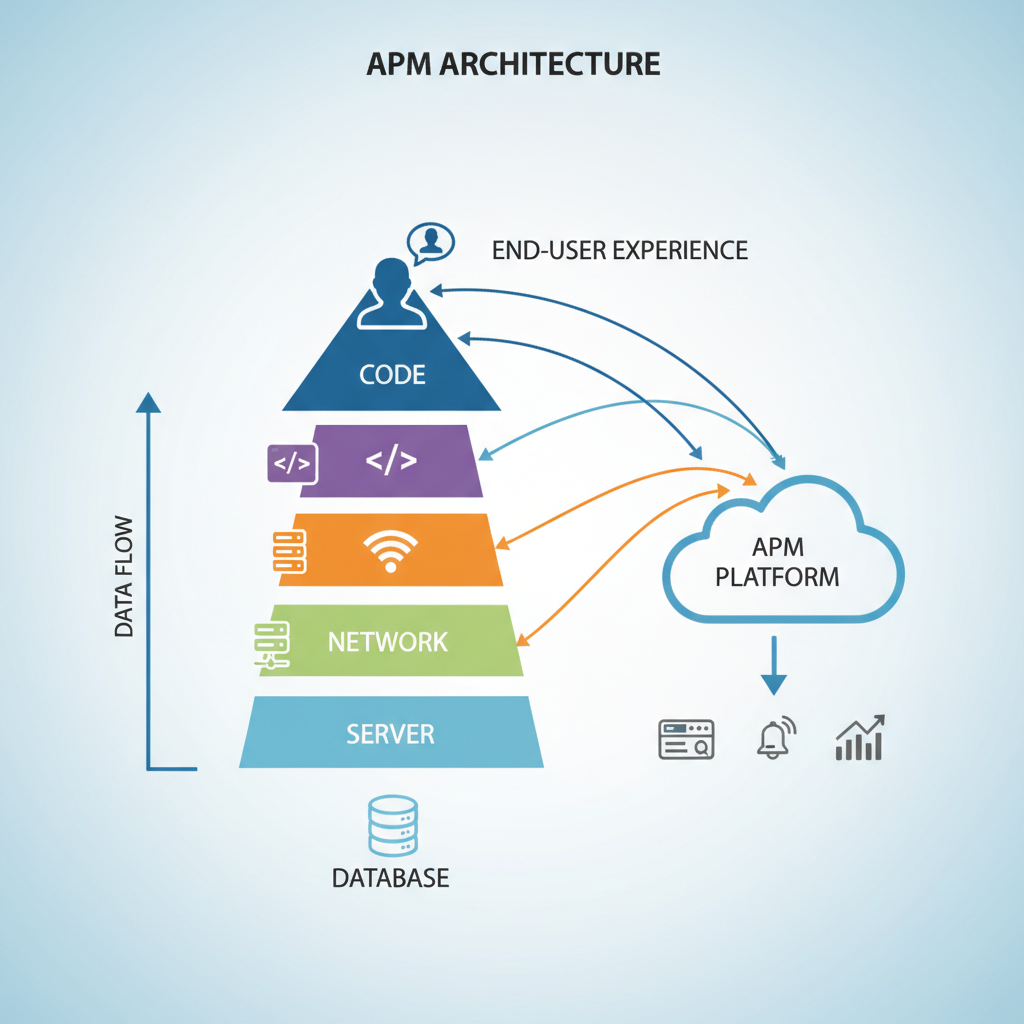
Application Performance Management (APM) is a comprehensive strategy and set of tools used to monitor and manage the performance and availability of software applications. Its primary focus is on understanding the internal workings of an application, from code execution to database interactions, to identify and resolve performance bottlenecks proactively. APM ensures that applications deliver a smooth and responsive experience for end-users.
APM goes beyond external availability checks by delving deep into the application’s components and infrastructure. It provides granular insights into transactions, resource consumption, and error rates within the application stack. This detailed visibility allows development and operations teams to diagnose root causes of performance issues swiftly.
A detailed diagram showing the different layers of APM monitoring an application, including code, database, server, network, and end-user experience components, with arrows indicating data flow.
Key Capabilities of APM
APM solutions offer a holistic view of application health, providing actionable data for technical teams. They are instrumental in maintaining high application quality and user satisfaction. This internal focus is a significant point of divergence in the Cloud sla monitoring vs apm discussion.
Essential capabilities include:
End-User Experience Monitoring (EUM): Tracking how actual users interact with the application, including page load times, click-through rates, and geographical performance variations. This offers a real-world perspective on user satisfaction.
Application Topology Mapping: Automatically discovering and mapping the interconnected components of an application, including servers, databases, and microservices. This helps visualize complex architectures.
Transaction Tracing: Following individual user requests or business transactions across multiple services and tiers. This pinpoints exactly where delays or errors occur within the application flow.
Code-Level Diagnostics: Identifying inefficient code, slow queries, or resource-intensive operations within the application’s source code. This capability is invaluable for developers.
Database Performance Monitoring: Analyzing database queries, connection pools, and overall database health to ensure optimal data access. Databases are often common culprits for performance issues.
Server and Infrastructure Monitoring: Keeping an eye on CPU utilization, memory usage, disk I/O, and network activity of the underlying servers hosting the application. This ensures the infrastructure supports the application effectively.
Anomaly Detection and Alerting: Automatically identifying deviations from normal application behavior and notifying relevant teams. This allows for proactive issue resolution before users are significantly impacted.
APM provides the granular detail needed by technical teams to optimize, troubleshoot, and scale applications effectively. It’s an invaluable tool for developers and operations teams seeking to understand “why” an application is performing a certain way, contrasting sharply with the “whether” focus of SLA monitoring.
Key Differences: Cloud SLA Monitoring vs APM
The fundamental difference between Cloud SLA monitoring vs APM lies in their scope, focus, and audience. While both contribute to ensuring digital service quality, they address different layers of the service delivery stack and cater to distinct stakeholders. This SLA monitoring comparison with APM highlights these essential distinctions.
Cloud SLA monitoring is primarily an external, contractual perspective, verifying compliance against agreed-upon service levels. It looks at the “what” – what is the service availability and response time from an external viewpoint. APM, conversely, is an internal, operational perspective, delving into the “how” and “why” of application performance. It investigates how an application functions and why it might be experiencing issues.
The difference between SLA and APM can be summarized by considering their primary objectives. SLA monitoring aims to validate external commitments and ensure business continuity from a contractual standpoint. APM aims to optimize the internal performance of applications, enhance user experience, and empower technical teams with deep diagnostic capabilities.
This table clearly illustrates the divergent paths of Cloud sla monitoring vs apm. One provides the strategic overview and accountability, while the other offers the tactical, granular insights required for technical excellence.
ENSURE UNINTERRUPTED SERVICE
Ensure uninterrupted service delivery and proactively prevent costly SLA breaches. Leverage our automated, real
✓ Free consultation ✓ No commitment required ✓ Trusted by experts
APM and Cloud Service Levels: How They Interact
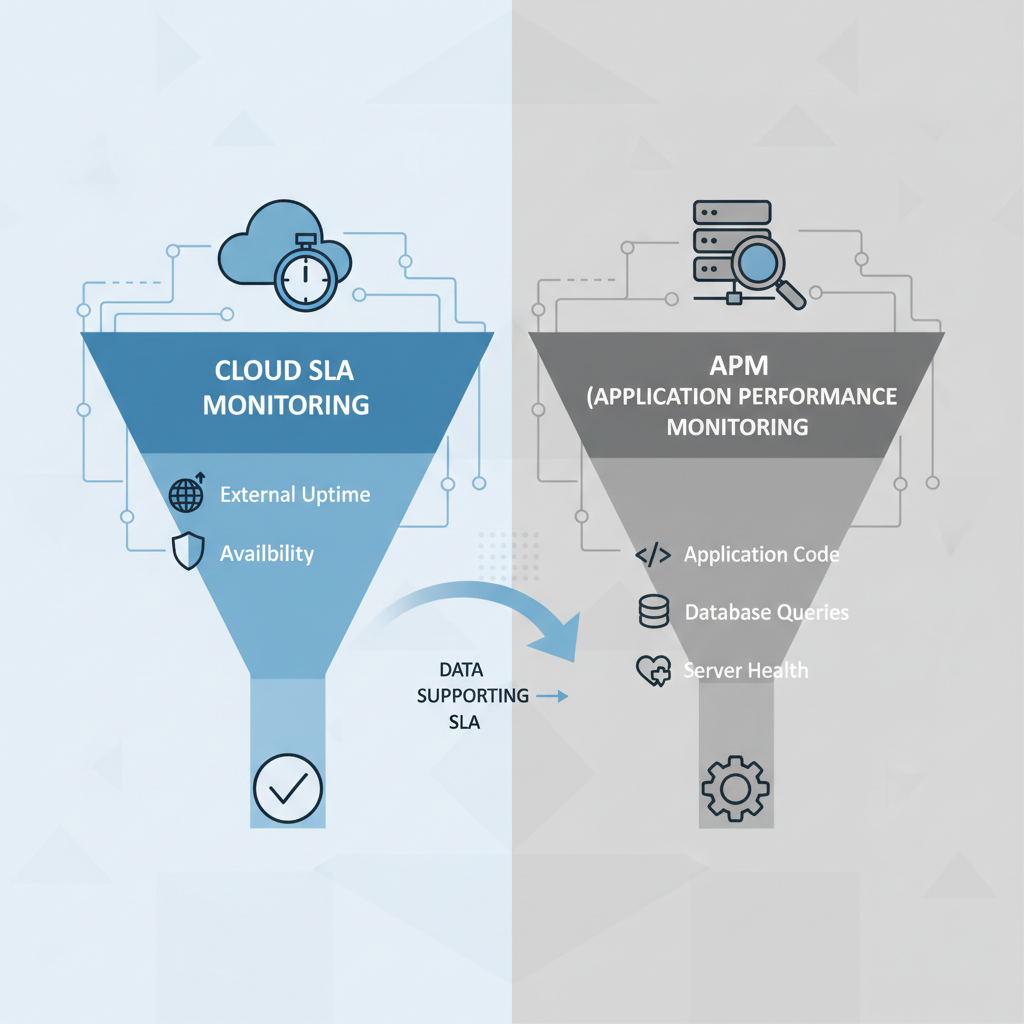
While distinct, APM and cloud service levels are not mutually exclusive; in fact, they are intrinsically linked. APM can provide the critical data necessary to understand and improve performance metrics that directly contribute to meeting cloud service levels. Without effective APM, meeting stringent SLA targets, especially those related to performance and responsiveness, becomes significantly more challenging.
Consider an SLA that guarantees an application’s average response time will not exceed 500 milliseconds. Cloud SLA monitoring would report whether this target is being met from an external perspective. However, if the target is consistently missed, APM tools become indispensable. They would quickly identify if a slow database query, an inefficient microservice, or a third-party API call is the bottleneck. This demonstrates how SLA monitoring and application performance management complement each other.
A comparative infographic showing two parallel funnels. One funnel represents Cloud SLA Monitoring focusing on external uptime and availability, while the other represents APM drilling down into application code, database queries, and server health. An arrow indicates APM data feeding into or supporting SLA compliance.
APM provides the operational intelligence required to proactively manage and optimize application performance, thereby supporting the achievement of Cloud SLA commitments. It’s the engine that helps ensure the promises made in SLAs can be fulfilled consistently. Without a robust APM strategy, cloud service levels become aspirational rather than achievable targets.
When to Use SLA vs APM
Deciding when to use SLA vs APM isn’t a matter of choosing one over the other in a modern cloud environment; rather, it’s about understanding their distinct applications and how they integrate. Each solution serves a specific purpose, and recognizing these roles is key to a robust monitoring strategy. A nuanced understanding of Cloud sla monitoring vs apm guide is crucial for optimal operations.
You rely heavily on Cloud SLA monitoring when your primary concern is validating provider performance and ensuring contractual compliance. This is especially true for services outside your direct control, such as Infrastructure as a Service (IaaS) or Platform as a Service (PaaS) offerings. It’s your external report card on your cloud provider.
Conversely, you primarily leverage APM when your focus is on the performance of your own applications, whether they run in the cloud or on-premises. This includes custom-built software, microservices, and complex enterprise applications where deep visibility into code, dependencies, and user experience is crucial for optimization and troubleshooting.
Specific Scenarios for Each
Let’s explore specific scenarios for using Cloud SLA monitoring and APM. This helps illustrate their individual strengths and applications, providing a clearer picture for informed decision-making.
Cloud SLA Monitoring is essential for:
Vendor Accountability: Verifying that your cloud provider delivers on its promised uptime, latency, and service reliability.
Cost Management: Ensuring you receive the service level you are paying for and identifying potential grounds for service credits.
Business Continuity Planning: Understanding the impact of provider-side issues on your overall business operations and mitigating risks.
Compliance and Governance: Meeting regulatory requirements that mandate specific service availability or performance thresholds from third-party vendors.
External Service Dependencies: Monitoring the performance of external APIs, SaaS applications, or other cloud services you integrate with.
APM is essential for:
Application Development and Optimization: Identifying performance bottlenecks in code, database queries, and API calls during development and post-deployment.
Proactive Problem Resolution: Detecting anomalies and performance degradations before they impact a significant number of users.
Root Cause Analysis: Quickly pinpointing the exact cause of an application error or slowdown, reducing mean time to resolution (MTTR).
User Experience Enhancement: Monitoring real user interactions to understand performance from their perspective and make informed improvements.
Capacity Planning: Gaining insights into resource utilization to make informed decisions about scaling application infrastructure.
Microservices Performance: Tracking distributed transactions across complex microservices architectures to ensure end-to-end performance.
In essence, Cloud SLA monitoring tells you if a service is meeting expectations externally, while APM tells you why or why not an application is performing internally. Both are vital for a comprehensive operational strategy.
Complementary Monitoring Solutions: Cloud SLA Monitoring and APM Working Together
The most effective strategy for managing cloud environments and applications is not to choose between Cloud SLA monitoring vs APM, but to integrate them. These two approaches are powerful complementary monitoring solutions, each providing unique insights that, when combined, create a holistic view of your entire digital service delivery chain. They offer a layered defense against performance issues and service disruptions.
By combining the external validation of Cloud SLA monitoring with the internal diagnostics of APM, organizations gain unparalleled visibility. SLA monitoring provides the high-level business perspective, while APM offers the deep technical insights. This integrated approach allows businesses to not only identify service degradations but also to swiftly diagnose and rectify the underlying causes. This truly represents the best Cloud sla monitoring vs apm strategy.
Benefits of an Integrated Approach
Integrating Cloud SLA monitoring and APM yields significant advantages for both business stakeholders and technical teams. This combined power ensures both contractual compliance and operational excellence, which are critical in today’s cloud-first world. The synergy enhances overall system reliability and user satisfaction.
Key benefits include:
Holistic Visibility: Gaining a complete end-to-end view from the external user perspective to the internal code execution. This eliminates blind spots and provides comprehensive operational context.
Faster Root Cause Analysis: When an SLA violation is detected, APM data can immediately provide the granular details needed to pinpoint the exact problem area, drastically reducing troubleshooting time.
Proactive Issue Resolution: APM can often detect subtle performance degradations before they escalate into full-blown SLA breaches, allowing teams to intervene preemptively.
Improved Communication: Bridging the gap between business expectations (SLA) and technical reality (APM data). This facilitates clearer communication between IT and business units.
Enhanced User Experience: By optimizing application performance with APM and ensuring cloud service reliability with SLA monitoring, end-users consistently receive a superior experience.
Informed Decision Making: Data from both systems informs capacity planning, architectural decisions, and vendor management strategies. This leads to more efficient resource allocation.
Stronger Vendor Relationships: Demonstrating SLA non-compliance with detailed APM data provides concrete evidence for discussions with cloud providers, leading to better outcomes.
An integrated approach transforms monitoring from a reactive chore into a proactive, strategic advantage. It moves beyond simply knowing if there’s a problem to understanding where and why, facilitating rapid resolution and continuous improvement.
Implementing a Unified Monitoring Strategy for Cloud sla monitoring vs apm
Implementing a unified strategy that leverages both Cloud SLA monitoring and APM requires careful planning and the right tools. It’s not just about installing software; it’s about defining processes, aligning teams, and creating a feedback loop between external performance and internal diagnostics. This systematic approach ensures maximum effectiveness.
The goal is to create a seamless flow of information that connects external service health with internal application performance. When an external metric begins to degrade, APM should be ready to provide immediate, deep insights. Conversely, internal application issues identified by APM should be correlated with potential impacts on external SLAs. This is a practical Cloud sla monitoring vs apm guide to implementation.
Steps for an Integrated Implementation
Follow these steps to successfully integrate Cloud SLA monitoring and APM within your organization. This structured approach helps ensure all aspects are considered, from tool selection to team collaboration.
1. Define Your SLAs and SLOs (Service Level Objectives): Clearly establish the contractual SLAs with your cloud providers and internal SLOs for your applications. These metrics will serve as your benchmarks. 2. Select Compatible Tools: Choose Cloud SLA monitoring tools that can track external metrics and APM solutions that provide deep internal visibility. Ideally, these tools should offer integration capabilities or a unified dashboard. 3. Map Dependencies: Understand how your applications rely on underlying cloud infrastructure and third-party services. This mapping helps correlate issues across the stack. 4. Implement Comprehensive Instrumentation: Ensure your applications are properly instrumented with APM agents to collect all necessary telemetry data, including traces, metrics, and logs. 5. Configure Alerts and Dashboards: Set up alerts for both SLA thresholds and APM-identified anomalies. Create dashboards that provide a consolidated view, showing both external service health and internal application performance. 6. Establish Incident Response Workflows: Define clear procedures for how teams will respond when an SLA alert or an APM alert is triggered. This should include escalation paths and collaboration mechanisms. 7. Regularly Review and Optimize: Continuously review monitoring data, alert thresholds, and incident response processes. Adjust your strategy as your applications and cloud environment evolve.
By following these steps, organizations can build a robust monitoring framework that provides continuous insight into both cloud service levels and application performance. This holistic view is crucial for maintaining high reliability and user satisfaction in the cloud.
Best Practices for Cloud SLA Monitoring and APM
To maximize the value derived from both Cloud SLA monitoring and APM, adopting best practices is essential. These practices ensure that your monitoring strategy is not only effective but also efficient and sustainable. Implementing these Cloud sla monitoring vs apm tips will significantly improve your operational posture.
Effective monitoring goes beyond just collecting data; it involves smart data utilization, proactive issue management, and continuous refinement of your approach. These best practices will help you get the most out of your investment in monitoring tools and processes, whether you are dealing with Cloud sla monitoring vs apm examples or complex hybrid scenarios.
Actionable Tips for Optimal Monitoring
Here are some actionable tips to ensure your Cloud SLA monitoring and APM efforts are successful:
Automate Everything Possible: Automate the collection of monitoring data, alert generation, and initial diagnostic steps. This reduces manual effort and speeds up response times.
Focus on Key Metrics: Don’t try to monitor everything. Identify the most critical metrics and KPIs that directly impact business outcomes and user experience for both SLA and APM.
Establish Clear Baselines: Understand what “normal” performance looks like for your cloud services and applications. This allows for accurate anomaly detection and threshold setting.
Implement Proactive Alerting: Configure alerts for early warning signs of potential issues, not just when a service is already down. Leverage predictive analytics where available.
Integrate Tools and Data: Connect your Cloud SLA monitoring tools with your APM platform. Centralize data where possible to provide a unified view for all stakeholders.
Regularly Review and Test Alerts: Periodically review your alert configurations to ensure they are still relevant and effective. Test your incident response procedures to identify any weaknesses.
Promote Collaboration: Foster a culture of collaboration between development, operations, and business teams. Share monitoring insights to align everyone on performance goals.
Use Synthetic Monitoring: Supplement real user monitoring with synthetic transactions for key business processes. This allows you to test performance from various locations and user paths, providing consistent baseline data for Cloud sla monitoring vs apm examples.
Leverage Distributed Tracing: For complex microservices, distributed tracing within APM is invaluable. It helps visualize transaction flows across multiple services and identify performance bottlenecks at a granular level.
Document Everything: Maintain clear documentation of your monitoring strategy, tool configurations, alert thresholds, and incident response procedures. This ensures consistency and facilitates onboarding.
By adhering to these best practices, organizations can build a robust, efficient, and highly effective monitoring strategy that drives continuous improvement and ensures the reliability of their cloud services and applications. This comprehensive approach effectively manages the challenges presented by Cloud sla monitoring vs apm.
Frequently Asked Questions
Understanding Cloud SLA monitoring vs APM can sometimes lead to further questions. This FAQ section addresses common queries to provide additional clarity and reinforce key concepts. These insights are crucial for grasping the practical implications of both monitoring disciplines.
What is the primary distinction between Cloud SLA monitoring and APM?
The primary distinction lies in their scope and focus. Cloud SLA monitoring verifies external contractual commitments from a cloud provider, concentrating on uptime and general service availability. APM, on the other hand, delves into the internal performance of an application itself, analyzing code, transactions, and infrastructure to optimize and troubleshoot.
Can I achieve good application performance with just Cloud SLA monitoring?
No, solely relying on Cloud SLA monitoring is insufficient for ensuring good application performance. While it confirms the cloud provider’s service levels, it offers no insight into the internal workings of your application. APM is necessary to diagnose, optimize, and improve the actual user experience and application efficiency.
Is APM only for cloud-based applications?
No, APM is not exclusively for cloud-based applications. While it is highly valuable in cloud environments due to their dynamic nature, APM tools can monitor applications deployed in hybrid environments, on-premises data centers, and traditional monolithic architectures. Its focus is on the application regardless of its deployment location.
How do Cloud SLA monitoring and APM work together effectively?
They work together by providing a complete picture. Cloud SLA monitoring flags external service degradation or non-compliance, indicating a problem at a high level. APM then provides the necessary internal data and diagnostics to pinpoint the root cause of that problem within your application or underlying infrastructure, allowing for rapid resolution.
Which solution is more important for a business?
Both solutions are crucial for different reasons. Cloud SLA monitoring is vital for business accountability, vendor management, and ensuring contractual obligations are met. APM is critical for technical teams to ensure application quality, user satisfaction, and operational efficiency. Neither is “more important”; they are complementary and equally essential for a healthy digital business.
Are there tools that combine both Cloud SLA monitoring and APM functionalities?
Yes, many modern observability platforms offer integrated capabilities that span both Cloud SLA monitoring and APM. These platforms aim to provide a unified view of your entire IT ecosystem, allowing you to monitor external SLAs and dive deep into internal application performance from a single dashboard. This integration simplifies management and improves correlation.
ENSURE UNINTERRUPTED SERVICE
Ensure uninterrupted service delivery and proactively prevent costly SLA breaches. Leverage our automated, real
✓ Free consultation ✓ No commitment required ✓ Trusted by experts
Conclusion
Navigating the complexities of cloud environments requires a sophisticated approach to monitoring, one that acknowledges the distinct yet complementary roles of Cloud SLA monitoring vs APM. While Cloud SLA monitoring focuses on external compliance and contractual guarantees from your cloud provider, APM delves into the granular internal performance of your applications. Understanding this fundamental difference is the first step toward building a resilient digital infrastructure.
By integrating these two powerful methodologies, organizations can achieve an unparalleled level of visibility and control. This combined strategy ensures that cloud service levels are met, applications perform optimally, and end-users consistently receive a superior experience. Embracing both Cloud SLA monitoring and APM is not just a best practice; it’s a strategic imperative for success in the cloud-first era.
Jacob Stålbro is a seasoned digitalization and transformation leader with over 20 years of experience, specializing in AI-driven innovation. As Head of Innovation and Co-Founder at Opsio, he drives the development of advanced AI, ML, and IoT solutions. Jacob is a sought-after speaker and webinar host known for translating emerging technologies into real business value and future-ready strategies.