Yes, Real-Time Cloud SLA Monitoring Is Possible Today
March 6, 2026|1:30 PM
Unlock Your Digital Potential
Whether it’s IT operations, cloud migration, or AI-driven innovation – let’s explore how we can support your success.
Home /
Work /
Blogs /
Yes, Real-Time Cloud SLA Monitoring Is Possible Today
Navigating the Cloud: is real-time Cloud sla monitoring possible?
In today’s dynamic digital landscape, businesses increasingly rely on cloud services to power their operations. Ensuring these services meet agreed-upon performance standards is critical, making Service Level Agreements (SLAs) more important than ever. The crucial question that arises for many organizations is: is real-time Cloud sla monitoring possible? The definitive answer is yes, and it has become an indispensable practice for maintaining robust cloud environments and ensuring service reliability. This comprehensive guide will explore the feasibility, mechanisms, benefits, and best practices involved in achieving real-time visibility into your cloud SLAs.
Understanding Cloud SLAs and Their Importance
Cloud Service Level Agreements (SLAs) are formal contracts between a cloud provider and a customer, outlining the minimum expected performance, availability, and reliability of a cloud service. These agreements typically cover various metrics, including uptime guarantees, response times, data availability, and disaster recovery commitments. Adhering to these SLAs is paramount for business continuity and user satisfaction.
For many enterprises, an SLA breach can lead to significant financial losses, reputational damage, and operational disruptions. Therefore, understanding the terms of your cloud SLAs is the first step toward effective management. These agreements establish a baseline for what constitutes acceptable service, making proactive monitoring an absolute necessity.
The Challenge of Real-Time Monitoring in the Cloud
While the concept of monitoring services is not new, the cloud introduces unique complexities that challenge traditional approaches. The highly distributed, elastic, and ephemeral nature of cloud infrastructure makes achieving real-time SLA monitoring feasibility a more intricate task. Resources can scale up and down rapidly, virtual machines come and go, and workloads shift across different regions and providers.
Traditional monitoring often relies on static infrastructure and predictable resource allocation. In contrast, cloud environments demand agile, automated, and comprehensive monitoring solutions that can keep pace with constant change. Overcoming these hurdles is essential for gaining immediate service level updates and ensuring compliance with your agreed-upon performance targets.
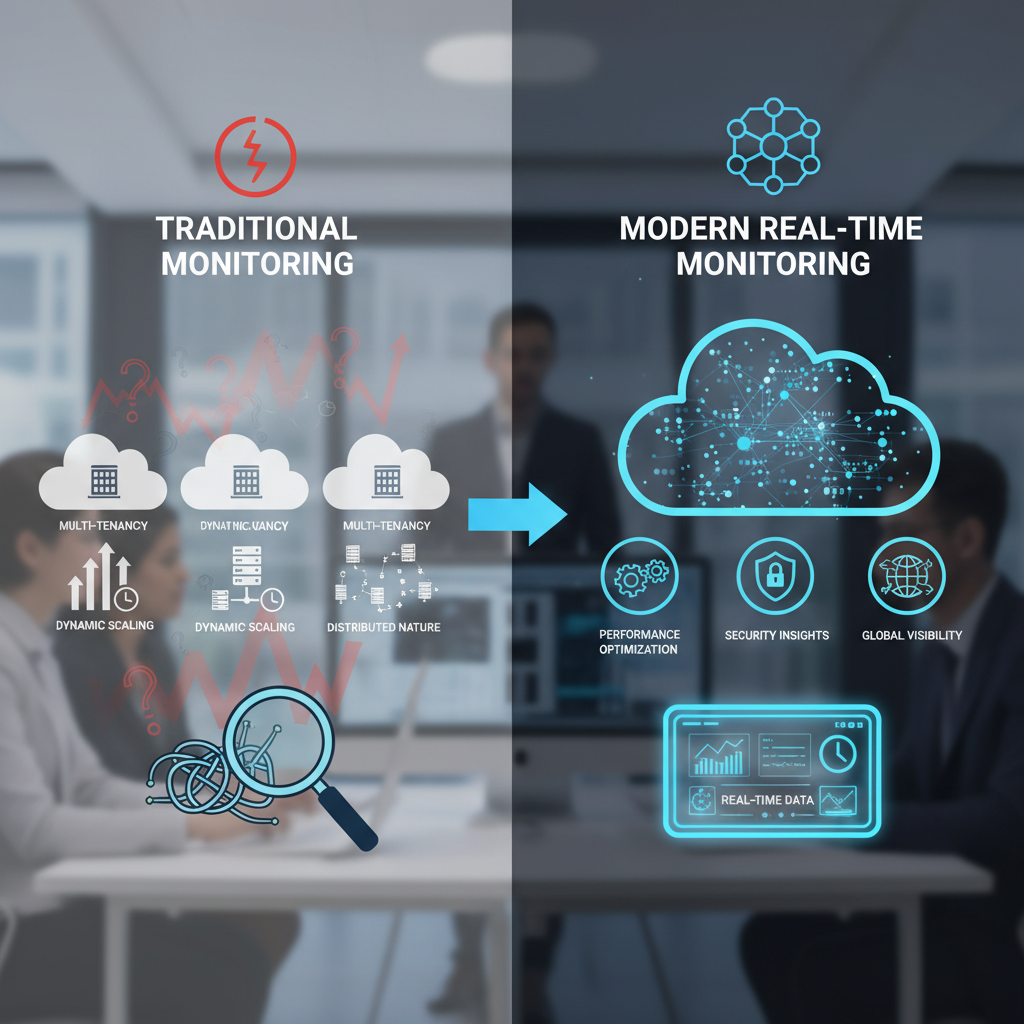
A detailed infographic illustrating the complexities of cloud environments (multi-tenancy, dynamic scaling, distributed nature) and how traditional monitoring struggles to adapt, while modern real-time monitoring solutions offer a comprehensive view.
The good news is that advancements in monitoring technologies have made sophisticated, real-time Cloud SLA monitoring not only possible but also highly effective. A combination of diverse tools and strategies provides the instant cloud performance visibility necessary for modern cloud operations. These technologies work in concert to collect, analyze, and present critical data with minimal delay.
Several key approaches contribute to robust live SLA tracking capabilities. These range from agent-based solutions embedded within virtual machines to synthetic transactions mimicking user behavior. Understanding these tools is fundamental to building a comprehensive monitoring strategy.
API-based Monitoring: Most cloud providers offer extensive APIs that allow third-party tools to collect metrics and status updates directly from their services. This method provides deep insights into the provider’s infrastructure and service health.
Agent-based Monitoring: Lightweight agents installed on virtual machines or containers collect performance data, resource utilization, and application-specific metrics. These agents offer granular insights into individual components within your cloud deployment.
Synthetic Monitoring: This involves simulating user interactions and transactions with your cloud-based applications from various geographical locations. Synthetic monitoring proactively identifies performance issues before actual users encounter them, providing crucial real-time SLA monitoring feasibility insights.
Real User Monitoring (RUM): RUM collects data directly from actual end-users interacting with your application. It provides an authentic view of user experience, capturing page load times, error rates, and interaction delays as they happen.
Cloud-Native Monitoring Tools: Major cloud providers like AWS CloudWatch, Azure Monitor, and Google Cloud Monitoring offer integrated services designed specifically for their platforms. These tools provide extensive metrics, logs, and alerting capabilities tailored to their respective ecosystems.
AI/ML for Anomaly Detection: Artificial intelligence and machine learning algorithms can analyze vast amounts of monitoring data to identify unusual patterns or deviations from normal behavior. This helps in proactive problem detection and reduces alert fatigue.
Centralized Dashboards and Visualization: Aggregating data from various sources into a single, intuitive dashboard is crucial. Tools like Grafana, Datadog, or specific cloud provider dashboards offer powerful visualization capabilities, enabling quick comprehension of complex data.
ENSURE UNINTERRUPTED SERVICE
Ensure uninterrupted service delivery and proactively prevent costly SLA breaches. Leverage our automated, real
✓ Free consultation ✓ No commitment required ✓ Trusted by experts
How Real-Time Cloud SLA Monitoring Works in Practice
Implementing real-time Cloud SLA monitoring involves a structured approach to data collection, analysis, and response. The goal is to move beyond periodic checks to continuous, instantaneous oversight, ensuring immediate service level updates. This process allows organizations to maintain vigilant awareness of their cloud environment’s health and performance.
Here’s a breakdown of the typical workflow:
1. Define Key Performance Indicators (KPIs): Identify the critical metrics tied directly to your SLAs, such as availability percentage, latency, error rates, and throughput. These KPIs form the basis of your monitoring strategy. 2. Instrument Your Environment: Deploy monitoring agents, configure API integrations, and set up synthetic transactions across your cloud infrastructure and applications. Ensure comprehensive coverage for all critical components. 3. Data Collection and Ingestion: Continuously gather data from all instrumentation points. This data is then ingested into a centralized monitoring platform, which acts as a single source of truth for all performance metrics. 4. Real-Time Data Processing: The ingested data is processed and analyzed in real-time, often leveraging stream processing technologies. This immediate analysis is vital for detecting anomalies as they occur, supporting the real-time SLA monitoring feasibility. 5. Baseline Establishment and Threshold Setting: Establish normal operating baselines for your KPIs and define thresholds that, when breached, indicate a potential or actual SLA violation. These thresholds trigger alerts. 6. Automated Alerting and Notification: When a threshold is crossed, the system automatically triggers alerts through various channels such as email, SMS, Slack, or incident management platforms. This ensures that relevant teams are notified instantly. 7. Visualization and Reporting: Present collected data and alert information through interactive dashboards. These dashboards provide instant cloud performance visibility, allowing operations teams to quickly understand the current state of services and track SLA compliance over time. 8. Automated Remediation (Optional but Recommended): In some advanced setups, certain alerts can trigger automated scripts or workflows to address common issues, such as scaling up resources or restarting services. This further enhances responsiveness.
Key Benefits of Real-Time Cloud SLA Monitoring
The implementation of robust, real-time Cloud SLA monitoring brings a multitude of advantages that significantly impact business operations, customer satisfaction, and financial performance. These benefits extend beyond simple problem detection to proactive management and strategic decision-making. Organizations gain a competitive edge by leveraging immediate service level updates.
Proactive Problem Resolution: By detecting performance degradation or potential issues in their infancy, teams can address problems before they escalate into full-blown outages or SLA breaches. This proactive approach minimizes downtime and mitigates negative impact.
Improved Customer Satisfaction: Consistent adherence to SLAs directly translates to a better user experience. Customers benefit from reliable, high-performing services, fostering trust and loyalty.
Enhanced Operational Efficiency: Automated monitoring reduces the need for manual checks, freeing up IT staff to focus on more strategic tasks. Rapid issue identification also shortens mean time to resolution (MTTR).
Better Resource Optimization: Real-time insights into resource utilization help organizations identify inefficiencies, right-size their cloud infrastructure, and avoid unnecessary cloud spending. This ensures resources are allocated optimally.
Compliance and Auditing Support: Accurate, real-time data provides verifiable proof of SLA adherence, which is crucial for regulatory compliance, internal audits, and demonstrating accountability to stakeholders.
Informed Decision-Making: With a constant stream of reliable performance data, businesses can make better-informed decisions regarding capacity planning, infrastructure upgrades, and cloud migration strategies. This supports long-term growth and stability.
Best Practices for Implementing Real-Time Cloud SLA Monitoring
Achieving effective real-time Cloud SLA monitoring requires more than just deploying tools; it demands a strategic approach and adherence to best practices. Following these guidelines will ensure your monitoring efforts are robust, efficient, and truly beneficial. These are some of the best is real-time Cloud sla monitoring possible tips.
Clearly Define SLA Objectives: Before implementing any monitoring, thoroughly understand and document your SLAs. What specific metrics are guaranteed? What are the thresholds for acceptable performance? This clarity is fundamental.
Choose the Right Monitoring Tools: Select a suite of tools that align with your cloud environment, application stack, and budget. Consider a combination of cloud-native, third-party, and open-source solutions to ensure comprehensive coverage and live SLA tracking capabilities.
Establish Baseline Performance: Monitor your systems during periods of normal operation to establish benchmarks. These baselines are essential for accurately identifying deviations and setting meaningful alert thresholds.
Implement Comprehensive Alerting: Configure alerts for all critical SLA metrics, ensuring they reach the right people at the right time. Differentiate between informational alerts, warnings, and critical incidents. Avoid alert fatigue by fine-tuning thresholds.
Regularly Review and Refine: Cloud environments are constantly evolving. Periodically review your monitoring configurations, thresholds, and alert rules to ensure they remain relevant and effective. Adapt your strategy as your cloud footprint changes.
Integrate Monitoring with Incident Management: Connect your monitoring system with your incident response and ticketing platforms. This streamlines the process of issue escalation, tracking, and resolution.
Visualize Data Effectively: Utilize dashboards that present critical SLA metrics clearly and concisely. Visualizations help teams quickly grasp the state of services and identify trends, providing instant cloud performance visibility.
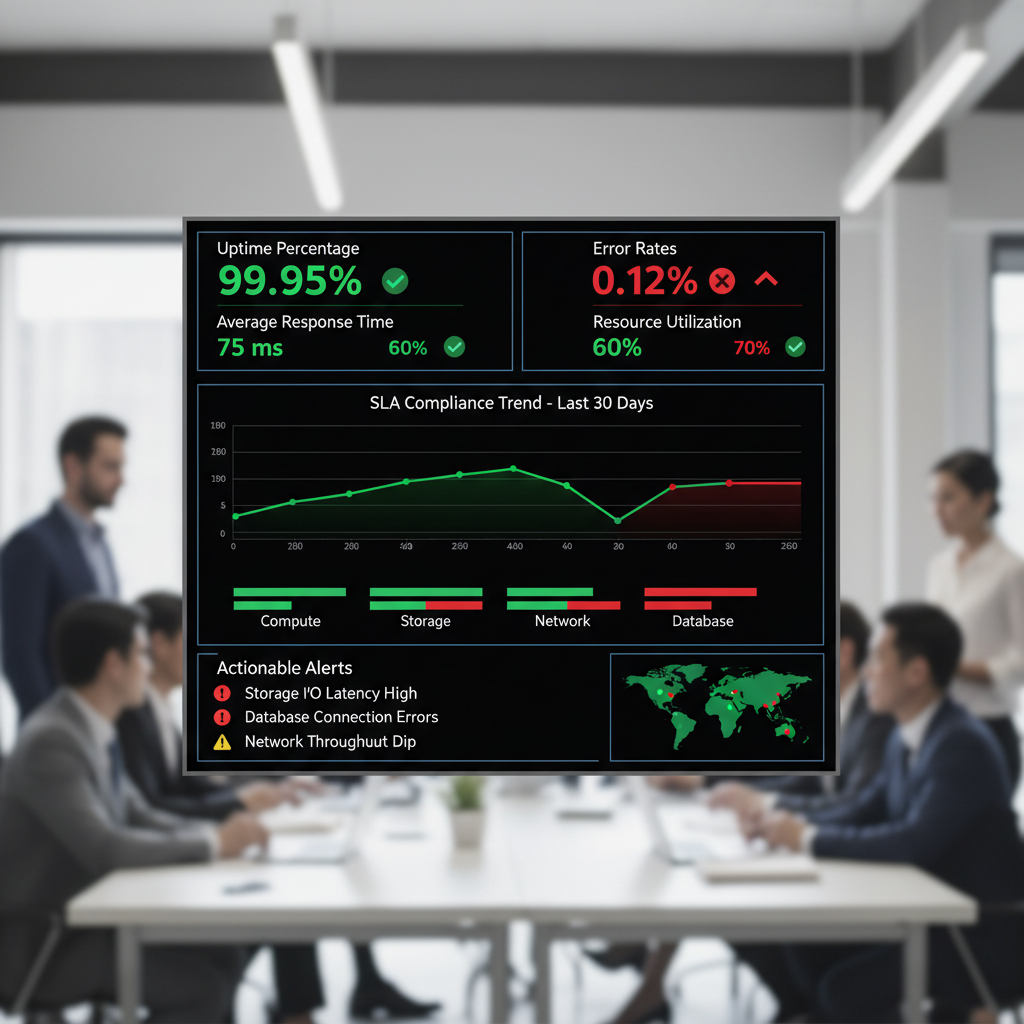
A dashboard displaying various real-time cloud SLA metrics such as uptime percentage, average response time, error rates, and resource utilization, with clear green/red indicators for SLA compliance and actionable alerts.
Real-World Examples and Use Cases
The application of real-time Cloud SLA monitoring spans across virtually every industry leveraging cloud technology. These is real-time Cloud sla monitoring possible examples illustrate how diverse organizations benefit from constant vigilance. From critical financial transactions to streaming media, immediate service level updates are non-negotiable.
E-commerce Platforms: An online retailer relies heavily on high availability and fast transaction processing. Real-time monitoring tracks website uptime, shopping cart performance, and payment gateway response times. Any slowdown or outage is immediately flagged, preventing lost sales and customer frustration.
SaaS Application Providers: A Software-as-a-Service company must guarantee specific uptime and performance metrics to its subscribers. Real-time monitoring continuously checks application availability, API response times, and database query speeds across all regions. This ensures contractual obligations are met and customer churn is minimized.
Financial Services: Banks and trading platforms operate under stringent regulatory compliance and demand absolute uptime. Real-time monitoring tracks the availability and latency of financial transaction systems, data integrity, and compliance with strict data residency requirements. This prevents massive financial losses and maintains regulatory standing.
Healthcare Providers: Patient data and critical medical applications require unwavering availability and security. Real-time monitoring ensures continuous access to electronic health records (EHRs), monitors the performance of telehealth platforms, and validates data transmission security, directly impacting patient care and safety.
Overcoming Common Challenges
While real-time Cloud SLA monitoring is highly beneficial, organizations often encounter several challenges during implementation and ongoing management. Addressing these proactively is key to a successful monitoring strategy.
Alert Fatigue: Too many non-actionable alerts can desensitize operations teams. Refine your thresholds, use intelligent alert grouping, and leverage AI/ML for anomaly detection to reduce noise.
Data Noise vs. Signal: Sifting through vast amounts of monitoring data to find meaningful insights can be overwhelming. Focus on key SLA-related metrics, use robust analytics, and prioritize actionable data.
Integration Complexity: Integrating various monitoring tools, cloud services, and legacy systems can be complex. Prioritize tools with strong API support and look for unified monitoring platforms that offer broad integration capabilities.
Cost Management: Monitoring tools and data ingestion can become expensive at scale. Regularly review your monitoring scope, optimize data retention policies, and leverage cost-effective cloud-native monitoring options where appropriate.
Ensuring Full Coverage: In dynamic cloud environments, ensuring every new service or scaled-up resource is under monitoring can be difficult. Implement automated deployment of monitoring agents and configuration as part of your CI/CD pipelines to ensure continuous coverage.
Future Trends in Cloud SLA Monitoring
The landscape of cloud technology is perpetually evolving, and real-time SLA monitoring is no exception. Several emerging trends promise to make monitoring even more sophisticated, proactive, and intelligent. These advancements further solidify the answer to “is real-time Cloud sla monitoring possible” with a resounding yes.
AIOps Integration: Artificial Intelligence for IT Operations (AIOps) will increasingly automate the detection, analysis, and even remediation of issues. AIOps platforms will correlate events across vast datasets, predict outages, and suggest solutions, moving beyond simple alerting to intelligent incident management.
Serverless Monitoring: As serverless architectures grow in popularity, monitoring will need to adapt to even more ephemeral and event-driven computing models. Specialized tools for tracking function execution, cold start times, and event source integrations will become standard.
Predictive Analytics: Leveraging historical data and machine learning, monitoring systems will become more adept at predicting potential SLA breaches before they occur. This allows for truly proactive intervention and preventative maintenance.
Automated Remediation: Beyond just alerting, future systems will incorporate more automated self-healing capabilities. Simple, well-defined issues could trigger automated scripts to resolve problems without human intervention, ensuring even faster recovery times.
Observability Platforms: The shift from traditional monitoring to full observability, encompassing logs, metrics, and traces, will provide a holistic view of system behavior and deeper insights into root causes of performance issues.
Frequently Asked Questions
What exactly is real-time Cloud SLA monitoring?
Real-time Cloud SLA monitoring involves continuously tracking and analyzing the performance, availability, and reliability of cloud services against predefined Service Level Agreement (SLA) metrics. It provides immediate updates on service health and alerts stakeholders to potential or actual breaches as they happen, ensuring immediate service level updates.
Why is real-time monitoring critical for cloud services?
Real-time monitoring is critical because cloud environments are dynamic and distributed, making traditional monitoring insufficient. It enables proactive problem resolution, minimizes downtime, improves customer satisfaction, ensures compliance, and allows for rapid response to performance degradations, all contributing to instant cloud performance visibility.
What technologies make real-time SLA tracking possible?
A combination of technologies enables real-time SLA tracking, including API-based monitoring, agent-based monitoring, synthetic monitoring, Real User Monitoring (RUM), cloud-native tools (like AWS CloudWatch), and AI/ML for anomaly detection. These diverse tools contribute to the real-time SLA monitoring feasibility.
How can I set up effective real-time Cloud SLA monitoring?
To set up effective monitoring, first, define clear SLA objectives and KPIs. Then, select appropriate monitoring tools, establish performance baselines, configure comprehensive alerting, and integrate with incident management systems. Regularly review and refine your strategy to ensure it remains relevant, embodying the best is real-time Cloud sla monitoring possible tips.
What are the biggest challenges in monitoring cloud SLAs in real-time?
Common challenges include managing alert fatigue, distinguishing meaningful signals from data noise, integrating diverse monitoring tools, controlling costs associated with extensive monitoring, and ensuring complete coverage across dynamic cloud infrastructures. Addressing these requires a strategic and adaptable approach.
Can real-time monitoring prevent SLA breaches?
While real-time monitoring cannot prevent all SLA breaches, it significantly reduces their likelihood and impact. By providing early warnings of performance degradations and potential issues, it allows teams to intervene proactively, often resolving problems before they escalate into full-blown breaches, enhancing live SLA tracking capabilities.
ENSURE UNINTERRUPTED SERVICE
Ensure uninterrupted service delivery and proactively prevent costly SLA breaches. Leverage our automated, real
✓ Free consultation ✓ No commitment required ✓ Trusted by experts
Conclusion
The question “is real-time Cloud sla monitoring possible” has been decisively answered: not only is it possible, but it is an essential component of modern cloud operations. Organizations leveraging real-time SLA monitoring gain unparalleled visibility, control, and agility in managing their cloud services. By understanding the underlying technologies, implementing best practices, and staying abreast of future trends, businesses can ensure their cloud investments deliver consistent performance, maintain high levels of customer satisfaction, and drive operational excellence. Embracing comprehensive, real-time Cloud SLA monitoring is no longer a luxury but a fundamental requirement for success in the cloud era.
Jacob Stålbro is a seasoned digitalization and transformation leader with over 20 years of experience, specializing in AI-driven innovation. As Head of Innovation and Co-Founder at Opsio, he drives the development of advanced AI, ML, and IoT solutions. Jacob is a sought-after speaker and webinar host known for translating emerging technologies into real business value and future-ready strategies.