Mastering Database Cloud SLA Monitoring for Peak Performance
March 6, 2026|1:00 PM
Unlock Your Digital Potential
Whether it’s IT operations, cloud migration, or AI-driven innovation – let’s explore how we can support your success.
Home /
Work /
Blogs /
Mastering Database Cloud SLA Monitoring for Peak Performance
Understanding database Cloud SLA Monitoring in 2026
In the rapidly evolving digital landscape, organizations increasingly rely on cloud-based databases to power their critical applications. Ensuring the reliability and performance of these data stores is paramount for business continuity and user satisfaction. Effective database Cloud sla monitoring is no longer a luxury but a fundamental necessity for maintaining operational excellence and meeting service level agreements (SLAs) in 2026.
This guide delves into the intricacies of managing and monitoring cloud database performance, offering insights into best practices and advanced strategies. We will explore how to proactively track performance, ensure data store SLA compliance, and leverage the latest tools to achieve superior database service levels. Understanding and implementing robust monitoring frameworks is crucial for any organization operating in the cloud.
The concept of an SLA, or Service Level Agreement, defines the expected level of service between a provider and a customer. For cloud databases, these agreements typically cover uptime, latency, throughput, and data availability. Comprehensive database SLA tracking involves continuously measuring these metrics against agreed-upon targets.
Core Pillars of Effective Cloud Database Performance Monitoring
Effective cloud database performance monitoring rests on several foundational pillars, ensuring consistent service delivery and prompt issue resolution. These pillars encompass a range of technical and operational considerations. Continuous monitoring provides a clear picture of database health and helps identify potential bottlenecks before they impact users.
A robust monitoring strategy begins with identifying key performance indicators (KPIs) that directly correlate with the database’s health and the user experience. These metrics form the basis for database SLA tracking and allow for objective performance evaluation. Establishing accurate baselines for these metrics is also crucial for detecting anomalies effectively.
Essential Metrics for Cloud Database Performance
Monitoring key metrics is fundamental to understanding database behavior and proactively addressing issues. These indicators provide actionable insights into the system’s operational status. A well-defined set of metrics supports comprehensive cloud database performance monitoring.
Crucial metrics typically include:
Availability: Percentage of time the database is operational and accessible.
Latency: The time it takes for a request to receive a response, often measured in milliseconds.
Throughput: The number of transactions or queries processed per second or minute.
Error Rate: The percentage of failed operations relative to total operations.
Resource Utilization: CPU, memory, storage I/O, and network bandwidth consumption.
Connection Count: The number of active connections to the database, indicating load.
Monitoring these metrics allows teams to identify trends, pinpoint performance degradation, and validate data store SLA compliance. Tools that offer real-time visualization and alerting capabilities are invaluable for this task. Without a clear understanding of these indicators, it’s impossible to gauge true performance.
Tools and Technologies for Cloud Database Performance Monitoring
A wide array of tools and technologies are available to facilitate comprehensive database Cloud sla monitoring. The choice often depends on the specific cloud provider, database type (SQL or NoSQL), and organizational requirements. These solutions integrate with various cloud environments to provide a unified monitoring experience.
Many cloud providers offer native monitoring services, such as Amazon CloudWatch for AWS or Azure Monitor for Microsoft Azure. These tools provide deep integration with their respective database services, like RDS or Azure SQL Database. They offer a baseline for database SLA tracking and performance analysis.
Third-party solutions like Datadog, Dynatrace, New Relic, and Prometheus with Grafana extend these capabilities, offering cross-cloud visibility and advanced analytics. These platforms can aggregate data from multiple sources, providing a holistic view of the database ecosystem. Selecting the best database Cloud sla monitoring solution requires careful evaluation of features, scalability, and cost.
Ensuring Data Store SLA Compliance and Mitigating Risks
Maintaining data store SLA compliance is a continuous effort that requires both proactive monitoring and robust risk mitigation strategies. Adherence to these agreements builds trust and ensures business continuity. Failing to meet SLAs can result in financial penalties and reputational damage.
Organizations must clearly define what constitutes an SLA breach for each database service. This includes setting specific thresholds for performance metrics and establishing clear protocols for incident response. A well-documented SLA forms the basis for all database Cloud sla monitoring activities.
Proactive vs. Reactive Monitoring Strategies
Successful database Cloud sla monitoring relies on a blend of proactive and reactive approaches. Proactive monitoring aims to prevent issues before they occur, while reactive monitoring addresses problems once they have arisen. Both are essential for comprehensive database service level management.
Proactive strategies involve continuous monitoring of performance trends, setting up predictive alerts, and conducting regular capacity planning. This allows teams to scale resources, optimize queries, or update configurations before they hit critical thresholds. Identifying subtle deviations can prevent major outages.
Reactive strategies involve rapid detection, diagnosis, and resolution of incidents. This includes immediate alerts for SLA breaches, detailed logging for root cause analysis, and automated incident response workflows. A quick response minimizes downtime and limits the impact on users.
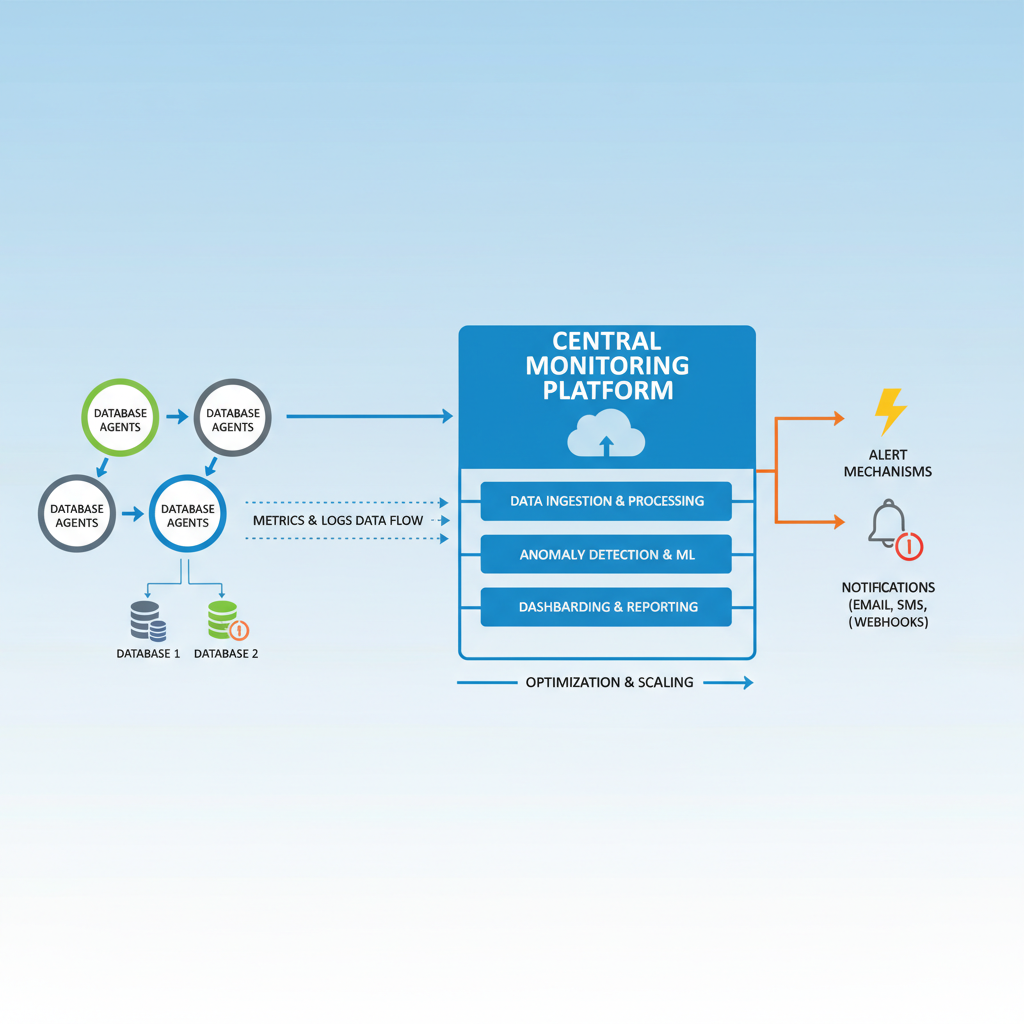
Diagram illustrating a cloud database monitoring architecture with different components and data flow, showing agents collecting metrics, a centralized monitoring platform, and alert mechanisms.
Risk Assessment and Mitigation Techniques
Comprehensive risk assessment is a critical component of ensuring data store SLA compliance. Identifying potential vulnerabilities and failure points allows organizations to implement effective mitigation strategies. This proactive stance significantly reduces the likelihood of service disruptions.
Common risks include hardware failures, software bugs, network outages, cyberattacks, and human error. Mitigation techniques often involve implementing redundancy (e.g., multi-AZ deployments), regular backups, robust security controls, and strict change management processes. Disaster recovery plans are also vital for rapid restoration.
Regularly testing these mitigation strategies, such as conducting failover drills, ensures their effectiveness when needed. This approach is central to effective database service level management. It helps to validate the integrity of the monitoring and response systems.
ENSURE UNINTERRUPTED SERVICE
Ensure uninterrupted service delivery and proactively prevent costly SLA breaches. Leverage our automated, real
✓ Free consultation ✓ No commitment required ✓ Trusted by experts
Specifics: SQL Database SLA and NoSQL SLA Monitoring
The diverse landscape of database technologies necessitates tailored monitoring approaches. While the core principles of database Cloud sla monitoring remain consistent, the specific metrics and challenges differ significantly between SQL and NoSQL databases. Understanding these nuances is key to effective database SLA tracking.
SQL databases, often relational, adhere to ACID properties and typically handle structured data. NoSQL databases, on the other hand, are designed for flexibility, scalability, and handling unstructured or semi-structured data. Each type requires a distinct focus in its monitoring strategy.
Differences in Monitoring Approaches for SQL Databases
Monitoring SQL database SLA involves a focus on traditional relational database characteristics. Performance issues often stem from slow queries, inefficient indexing, or locking conflicts. These aspects are critical for maintaining query performance and transaction integrity.
Key areas for SQL database performance monitoring include:
Index Health: Ensuring indexes are properly maintained and utilized by the query optimizer.
Replication Status: For high availability setups, monitoring replication lag and consistency.
Tools for SQL database SLA monitoring often provide deep insights into query statistics, connection pool usage, and buffer cache hit ratios. These granular details are essential for fine-tuning performance. Many commercial and open-source solutions excel in this specific domain.
Challenges and Solutions for NoSQL SLA Monitoring
NoSQL databases present a different set of monitoring challenges due to their varied architectures and data models. NoSQL SLA monitoring requires understanding the specific operational characteristics of each database type. For example, a document database like MongoDB will have different monitoring needs than a key-value store like Redis.
Common challenges in NoSQL SLA monitoring include:
Dynamic Schemas: Less rigid structures can make performance profiling more complex.
Distributed Architectures: Monitoring many nodes across a cluster requires sophisticated aggregation.
Eventual Consistency: Understanding consistency models is crucial when assessing data availability and accuracy.
Specific Operations: Focusing on unique operations like sharding performance, replication factor, or specific data model interactions.
Solutions involve specialized agents that understand the internal workings of different NoSQL databases, collecting relevant metrics like shard health, replica set status, and specific operation latencies. These tools provide the necessary depth for accurate NoSQL SLA monitoring and compliance.
Implementing Best Practices for Database Service Level Management
Effective database service level management goes beyond just monitoring; it involves establishing a comprehensive framework that includes defining clear SLAs, setting appropriate thresholds, and leveraging automation. This holistic approach ensures continuous improvement and sustained performance.
Adopting best practices helps organizations move from reactive troubleshooting to proactive optimization. It also fosters a culture of reliability and performance awareness across development and operations teams. These practices are integral to any database Cloud sla monitoring guide worth its salt.
Defining Clear SLAs for Cloud Databases
The foundation of robust database Cloud sla monitoring is the clear definition of service level agreements. These agreements must be precise, measurable, and achievable. Ambiguous SLAs lead to disputes and make effective monitoring impossible.
When defining SLAs, consider:
Key Metrics: Clearly state which metrics (e.g., uptime, latency) are included.
Reporting Frequency: Define how often performance reports will be generated and reviewed.
Remedies for Breach: Outline the actions or compensation for failing to meet SLA targets.
Exclusions: Clearly list any scenarios or conditions that are excluded from SLA coverage.
Involving stakeholders from business, development, and operations in the SLA definition process ensures alignment and realism. This collaborative effort helps to set achievable expectations for database Cloud sla monitoring.
Establishing Baselines and Thresholds
Once SLAs are defined, establishing accurate performance baselines and thresholds is the next critical step for effective database Cloud sla monitoring. Baselines represent normal operating conditions, while thresholds indicate acceptable deviations from these norms.
Baselines should be established over a period of typical workload, capturing daily, weekly, and monthly patterns. This provides a realistic benchmark against which current performance can be compared. Dynamic baselines, which adjust over time, are often more effective than static ones.
Thresholds should be set just below SLA targets, providing early warnings before an actual breach occurs. For example, if the SLA guarantees 99.9% uptime, a threshold might alert at 99.95% availability. This allows teams to intervene proactively, embodying best database Cloud sla monitoring practices.
Leveraging Automation for Database Service Level Management
Automation is a powerful enabler for efficient and scalable database service level management. It minimizes manual effort, reduces human error, and accelerates response times. Automation can transform the effectiveness of database Cloud sla monitoring.
Automation can be applied to various aspects of monitoring:
Alerting and Notifications: Automatically sending alerts to the right teams via email, Slack, or PagerDuty when thresholds are breached.
Incident Remediation: Triggering automated scripts to restart services, scale resources, or execute database maintenance tasks in response to specific events.
Reporting: Generating scheduled performance reports to track SLA compliance and identify long-term trends.
Proactive Adjustments: Using data to automatically adjust resource allocation or initiate preventative actions based on predicted loads.
Implementing these automation capabilities frees up valuable engineering time, allowing teams to focus on more complex strategic initiatives. It represents a significant step forward in optimizing database Cloud sla monitoring.
A Comprehensive Database Cloud SLA Monitoring Guide for 2026
Setting up an effective database Cloud sla monitoring system involves a structured approach, from initial planning to continuous optimization. This guide outlines key steps for organizations looking to elevate their monitoring capabilities in 2026. Following these steps helps establish robust database SLA tracking.
Consider this as your practical database Cloud sla monitoring guide, offering actionable advice for implementation. Each step builds upon the previous one, creating a comprehensive framework for managing database performance.
Step-by-Step Approach to Setting Up Monitoring
1. Define Clear Objectives: Articulate what you aim to achieve with monitoring (e.g., 99.99% uptime, specific latency targets). 2. Identify Key Stakeholders: Determine who needs access to monitoring data and who is responsible for responding to alerts. 3. Inventory Cloud Databases: List all cloud database instances, their types (SQL, NoSQL), and their criticality. 4. Select a Monitoring Solution: Choose tools that align with your cloud environment, database types, and budget. Evaluate options for best database Cloud sla monitoring capabilities. 5. Configure Data Collection: Deploy agents or configure API integrations to collect relevant metrics and logs from your databases. 6. Establish Baselines and Thresholds: Monitor performance over time to understand normal behavior and set alert triggers. 7. Implement Alerting and Notification Systems: Configure alerts for critical events and ensure they reach the appropriate personnel quickly. 8. Develop Incident Response Procedures: Create clear runbooks and workflows for responding to various types of database incidents. 9. Generate Regular Reports: Schedule automated reports to track SLA compliance and identify long-term performance trends. 10. Continuously Review and Optimize: Regularly assess the effectiveness of your monitoring system and make adjustments as your environment evolves.
Following these steps ensures a systematic approach to database Cloud sla monitoring. It covers the entire lifecycle from planning to continuous improvement.
Choosing the Right Database Cloud SLA Monitoring Solution
The market offers a diverse range of tools for database Cloud sla monitoring, making the selection process critical. The right solution should integrate seamlessly with your existing infrastructure and provide the necessary depth of insight. This choice significantly impacts the efficiency of your database SLA tracking efforts.
Consider the following factors when making your decision:
Cloud Provider Integration: Does it seamlessly integrate with AWS, Azure, GCP, or other clouds you use?
Database Compatibility: Does it support your specific SQL database (e.g., PostgreSQL, MySQL, SQL Server) and NoSQL database (e.g., MongoDB, Cassandra, Redis) types?
Scalability: Can the solution handle your current and future database scale and data volume?
Features: Look for real-time dashboards, customizable alerts, historical data analysis, and anomaly detection.
Ease of Use: Is the interface intuitive, and is it easy to configure and manage?
Cost: Evaluate licensing models, data ingestion fees, and total cost of ownership.
Support and Community: Assess the vendor’s support quality and the availability of a strong user community.
Taking these points into account will help you identify the best database Cloud sla monitoring solution for your specific needs. It’s an investment that pays dividends in reliability and performance.
Database Cloud SLA Monitoring Tips and Examples
To maximize the effectiveness of your database Cloud sla monitoring efforts, consider these practical tips and real-world examples. These insights can help refine your strategy and improve overall database service level management.
Leverage Tags and Metadata: Use cloud provider tags to organize databases by application, environment, or ownership for easier filtering and reporting in your monitoring tools.
Implement Distributed Tracing: For complex microservices architectures, distributed tracing can help pinpoint database-related performance issues across the entire transaction path, providing valuable database Cloud sla monitoring examples.
Focus on Business-Critical Services: Prioritize monitoring and alerting for databases supporting your most important applications, ensuring resources are allocated effectively.
Regularly Review Alert Fatigue: If your teams are overwhelmed with alerts, revisit thresholds and notification policies. Too many false positives can lead to ignored critical alerts.
Simulate Load: Periodically conduct load testing to understand how your database performs under stress and to validate your monitoring setup’s ability to detect issues. This provides practical database Cloud sla monitoring tips for resilience.
Automate Reporting: Set up weekly or monthly reports summarizing key SLA metrics. This ensures continuous visibility for stakeholders and helps track compliance over time.
Dashboard view of key performance indicators (KPIs) for a cloud database, showing graphs for latency, throughput, and error rates, with color-coded alerts and trending data.
Advanced Strategies and Future Trends in Database Cloud SLA Monitoring
As cloud database environments grow in complexity, advanced strategies and an eye toward future trends become crucial for maintaining peak performance and robust database Cloud sla monitoring. These approaches leverage cutting-edge technologies to provide deeper insights and more proactive management. Staying ahead of the curve ensures continued data store SLA compliance.
The landscape of database service level management is constantly evolving, driven by innovations in AI, machine learning, and observability. Embracing these advancements will define the best database Cloud sla monitoring practices of tomorrow.
Predictive Analytics for Performance Issues
Predictive analytics uses historical data and machine learning algorithms to forecast future performance issues before they occur. This moves database Cloud sla monitoring from reactive to truly proactive. By analyzing past trends, systems can predict potential bottlenecks.
For example, a predictive model might identify a gradual increase in query latency that, based on historical data, suggests a storage I/O bottleneck will occur in the next 48 hours. This early warning allows operations teams to scale resources or optimize queries preventatively. Such capabilities are transformative for database SLA tracking.
Implementing predictive analytics requires robust data collection and sophisticated algorithms, often integrated into advanced monitoring platforms. It represents a significant leap forward in ensuring consistent data store SLA compliance.
Observability and Distributed Tracing
Observability extends traditional monitoring by providing a deeper understanding of a system’s internal state through its outputs. It focuses on gathering metrics, logs, and traces to answer arbitrary questions about system behavior. This holistic view is vital for complex cloud-native applications.
Distributed tracing, a key component of observability, tracks the full lifecycle of a request as it passes through multiple services and databases. This helps pinpoint exactly where performance bottlenecks originate within a distributed system. For example, it can clearly show if a latency spike is in the application layer, the network, or the SQL database SLA processing.
Adopting observability principles and tools significantly enhances database Cloud sla monitoring capabilities, especially in microservices architectures. It enables teams to quickly diagnose and resolve intricate performance issues.
Security Considerations in Database SLA Monitoring
Security is an inseparable part of database Cloud sla monitoring. A database breach can severely impact availability, integrity, and confidentiality, directly violating SLA terms. Monitoring for security-related events is as critical as monitoring performance.
Key security aspects to monitor include:
Access Audits: Tracking who accesses the database, from where, and what actions they perform.
Vulnerability Scanning: Regularly scanning for known database vulnerabilities and misconfigurations.
Intrusion Detection: Monitoring for unusual login attempts, SQL injection patterns, or data exfiltration attempts.
Encryption Status: Ensuring data at rest and in transit is properly encrypted according to policy.
Integrating security event monitoring into your overall database service level management platform provides a unified view of potential threats. This integrated approach is vital for comprehensive data store SLA compliance.
Frequently Asked Questions (FAQ)
This section addresses common questions about database Cloud sla monitoring, providing quick and clear answers to help deepen your understanding.
What is database Cloud sla monitoring?
Database Cloud SLA monitoring is the continuous process of tracking, analyzing, and reporting on the performance and availability of cloud-hosted databases against predefined Service Level Agreements (SLAs). It involves collecting metrics like uptime, latency, throughput, and error rates to ensure services meet contractual obligations and user expectations. This systematic approach helps maintain operational excellence and data store SLA compliance.
Why is database Cloud sla monitoring important for businesses?
Database Cloud SLA monitoring is crucial for businesses because it ensures the reliability, performance, and availability of critical data, which directly impacts application functionality and user experience. It helps prevent costly downtime, identifies performance bottlenecks proactively, and ensures adherence to contractual obligations with cloud providers. Effective monitoring underpins business continuity and customer trust.
What are common metrics for database SLA tracking?
Common metrics for database SLA tracking include database uptime (availability percentage), query latency (response time), transaction throughput (transactions per second), error rates (failed operations), and resource utilization (CPU, memory, I/O). These metrics provide a comprehensive view of database health and performance, enabling teams to assess data store SLA compliance accurately. Specific metrics may vary slightly for SQL database SLA versus NoSQL SLA monitoring.
How does database Cloud sla monitoring differ for SQL and NoSQL databases?
While both require monitoring for availability and performance, database Cloud SLA monitoring differs for SQL and NoSQL databases primarily due to their architectural and operational characteristics. SQL database monitoring often focuses on query optimization, transaction integrity, and index health. NoSQL SLA monitoring, conversely, emphasizes cluster health, sharding performance, replication status, and specific data model operations, reflecting their distributed and schema-flexible nature.
Can database Cloud sla monitoring prevent outages?
Yes, database Cloud SLA monitoring can significantly help prevent outages by enabling proactive identification of performance degradation and potential issues. By setting appropriate thresholds and using predictive analytics, monitoring systems can alert teams to problems before they escalate into full-blown outages. It facilitates early intervention, allowing for preemptive actions like scaling resources or optimizing queries, thus improving overall system resilience.
ENSURE UNINTERRUPTED SERVICE
Ensure uninterrupted service delivery and proactively prevent costly SLA breaches. Leverage our automated, real
✓ Free consultation ✓ No commitment required ✓ Trusted by experts
Conclusion
Effective database Cloud sla monitoring is a cornerstone of modern digital operations, ensuring the reliability and performance of cloud-hosted data. As organizations increasingly migrate critical workloads to the cloud, the ability to robustly track database SLA compliance and proactively manage service levels becomes indispensable. By implementing comprehensive monitoring strategies, leveraging advanced tools, and adhering to best practices, businesses can achieve unparalleled stability and efficiency.
Embrace the insights provided in this guide to optimize your database Cloud sla monitoring in 2026 and beyond. A well-executed monitoring strategy will not only meet your current operational needs but also pave the way for future growth and innovation. Prioritizing database service level management protects your data, your applications, and your reputation.
Jacob Stålbro is a seasoned digitalization and transformation leader with over 20 years of experience, specializing in AI-driven innovation. As Head of Innovation and Co-Founder at Opsio, he drives the development of advanced AI, ML, and IoT solutions. Jacob is a sought-after speaker and webinar host known for translating emerging technologies into real business value and future-ready strategies.