Whether it’s IT operations, cloud migration, or AI-driven innovation – let’s explore how we can support your success.
Home /
Work /
Blogs /
Expert Cloud SLA Monitoring: Ensure Application Uptime & Performance
Understanding Application Cloud SLA Monitoring Systems
In today’s fast-paced digital landscape, maintaining high availability and performance for cloud-based applications is paramount. Businesses increasingly rely on these applications to deliver critical services and manage operations. This dependence underscores the vital role of robust application Cloud sla monitoring systems. These sophisticated tools ensure that services meet predefined performance and availability commitments.
These systems provide real-time visibility into the health and performance of cloud applications. They are indispensable for organizations aiming to uphold service level agreements (SLAs) with their users and customers. Effective monitoring helps identify issues proactively, preventing potential disruptions and maintaining user satisfaction.
What Are Application Cloud SLA Monitoring Systems?
Application Cloud SLA monitoring systems are specialized tools designed to continuously track, measure, and report on the performance, availability, and reliability of applications deployed in cloud environments. Their primary goal is to verify that these applications consistently meet their agreed-upon Service Level Agreements (SLAs). An SLA typically outlines specific metrics, such as uptime, response time, and error rates, that a service provider commits to.
These systems go beyond basic infrastructure monitoring. They delve into the actual user experience and application functionality. By observing key performance indicators (KPIs), they provide a comprehensive view of how well an application is performing from an end-user perspective. This deep insight is crucial for maintaining operational excellence.
Core Components of Effective Monitoring
A comprehensive monitoring system typically integrates several key functionalities to achieve its objectives. These components work in unison to provide a holistic view of application health.
Key components usually include:
Performance Monitoring: Tracks metrics like response times, transaction rates, and resource utilization. This helps identify bottlenecks affecting speed and efficiency.
Availability Monitoring: Verifies that applications and their underlying services are accessible and operational. It often involves uptime checks and synthetic transactions.
Error Rate Tracking: Monitors the frequency and types of errors encountered by the application. High error rates can indicate underlying issues impacting stability.
SLA Compliance Reporting: Generates detailed reports demonstrating adherence to or deviation from defined SLA metrics. These reports are essential for accountability and communication.
Alerting and Notifications: Provides immediate alerts to operations teams when performance thresholds are breached or outages occur. Timely notifications enable rapid response.
Why Are Application Cloud SLA Monitoring Systems Essential?
The adoption of cloud services has transformed how businesses operate, offering scalability and flexibility. However, this shift also introduces complexities in ensuring consistent application performance. Application Cloud SLA monitoring systems address these challenges directly, becoming an indispensable part of any modern IT strategy. They ensure that cloud applications deliver the expected reliability and speed.
Without proper monitoring, organizations risk significant financial losses due to downtime and performance degradation. Poor application performance can lead to customer dissatisfaction, reputational damage, and lost revenue. Therefore, investing in robust monitoring solutions is a strategic decision that safeguards business continuity.
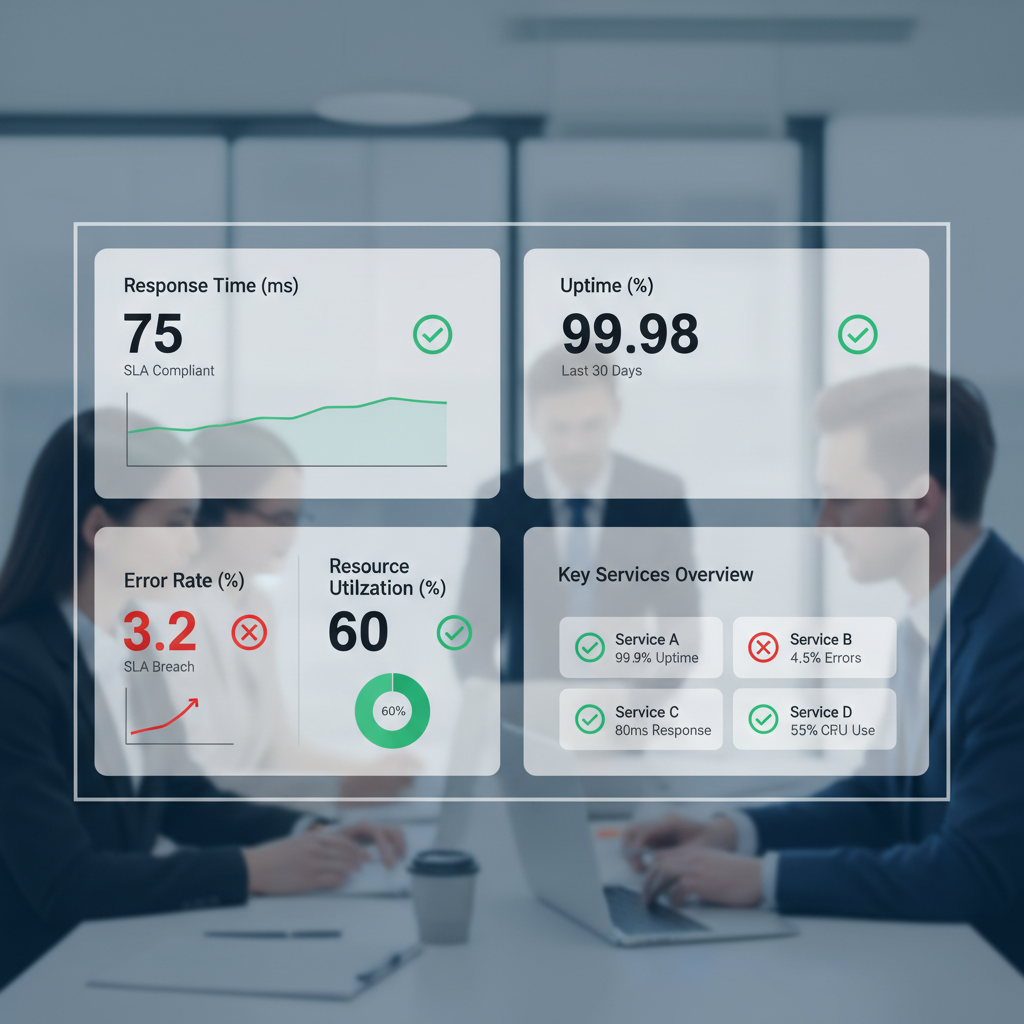
A dashboard showing various application performance metrics like response time, uptime, error rates, and resource utilization, with clear green/red indicators for SLA compliance.
Benefits of Robust Monitoring
Implementing effective app SLA monitoring tools offers numerous advantages for organizations. These benefits extend from operational efficiency to improved customer relationships. They fundamentally transform how businesses manage their cloud-based services.
Key benefits include:
Ensuring SLA Compliance: Directly verifies that applications meet the agreed-upon performance and availability targets. This builds trust with stakeholders and customers.
Proactive Issue Detection: Identifies potential problems before they escalate into major outages. Early detection allows teams to address issues with minimal impact.
Improved User Experience: By maintaining optimal performance, these systems help ensure users have a seamless and positive experience. This directly impacts customer loyalty.
Optimized Resource Utilization: Provides insights into resource consumption, helping to identify over-provisioned or under-provisioned resources. This leads to cost savings and better efficiency.
Faster Root Cause Analysis: Detailed metrics and historical data enable quick diagnosis of performance bottlenecks and underlying causes of issues. This reduces mean time to resolution (MTTR).
Enhanced Business Reputation: Consistent delivery of high-performing applications strengthens a company’s reputation as reliable and customer-focused. This can provide a competitive edge.
Key Features of Effective Application Cloud SLA Monitoring Systems
An effective application Cloud sla monitoring systems solution offers a comprehensive suite of features designed to provide deep visibility and control. These features empower IT teams to manage complex cloud environments efficiently. Choosing a system with the right capabilities is crucial for meeting specific organizational needs.
Beyond basic uptime checks, advanced systems incorporate sophisticated analytics and automation. They provide actionable insights rather than just raw data. This allows for proactive management and continuous improvement of service delivery.
Essential Functionalities
When evaluating software SLA tracking systems, several key functionalities stand out as critical. These features collectively contribute to a robust and comprehensive monitoring solution.
Look for systems that provide:
End-to-End Visibility: Monitors all layers of the application stack, from the user interface down to the underlying infrastructure components. This holistic view is essential for understanding performance dependencies.
Customizable Dashboards: Allows users to create personalized views of key metrics relevant to their roles. Visual, intuitive dashboards simplify complex data interpretation.
Real-time Alerting and Notifications: Configurable alerts via various channels (email, SMS, Slack) for threshold breaches, anomalies, or service degradation. Immediate alerts are crucial for rapid incident response.
Historical Data Analysis and Reporting: Stores performance data over time, enabling trend analysis, capacity planning, and post-incident reviews. Comprehensive reports are vital for demonstrating SLA compliance.
Synthetic Monitoring: Simulates user interactions with the application from various geographic locations to proactively measure performance and availability. This provides an external perspective of user experience.
Real User Monitoring (RUM): Collects data from actual user sessions, providing insights into real-world performance experienced by end-users. RUM captures the true impact of performance issues.
Integration Capabilities: Seamlessly integrates with existing IT ecosystems, including incident management, CI/CD pipelines, and other observability tools. This fosters a unified operational environment.
Scalability for Cloud Environments: Designed to handle dynamic and elastic cloud infrastructures, adapting to fluctuating workloads and rapidly changing resources. This ensures the monitoring system itself remains performant.
ENSURE UNINTERRUPTED SERVICE
Ensure uninterrupted service delivery and proactively prevent costly SLA breaches. Leverage our automated, real
✓ Free consultation ✓ No commitment required ✓ Trusted by experts
Types of Application Cloud SLA Monitoring Systems
The landscape of application Cloud sla monitoring systems is diverse, with various approaches and tools tailored to different needs. Understanding these types helps organizations select the most appropriate solution for their specific cloud architecture and business requirements. Each type offers unique strengths in collecting and analyzing performance data.
From specialized SaaS solutions to broader enterprise platforms, the choice depends on factors like application complexity, budget, and desired level of control. Many organizations opt for a hybrid approach, combining different tools to achieve comprehensive coverage.
Common Categories of Monitoring Solutions
Different categories of application performance SLA tools cater to various aspects of application health. These can often be combined for a more holistic view.
Key categories include:
Cloud Provider Native Tools: Major cloud providers (AWS, Azure, Google Cloud) offer their own monitoring services, such as AWS CloudWatch or Azure Monitor. These are tightly integrated with their respective ecosystems but might lack multi-cloud capabilities.
Third-Party SaaS Monitoring Solutions: These are cloud-based services that offer comprehensive monitoring capabilities for various cloud environments. Examples include Datadog, New Relic, and Dynatrace, offering extensive features like APM, RUM, and synthetic monitoring. Many provide excellent `SaaS SLA monitoring` capabilities.
Open-Source Monitoring Tools: Solutions like Prometheus, Grafana, and ELK Stack offer powerful, customizable monitoring platforms. While requiring more setup and maintenance expertise, they provide significant flexibility and cost savings.
On-Premise Monitoring Software: Less common for purely cloud applications but still used in hybrid environments. These tools are installed within an organization’s own data center and can monitor cloud resources through agents or APIs.
Specialized APM Tools: Application Performance Management (APM) tools focus specifically on deep code-level visibility, transaction tracing, and dependency mapping within applications. They are crucial for understanding `enterprise application SLA` performance from an architectural perspective.
Implementing Application Cloud SLA Monitoring Systems
Successfully implementing application Cloud sla monitoring systems requires a strategic approach. It’s not merely about installing software; it involves defining objectives, configuring metrics, and integrating the system into existing workflows. A well-planned implementation ensures maximum value and operational efficiency.
This section provides a step-by-step guide, drawing on insights from an application Cloud sla monitoring systems guide. Following these steps will help establish a robust monitoring framework that delivers actionable insights and supports continuous service improvement.
Step-by-Step Implementation Guide
Here are the key steps to effectively implement and leverage your monitoring solution:
1. Define Your SLAs and KPIs: Clearly articulate what “performance” and “availability” mean for each critical application. Establish specific, measurable, achievable, relevant, and time-bound (SMART) metrics for your SLAs. * Examples include 99.9% uptime, average response time under 500ms, and error rates below 0.1%.
2. Select the Right Monitoring Solution: Evaluate options based on your cloud environment (single-cloud, multi-cloud, hybrid), application architecture, budget, and specific feature requirements. Consider scalability, integration capabilities, and ease of use. This is where researching `best application Cloud sla monitoring systems` becomes critical.
3. Instrument Your Applications and Infrastructure: Deploy agents or configure API integrations to collect data from your cloud resources, servers, databases, and application code. Ensure comprehensive data collection across the entire application stack.
4. Configure Monitoring Thresholds and Alerts: Set appropriate thresholds for your defined KPIs. For example, trigger an alert if response time exceeds 750ms for more than 5 minutes. Configure notification channels (email, SMS, Slack, PagerDuty) and escalation policies.
5. Develop Custom Dashboards and Reports: Create dashboards tailored to different roles (developers, operations, business stakeholders) to visualize key metrics. Automate regular SLA compliance reports to track performance over time.
6. Integrate with Incident Management and DevOps Workflows: Connect your monitoring system with your incident management platform (e.g., ServiceNow, Jira Service Management) for automated ticket creation. Integrate with CI/CD pipelines to ensure performance testing and monitoring are part of the development lifecycle.
7. Regularly Review and Optimize: Periodically review your SLAs, KPIs, and monitoring configurations to ensure they remain relevant. Use insights from your monitoring data to optimize application performance, architecture, and resource allocation. This iterative process is key to continuous improvement.
Best Practices for Application Cloud SLA Monitoring Systems
Adopting best practices is crucial for maximizing the effectiveness of your application Cloud sla monitoring systems. These practices ensure that your monitoring efforts are proactive, efficient, and aligned with business objectives. They help transform raw data into actionable insights, driving continuous improvement.
Focusing on these tips will help organizations move beyond reactive issue resolution to a more strategic, predictive approach. Effective implementation of these practices significantly enhances the reliability and performance of cloud applications.
ENSURE UNINTERRUPTED SERVICE
Ensure uninterrupted service delivery and proactively prevent costly SLA breaches. Leverage our automated, real
✓ Free consultation ✓ No commitment required ✓ Trusted by experts
Conclusion
Application Cloud SLA monitoring systems are no longer a luxury but a fundamental necessity for any organization relying on cloud applications. They provide the critical visibility and control needed to ensure applications perform optimally, remain available, and consistently meet user expectations. By embracing these systems, businesses can safeguard their reputation, enhance customer satisfaction, and drive operational excellence.
From proactive issue detection to strategic resource optimization, the benefits are clear and far-reaching. As cloud environments continue to evolve, investing in comprehensive and intelligent monitoring solutions remains a strategic imperative. Regularly reviewing and optimizing your monitoring strategy will ensure your applications continue to thrive in the dynamic cloud landscape.
Jacob Stålbro is a seasoned digitalization and transformation leader with over 20 years of experience, specializing in AI-driven innovation. As Head of Innovation and Co-Founder at Opsio, he drives the development of advanced AI, ML, and IoT solutions. Jacob is a sought-after speaker and webinar host known for translating emerging technologies into real business value and future-ready strategies.