Unlock Business Potential with Flexible Cloud Services
March 5, 2026|1:03 PM
Unlock Your Digital Potential
Whether it’s IT operations, cloud migration, or AI-driven innovation – let’s explore how we can support your success.
Home /
Work /
Blogs /
Unlock Business Potential with Flexible Cloud Services
Understanding the Fundamentals of cloud services
In today’s fast-paced digital landscape, understanding cloud services is no longer optional but essential for businesses of all sizes. These powerful, flexible solutions enable organizations to innovate faster, operate more efficiently, and scale seamlessly. By leveraging the internet to deliver computing resources, cloud services transform how companies manage their IT infrastructure and applications.
At its core, cloud computing involves delivering on-demand computing services—including servers, storage, databases, networking, software, analytics, and intelligence—over the Internet (“the cloud”). Instead of owning computing infrastructure or data centers, businesses can access services from a cloud provider. This model shifts IT from a capital expenditure to an operational one, offering significant advantages.
Cloud services are built upon several key principles that define their utility and efficiency. These include broad network access, allowing capabilities to be available over the network and accessed by diverse client platforms. Resource pooling aggregates computing resources to serve multiple consumers, dynamically assigning and reassigning them based on demand.
Rapid elasticity is another defining characteristic, enabling resources to be provisioned and released quickly and elastically to scale out and in as needed. This allows businesses to handle fluctuating workloads without over-provisioning. Finally, measured service tracks resource usage, providing transparency for both providers and consumers, often leading to a pay-per-use model.
The Core Service Models of cloud services
Navigating the landscape of cloud services begins with understanding its fundamental service models. Each model offers different levels of control and management, catering to distinct business needs and technical capabilities. These models are typically categorized as Infrastructure as a Service (IaaS), Platform as a Service (PaaS), and Software as a Service (SaaS).
Choosing the right service model depends on your organization’s specific requirements for infrastructure control, application development, and software deployment. Understanding these distinctions helps in making informed decisions that align with your strategic goals. Let’s delve into each one to clarify their roles and benefits.
Infrastructure as a Service (IaaS)
IaaS provides the foundational computing infrastructure over the internet. This includes virtual machines, networks, operating systems, and data storage. Users essentially rent hardware and networking components, giving them the highest level of control over their computing resources.
Businesses using IaaS can install and manage their own applications, data, and operating systems. This model is ideal for organizations that need complete control over their IT environment without the overhead of physical hardware maintenance. Examples include hosting websites, developing custom applications, and managing extensive data storage.
Many businesses leverage IaaS for running virtual machines, providing flexible and scalable computing power. It’s also frequently used for network services configuration, allowing companies to design their virtual networks with specific security and performance requirements. IaaS offers immense flexibility for IT teams looking to manage their infrastructure directly.
Platform as a Service (PaaS)
PaaS delivers a complete development and deployment environment in the cloud. This includes everything needed to support the entire lifecycle of building and delivering web-based applications, without the complexity of managing the underlying infrastructure. PaaS typically includes operating systems, programming language execution environments, databases, and web servers.
This service model is particularly beneficial for developers who want to focus solely on writing code and building applications. They don’t need to worry about server maintenance, operating system updates, or network configurations. PaaS streamlines the development process, accelerating time to market for new applications.
Examples of PaaS include application hosting platforms and integrated development environments delivered as a service. It supports various programming languages and frameworks, offering a versatile platform for creating custom software solutions. Businesses utilize PaaS to enhance collaboration among development teams and automate deployment workflows.
Software as a Service (SaaS)
SaaS is the most widely recognized and consumer-friendly cloud service model. It delivers ready-to-use software applications over the internet, typically on a subscription basis. Users access the software via a web browser or a mobile app, eliminating the need for installation, maintenance, or complex software management.
With SaaS, the cloud provider manages all aspects of the application, from the underlying infrastructure to ongoing maintenance and updates. This allows businesses and individual users to focus entirely on utilizing the software for their specific tasks. This model has revolutionized how businesses access and use critical tools.
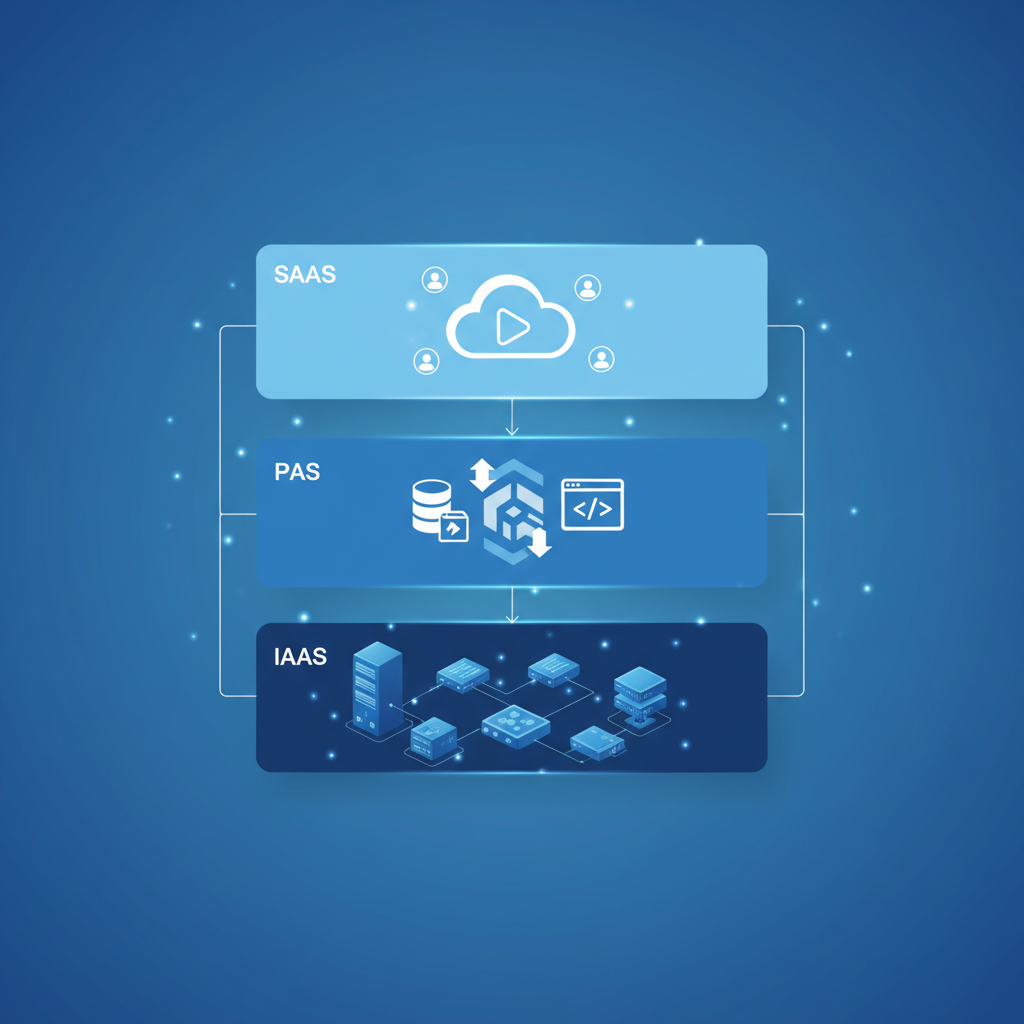
A diagram showing three distinct layers: “IaaS” at the bottom with infrastructure components like servers and storage, “PaaS” in the middle with an application development platform, and “SaaS” at the top represented by a cloud-based software application logo.
Common examples of SaaS include customer relationship management (CRM) systems, email services, office productivity suites, and enterprise resource planning (ERP) solutions. These services provide immediate value, requiring minimal setup and offering accessibility from anywhere with an internet connection. SaaS simplifies IT management significantly.
Deployment Models for cloud services
Beyond the service models, understanding the different deployment models for cloud services is crucial for strategic decision-making. These models dictate where your data and applications reside and how they are managed, impacting factors like security, control, and cost. Each model offers a unique balance of benefits tailored to specific organizational needs.
Exploring these deployment options helps businesses align their cloud strategy with their operational requirements and compliance mandates. From fully shared environments to dedicated infrastructure, the choice of deployment model significantly influences the overall cloud experience. Let’s examine the most prevalent models in detail.
Public Cloud
The public cloud model is characterized by cloud services delivered over the internet and shared among multiple organizations. A third-party provider owns and manages all the hardware, software, and supporting infrastructure. Users access these services on a pay-per-use or subscription basis, making it highly cost-effective.
Public cloud offers immense scalability and elasticity, allowing businesses to easily expand or contract their resources based on demand. This model is ideal for general-purpose computing, web applications, and non-sensitive data, where cost efficiency and rapid deployment are priorities. Providers like AWS, Azure, and Google Cloud are prominent examples.
Many small and medium-sized businesses benefit from public cloud due to its low entry barriers and minimal management overhead. They can quickly provision resources without large upfront investments in hardware. This flexibility empowers them to compete with larger enterprises.
Private Cloud
A private cloud refers to cloud services exclusively used by a single organization. It can be physically located on the company’s premises (on-premises private cloud) or hosted by a third-party provider. The key distinction is that the infrastructure is dedicated to one organization, offering enhanced control and security.
Private cloud environments are often chosen by organizations with strict regulatory compliance requirements or highly sensitive data. They provide greater customization options for the infrastructure and network services, allowing businesses to tailor the environment to their exact specifications. This dedicated approach ensures isolation from other users.
While private clouds require a higher upfront investment and more internal IT management, they offer unparalleled levels of data privacy and control. Many enterprises opt for private cloud for their core mission-critical applications. This model is a strong choice when data governance is paramount.
Hybrid Cloud
A hybrid cloud combines elements of both public and private cloud environments, allowing data and applications to be shared between them. This model enables organizations to leverage the scalability and cost-effectiveness of the public cloud while maintaining sensitive data and critical applications in a more controlled private cloud.
The primary benefit of a hybrid cloud is its flexibility. Businesses can “burst” workloads from their private cloud to the public cloud during peak demand, avoiding costly investments in additional private infrastructure. It allows for optimized resource utilization and strategic placement of workloads.
Organizations commonly use hybrid cloud for disaster recovery scenarios, placing backup data in the public cloud while primary operations run on a private cloud. It offers a bridge between existing on-premises infrastructure and the public cloud, facilitating a gradual transition to cloud computing.
Multi-Cloud
Multi-cloud involves using multiple cloud services from different providers, typically across two or more public clouds. This strategy aims to avoid vendor lock-in, take advantage of best-of-breed services from various providers, and enhance resilience by distributing workloads.
Organizations adopting a multi-cloud strategy might use one provider for IaaS, another for PaaS, and yet another for specific SaaS applications. This approach provides greater flexibility and redundancy, reducing the risk of a single point of failure. It enables businesses to select the optimal service for each specific task or application.
While multi-cloud offers significant advantages, it also introduces complexity in management and integration. Careful planning and robust orchestration tools are essential to effectively manage resources across disparate cloud environments. Despite the challenges, it’s increasingly popular for maximizing innovation and flexibility.
MAXIMIZE YOUR CLOUDS
Maximize your cloud’s potential with expert management. Discover custom cloud solutions
✓ Free consultation ✓ No commitment required ✓ Trusted by experts
Key Benefits of Adopting cloud services
Adopting cloud services offers a multitude of benefits that can profoundly impact a business’s operations, finances, and strategic positioning. From enhanced efficiency to greater resilience, the advantages make a compelling case for migration. Understanding these benefits helps organizations build a robust business case for their cloud journey.
Cloud adoption goes beyond merely offloading IT infrastructure; it’s about transforming how businesses operate and compete. The strategic shift empowers organizations to be more agile, innovative, and cost-effective. Let’s explore some of the most significant advantages that cloud services provide.
Cost Savings: cloud services significantly reduce capital expenditures by eliminating the need for expensive hardware purchases and maintenance. Businesses switch to an operational expenditure model, paying only for the resources they consume. This allows for better budget predictability and optimization.
Scalability and Flexibility: The ability to scale computing resources up or down almost instantly is a hallmark of cloud services. Businesses can rapidly respond to changing demand, whether it’s handling a sudden surge in website traffic or expanding into new markets. This unparalleled flexibility supports dynamic business growth.
Reliability and Performance: Cloud providers invest heavily in robust infrastructure, redundant systems, and global data centers, ensuring high availability and excellent performance. This translates to fewer outages and faster application response times for users. Expert teams manage the complex underlying technology.
Enhanced Security: Reputable cloud providers implement sophisticated security measures, often exceeding what individual organizations can afford or manage on their own. These include physical security, data encryption, identity and access management, and continuous threat monitoring. While cloud security is a shared responsibility, providers handle much of the heavy lifting.
Innovation and Agility: By offloading infrastructure management, IT teams can focus on strategic initiatives and application development rather than routine maintenance. This accelerates innovation, allowing businesses to bring new products and services to market faster. cloud services foster a culture of rapid experimentation and deployment.
Disaster Recovery and Business Continuity: cloud services inherently offer superior disaster recovery capabilities. Data can be replicated across multiple geographically dispersed data centers, ensuring business continuity even in the event of a localized outage or disaster. This provides peace of mind and minimizes downtime.
How to Choose the Right cloud services Provider
Selecting the appropriate cloud services provider is a critical decision that impacts your business’s future operations and growth. It’s not a one-size-fits-all choice, as different providers excel in various areas and offer distinct features. A methodical approach ensures you find a partner that aligns with your specific technical and business needs.
This process involves careful evaluation of your requirements, thorough research into potential providers, and a clear understanding of their offerings. By following a structured approach, you can minimize risks and maximize the benefits of your cloud investment. Here are the key steps to guide your selection process.
1. Assess Your Needs: Begin by thoroughly documenting your current IT environment, applications, data storage requirements, and anticipated growth. Consider your budget constraints, compliance obligations (like HIPAA or GDPR), and performance expectations. Identify which specific cloud services, such as IaaS, PaaS, or SaaS, are most relevant to your operations.
2. Evaluate Service Models: Determine if you need raw computing power and control (IaaS), a development platform (PaaS), or ready-to-use applications (SaaS). Many businesses use a combination of these. Your choice will narrow down suitable providers and their specific offerings.
3. Consider Deployment Models: Decide whether a public, private, hybrid, or multi-cloud strategy best fits your security, control, and cost requirements. Some providers specialize in particular deployment models or offer stronger capabilities in one over another.
4. Review Security and Compliance: Examine the provider’s security certifications, data privacy policies, and compliance track record. Understand their data residency options and how they protect your data storage. Ensure they meet all industry-specific and regulatory standards applicable to your business.
5. Understand Pricing Models: Cloud pricing can be complex, involving various factors like data transfer, storage, virtual machines, and network services. Obtain clear quotes, understand potential hidden costs, and analyze how pricing scales with usage. Compare costs across multiple providers for similar services.
6. Check Support and SLAs: Evaluate the level of customer support offered, including response times and available channels (phone, email, chat). Review their Service Level Agreements (SLAs) to understand uptime guarantees, performance metrics, and compensation for service disruptions.
7. Plan for Migration and Integration: Consider the ease of migrating your existing data and applications to the new cloud environment. Ask about tools and support for migration, and how well the provider’s services integrate with your current systems and third-party applications.
Advanced cloud services Concepts
As organizations mature in their cloud journey, they often explore more advanced cloud services concepts that push the boundaries of traditional computing. These innovations further enhance efficiency, reduce operational overhead, and enable entirely new application architectures. Understanding these concepts helps businesses stay competitive and leverage the full power of the cloud.
These advanced approaches represent the cutting edge of cloud computing, offering solutions to complex modern challenges. From event-driven architectures to highly distributed processing, these models unlock significant opportunities for optimization and innovation. Let’s delve into a few key areas that are transforming the cloud landscape.
Serverless Computing
Serverless computing allows developers to build and run application code without provisioning or managing servers. The cloud provider dynamically manages the server infrastructure, scaling it automatically to meet demand. Developers simply upload their code, and the provider executes it in response to events.
This model is incredibly cost-effective because you only pay for the compute time your code actually consumes. It also significantly reduces operational overhead, as developers no longer need to worry about patching, scaling, or maintaining servers. Serverless computing is ideal for event-driven architectures, APIs, and microservices.
Examples include AWS Lambda, Azure Functions, and Google Cloud Functions. These services abstract away the server, allowing developers to focus purely on application logic. This approach is revolutionizing application hosting and deployment strategies.
Containers and Microservices
Containers, such as Docker, package applications and their dependencies into isolated units that can run consistently across any environment. They provide a lightweight, portable way to deploy applications. Microservices architecture, on the other hand, structures an application as a collection of loosely coupled services.
When combined with cloud services, containers and microservices enable greater agility, scalability, and resilience. Applications can be broken down into smaller, independent components, making them easier to develop, deploy, and scale individually. This modular approach is a cornerstone of modern cloud-native development.
Orchestration tools like Kubernetes manage containerized applications, automating deployment, scaling, and operational tasks. This synergy allows for highly efficient resource utilization and faster development cycles. Many organizations are migrating traditional monolithic applications to containerized microservices.
Edge Computing
Edge computing extends cloud services closer to the source of data generation, such as IoT devices or local data centers. Instead of sending all data to a centralized cloud for processing, computation happens at the “edge” of the network. This reduces latency and bandwidth usage, especially crucial for real-time applications.
Edge computing works in conjunction with cloud services, with the edge handling immediate processing and the cloud providing centralized data storage, analytics, and long-term insights. This distributed architecture is vital for applications requiring instant responses, like autonomous vehicles or smart factories.
It leverages cloud capabilities by distributing them more strategically, optimizing data flow and processing. This integration creates a powerful, hybrid environment that addresses the challenges of massive data volumes and low-latency requirements.
Maximizing Your Investment in cloud services
Simply adopting cloud services is just the first step; truly maximizing your investment requires ongoing strategy, optimization, and vigilant management. A proactive approach ensures that your cloud infrastructure continuously delivers value, maintains security, and aligns with evolving business goals. This involves more than just technical configuration.
To fully realize the potential of cloud computing, businesses must cultivate best practices in financial management, security protocols, and development methodologies. This continuous effort transforms cloud services from a mere utility into a strategic advantage. Here are key areas to focus on for maximizing your cloud ROI.
Optimize Cost Management
Effective cost management is paramount to prevent cloud spending from spiraling out of control. This involves understanding consumption patterns, leveraging discount programs, and right-sizing your resources. Cloud providers offer various tools and dashboards to help monitor usage and expenditure.
Implement Cost Monitoring Tools: Utilize native cloud provider tools or third-party solutions to track spending across departments and projects. This visibility is crucial for identifying areas of inefficiency.
Right-Size Resources: Regularly review your virtual machines and other resources to ensure they match actual workload demands. Avoid over-provisioning resources that are rarely fully utilized.
Leverage Reserved Instances and Savings Plans: For stable, predictable workloads, committing to reserved instances or savings plans can significantly reduce costs compared to on-demand pricing.
Automate Shutdown of Non-Production Resources: Automatically turn off development and test environments outside of working hours to save on compute costs.
Enhance Security Posture
While cloud providers secure the underlying infrastructure, securing your data and applications in the cloud is a shared responsibility. Proactive measures are essential to protect against threats and maintain compliance. Strong security practices are fundamental to trust in cloud services.
Implement Identity and Access Management (IAM): Enforce the principle of least privilege, granting users and services only the necessary permissions. Use multi-factor authentication for all administrative access.
Encrypt Data: Ensure data storage is encrypted both at rest and in transit. This provides a critical layer of protection for sensitive information.
Regularly Audit Configurations: Conduct frequent security audits of your cloud configurations to identify and remediate vulnerabilities. Cloud security posture management tools can assist with this.
Stay Informed on Best Practices: Keep up-to-date with the latest cloud security best practices and threat intelligence from your cloud provider and security experts.
Foster Cloud-Native Development
Embracing cloud-native development practices enables organizations to fully capitalize on the agility and scalability of cloud services. This involves designing applications specifically for the cloud environment, leveraging its unique characteristics. Cloud-native approaches drive faster innovation and more resilient systems.
Adopt Microservices Architectures: Break down monolithic applications into smaller, independent services that can be developed, deployed, and scaled independently.
Utilize Serverless and Containers: Leverage serverless computing for event-driven functions and containers for consistent application packaging and deployment.
Implement DevOps Practices: Integrate development and operations teams to automate workflows, improve collaboration, and accelerate software delivery cycles.
Design for Resilience: Build applications that are inherently fault-tolerant and can recover gracefully from failures, leveraging cloud’s distributed nature.
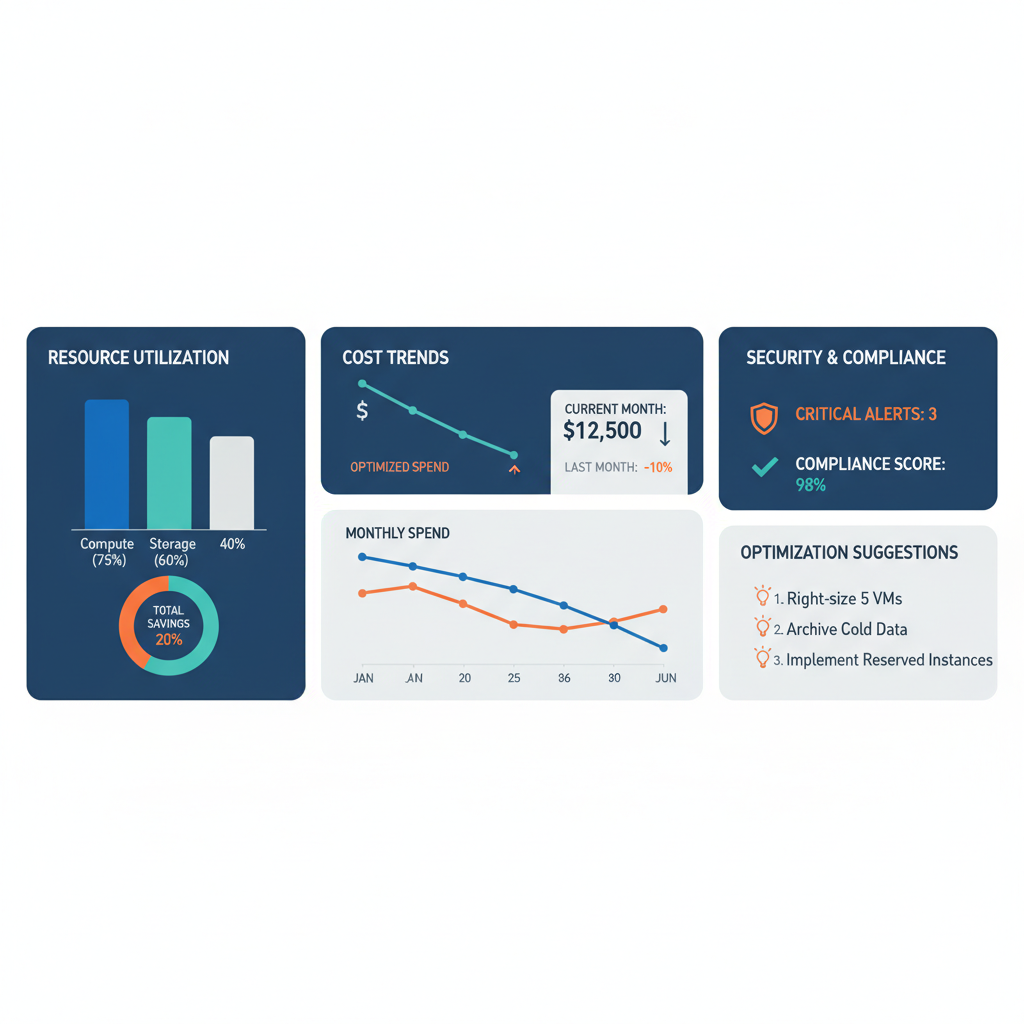
A dashboard showing various metrics related to cloud resource usage, cost trends, and security alerts, with an emphasis on optimization suggestions.
Continuous Monitoring and Improvement
The cloud environment is dynamic, requiring continuous monitoring and a commitment to ongoing improvement. Regular review of performance, security, and cost ensures that your cloud strategy remains optimized and responsive to business needs. This iterative approach is key to long-term success.
Monitor Performance Metrics: Track key performance indicators (KPIs) for your applications and infrastructure to ensure optimal user experience and resource utilization.
Review and Refine Architectures: Regularly assess your cloud architecture for efficiency, cost-effectiveness, and alignment with business objectives. Look for opportunities to refactor or re-architect.
Stay Updated with Cloud Innovations: Cloud providers continuously release new services and features. Stay informed and evaluate how these innovations can further benefit your organization.
Gather Feedback and Iterate: Collect feedback from users and teams to identify pain points and areas for improvement, fostering a cycle of continuous optimization.
Frequently Asked Questions about cloud services
Understanding cloud services can sometimes lead to many questions, especially for those new to cloud computing. This section addresses some of the most common inquiries, providing clear and concise answers to help demystify key aspects of cloud services. These insights will help solidify your understanding and guide your cloud journey.
What are cloud services?
cloud services refer to the delivery of on-demand computing resources—including servers, data storage, databases, networking, software, analytics, and intelligence—over the Internet. Instead of owning and maintaining your own computing infrastructure, you access these services from a third-party provider, typically paying for them on a consumption basis. This model offers flexibility, scalability, and cost efficiency.
What is the difference between IaaS, PaaS, and SaaS?
These are the three main service models of cloud computing, differing in the level of management and control offered. IaaS (Infrastructure as a Service) provides foundational computing resources like virtual machines and network services, giving you the most control. PaaS (Platform as a Service) offers a complete development and deployment environment for applications, abstracting away the underlying infrastructure. SaaS (Software as a Service) delivers ready-to-use software applications over the internet, with the provider managing everything.
Is cloud services secure?
Yes, reputable cloud services providers invest heavily in security, often surpassing the capabilities of individual organizations. They employ robust physical security, data encryption, identity and access management, and continuous threat monitoring. However, cloud security is a shared responsibility; while providers secure the “cloud itself,” users are responsible for securing their data and applications “in the cloud.”
How much do cloud services cost?
The cost of cloud services varies widely depending on the provider, the type of services used (IaaS, PaaS, SaaS), the amount of resources consumed (data storage, virtual machines, network services), and your chosen pricing model (on-demand, reserved instances). Most cloud providers offer a pay-as-you-go model, allowing you to pay only for what you use, which can lead to significant cost savings compared to traditional IT infrastructure. It’s crucial to monitor usage and optimize resources to manage costs effectively.
Can small businesses benefit from cloud services?
Absolutely. Small businesses can benefit immensely from cloud services. They gain access to enterprise-grade technology and infrastructure without significant upfront capital investment, allowing them to scale resources as needed. Cloud services enable small businesses to improve operational efficiency, enhance collaboration, bolster security, and compete more effectively with larger organizations, all while managing costs.
MAXIMIZE YOUR CLOUDS
Maximize your cloud’s potential with expert management. Discover custom cloud solutions
✓ Free consultation ✓ No commitment required ✓ Trusted by experts
Conclusion
cloud services have fundamentally reshaped the landscape of business technology, offering unparalleled flexibility, scalability, and cost-efficiency. From foundational Infrastructure as a Service (IaaS) to ready-to-use Software as a Service (SaaS), these models empower organizations to innovate faster and manage their IT resources with greater agility. Understanding the various service and deployment models is crucial for making informed strategic decisions.
By embracing advanced concepts like serverless computing and meticulously managing costs and security, businesses can truly maximize their cloud investment. The journey to the cloud is an ongoing evolution, requiring continuous learning, optimization, and adaptation. Leveraging cloud services strategically enables businesses of all sizes to thrive in the digital age, focusing on their core competencies while the cloud handles the heavy lifting of IT infrastructure.