Streamline Your Business with Cloud Migration and Optmization Strategies
March 4, 2026|6:42 AM
Unlock Your Digital Potential
Whether it’s IT operations, cloud migration, or AI-driven innovation – let’s explore how we can support your success.
Home /
Work /
Blogs /
Streamline Your Business with Cloud Migration and Optmization Strategies
Understanding Cloud Migration: The Journey to the Cloud
Cloud Migration and Optmization represent two sides of the same critical coin in modern IT. Cloud migration is the process of moving digital assets—applications, data, IT resources, or an entire organization’s IT infrastructure—to the cloud. This strategic move from on-premises servers to cloud environments offers numerous potential benefits for businesses of all sizes.
It involves a careful assessment of current infrastructure, identifying suitable cloud platforms, and executing the transfer with minimal disruption. The goal is to leverage the scalability, flexibility, and cost-efficiency that cloud computing provides. This journey is often the first major step in a broader digital transformation with cloud initiatives.
Why Migrate to the Cloud?
Migrating to the cloud unlocks a myriad of advantages that drive business growth and innovation. Scalability is a primary benefit, allowing businesses to effortlessly adjust resources up or down based on demand. This flexibility ensures that computing power aligns perfectly with operational needs.
Cost efficiency is another significant driver, as organizations can shift from large capital expenditures (CapEx) on hardware to more manageable operational expenses (OpEx) for cloud services. Cloud environments also foster greater agility, enabling faster deployment of new applications and services. This speed accelerates time to market and enhances competitive advantage.
Key Challenges in Cloud Migration
Despite the numerous benefits, the path of Cloud Migration and Optmization is not without its hurdles. One major challenge involves the complexity of identifying and disentangling dependencies within existing legacy systems. This often requires significant planning and detailed mapping.
Data security remains a paramount concern, demanding robust encryption, access controls, and compliance measures throughout the data migration to cloud processes. Furthermore, potential vendor lock-in and the need for specialized skills within the organization can present formidable barriers. Thorough planning and strategic partnerships are essential to overcome these obstacles successfully.
Exploring Cloud Optimization: Maximizing Cloud Value
Following a successful migration, Cloud Migration and Optmization shifts focus towards ensuring the migrated assets perform optimally and efficiently. Cloud optimization is the ongoing process of refining cloud resource utilization, performance, and cost-effectiveness. It involves continuously monitoring, analyzing, and adjusting cloud configurations to achieve desired business outcomes.
This crucial phase ensures that the initial investment in migration yields maximum return. Without optimization, organizations risk accruing unnecessary costs or experiencing suboptimal performance from their cloud environments. Effective optimization practices are vital for sustained cloud success.
Pillars of Cloud Optimization
Cloud optimization rests upon several fundamental pillars, each critical for achieving comprehensive efficiency. Cost management is a primary focus, ensuring that resources are utilized effectively to prevent overspending. This involves identifying idle resources and rightsizing instances.
Performance optimization in cloud environments guarantees applications run smoothly and respond quickly to user demands. Security optimization strengthens defenses against cyber threats, while resource management focuses on allocating compute, storage, and network resources efficiently. Addressing these pillars systematically leads to a well-oiled cloud infrastructure.
The Role of FinOps Practices
FinOps practices are an integral component of comprehensive Cloud Migration and Optmization. FinOps is an evolving operational framework that brings financial accountability to the variable spend model of the cloud. It fosters collaboration between finance, technology, and business teams.
By embedding financial governance into cloud operations, FinOps helps organizations make data-driven decisions about cloud spending. This approach promotes a culture of cost awareness and shared responsibility, ensuring cloud investments deliver maximum business value. It bridges the gap between technical teams and financial objectives.
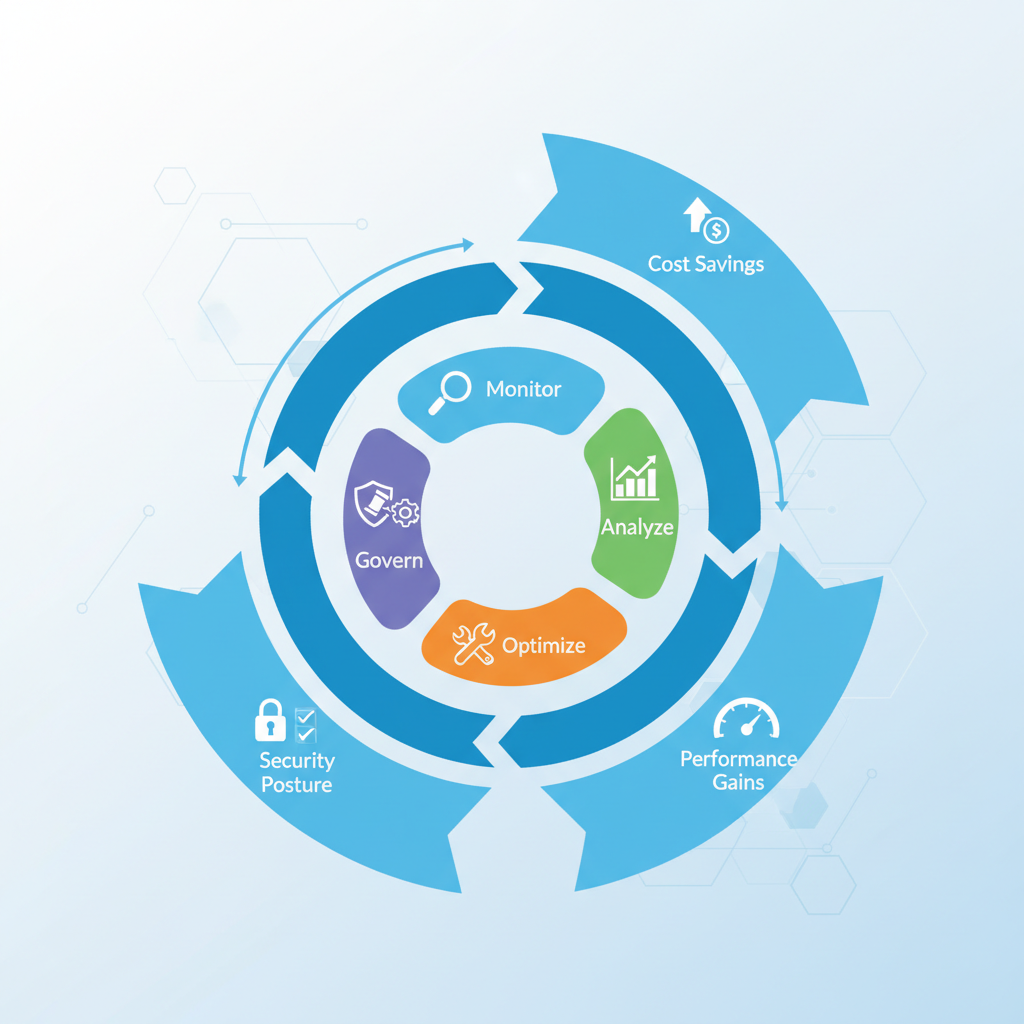
A detailed diagram showing a circular flow of continuous improvement in cloud optimization, including stages like “Monitor,” “Analyze,” “Optimize,” and “Govern,” with arrows indicating the iterative nature and key metrics like “Cost Savings,” “Performance Gains,” and “Security Posture” highlighted.
The Interplay: Cloud Migration and Optmization – A Synergistic Approach
Cloud Migration and Optmization are not distinct, sequential events but rather deeply intertwined processes that operate synergistically. Migration sets the stage by moving workloads to the cloud, while optimization ensures these workloads thrive in their new environment. One cannot truly succeed without the other.
A holistic approach integrates optimization considerations from the very beginning of the migration planning phase. This ensures that the chosen cloud adoption strategy is inherently designed for efficiency and future-proofing. It’s about building a solid foundation for sustainable cloud operations.
When Optimization Begins
Optimization considerations should ideally commence even before the first workload is moved. Pre-migration optimization involves assessing current on-premises environments to identify opportunities for improvement and resource rationalization. This helps to avoid migrating unnecessary costs or inefficiencies to the cloud.
During the migration itself, choices regarding instance types, storage tiers, and networking configurations have direct optimization implications. Post-migration, optimization becomes a continuous process of monitoring, refining, and adapting to evolving needs. This ongoing effort ensures that cloud investments continue to deliver value.
Continuous Improvement with Cloud
The dynamic nature of cloud environments necessitates a commitment to continuous improvement. Cloud Migration and Optmization is an ongoing journey, not a destination. Organizations must regularly review their cloud footprint, performance metrics, and cost reports.
Implementing iterative cycles of assessment, adjustment, and re-evaluation allows businesses to adapt to new technologies and changing market demands. This proactive approach ensures that cloud infrastructure remains agile, secure, and cost-effective over time. It is a fundamental aspect of maintaining competitive advantage.
✓ Free consultation ✓ No commitment required ✓ Trusted by experts
Key Stages of Cloud Migration and Optmization Strategy
Developing a robust cloud adoption strategy is crucial for successful Cloud Migration and Optmization. This strategic roadmap typically involves several distinct stages, each building upon the last to ensure a smooth transition and optimized operations. Each stage requires careful planning and execution.
Effective planning minimizes risks and maximizes the benefits derived from cloud investments. It ensures that business objectives are aligned with technical implementations. A well-defined strategy is the backbone of any successful cloud journey.
Assessment and Planning
The initial stage involves a comprehensive assessment of the existing IT landscape. This includes inventorying applications, infrastructure, data, and interdependencies. A crucial part of this is developing a clear cloud adoption strategy.
Organizations must define their motivations for migration, identify key stakeholders, and set realistic goals. This phase also includes selecting the appropriate cloud provider and services, along with designing the future state architecture. Thorough planning lays the groundwork for efficient data migration to cloud later.
Execution: Data Migration to Cloud and Application Refactoring
Once the planning is complete, the execution phase begins. This involves the actual data migration to cloud, moving information from on-premises systems to the chosen cloud platform. Careful consideration must be given to data integrity, security, and minimizing downtime during this process.
Simultaneously, applications may undergo refactoring or modernization to better leverage cloud-native services. This could involve re-architecting components or adopting containerization technologies. Robust testing is critical at every step to ensure functionality and performance.
Post-Migration: Cloud Cost Management and Performance Optimization in Cloud
After migration, the focus shifts heavily towards Cloud Migration and Optmization. This post-migration phase is crucial for realizing the full benefits of the cloud. It involves continuous cloud cost management to control expenses and prevent budget overruns.
Additionally, performance optimization in cloud environments is essential to ensure applications deliver the required speed and responsiveness. This includes monitoring resource utilization, scaling services appropriately, and fine-tuning configurations. Regular reviews are key to sustained success.
Different Migration Strategies and Their Optimization Implications
Organizations employ various strategies for Cloud Migration and Optmization, each with its own benefits and challenges. The choice of strategy significantly impacts the effort required, the potential for optimization, and the long-term cost implications. Selecting the right approach is paramount.
Understanding these different strategies helps businesses make informed decisions tailored to their specific applications and workloads. It ensures that the migration process aligns with overall business goals and technical capabilities. Careful evaluation is always recommended.
Rehost (Lift and Shift)
Rehosting, often called “lift and shift,” involves moving applications and data to the cloud with minimal changes. This strategy is typically the fastest and least disruptive migration method. It focuses on quickly relocating workloads.
While simple, lift and shift may not immediately yield maximum optimization benefits. Applications might run less efficiently than if they were refactored for the cloud. However, it provides a quick entry point to the cloud, allowing for optimization to occur post-migration.
Replatform (Lift-Tinker-Shift)
Replatforming involves making minor, cloud-specific optimizations to applications during migration without significantly changing the core architecture. This could include upgrading databases to managed cloud services or integrating with platform-as-a-service (PaaS) offerings. It offers a balance between speed and optimization.
This approach often provides better performance and cost benefits than rehosting, while still avoiding a full re-architecting effort. It allows organizations to leverage some cloud-native features without extensive code modifications. This strategy accelerates the path to enhanced cloud efficiency.
Refactor (Re-architect)
Refactoring, or re-architecting, involves significantly modifying an application’s code and architecture to fully embrace cloud-native capabilities. This often includes breaking monolithic applications into microservices or adopting serverless computing. This is the most complex but potentially most rewarding strategy.
While it requires the most effort upfront, refactoring unlocks the highest levels of performance optimization in cloud environments and significant long-term cost savings. It empowers true cloud infrastructure modernization. This strategy is ideal for applications requiring high scalability, resilience, and agility.
Repurchase (SaaS)
Repurchasing means migrating to a different, cloud-native product, typically a Software-as-a-Service (SaaS) solution. Instead of migrating an existing application, the organization subscribes to an off-the-shelf cloud service that fulfills similar business needs. This can be a very efficient approach.
This strategy can eliminate the need for infrastructure management entirely, shifting operational responsibility to the SaaS provider. It simplifies Cloud Migration and Optmization by leveraging pre-optimized solutions. However, it requires careful evaluation of available SaaS offerings and potential data migration to cloud complexities.
Retire and Retain
Not every application needs to be migrated; some are simply retired if they are no longer needed. Others may be retained on-premises if their specific requirements or compliance regulations make cloud migration impractical or too costly. This strategic decision is part of a comprehensive cloud adoption strategy.
Determining which applications to retire or retain is a critical aspect of initial assessment. It helps streamline the migration process by focusing resources on high-value applications. This also contributes to overall cloud cost management by avoiding unnecessary migration efforts.
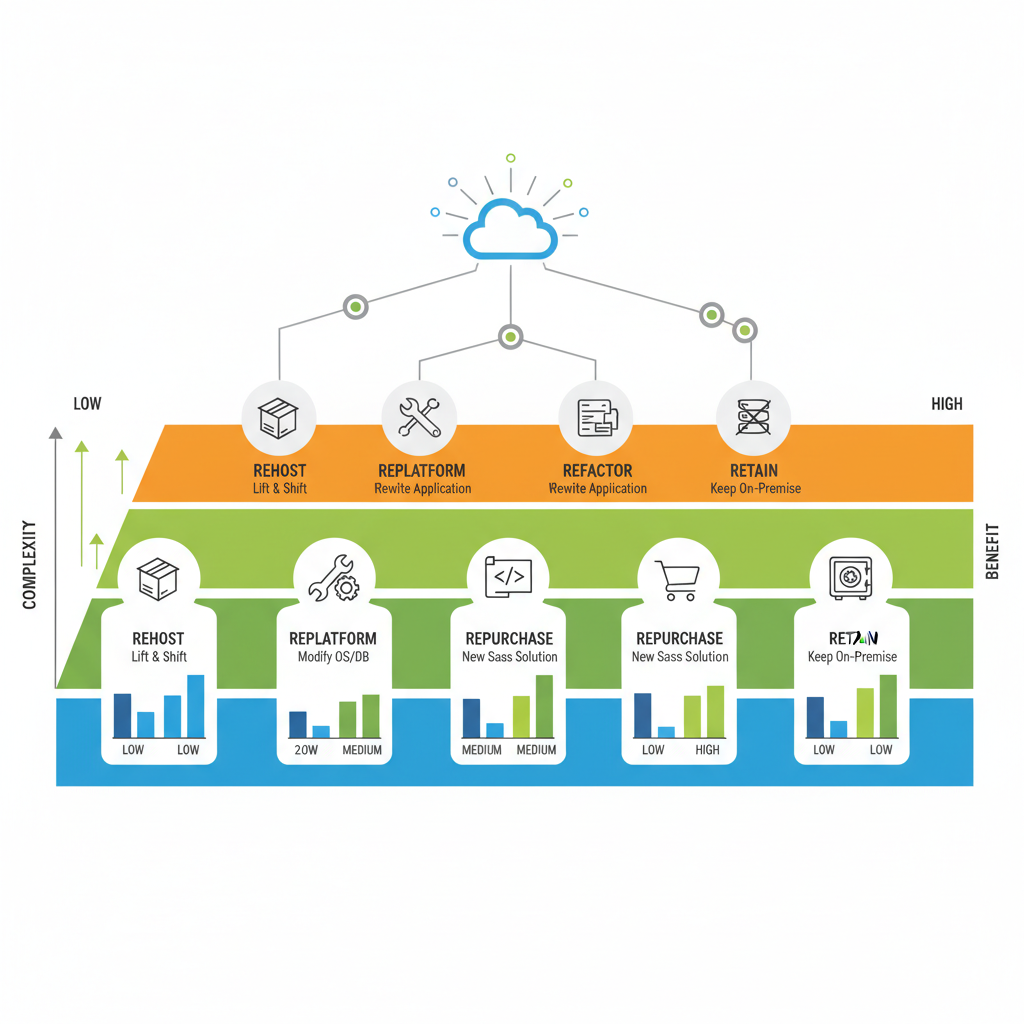
An infographic illustrating the “6 Rs” of cloud migration (Rehost, Replatform, Refactor, Repurchase, Retire, Retain) with a brief description and associated complexity/benefit levels for each strategy.
Advanced Concepts: Hybrid Cloud Solutions and Digital Transformation
Beyond individual migration strategies, Cloud Migration and Optmization increasingly involves embracing more sophisticated architectures and broader business goals. Hybrid cloud solutions and the overarching drive for digital transformation with cloud represent advanced frontiers. These concepts leverage cloud capabilities for strategic advantage.
They highlight the evolving landscape where flexibility and innovation are paramount. Organizations are not just moving to the cloud; they are strategically using it to reshape their entire operational model. This leads to profound changes in how business is conducted.
Embracing Hybrid Cloud Solutions for Flexibility
Hybrid cloud solutions combine on-premises infrastructure with private and/or public cloud services, allowing data and applications to move seamlessly between them. This approach offers unparalleled flexibility, enabling organizations to place workloads where they make the most sense. It’s particularly useful for specific compliance needs or latency requirements.
A well-implemented hybrid cloud can optimize resource utilization, enhance disaster recovery capabilities, and provide greater control over sensitive data. It enables a gradual cloud adoption strategy, mitigating risks while leveraging the best of both worlds. This model is central to many modern IT strategies.
Driving Digital Transformation with Cloud
Cloud Migration and Optmization is a fundamental enabler of digital transformation with cloud. By moving to the cloud, businesses can innovate faster, improve customer experiences, and unlock new revenue streams. The agility and scalability of cloud platforms accelerate the adoption of emerging technologies.
This transformation goes beyond just IT infrastructure; it impacts business processes, organizational culture, and strategic decision-making. Cloud acts as the backbone, providing the elastic infrastructure needed to experiment, scale, and deliver digital services rapidly. It fundamentally changes how businesses operate.
Cloud Infrastructure Modernization for Future Growth
Cloud infrastructure modernization is a continuous effort to update and optimize cloud environments to support future business needs. This includes adopting cloud-native architectures, leveraging serverless computing, and integrating advanced analytics and AI capabilities. It’s about staying ahead of the technological curve.
This modernization ensures that the cloud infrastructure remains resilient, efficient, and capable of supporting evolving digital transformation initiatives. It involves continuous investment in skills, tools, and processes. An ongoing commitment to modernization is key to long-term success in the cloud.
Best Practices for Cloud Migration and Optmization in 2026
To achieve enduring success with Cloud Migration and Optmization, organizations must adhere to a set of robust best practices. These guidelines help navigate complexities, mitigate risks, and maximize the return on cloud investments. They represent accumulated wisdom in the cloud journey.
Implementing these practices ensures that cloud initiatives are not just technically sound but also strategically aligned with business objectives. This proactive approach sets the stage for efficient and secure cloud operations. It creates a framework for sustainable growth.
Prioritize a Robust Cloud Adoption Strategy
Begin every cloud journey with a well-defined cloud adoption strategy that aligns with business objectives. Clearly articulate goals, identify key performance indicators, and map out a phased migration plan. This strategic foresight prevents common pitfalls and ensures clarity.
Invest in thorough discovery and assessment phases to understand existing infrastructure and application dependencies. A clear strategy serves as a compass, guiding all subsequent decisions and actions throughout the migration and optimization lifecycle. This foundation is non-negotiable for success.
Implement Proactive Cloud Cost Management and FinOps Practices
Actively manage cloud costs from day one through diligent monitoring, forecasting, and optimization. Implement FinOps practices to foster collaboration between finance, operations, and business teams. This ensures shared responsibility for cloud spend.
Utilize cloud provider tools for budgeting, alerts, and cost analysis. Regularly review resource utilization, rightsize instances, and leverage reserved instances or spot instances where appropriate. Proactive cloud cost management is crucial for maintaining financial health.
Focus on Performance Optimization in Cloud
Ensure applications and services perform optimally by continuous monitoring and tuning. Establish clear performance benchmarks and regularly assess whether your cloud environment is meeting them. Proactively identify and resolve bottlenecks.
Leverage cloud-native services designed for high performance and scalability. This includes using content delivery networks (CDNs), auto-scaling groups, and load balancers. Prioritizing performance optimization in cloud environments leads to better user experiences and operational efficiency.
Ensure Data Security and Compliance during Data Migration to Cloud
Security must be a top priority throughout every phase of Cloud Migration and Optmization. Implement robust encryption for data at rest and in transit during data migration to cloud processes. Adhere to strict access controls and identity management policies.
Ensure that all cloud configurations comply with relevant industry regulations and data privacy laws. Regular security audits and vulnerability assessments are essential. A strong security posture builds trust and protects valuable assets.
Frequently Asked Questions about Cloud Migration and Optmization
What is the primary difference between Cloud Migration and Cloud Optimization?
Cloud migration refers to the initial process of moving applications, data, and IT infrastructure from on-premises environments to a cloud platform. Cloud optimization, conversely, is the ongoing effort to enhance the performance, cost-efficiency, and security of these assets once they reside in the cloud. Migration is the move, optimization is the refinement.
Why is a cloud adoption strategy important before starting migration?
A well-defined cloud adoption strategy is crucial because it aligns the technical migration plan with overarching business goals. It helps identify motivations, select the right cloud services, plan for data migration to cloud, and anticipate potential challenges. Without a clear strategy, projects can become costly and inefficient.
How do FinOps practices contribute to Cloud Migration and Optmization?
FinOps practices integrate financial accountability into cloud operations, fostering collaboration between technical, finance, and business teams. This framework helps organizations manage cloud spending effectively, optimize costs, and make data-driven decisions. It ensures that cloud investments deliver maximum business value and supports continuous cloud cost management.
Can I optimize my cloud environment before completing the migration?
Yes, optimization can and should begin even before a full migration. Pre-migration optimization involves assessing existing on-premises infrastructure to identify redundancies and inefficiencies. This “clean-up” phase ensures you don’t migrate unnecessary costs or poorly configured systems to the cloud, streamlining subsequent performance optimization in cloud efforts.
What are some common challenges in data migration to cloud?
Common challenges in data migration to cloud include ensuring data integrity and security during transfer, managing large volumes of data, minimizing downtime, and dealing with complex data dependencies. Planning for data encryption, validating data post-migration, and having robust rollback strategies are essential to overcome these hurdles.
What is cloud infrastructure modernization?
Cloud infrastructure modernization is the ongoing process of updating and enhancing cloud environments to leverage the latest cloud-native technologies and architectural patterns. It aims to improve agility, scalability, and resilience by adopting solutions like microservices, containers, and serverless computing. This ensures the cloud platform remains effective for digital transformation with cloud initiatives.
✓ Free consultation ✓ No commitment required ✓ Trusted by experts
Conclusion: The Continuous Evolution of Cloud Environments
Cloud Migration and Optmization are fundamental pillars of modern IT strategy, essential for any organization seeking agility, scalability, and efficiency. The journey begins with a thoughtful migration, transitioning digital assets to the cloud. However, this is merely the first step on a continuous path.
True value is unlocked through persistent optimization, embracing FinOps practices, and committing to continuous improvement. By integrating migration strategies with an ongoing focus on cloud cost management and performance optimization in cloud environments, businesses can maximize their cloud investments. This strategic approach ensures long-term success in an ever-evolving digital landscape.
Fredrik Karlsson
- Chief Operating Officer (Group) & Chief Information Security Officer, Opsio
Fredrik Karlsson is the Group Chief Operating Officer and Chief Information Security Officer at Opsio in Sweden. With extensive experience in operations, governance, and information security, he focuses on aligning business objectives with risk management, compliance, and scalable IT operations. Fredrik works closely with leadership and delivery teams to ensure resilient, secure, and efficient cloud and hybrid technology environments.