Azure Migration – How to Migrate to Azure: Your Complete…
March 3, 2026|12:27 PM
Unlock Your Digital Potential
Whether it’s IT operations, cloud migration, or AI-driven innovation – let’s explore how we can support your success.
Home /
Insights /
Azure Migration – How to Migrate to Azure: Your Complete…
Understanding Azure Migration : Why Move to the Cloud?
Embarking on an Azure Migration represents a pivotal strategic move for many organizations today. This process involves shifting applications, data, and IT infrastructure from on-premises data centers or other cloud environments to Microsoft Azure. It offers a pathway to modernize operations, enhance scalability, and reduce operational overhead.
The decision to undertake an Azure Migration is often driven by a desire for greater agility and efficiency. Businesses can leverage Azure’s robust global infrastructure to expand their reach and respond faster to market demands. This strategic shift facilitates innovation and supports future growth.
The Strategic Advantages of Microsoft Azure Services
Migrating to Azure unlocks a host of benefits that directly impact business performance and innovation. These advantages extend across various operational facets, offering both immediate and long-term gains. Understanding these benefits is crucial for any effective Cloud migration strategy.
Consider the enhanced scalability that Azure provides, allowing resources to scale up or down automatically based on demand. This flexibility ensures optimal performance during peak times and cost savings during quieter periods. It prevents over-provisioning and under-utilization of resources.
Furthermore, Azure’s pay-as-you-go model transforms capital expenditures into operational expenses. This shift in financial structure can free up capital that would otherwise be tied up in physical hardware. It enables businesses to invest more in core innovation rather than infrastructure maintenance.
Security is another paramount advantage, with Azure offering a comprehensive suite of security services and compliance certifications. Microsoft invests heavily in securing its cloud infrastructure, often exceeding the capabilities of individual organizations. This provides peace of mind regarding data protection and regulatory adherence.
Common Drivers for Azure Migration
Organizations choose Azure Migration for diverse reasons, all pointing towards improved business outcomes. Identifying these drivers helps in formulating a clear and justified Cloud migration strategy. Several common motivations frequently emerge.
Many businesses seek to retire aging on-premises hardware, which incurs significant maintenance costs and requires constant upgrades. Moving to Azure eliminates these capital expenditures and simplifies IT management. It allows IT teams to focus on strategic initiatives rather than infrastructure upkeep.
Another strong driver is the need for enhanced disaster recovery and business continuity capabilities. Azure offers resilient, geo-redundant infrastructure that ensures applications and data remain available even in the face of regional outages. This dramatically improves recovery time objectives and recovery point objectives.
Innovation and competitive advantage also play a significant role. Azure provides access to cutting-edge technologies like artificial intelligence, machine learning, and serverless computing without the need for significant upfront investment. This enables rapid experimentation and deployment of new services.
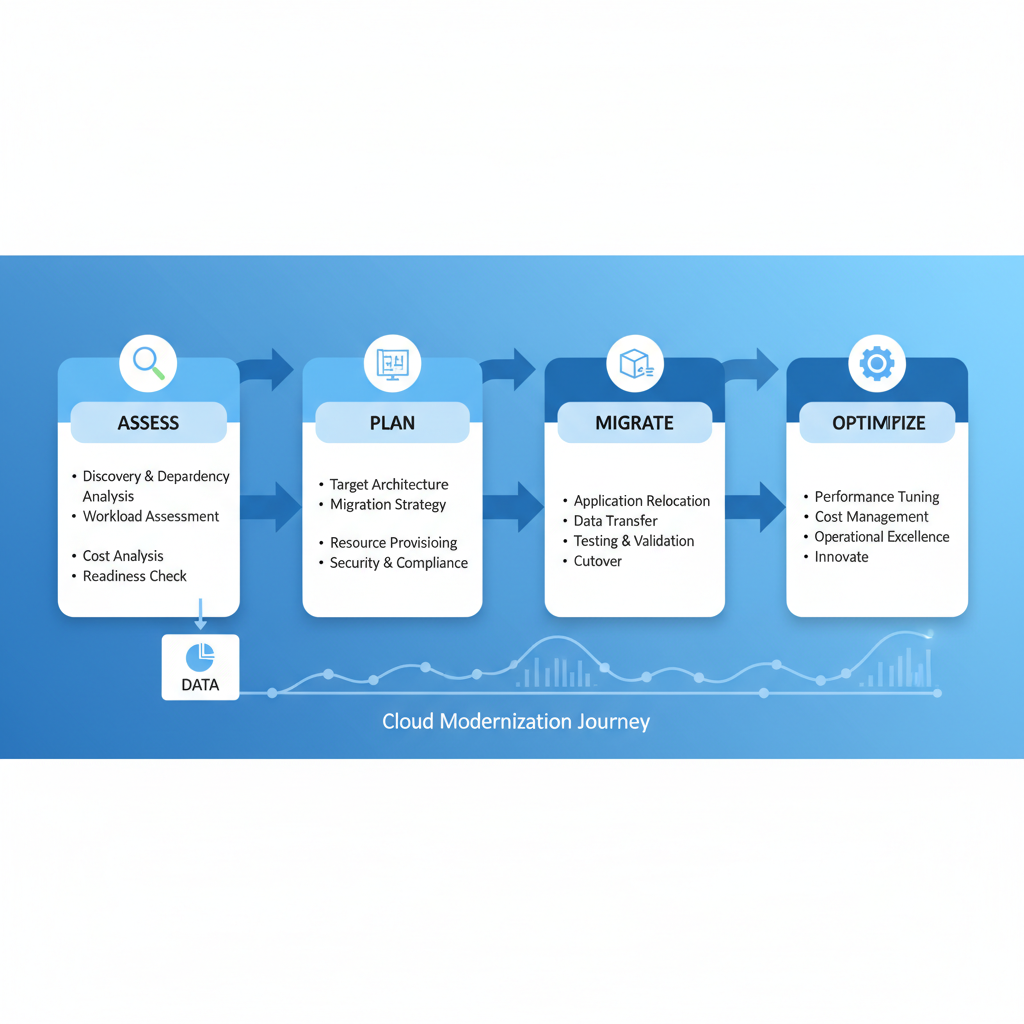
The Azure Migration Journey: A Phased Approach
A successful Azure Migration is not an overnight task; it requires a structured, methodical approach. Following a well-defined process ensures all aspects are considered, minimizing risks and maximizing the benefits. This systematic journey typically involves several distinct phases.
Effective Cloud migration planning is the cornerstone of this process, turning a complex undertaking into manageable steps. Each phase builds upon the previous one, ensuring a smooth and efficient transition to Microsoft Azure services. Adhering to this phased approach is critical for success.
Phase 1: Assessment and Discovery
The initial phase of any Azure Migration involves a thorough assessment and discovery of the current IT environment. This critical step provides a clear understanding of what needs to be moved and how it should be configured in Azure. It lays the groundwork for all subsequent planning.
Begin by identifying all applications, servers, databases, and network components currently in use. Document their interdependencies, resource utilization, and performance requirements meticulously. This inventory forms the baseline for your migration plan and helps avoid unforeseen issues.
Tools like Azure Migrate can automate much of this discovery process, providing insights into server readiness, application compatibility, and estimated Azure costs. This helps to build a comprehensive picture of your existing Azure infrastructure needs. Understanding these initial requirements is paramount.
It is also important to assess current resource consumption, including CPU, memory, storage, and network bandwidth. This data is vital for right-sizing resources in Azure, preventing both over-provisioning (which leads to unnecessary costs) and under-provisioning (which results in performance bottlenecks). Detailed discovery ensures no critical components are overlooked.
A flowchart illustrating the four phases of Azure Migration: Assess, Plan, Migrate, Optimize, with key activities listed under each phase.
Phase 2: Planning Your Azure Migration Strategy
With a clear understanding of your current environment, the next phase focuses on developing a detailed Cloud migration planning strategy. This involves defining objectives, choosing appropriate migration methods, and designing the future state architecture in Azure. Careful planning at this stage mitigates significant risks later on.
Start by defining clear, measurable migration goals. What do you hope to achieve with this Azure Migration? Is it cost savings, improved performance, enhanced security, or a combination? Establishing these goals guides all subsequent decisions and helps measure success.
Consider various migration patterns for your applications and Data migration to Azure. A common approach is the Lift and shift migration, where applications are moved to Azure with minimal changes. This is often the fastest method and suitable for applications that are already cloud-ready. However, other applications might benefit from re-platforming (some optimization for cloud) or re-architecting (complete redesign for cloud-native benefits).
Network design is another crucial aspect of your plan. This includes setting up virtual networks, subnets, VPN gateways, and ExpressRoute connections to ensure secure and efficient connectivity between your on-premises environment and Azure. Proper network architecture supports both migration and ongoing operations.
Security considerations must be integrated throughout the planning phase. This involves defining identity and access management policies, network security groups, and data encryption strategies. Aligning with your organization’s security posture and compliance requirements from the outset is essential.
Finally, dedicate effort to Azure cost optimization during planning. Utilize tools to estimate costs for chosen Azure services and identify potential savings. This might involve choosing appropriate virtual machine sizes, storage tiers, and exploring reserved instances or Azure Hybrid Benefit to reduce expenses. A proactive approach to cost management is vital.
Phase 3: Migration Execution to Microsoft Azure Services
Once the meticulous planning is complete, the execution phase begins, focusing on the actual Data migration to Azure and application cutovers. This stage involves systematic movement of workloads while ensuring minimal disruption to business operations. Precision and careful coordination are key during this period.
There are various tools and methods available for Data migration to Azure. For databases, services like Azure Database Migration Service offer online or offline migration capabilities. For virtual machines, Azure Migrate can replicate servers and perform seamless cutovers. The choice of tool depends on the type and volume of data.
When migrating applications, consider a phased approach, starting with less critical workloads to gain experience and refine processes. This incremental strategy helps mitigate risks and allows for adjustments along the way. Performing migrations in stages also helps manage potential impact on users.
Thorough testing and validation are indispensable at every step of the migration. After migrating each component, rigorously test its functionality, performance, and security in the Azure environment. This includes application testing, user acceptance testing, and performance benchmarking against established baselines. Ensure all dependencies function correctly.
During the actual cutover, ensure comprehensive monitoring is in place. This allows for immediate identification and resolution of any issues that may arise. Have clear rollback plans defined, providing a safety net in case of unexpected problems or significant service disruptions. Effective communication with stakeholders is also essential throughout this phase.
Phase 4: Optimization and Management
The migration process doesn’t conclude with the cutover; rather, it transitions into an ongoing phase of optimization and management. This ensures that the Azure environment is performing efficiently, securely, and cost-effectively. Continuous improvement is crucial for long-term success.
Performance tuning involves monitoring resource utilization and making adjustments to Azure services to enhance efficiency. This might include resizing virtual machines, optimizing database queries, or configuring auto-scaling rules. Regular performance reviews help maintain optimal operational standards.
Ongoing Azure cost optimization is a continuous effort. Regularly review your Azure spending using tools like Azure Cost Management and Billing. Identify idle resources, right-size existing services, and explore opportunities for reservations or spot instances to reduce costs further. Financial governance is a vital aspect of cloud management.
Security hardening is also a perpetual process in the cloud. Continuously monitor for security vulnerabilities, implement threat protection measures, and ensure compliance with evolving regulations. Leverage Azure Security Center and Azure Sentinel for comprehensive security posture management and threat detection.
Finally, explore and integrate Hybrid cloud solutions where appropriate. For some organizations, a fully cloud-native approach isn’t always feasible or optimal. Hybrid cloud allows you to maintain some workloads on-premises while leveraging Azure for others, providing flexibility and control. This strategy offers the best of both worlds.
Key Considerations for a Successful Azure Migration in 2026
As technology evolves, certain considerations become even more critical for a successful Azure Migration. Focusing on these areas will ensure your migration is robust, secure, and future-proofed for 2026 and beyond. Proactive planning in these domains significantly enhances outcomes.
A robust Azure infrastructure hinges on strong foundational elements, especially concerning security and data protection. Understanding these elements from the outset is key to a stable environment. Never underestimate the importance of these core components.
Data Security and Compliance
Data security and compliance are non-negotiable aspects of any Azure Migration. Organizations must ensure that all data moved to Azure remains protected and adheres to relevant industry regulations and geographic data residency requirements. Compliance frameworks such as GDPR, HIPAA, and PCI DSS must be carefully considered.
Azure offers a wide array of security features, including encryption at rest and in transit, multi-factor authentication, and robust identity management. Implementing these effectively is crucial. Regular security audits and vulnerability assessments help maintain a strong security posture.
Networking and Connectivity
Efficient and secure networking is fundamental to the performance of applications hosted in Azure. Design your network architecture to support high bandwidth, low latency, and secure access between Azure and your on-premises or other cloud environments. This often involves VPNs or dedicated connections like ExpressRoute.
Proper IP address planning, virtual network segmentation, and network security group configurations are essential. These measures protect your Azure infrastructure and control traffic flow. A well-designed network prevents bottlenecks and enhances application responsiveness.
Disaster Recovery and Business Continuity
One of the primary advantages of Azure is its built-in resilience and disaster recovery capabilities. Integrate Azure Site Recovery for replicating virtual machines and Azure Backup for data protection. These services ensure rapid recovery of applications and data in the event of an outage.
Develop comprehensive disaster recovery plans, including regular testing of failover and failback procedures. This ensures that your business can withstand unforeseen disruptions with minimal downtime. Business continuity is paramount for critical operations.
Skills and Training for Your Team
Successfully managing an Azure environment requires a different skill set than traditional on-premises IT. Invest in training your IT staff on Azure administration, security, networking, and development practices. Empowering your team with the right skills is crucial for operational efficiency.
Consider leveraging Microsoft Azure services training programs and certifications. A well-trained team can optimize Azure costs, manage resources effectively, and troubleshoot issues proactively. This investment pays dividends in the long run.
Avoiding Common Pitfalls During Your Azure Migration
While the benefits of Azure Migration are substantial, the journey is not without its challenges. Being aware of common pitfalls can help organizations navigate the process more smoothly and prevent costly mistakes. Proactive measures are always better than reactive solutions.
Many issues stem from inadequate preparation or a lack of understanding of the cloud paradigm. Addressing these potential problems early in the Cloud migration planning phase can save considerable time and resources. Learn from the experiences of others to ensure your success.
Lack of Clear Strategy
One of the most frequent mistakes is undertaking an Azure Migration without a clearly defined Cloud migration strategy. Without clear goals, scope, and success metrics, projects can quickly lose direction, leading to budget overruns and missed deadlines. A well-articulated strategy provides the roadmap.
Ensure that all stakeholders understand the ‘why’ behind the migration and agree on the expected outcomes. This alignment is critical for maintaining momentum and making informed decisions throughout the project. Clarity reduces ambiguity and improves focus.
Underestimating Complexity
Many organizations underestimate the complexity involved in migrating legacy applications or intricate data sets. Application dependencies, data integrity, and network configurations can be more challenging than initially perceived. A thorough assessment in Phase 1 is essential to accurately gauge effort.
Do not assume a simple Lift and shift migration will work for all applications. Some may require significant refactoring or re-platforming, which takes more time and resources. Be realistic about the effort involved and allocate sufficient budget and personnel.
Ignoring Azure Cost Optimization
Without proper planning and ongoing monitoring, cloud costs can quickly spiral out of control. Organizations often neglect to right-size resources, forget to shut down idle environments, or fail to leverage cost-saving features like reserved instances. Azure cost optimization needs continuous attention.
Implement financial governance policies from the start, including budget alerts and cost allocation tags. Regularly review your Azure spend and identify opportunities for optimization. Proactive cost management is crucial for realizing the financial benefits of the cloud.
Data Integrity Issues
Ensuring data integrity during Data migration to Azure is paramount. Errors during the migration process can lead to data loss, corruption, or inconsistencies, which can have severe business implications. Rigorous testing and validation are essential after every data transfer.
Utilize robust migration tools that include data validation features and checksums. Plan for incremental data synchronization to minimize downtime and reduce the risk of data discrepancies. Always have a rollback plan in place for critical data sets.
Conclusion: Embracing the Future with Azure
Undertaking an Azure Migration is a significant strategic investment that, when executed correctly, can transform an organization’s IT landscape. It offers unparalleled opportunities for scalability, cost efficiency, security, and innovation through cutting-edge Microsoft Azure services. By carefully planning and executing each phase, businesses can achieve their cloud ambitions.
The journey requires thorough Cloud migration planning, from initial assessment and discovery to ongoing optimization and management. Adhering to best practices, leveraging the right tools, and empowering your team are key ingredients for a successful transition. Embracing Hybrid cloud solutions can further tailor the cloud strategy to specific business needs.
Ready to unlock the full potential of the cloud for your organization? Contact our Azure Migration experts today for a personalized assessment and a tailored migration plan that sets you up for success in 2026 and beyond.
A conceptual image showing data and applications moving from an on-premises server rack to a stylized cloud icon representing Azure, with arrows indicating a smooth, secure transition.